
How to Interpret SPT N-Values in Geotechnical Reports
In my two decades of managing site investigations, I have seen countless foundation designs falter because engineers took raw field data at face value. The Standard Penetration Test (SPT) is the most widely used in-situ test globally, yet it remains one of the most misunderstood. When you open a geotechnical report, the N-value is not a static number; it is a raw observation influenced by hammer efficiency, borehole diameter, and effective overburden pressure.
To design safe, cost-effective foundations, you must move beyond the raw blow count. We will dissect how to normalize these values and translate them into actionable soil mechanics parameters for your next project.
Key Takeaways for Engineers
- Always verify the hammer energy efficiency (ER) before applying corrections.
- N-values require normalization to an effective overburden pressure of 100 kPa (N1,60).
- Never rely on SPT data alone for critical structures; correlate with CPT or lab testing.
- Understand that gravelly soils often yield artificially high N-values due to obstruction.
Technical Analysis: How to Interpret SPT N-Values
SPT Data Normalization: The systematic adjustment of raw field blow counts to account for energy losses and depth-dependent confining pressures to ensure consistency in soil strength assessment.
The raw N-value represents the number of blows required to drive a split-spoon sampler 300 mm into the soil after an initial 150 mm seating drive. However, the energy delivered by the hammer varies significantly between equipment types—ranging from 45% to 90% of theoretical free-fall energy. To standardize this, we use the N(60) value, calculated as N(60) = N(raw) * (ER / 60), where ER is the hammer energy ratio.
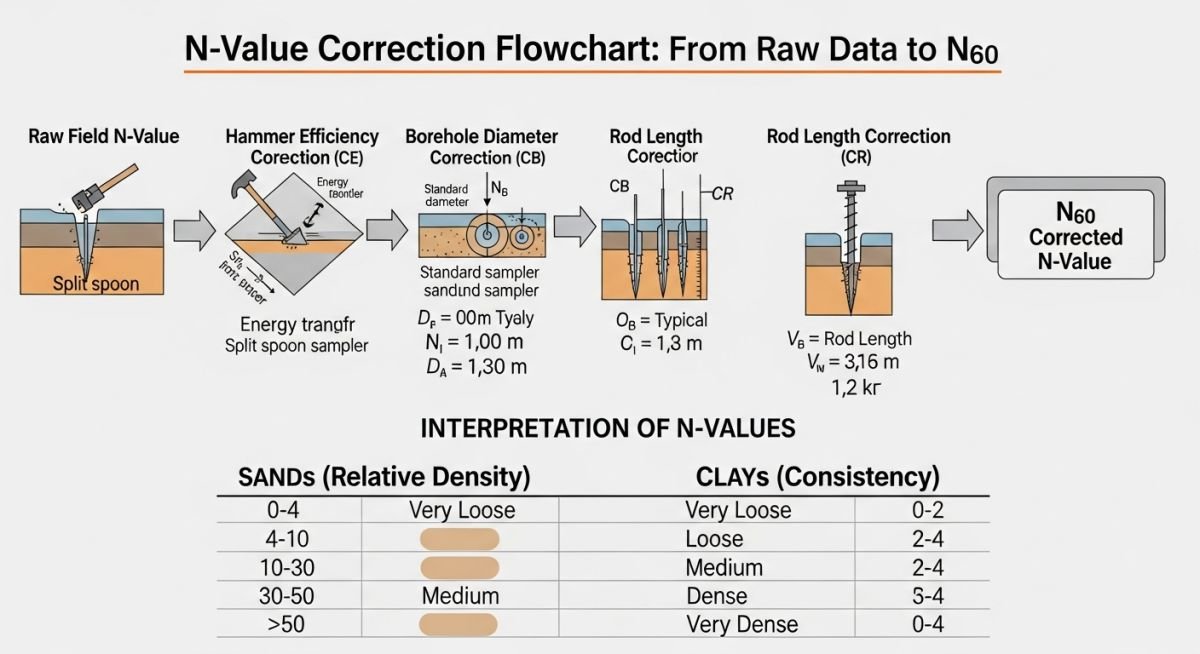
Once you have the N(60) value, you must account for the effective overburden pressure. As depth increases, the confining pressure increases, which artificially inflates the blow count. We apply the overburden correction factor (Cn) to derive the normalized N(1,60) value. The standard formula used in practice is Cn = (Pa / sigma_v_prime)^0.5, where Pa is atmospheric pressure and sigma_v_prime is the effective vertical stress.
Field Warning: The Gravel Trap
In my experience, N-values exceeding 50 are often unreliable in granular soils containing gravel or cobbles. The sampler may strike a large particle, causing a “refusal” reading that does not reflect the actual density of the soil matrix. Always cross-reference these high values with visual soil descriptions in the boring logs.
For cohesive soils, the correlation between N-values and undrained shear strength (Su) is notoriously imprecise. While empirical relationships exist, such as Su = 6 * N(60) (in kPa), these should only be used for preliminary estimates. For final design, I insist on laboratory triaxial or unconfined compression tests to validate these correlations.
When dealing with liquefaction potential, the N(1,60) value is the primary input for the Simplified Procedure. You must ensure that the N-values are corrected for borehole diameter, sampler liner, and rod length, as these factors significantly influence the energy transfer efficiency. Neglecting these corrections can lead to an underestimation of liquefaction risk, which is a catastrophic error in seismic design.
SPT Methodology Evaluation: A critical assessment of the operational benefits and inherent limitations of using Standard Penetration Test data for geotechnical site characterization.
Advantages
- Provides a physical soil sample for visual classification and lab testing.
- Widely available equipment and standardized procedures across global markets.
- Effective in a broad range of soil types, from loose sands to stiff clays.
- Cost-effective compared to advanced in-situ testing like pressuremeter or CPT.
- Extensive historical database allows for reliable empirical correlations.
Disadvantages
- Highly sensitive to operator technique and equipment maintenance.
- Discrete point data; does not provide a continuous soil profile.
- Poor reliability in very soft clays or extremely dense gravels.
- Energy transfer variability requires complex correction factors for accuracy.
- Subject to significant scatter in heterogeneous soil deposits.
Geotechnical Design Implementation: The practical application of normalized SPT N-values in structural foundation engineering and ground improvement verification.
Shallow Foundation Bearing Capacity
Engineers utilize N-values to estimate the allowable bearing pressure for spread footings in granular soils. By applying the Terzaghi or Meyerhof bearing capacity equations, the N-value serves as a proxy for the angle of internal friction, allowing for rapid sizing of footings during the preliminary design phase.
Liquefaction Triggering Analysis
In seismic zones, the N(1,60) value is the cornerstone of the Simplified Procedure for evaluating liquefaction potential. By comparing the Cyclic Resistance Ratio derived from N-values against the Cyclic Stress Ratio, we determine if soil densification or ground improvement is required to prevent foundation failure during an earthquake.
Deep Foundation Pile Design
For driven piles, SPT data provides an empirical basis for calculating skin friction and end-bearing capacity. While static load tests are the gold standard, N-values allow for the estimation of pile lengths and driving resistance, ensuring that the pile reaches the required bearing stratum without excessive waste.
Ground Improvement Verification
Following techniques like dynamic compaction or vibro-replacement, post-treatment SPT testing is used to verify the increase in soil density. A significant increase in N-values confirms that the ground improvement program has successfully achieved the target relative density and stiffness requirements for the project.
When I review geotechnical reports, the raw N-value is merely the starting point for my structural assessment. To derive meaningful design parameters, I must apply specific correction factors as outlined in ASTM D1586. These corrections account for energy efficiency of the hammer system, overburden pressure, and borehole diameter variations, which are critical for ensuring the safety of shallow foundation designs.
The following table provides a standardized reference for correlating corrected N-values, denoted as N-60 or N-1,60, with relative density and consistency. Engineers must exercise caution when using these empirical correlations in heterogeneous soil deposits, as local site conditions often deviate from textbook values. Always verify these correlations against laboratory triaxial or direct shear test results whenever the project budget allows for comprehensive site characterization.
| Soil Type | Corrected N-Value | Relative Density/Consistency |
|---|---|---|
| Granular (Sand) | 0 – 4 | Very Loose |
| Granular (Sand) | 10 – 30 | Medium Dense |
| Cohesive (Clay) | 2 – 4 | Very Soft |
| Cohesive (Clay) | 8 – 15 | Stiff |
By normalizing the N-value to an energy ratio of 60 percent, we create a consistent baseline for comparing data across different drilling rigs. This normalization is the most significant step in preventing over-conservative or unsafe foundation sizing during the preliminary design phase.
The following matrix maps the essential technical entities involved in the Standard Penetration Test process. As a piping and structural engineer, I rely on these specific parameters to communicate effectively with geotechnical consultants regarding soil-structure interaction and settlement analysis.
Understanding the relationship between these variables is vital for interpreting the validity of the data provided in a site investigation report. If the report lacks documentation on hammer energy or borehole stabilization methods, the integrity of the reported N-values should be questioned before proceeding with structural calculations.
| Entity | Standard Reference | Primary Function |
|---|---|---|
| Energy Ratio (ER) | ASTM D1586 | Normalizes hammer efficiency |
| Overburden Correction (Cn) | Liao & Whitman | Adjusts for effective stress |
| Borehole Diameter (Cb) | Skempton (1986) | Corrects for hole size |
This matrix serves as a quick-reference guide for verifying that all necessary correction factors have been applied to the raw field data. Always ensure that the geotechnical report explicitly states the energy ratio of the hammer used, as this is the most common source of error in N-value interpretation.
SPT N-Value Interpretation Verification: Before finalizing any foundation design, I perform a rigorous audit of the geotechnical data. This checklist ensures that the reported N-values are reliable and that the necessary corrections have been applied to reflect actual soil behavior under load.
-
☐
Energy Calibration: Confirm the hammer energy ratio (ER) is documented. If the ER is unknown, assume a conservative value based on the hammer type (e.g., 60% for safety). -
☐
Overburden Pressure: Verify that the N-values have been corrected for effective overburden pressure (Cn) for depths exceeding 3 meters. -
☐
Groundwater Influence: Check if the N-values were taken below the water table. If so, ensure the values were adjusted for pore pressure effects in fine sands. -
☐
Borehole Integrity: Review the report for mentions of “heave” or “caving” during drilling, which can artificially lower the N-value. -
☐
Sample Recovery: Ensure that the sample recovery percentage is noted; low recovery often indicates disturbed or washed-out soil samples.
When I encounter a site with highly variable N-values, I immediately request a secondary investigation or additional CPT (Cone Penetration Test) data. Relying on a single, potentially erroneous N-value can lead to catastrophic differential settlement in heavy industrial structures. Always cross-reference the N-values with the visual soil classification provided in the boring logs to ensure consistency between the physical description and the penetration resistance.
The Problem: Misinterpreted N-Values in Loose Saturated Sand
- The initial geotechnical report provided raw N-values without energy corrections for a heavy compressor foundation.
- The design team assumed a high bearing capacity based on raw values, ignoring the potential for liquefaction.
- Borehole logs indicated high water table levels, which were not accounted for in the penetration resistance analysis.
- The resulting foundation design was undersized, leading to significant vibration issues during commissioning.
The Outcome: Corrective Measures and Structural Stabilization
- We performed a post-construction audit, applying the N-60 correction factor to the original field data.
- The corrected values revealed a much lower relative density, confirming the risk of soil instability.
- We implemented deep soil mixing to improve the bearing capacity and mitigate liquefaction risks.
- The foundation was successfully retrofitted with a reinforced concrete mat to distribute loads more effectively.
This case highlights the danger of taking raw field data at face value. As engineers, we must demand transparency in how N-values are derived and corrected. My recommendation is to always include a “sensitivity analysis” in your foundation design, testing the structure against a range of N-values rather than a single point estimate.
Why is the N-60 correction necessary for design?
- It accounts for the efficiency of the hammer release mechanism.
- It ensures that the penetration resistance is independent of the specific equipment used.
- It aligns with the requirements of ASTM D1586 for consistent geotechnical reporting.
How does overburden pressure affect N-values?
- At shallow depths, the soil is less confined, leading to lower N-values.
- The correction factor (Cn) normalizes the N-value to a standard effective stress of 100 kPa.
- Failure to apply this correction leads to an overestimation of soil strength in deep strata.
Can I use SPT for cohesive soils?
- The N-value correlates to the undrained shear strength of the clay.
- However, these correlations are empirical and less reliable than laboratory vane shear tests.
- Always use SPT in clays as a preliminary indicator, not as a final design parameter for critical structures.
What is the impact of borehole diameter?
- Larger boreholes provide less lateral support, potentially reducing the N-value.
- Standard practice assumes a borehole diameter of 65mm to 115mm.
- If the borehole is significantly larger, a correction factor (Cb) must be applied to maintain accuracy.
How do I handle refusal in SPT?
- Typically, refusal is defined as 50 blows for 150mm of penetration.
- When this happens, the test should be stopped to prevent damage to the equipment.
- The report should clearly state the depth of refusal, which often indicates bedrock or dense gravel layers.
Are N-values reliable for liquefaction analysis?
- The N-value is used to calculate the Cyclic Resistance Ratio (CRR).
- It is essential to use the corrected N-1,60 value for these calculations.
- For critical infrastructure, I always recommend supplementing SPT data with CPT or shear wave velocity measurements.
Complete Course on
Piping Engineering
Check Now
Key Features
- 125+ Hours Content
- 500+ Recorded Lectures
- 20+ Years Exp.
- Lifetime Access
Coverage
- Codes & Standards
- Layouts & Design
- Material Eng.
- Stress Analysis

📚 Recommended Resources: Interpret SPT N-Values
Read these Guides
- 📄 How to Read and Interpret Geotechnical Investigation Reports for Engineers
- 📄 Essential Geotechnical Investigation Terminology for Structural Foundation Design Success
- 📄 Understanding Borehole Logs: A Practical Guide for Civil Engineers
- 📄 Essential Survey Instruments Used in Geotechnical Investigations for Site Analysis