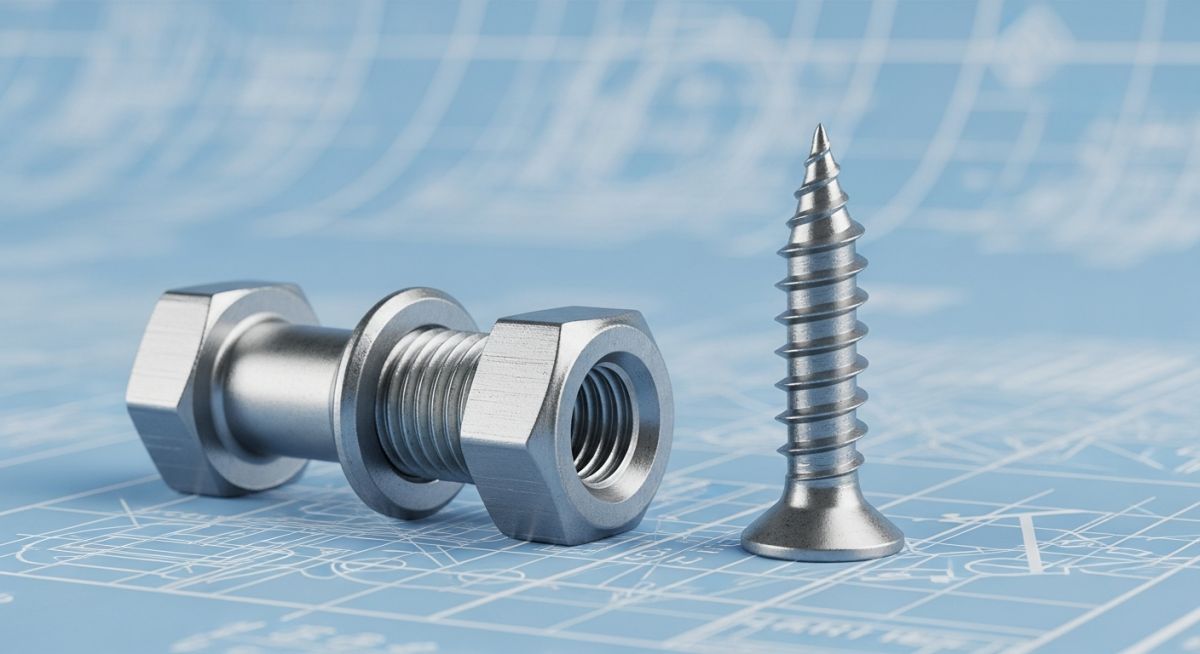
The Structural Difference Between Bolts and Screws Explained
During my 20 years in piping design and structural engineering, I have seen many field errors. One of the most common mistakes is the confusion between bolts and screws. I remember a project in 2014 where a contractor used heavy-duty lag screws instead of structural bolts on a pipe rack support. Under thermal expansion cycles, the screws sheared off, causing a partial line collapse. This taught me that understanding the exact mechanical differences is not just academic—it is a safety requirement.
In this guide, I will break down the mechanical, structural, and material differences between these two critical fasteners. We will look at thread profiles, stress calculations, and installation methods so you can make the right choice for your next project.
Key Takeaways
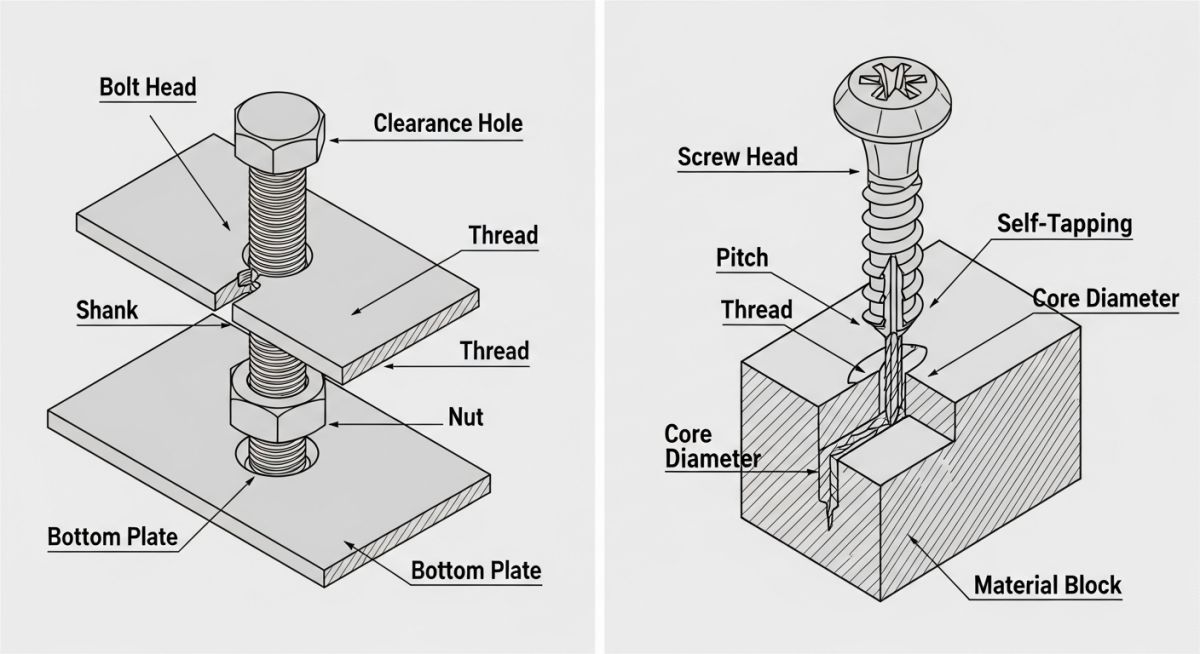
- Installation Method: Bolts require a nut and a pre-drilled clearance hole, whereas screws can tap their own threads or mate directly with pre-tapped holes.
- Load Distribution: Bolts rely on axial pre-tension to clamp joint members together, while screws transfer loads primarily through thread shear.
- Standards Compliance: Structural bolts are governed by strict standards like ASME B18.2.1 and ASTM A325, while screws follow ASME B18.6.3.
Analyzing the Difference Between Bolts and Screws
Fastener Mechanics and Load Paths: The structural performance of bolts relies on axial pre-tension to clamp joint members together, whereas screws transfer loads primarily through direct thread shear engagement with the host material.
To truly understand the difference, we must look at how they handle mechanical stress. A bolt is designed to act as a spring. When you tighten a bolt-nut assembly, you stretch the bolt within its elastic limit. This stretch creates a clamping force that holds the two mating surfaces together. The friction between these surfaces is what actually carries the shear load in a friction-grip joint.
Thread Design and Pitch Variations
Thread Geometry Standards: Bolts feature uniform, fine or coarse machine threads designed to mate with nuts, whereas screws utilize tapered, sharper threads designed to cut or form their own mating threads in the substrate.
Screws typically have a more aggressive thread pitch. This allows them to grip the surrounding material tightly. Because they do not use a nut, the thread engagement length must be carefully calculated to prevent thread stripping. In my experience, a good rule of thumb is to have at least 1.5 times the nominal diameter of thread engagement when screwing into softer metals like aluminum.
Mechanical Load and Stress Calculations
Fastener Stress Analysis: Structural bolts are designed to handle high tensile and shear loads under controlled pre-tension, whereas screws are typically limited to lower-load applications where thread shear in the host material is the primary limiting factor.
Let us look at the basic torque-tension relationship for a bolt:
Where:
T = Tightening torque (Newton-meters)
K = Torque coefficient (dimensionless, typically 0.20 for dry steel)
D = Nominal bolt diameter (meters)
F = Bolt tension force (Newtons)
For screws, the primary failure mode is often thread shear in the host material. The shear area of the internal threads can be calculated using the following formula:
Where:
As = Shear area of internal threads
n = Threads per inch
Le = Length of thread engagement
Dmin = Minimum minor diameter of internal thread
d = Basic major diameter of external thread
D2max = Maximum pitch diameter of internal thread
Evaluating the Difference Between Bolts and Screws
Fastener Selection Criteria: Engineering standards dictate specific material grades, thread pitches, and installation tools to ensure structural integrity across varying joint configurations.
To help you quickly identify which fastener is suitable for your application, I have compiled a comparison table based on standard industrial practices and ASTM International guidelines.
| Parameter | Structural Bolts (e.g., ASTM A325) | Industrial Screws (e.g., ASME B18.6.3) |
|---|---|---|
| Installation Method | Requires a nut and pre-drilled clearance hole. Tightened via the nut or bolt head. | Driven directly into a pre-tapped or self-drilled hole. Tightened via the head drive. |
| Primary Load Type | High tension, high shear, and dynamic fatigue loads. | Low to medium shear, holding force, and static loads. |
| Thread Profile | Uniform machine threads (UNC/UNF) along the shank. | Tapered or straight threads, often with sharp cutting edges. |
| Nut Requirement | Always required (except in specific tapped-hole applications). | Not required; mates directly with the host material. |
Technical Mapping & Specifications Matrix
| Fastener Type | Standard Reference | Material Specification | Yield Strength (MPa) | Tensile Strength (MPa) |
|---|---|---|---|---|
| Heavy Hex Bolt | ASME B18.2.1 | ASTM A325 / Type 1 | 635 | 825 |
| Socket Head Cap Screw | ASME B18.3 | ASTM A574 | 1055 | 1170 |
| Machine Screw | ASME B18.6.3 | SAE J82 Grade 2 | 390 | 510 |
Fastener Selection and Installation Field Checklist
Quality Assurance Protocols: Field verification requires systematic inspection of thread engagement, torque values, and material certifications to prevent premature joint failure.
Before signing off on any structural or piping installation, I always run through a strict verification process. Use this checklist on-site to ensure your fasteners are installed correctly and comply with ASME and ASTM codes.
Site Verification Checkpoints
-
Head Marking Verification: Check the fastener head for grade markings (e.g., “A325” or “A490” for structural bolts; “12.9” for high-tensile socket screws).
-
Thread Engagement Length: Ensure screws have a minimum engagement length of 1.0 times the nominal diameter in steel, and 1.5 times in aluminum or softer alloys.
-
Nut and Washer Compatibility: Verify that nuts match the strength grade of the bolt (e.g., ASTM A563 DH nuts with ASTM A325 bolts) and that hardened washers are used where required.
-
Torque Calibration: Confirm that all torque wrenches used on-site have been calibrated within the last 12 months and that the correct torque values are applied.
-
Hole Clearance: Ensure bolt clearance holes are drilled to the correct size according to ASME B18.2.8 to prevent excessive joint play.
Field Case Study: Real-World Application
Structural Failure Analysis: A forensic engineering review of a failed industrial pipe support assembly highlights the consequences of substituting structural bolts with self-tapping screws in dynamic loading environments.
The Problem
At a petrochemical plant in Texas, a series of heavy-duty pipe supports on a reciprocating compressor skid began to sag. Upon inspection, I discovered that the field contractor had used self-tapping metal screws instead of the specified ASTM A325 structural bolts to secure the support brackets to the steel columns. The high-frequency vibration from the compressor caused the screw threads to strip out of the structural steel columns, leading to joint slippage and a high risk of pipe rupture.
The Outcome
I immediately ordered a shutdown of the affected line. We re-drilled the stripped holes to create clean clearance holes, installed ASTM A325 heavy hex bolts with matching ASTM A563 DH nuts, and added hardened washers. We tightened the bolts using the turn-of-nut method to ensure proper pre-tension. After restarting the compressor, vibration measurements showed zero joint movement, and subsequent inspections over the next five years confirmed the joint remained completely secure.
My Recommendation: Always verify fastener specifications against the engineering drawings before installation. Never allow field substitutions of bolts with screws on any load-bearing or vibrating equipment without a formal engineering sign-off.
Frequently Asked Engineering Questions
Fastener Engineering FAQ: This technical reference addresses common field queries regarding thread engagement, torque limits, and material compatibility under ASME and ASTM standards.
Can a screw be used as a bolt if a nut is added?
What is the difference in thread pitch between bolts and screws?
How do I identify a structural bolt from a standard screw in the field?
Why do bolts require washers while many screws do not?
What are the torque-tension limits for ASTM A325 bolts?
Can self-tapping screws be used in structural steel connections?
===FAQ_BLOCK===
Complete Course on
Piping Engineering
Check Now
Key Features
- 125+ Hours Content
- 500+ Recorded Lectures
- 20+ Years Exp.
- Lifetime Access
Coverage
- Codes & Standards
- Layouts & Design
- Material Eng.
- Stress Analysis
