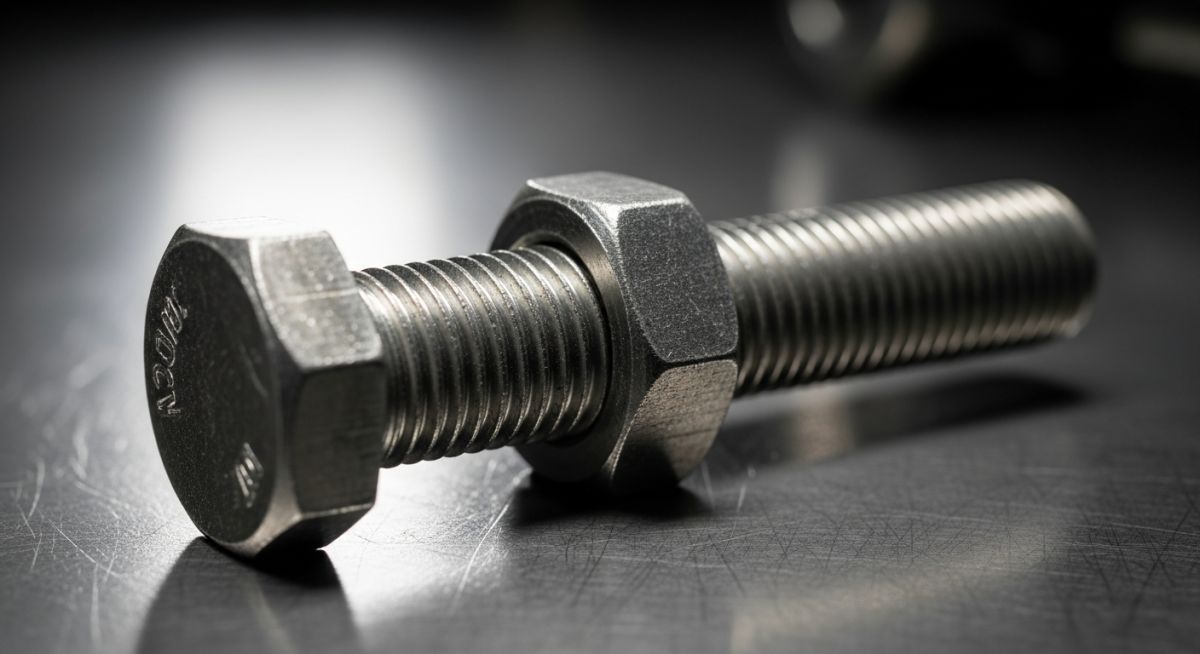
What is a Hex Bolt? Types, Sizes, and Engineering Applications
In my 20 plus years of experience managing piping systems and structural installations in heavy industrial plants, I have seen how the selection of a single fastener can dictate the integrity of an entire facility. The humble hex bolt is the undisputed workhorse of industrial construction. Whether securing high-pressure piping flanges under ASME B31.3 or anchoring heavy rotating machinery, understanding the mechanical limits, material grades, and dimensional standards of these fasteners is a fundamental requirement for any practicing engineer.
Often confused with hex cap screws, a true heavy hex bolt provides the robust bearing surface and high tensile capacity needed to withstand severe shear and tension loads. In this guide, I will share the practical field insights, calculations, and standard specifications that I rely on daily to ensure leak-free, structurally sound bolted joints.
Key Engineering Takeaways
- Standard Compliance: Always verify if your project requires ASME B18.2.1 heavy hex bolts or standard hex cap screws, as their head dimensions and tolerances differ.
- Preload Control: Joint reliability depends on achieving the correct bolt preload, which is highly sensitive to the lubrication coefficient of friction.
- Material Selection: Match your operating temperature and fluid chemistry to the correct ASTM grade, such as ASTM A193 Grade B7 for high-temperature piping.
- Thread Engagement: Ensure a minimum thread engagement equal to one nominal bolt diameter when threading into tapped holes.
Complete Course on
Piping Engineering
Check Now
Key Features
- 125+ Hours Content
- 500+ Recorded Lectures
- 20+ Years Exp.
- Lifetime Access
Coverage
- Codes & Standards
- Layouts & Design
- Material Eng.
- Stress Analysis
How Does a Hex Bolt Function Under Load?
When we tighten a hex bolt, we are essentially stretching it like a very stiff spring. This elastic deformation generates a clamping force that holds the mating components together. The integrity of the joint relies entirely on maintaining this clamping force, known as preload, throughout the operating life of the equipment. If the preload is too low, the joint will leak or suffer from fatigue failure. If it is too high, the bolt will yield or strip its threads.
To calculate the required torque to achieve a specific preload, we use the standard torque-tension relationship:
Where:
- Torque: The tightening torque applied to the bolt head or nut (typically in Newton-meters or Foot-pounds).
- K: The torque coefficient (dimensionless), which accounts for friction in the threads and under the bolt head.
- D: The nominal bolt diameter (in meters or inches).
- F_p: The target bolt preload or clamping force (in Newtons or Pounds).
In my field experience, the torque coefficient “K” is the most volatile variable. For dry, unlubricated steel bolts, K is approximately 0.20. If you apply a high-quality nickel-based anti-seize lubricant, K drops to roughly 0.15. For PTFE-coated fasteners, K can be as low as 0.12. Failing to adjust your torque values based on the lubricant used is a primary cause of bolt yielding during installation.
Never reuse high-strength structural hex bolts (such as ASTM A325 or A490) that have been tightened past their yield point. Plastic deformation permanently alters the thread pitch and reduces the bolt’s fatigue resistance, leading to sudden, catastrophic joint failure under cyclic operating loads.
To determine the maximum allowable preload, we must calculate the tensile stress area of the bolt. For standard unified national coarse (UNC) threads, the tensile stress area is calculated using the following formula:
Where “n” represents the number of threads per inch. Once the tensile stress area is established, the allowable design load is typically limited to 75% of the bolt’s yield strength for temporary or non-critical joints, and up to 90% of the proof load for critical pressure-boundary flanges under ASME PCC-1.
What Are the Primary Hex Bolt Types?
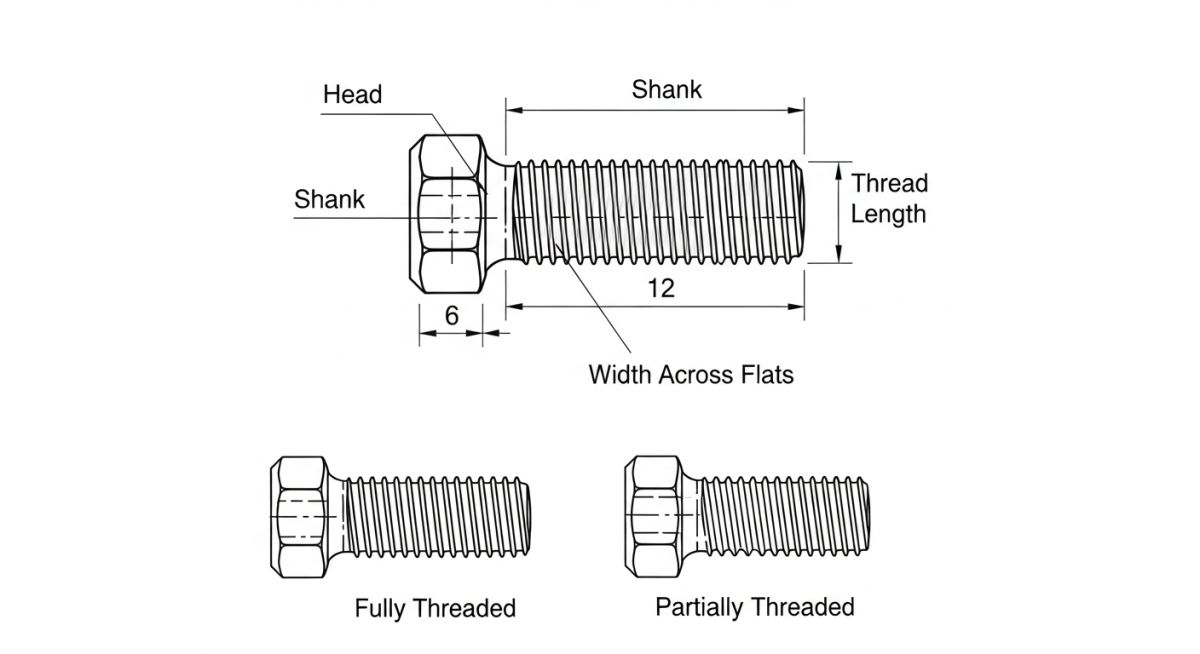
In the field, we classify these fasteners into several distinct types based on their geometry and manufacturing standards:
- Standard Hex Bolts: Typically feature a semi-finished bearing surface under the head and are used in general utility applications.
- Heavy Hex Bolts: Designed with a larger head width across flats and greater head height. These are the industry standard for structural steel connections and high-pressure piping flanges because they distribute clamping loads over a larger area.
- Hex Cap Screws: Manufactured to tighter dimensional tolerances than standard bolts. They feature a machined washer face under the head to act as a clean bearing surface, making them ideal for precision machinery.
- Fully Threaded Tap Bolts: Threaded from the tip all the way to the underside of the head, used in tapped holes where maximum thread engagement is required.
Standard Dimensions of a Hex Bolt
The table below outlines the standard dimensions for heavy hex bolts used in structural and piping applications according to ASME B18.2.1. These dimensions are critical for ensuring proper wrench clearance and socket fitment during field installation.
| Nominal Size (inches) | Width Across Flats (F – inches) | Head Height (H – inches) | Threads Per Inch (UNC) | Tensile Stress Area (sq. inches) |
|---|---|---|---|---|
| 1/2 | 7/8 | 11/32 | 13 | 0.1419 |
| 5/8 | 1-1/16 | 27/64 | 11 | 0.2260 |
| 3/4 | 1-1/4 | 15/32 | 10 | 0.3340 |
| 7/8 | 1-7/16 | 35/64 | 9 | 0.4620 |
| 1 | 1-5/8 | 39/64 | 8 | 0.6060 |
Selecting the correct material grade is paramount to preventing premature joint failure. This matrix maps common ASTM and SAE fastener grades to their mechanical properties and intended industrial environments.
| Material Specification | Yield Strength (min – ksi) | Tensile Strength (min – ksi) | Temperature Range | Primary Application |
|---|---|---|---|---|
| ASTM A193 Grade B7 | 105 | 125 | -50°F to 1000°F | High-pressure piping, refinery flanges, and pressure vessels. |
| ASTM A325 | 92 | 120 | Ambient | Structural steel connections, building frames, and bridges. |
| ASTM A193 Grade B8M | 30 | 75 | -325°F to 1500°F | Cryogenic systems, chemical processing, and marine environments. |
| SAE J429 Grade 8 | 130 | 150 | Ambient | Heavy machinery, automotive engines, and military equipment. |
How to Inspect a Hex Bolt Onsite?
Before any high-pressure flange or structural joint is cleared for service, a rigorous physical inspection of the fasteners must be conducted. Use this field checklist to verify that your hex bolt installations comply with engineering specifications.
Field Quality Control Checklist
-
Grade Marking Verification: Confirm that the bolt head markings match the design drawings (e.g., “B7” for ASTM A193, or three radial lines for SAE Grade 5).
-
Thread Condition Check: Inspect threads for nicks, burrs, or corrosion. The nut must run freely by hand along the entire length of the bolt thread.
-
Thread Engagement Rule: Verify that at least two full threads extend beyond the outer face of the nut after final torque application.
-
Lubrication Uniformity: Ensure that the specified lubricant is applied evenly to both the bolt threads and the nut bearing face to prevent frictional galling.
-
Calibrated Tooling: Confirm that the torque wrench or hydraulic tensioner has a valid calibration certificate dated within the last 12 months.
Field Case Study: Real-World Application
The Problem: Catastrophic Flange Leakage
During the commissioning of a high-pressure steam line (600 psi at 750°F) in a petrochemical facility, a major flange joint began leaking steam. The joint was secured with standard ASTM A193 Grade B7 hex bolts. Upon inspection, three of the bolts had fractured completely at the first thread engagement point. The plant faced an unscheduled shutdown costing over 150,000 per day.
The Outcome: Root Cause & Resolution
Our forensic analysis revealed two primary issues: first, the field crew had used an uncalibrated impact wrench, resulting in uneven bolt preload. Second, the lack of thread lubrication caused severe galling, which simulated a high torque reading on the wrench without actually stretching the bolt to its required preload.
We resolved the issue by replacing all damaged fasteners with new, certified ASTM A193 Grade B7 heavy hex bolts. We implemented a strict hydraulic tensioning protocol using a cross-pattern tightening sequence in accordance with ASME PCC-1. A high-temperature nickel-based lubricant was applied to achieve a consistent torque coefficient of 0.15. The joint was successfully pressurized and has remained leak-free for over five years of continuous operation.
This case highlights why precise torque control and proper fastener selection are not optional. In high-pressure piping, a bolt is not just a pin; it is a highly engineered spring that must be loaded precisely to maintain joint integrity.
