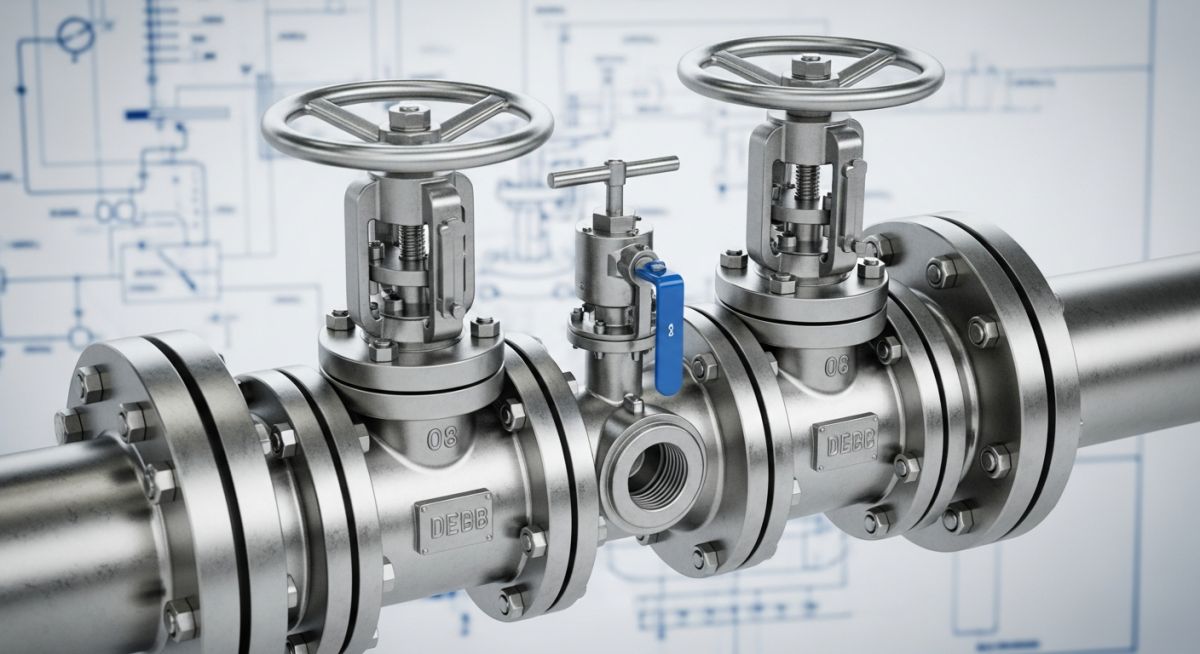
What is a Double Block and Bleed Valve and How Does It Work?
In my 20 years of managing piping systems in offshore platforms and refinery units, I have seen how a minor valve leak can escalate into a catastrophic safety hazard. When you are preparing a line for hot work or instrument calibration, relying on a single isolation valve is a risk you simply cannot take. That is where the double block and bleed valve becomes your ultimate line of defense. I remember a project in a North Sea gas terminal where we replaced traditional multi-valve bypass loops with compact DBB units, saving tons of structural weight and eliminating dozens of potential leak paths. Let me walk you through how these robust assemblies function, their design variations, and how to select them for your high-integrity piping systems.
- Dual isolation barriers with an intermediate bleed path guarantee absolute process isolation.
- Compliance with API 6D is mandatory for verifying true double block and bleed performance.
- Significant reduction in space, weight, and installation costs compared to traditional multi-valve hookups.
- Critical for toxic, flammable, and high-pressure media where zero-leakage is non-negotiable.
- Proper bleed monitoring prevents pressure build-up and alerts operators to primary seal degradation.
Why Use a Double Block and Bleed Valve?
Double Block and Bleed Valve Isolation: This safety-critical piping configuration utilizes two distinct block valves and a central bleed valve to isolate and drain a piping section. It complies with OSHA 1910.147 and API 6D requirements to prevent hazardous fluid bypass into active work zones.
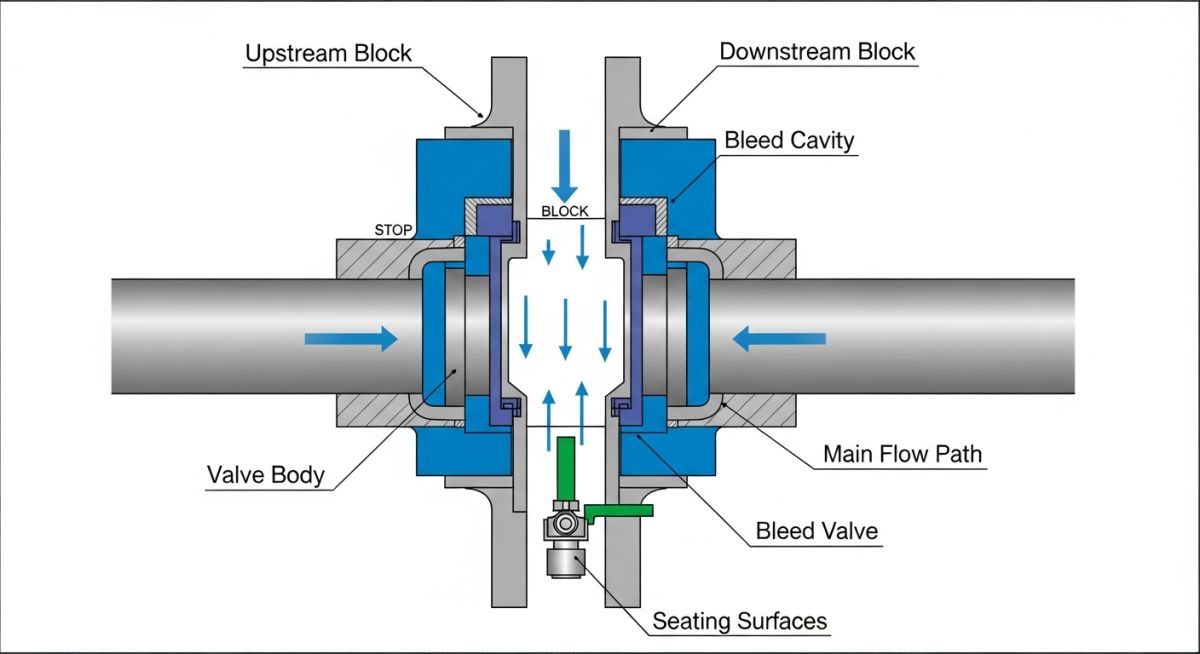
To understand the mechanics, we must look at how pressure behaves within the valve cavity. In a standard single-valve setup, any scratch on the seat face allows fluid to pass directly downstream. A double block and bleed valve solves this by placing two independent seals in series. When both seals are closed, the bleed valve (located in the cavity between the seals) is opened to the atmosphere or a closed flare system. If the upstream seal leaks, the fluid escapes through the bleed path rather than passing through the downstream seal into the safe working area.
In my experience, many young engineers confuse Double Block and Bleed (DBB) with Double Isolation and Bleed (DIB). According to API 6D, a DBB valve seals against pressure from both ends of the valve but cannot relieve cavity pressure if the upstream seal fails under single-source pressure. A DIB valve provides double isolation from a single pressure source using bidirectional seats. Always verify your process safety requirements before specifying the valve type.
Bleed Valve Sizing and Cavity Pressure Calculations
To ensure the bleed valve can handle potential seat leakage without building up backpressure in the cavity, we perform a flow capacity check. The maximum allowable cavity pressure must not exceed the downstream safe working limit during maintenance.
The required flow coefficient (Cv) of the bleed valve is calculated using the standard liquid flow equation:
Where:
– Q_leak = Estimated maximum primary seal leak rate (cubic meters per hour)
– SG = Specific gravity of the process fluid
– P_cavity = Maximum allowable cavity pressure (bar gauge)
– P_bleed_dest = Pressure at the bleed destination/flare header (bar gauge)
For example, if we assume a severe primary seal scratch results in a water leak rate (SG = 1.0) of 0.4 cubic meters per hour, and our maximum allowable cavity pressure is 0.15 bar gauge venting to an atmospheric flare (0 bar gauge):
Cv = 0.4 * square_root( 6.67 )
Cv = 0.4 * 2.58 = 1.03
This calculation shows that our bleed valve must have a minimum Cv of 1.03. Typically, a standard 1/2-inch or 3/4-inch needle or ball valve easily exceeds this capacity, ensuring that no pressure builds up to threaten the secondary barrier.
Standard Dimensions and Pressure Ratings
DBB Valve Dimensions: These physical and pressure specifications define the face-to-face dimensions and pressure-temperature ratings of double block and bleed valves. They conform to ASME B16.10 and ASME B16.34 standards to ensure structural interchangeability and pressure containment.
| Nominal Pipe Size (NPS) | ASME Class | Face-to-Face (mm) | Bleed Connection Size | Approx. Weight (kg) |
|---|---|---|---|---|
| 2 Inch (DN 50) | Class 150 | 292 | 1/2″ NPT | 28 |
| 3 Inch (DN 80) | Class 300 | 381 | 1/2″ NPT | 45 |
| 4 Inch (DN 100) | Class 600 | 432 | 3/4″ NPT | 85 |
| 6 Inch (DN 150) | Class 900 | 610 | 3/4″ Flanged | 195 |
| 8 Inch (DN 200) | Class 1500 | 832 | 1″ Flanged | 410 |
Technical Mapping and Specifications Matrix
DBB Valve Specifications Matrix: This technical reference maps valve configurations, sealing types, and industry standards to specific process applications. It aligns with API 598 and ISO 10497 to guide engineers in selecting the correct valve design for severe service.
| Valve Configuration | Primary Seal Type | Bleed Type | Standard Compliance | Typical Application |
|---|---|---|---|---|
| Split Body Ball (Trunnion) | Soft Seat (PTFE/Devlon) | Integrated Needle Valve | API 6D, ASME B16.34 | Natural Gas Transmission, Light Hydrocarbons |
| Dual Expandable Plug | Elastomer Slip Seals | Manual Bleed Valve | API 6D, API 598 | Aviation Fueling, Metering Stations, Terminals |
| Forged Monoflange | Metal-to-Metal Seat | OS&Y Bleed Bonnet | ASME B16.5, ISO 10497 | Chemical Injection, Pressure Instrument Isolation |
| Gate-Globe-Gate Combo | Stellite Faced Metal Seat | Globe Bleed Valve | ASME B31.3, API 600 | High-Temperature Steam, Severe Slurry Service |
How to Verify DBB Valve Installation on Site?
DBB Valve Site Verification: This quality assurance protocol outlines the physical inspection and pressure testing steps required before commissioning a double block and bleed valve. It complies with API 598 and ASME B31.3 to verify seal integrity and prevent bypass leakage.
Before you sign off on a newly installed DBB valve, you must perform systematic field checks. I have seen installations where the bleed port was piped backward or plugged completely, rendering the entire safety system useless. Use this checklist on your next walkdown to ensure compliance.
-
Flow Direction Alignment: Verify that the valve flow arrow matches the process flow direction, especially for asymmetric seat designs. -
Bleed Piping Routing: Ensure the bleed port is piped to a safe location (flare, slop tank, or atmospheric vent) and is not left open to the ground if handling hazardous fluids. -
Cavity Relief Valve Check: If the valve has an automatic cavity relief feature, verify that the relief path is clear and set to the correct pressure. -
Actuator Stroke Calibration: For automated DBB valves, confirm that both block elements reach 100% closure before the bleed valve opens. -
Seat Integrity Test: Perform a low-pressure pneumatic test on site according to API 598 to confirm zero bubble leakage through the bleed port.
Field Case Study: Real-World Application
DBB Valve Field Performance: This operational analysis evaluates the transition from traditional multi-valve isolation systems to integrated double block and bleed valves in a high-pressure gas facility. It demonstrates compliance with API 6D and OSHA safety standards while reducing fugitive emissions.
A refinery in Texas was experiencing frequent leaks during instrument transmitter maintenance on a high-pressure sour gas line. The existing setup used two separate gate valves and a threaded bleed tee, which took up 1.5 meters of space, weighed over 120 kg, and had 8 potential flange/threaded leak paths. Operators were hesitant to perform maintenance because the threaded connections frequently corroded, creating a risk of toxic hydrogen sulfide (H2S) exposure.
We replaced the bulky multi-valve assembly with a single, integrated forged-body split-ball Double Block and Bleed Valve. This reduced the face-to-face dimension to just 280 mm, cut the weight by 65%, and eliminated 6 flanged connections. Most importantly, the integrated bleed valve allowed operators to safely vent the cavity and verify 100% isolation before servicing the instruments, reducing maintenance downtime by 4 hours per instrument.
Based on this project, my direct recommendation is to phase out multi-valve bypass loops for instrument isolation and replace them with integrated forged DBB valves. The reduction in fugitive emission points alone justifies the initial capital cost, while the safety improvement for field technicians is invaluable.
Frequently Asked Engineering Questions
What is the difference between DBB and DIB valves according to API 6D?
Can a single ball valve act as a true Double Block and Bleed Valve?
What are the primary materials of construction for DBB valves in sour service?
How do you test a DBB valve for zero-leakage compliance?
Why is cavity relief critical in liquid-service DBB valves?
What are the space and weight savings of an integrated DBB valve?
Double Block and Bleed Valve Maintenance Tips
DBB Valve Maintenance Protocols: These preventive maintenance steps ensure the long-term sealing performance and operational safety of double block and bleed valves. They align with API 6D and manufacturer guidelines to prevent seat damage and actuator misalignment.
To keep your DBB valves operating flawlessly, I highly recommend implementing a routine flushing program. Over time, pipeline debris, scale, and hydrates can accumulate in the valve cavity, preventing the seats from sealing completely. Regularly flushing the cavity through the bleed port removes these contaminants. Additionally, ensure that the bleed valve itself is cycled during every maintenance turnaround to prevent it from seizing in the closed position.
===
Complete Course on
Piping Engineering
Check Now
Key Features
- 125+ Hours Content
- 500+ Recorded Lectures
- 20+ Years Exp.
- Lifetime Access
Coverage
- Codes & Standards
- Layouts & Design
- Material Eng.
- Stress Analysis