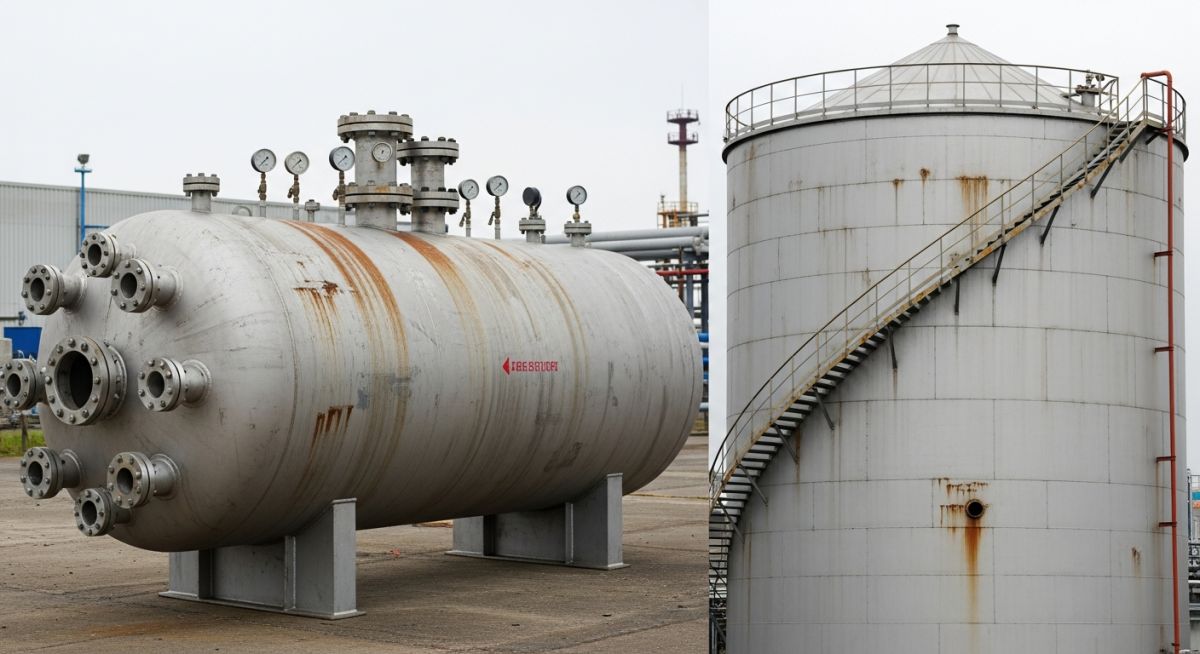
Pressure Vessels vs Storage Tanks Major Differences
In my 20+ years across EPC projects—including methanol plants, ZLD systems, and large industrial storage terminals—I’ve seen one mistake repeated again and again: teams underestimate the engineering difference between a storage tank and a pressure vessel.
On paper, both are just “containers.” But in the field, the wrong classification can lead to failed hydrotests, roof buckling, insurance rejection, or worse—catastrophic rupture.
I’ve personally encountered early-stage designs where process teams tagged a separator as a tank to reduce cost, only for mechanical teams to reclassify it as a pressure vessel later—causing complete redesign, schedule delay, and cost escalation.
Key Engineering Takeaways
- Pressure vessels follow ASME codes; tanks follow API standards
- Even small internal pressure changes the design category completely
- Thickness increases non-linearly with pressure in vessels
- Tanks fail through buckling; vessels fail through stress rupture
- Misclassification is one of the most expensive early design mistakes
Interactive Engineering Quiz
1. Which standard is used for pressure vessel design?
Complete Course on
Piping Engineering
Check Now
Key Features
- 125+ Hours Content
- 500+ Recorded Lectures
- 20+ Years Exp.
- Lifetime Access
Coverage
- Codes & Standards
- Layouts & Design
- Material Eng.
- Stress Analysis
What is a Pressure Vessel in Design Codes
Pressure Vessel Definition: A pressure vessel is a closed container designed to hold gases or liquids at a pressure substantially different from atmospheric pressure, governed primarily by ASME Section VIII with strict stress limits, safety factors, and mandatory inspection controls.
In my EPC experience across methanol plants and high-pressure utility systems, pressure vessels are among the most rigorously engineered equipment because failure is not gradual — it is sudden and catastrophic.
The governing design relationship for cylindrical pressure vessels is based on hoop stress:
Hoop Stress σh = (P × D) / (2 × t)
- P = Internal design pressure
- D = Internal diameter
- t = Shell thickness
Rearranging for thickness:
t = (P × D) / (2 × S × E – 1.2 × P)
- S = Allowable stress from ASME material tables
- E = Weld joint efficiency
What is a Storage Tank in Industry
Storage Tank Definition: A storage tank is a large container designed for storing liquids at atmospheric or near-atmospheric pressure, typically governed by API 650 or API 620 with emphasis on hydrostatic loading rather than internal pressure stress control.
Storage tanks in your land development and methanol storage areas are governed primarily by hydrostatic head:
Hydrostatic Pressure P = ρ × g × h
- ρ = Fluid density
- g = Gravity
- h = Liquid height
Shell thickness in tanks increases from top to bottom due to increasing liquid head, unlike uniform thickness in pressure vessels.
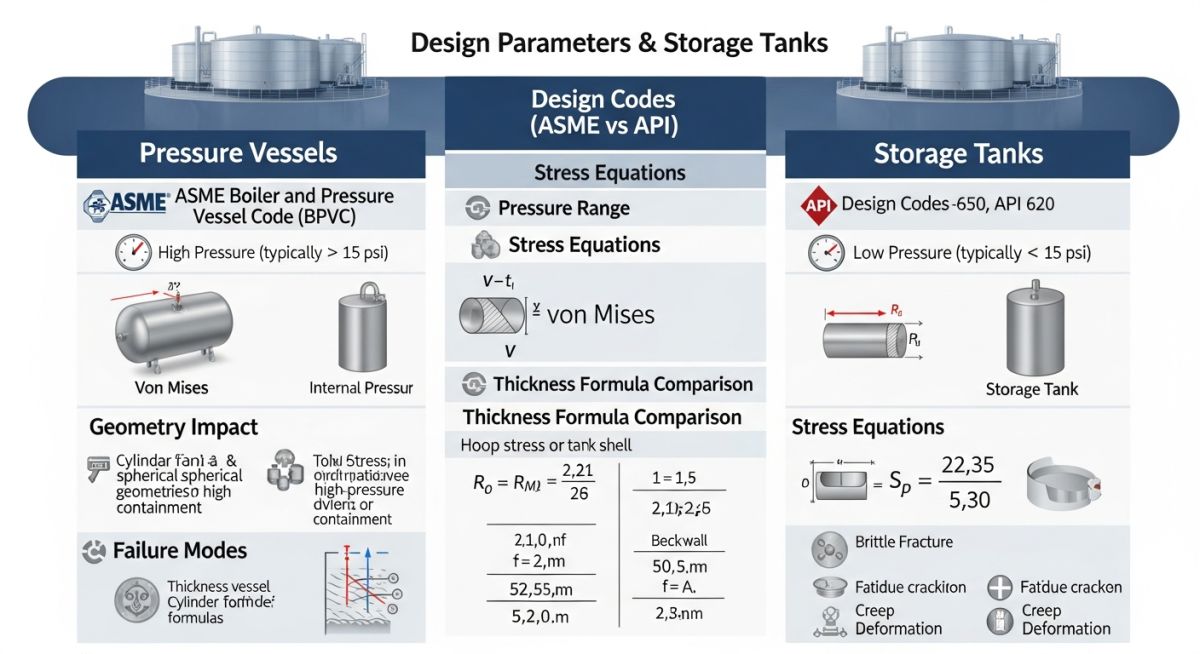
| Parameter | Pressure Vessel | Storage Tank |
|---|---|---|
| Design Code | ASME Section VIII | API 650 / API 620 |
| Pressure Range | Above 1 bar (can exceed 300 bar) | Atmospheric to very low pressure |
| Stress Type | Hoop and longitudinal stress | Hydrostatic stress |
| Failure Mode | Burst / rupture | Buckling / shell instability |
| Thickness Distribution | Uniform | Variable (bottom thicker) |
| Inspection | Radiography, UT, hydrotest mandatory | Visual + settlement checks |
| Typical Examples | Reactors, separators, heat exchangers | Diesel tanks, ethanol tanks |
| Entity | Pressure Vessel | Storage Tank |
|---|---|---|
| Geometry | Cylindrical with heads | Cylindrical flat/conical roof |
| Orientation | Horizontal or vertical | Mostly vertical |
| Mounting | Saddle, skirt, leg supports | Bottom resting on foundation |
| Diameter Range | Up to ~5 meters typically | Up to 60+ meters |
| Wall Thickness | High thickness due to pressure | Low, varies with liquid height |
| CAPEX Impact | High fabrication cost | Lower cost per volume |
| Fabrication Complexity | High (code welding + NDT) | Moderate |
Engineering Checklist Purpose: This checklist ensures correct classification between pressure vessels and storage tanks by validating pressure conditions, code applicability, and structural design basis before procurement or fabrication decisions are locked.
In my experience across methanol plant layouts and ZLD installations, this exact checkpoint is where most high-cost mistakes originate—especially during early FEED and vendor alignment stages.
Pre-Engineering Classification Checks
- Confirm design pressure exceeds atmospheric threshold (even marginal vapor pressure must be evaluated)
- Validate process simulation data for transient pressure rise (startup/shutdown cases)
- Check if gas blanketing introduces pressurization condition
- Identify vapor pressure at operating temperature (methanol, brine, hydrocarbons)
- Verify if API 650 limits are exceeded under worst conditions
Code Compliance Validation
- Confirm if ASME Section VIII applies due to internal pressure
- Check eligibility under API 650 or API 620 standards
- Review allowable stress values based on material and temperature
- Confirm weld joint efficiency assumptions and NDT scope
- Cross-check with statutory inspection requirements
Mechanical Design Checks
- Evaluate shell thickness variation profile (uniform vs variable)
- Check need for dished heads vs flat/conical roof design
- Assess nozzle reinforcement requirements under pressure loads
- Validate support structure (skirt/saddle vs bottom annular plate)
- Check wind and seismic loads for large diameter tanks
Field Execution Validation
- Confirm hydrotest pressure criteria as per design code
- Ensure radiography or UT is planned for pressure-containing welds
- Check for settlement monitoring in large storage tanks
- Verify foundation interface (ring wall vs pedestal)
- Confirm venting and overpressure protection systems
Field Case Study Real World Application Insights
When dynamic simulation was later performed, internal pressure reached 3.5 bar during upset conditions. The tank roof and shell configuration could not handle hoop stress, creating a high rupture risk.
Based on my field experience, I always recommend validating transient pressure cases early. Many failures are not due to steady-state conditions but occur during startup, shutdown, or blocked outlet scenarios.
Shape Differences In Engineering Design
Shape Difference: Pressure vessels use cylindrical shells with elliptical or hemispherical heads to distribute stress evenly, while storage tanks use flat or conical roofs suitable for low-pressure hydrostatic storage.
Purpose Driven Equipment Classification Logic
Purpose Difference: Pressure vessels are designed for process containment under pressure conditions, while storage tanks are intended for bulk storage without significant pressure variation.
Construction Code And Fabrication Approach
Construction Difference: Pressure vessels follow strict fabrication under ASME Section VIII with mandatory NDT, while tanks follow API 650 focusing on hydrostatic integrity and weld quality checks.
Orientation Strategy And Layout Constraints
Orientation Difference: Pressure vessels can be vertical or horizontal based on process design, while storage tanks are predominantly vertical due to land utilization and gravity-based storage efficiency.
Mounting And Support System Differences
Mounting Difference: Vessels require engineered supports like saddle or skirt foundations to handle loads, whereas tanks rest directly on foundations with annular plates and settlement considerations.
Size Range And Capacity Limitations
Size Difference: Pressure vessels are size-limited due to fabrication and transport constraints, whereas tanks can exceed 60-meter diameter for large storage terminals.
Cost Impact Based On Design Basis
Cost Difference: Pressure vessels have significantly higher cost due to thicker shells, strict inspection, and code compliance, while tanks offer lower cost per unit volume for storage applications.
Frequently Asked Engineering Questions
Can a storage tank handle internal pressure conditions?
What defines pressure vessel classification threshold?
Why do pressure vessels require dished heads?
What is the main failure difference between tank and vessel?
How does thickness vary between tank and vessel?
Which is more economical for large storage projects?
