Engineering Guide to Nitrogen Storage Tank Selection and Design (2026)
A Nitrogen Storage Tank is a critical asset for industrial facilities requiring high-purity gas or cryogenic liquid for processes such as laser cutting, food preservation, and electronics manufacturing.
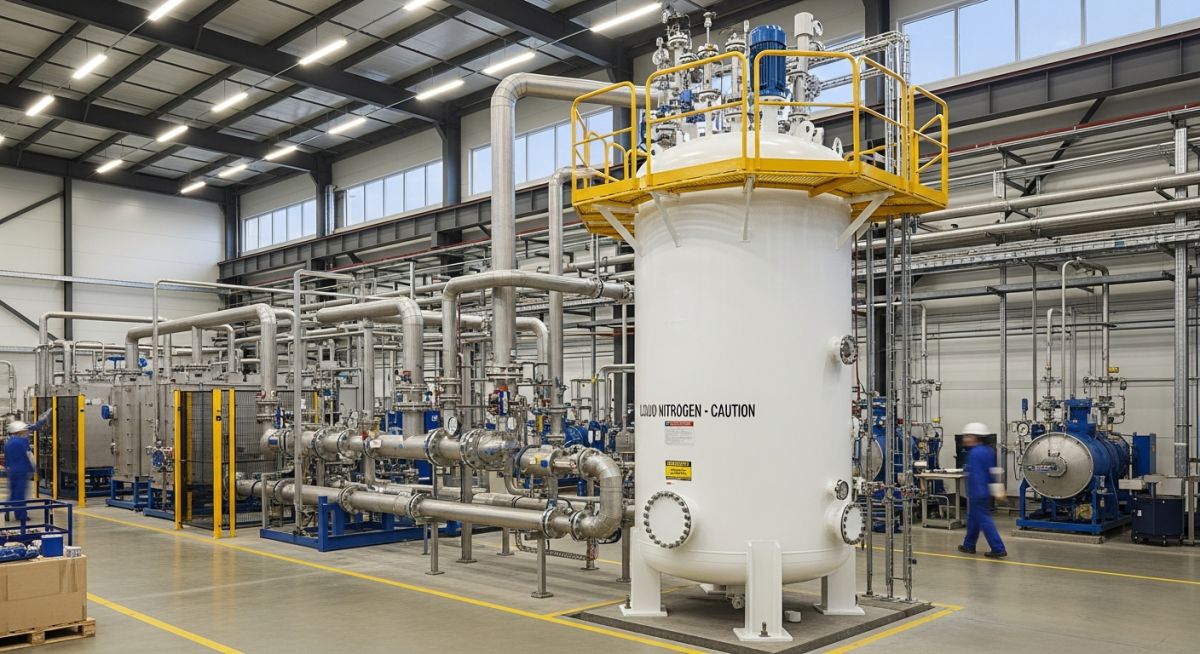
What is a Nitrogen Storage Tank?
A Nitrogen Storage Tank is a specialized pressure vessel designed to store nitrogen in liquid (cryogenic) or gaseous form. These tanks typically utilize vacuum-insulated double-wall construction to maintain temperatures as low as -196 degrees Celsius, ensuring efficient storage and safety for industrial, medical, and scientific applications.
Technical Knowledge Check
Question 1 of 5
Complete Course on
Piping Engineering
Check Now
Key Features
- 125+ Hours Content
- 500+ Recorded Lectures
- 20+ Years Exp.
- Lifetime Access
Coverage
- Codes & Standards
- Layouts & Design
- Material Eng.
- Stress Analysis
Why Industrial Facilities Require a Nitrogen Storage Tank?
In modern industrial ecosystems, a Nitrogen Storage Tank serves as the heartbeat of chemical processing, electronics manufacturing, and food logistics. Nitrogen is preferred over other gases due to its inert properties, which prevent oxidation and combustion in sensitive environments. By installing an on-site Nitrogen Storage Tank, facilities transition from the logistical headache of frequent cylinder deliveries to a continuous, high-volume supply that significantly reduces the cost per cubic meter of gas.
Engineering teams prioritize these tanks for three primary functions: Inerting (purging tanks or pipelines to prevent explosions), Cooling (utilizing the cryogenic temperature of liquid nitrogen for flash freezing), and Pressurization (providing consistent pneumatic force for automated systems). In 2026, the shift toward sustainable manufacturing has also seen the Nitrogen Storage Tank integrated with on-site nitrogen generators to maximize operational efficiency.
Engineering Fundamentals of the Liquid Nitrogen Tank
A Liquid Nitrogen Tank, often referred to by engineers as a cryogenic storage vessel, is a highly engineered thermos bottle. Because liquid nitrogen exists at temperatures as low as -196 degrees Celsius (77 Kelvin), it cannot be contained in standard carbon steel vessels, which would undergo “brittle fracture” and fail catastrophically. Instead, these tanks are designed as Cryogenic Storage Vessels under strict compliance with ASME Section VIII Division 1.
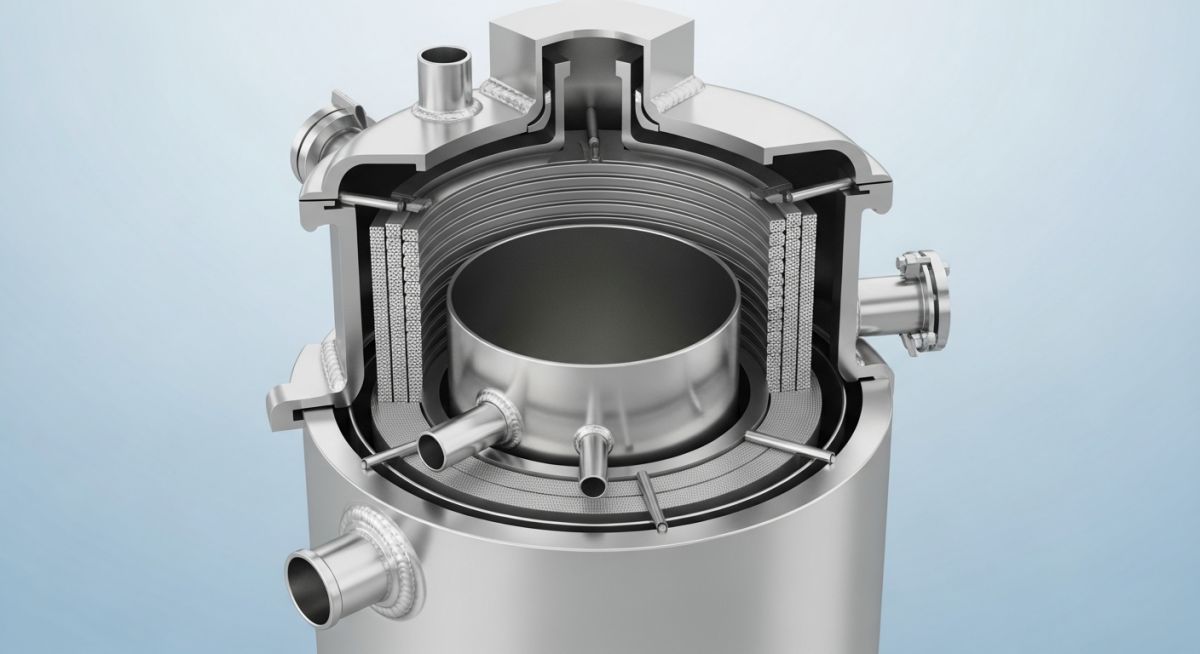
Physics of Cryogenic Insulation in a Nitrogen Storage Tank
The efficiency of a Nitrogen Storage Tank depends entirely on its ability to limit heat ingress from the ambient environment. This is achieved through a “double-wall” design. The inner vessel, which holds the liquid nitrogen, is suspended within an outer shell using low-conductivity supports. The space between these two shells, known as the annular space, is filled with a specialized insulation material like expanded perlite or multi-layer insulation (MLI) and then evacuated to a high vacuum.
- Conduction: Minimized by using high-strength, low-thermal-conductivity materials for support rods.
- Convection: Virtually eliminated by removing air from the annular space to create a vacuum.
- Radiation: Reduced by using reflective foils (MLI) or perlite to bounce heat away from the inner vessel.
Critical Components of a Nitrogen Storage Tank System
A Nitrogen Storage Tank is more than just a vessel; it is a complex system of valves, sensors, and heat exchangers. To ensure safety and performance, every component must be rated for cryogenic service and oxygen compatibility (to prevent fires if liquid oxygen ever condenses).
Pressure Relief Devices and Safety Redundancy
Safety is the paramount concern in cryogenic engineering. As liquid nitrogen absorbs heat, it expands at a ratio of approximately 694:1. Without adequate Pressure Relief Devices, the pressure rise would exceed the vessel’s Maximum Allowable Working Pressure (MAWP). Standard Nitrogen Storage Tank configurations include:
| Component | Function | Engineering Standard |
|---|---|---|
| Primary Relief Valve | First-stage pressure venting during normal overpressure events. | ASME Section VIII / CGA S-1.3 |
| Bursting Disc | Secondary fail-safe that ruptures if the relief valve fails or is overwhelmed. | ISO 4126-2 |
| Ambient Vaporizer | Converts liquid to gas using atmospheric heat before delivery to process. | CGA G-10.1 |
| Economizer Valve | Prioritizes gaseous nitrogen from the head space to save energy. | Manufacturer Specific |
Comparing Nitrogen Tank Sizes for Specific Applications
Selecting the correct Nitrogen Storage Tank size is a balancing act between operational footprint, consumption rates, and the frequency of refills. Oversizing leads to unnecessary boil-off losses, while undersizing results in process downtime during supply replenishment. In 2026, the industry has standardized three primary categories for Nitrogen Tank Sizes.
Small Portable Nitrogen Tank Sizes for Laboratories
Often referred to as Dewars, these portable Nitrogen Storage Tank units range from 5 to 50 liters. They are ideal for low-volume applications such as cryotherapy, dermatological procedures, and small-scale biological research. Their portability allows for manual handling within a facility, but they require high-frequency manual filling from a larger source.
Intermediate Microbulk Nitrogen Storage Tank Solutions
Microbulk systems bridge the gap between portable cylinders and large stationary vessels. These Nitrogen Storage Tank sizes typically range from 230 to 3,000 liters. They are designed to be filled in-place by a specialized cryogenic truck, eliminating the need for cylinder handling and improving safety for manufacturing floors.
Large Stationary Nitrogen Tank Sizes for Industrial Plants
For heavy industry, such as large-scale chemical plants or semiconductor fabs, a Nitrogen Storage Tank can exceed 50,000 liters. These vertical or horizontal vessels are fixed onto concrete pads and integrated into Vacuum Jacketed Piping networks.
| Tank Category | Typical Volume (Liters) | Storage Format | Primary Usage |
|---|---|---|---|
| Portable (Dewar) | 5 to 50 L | Liquid | Medical & Small Labs |
| Microbulk | 230 to 3,000 L | Liquid / Gas Interface | Laser Cutting & Welding |
| Bulk Stationary | 3,000 to 100,000+ L | Bulk Cryogenic Liquid | Refineries & Food Plants |
Materials of Construction for a Nitrogen Storage Tank
The integrity of a Nitrogen Storage Tank hinges on material science. According to ASME Section II, materials used for cryogenic service must possess high fracture toughness at sub-zero temperatures.
Selection of Austenitic Stainless Steel (304/316)
The inner vessel of a Nitrogen Storage Tank is almost exclusively manufactured from 300-series stainless steels. Unlike ferritic steels, these materials do not have a ductile-to-brittle transition temperature, meaning they remain strong and flexible even at -196 degrees Celsius. The outer shell, which is only exposed to ambient temperatures, is typically made of high-quality Carbon Steel, which is then painted with a reflective white coating to minimize solar heat gain.
Engineering Calculation: Gas-to-Liquid Expansion
To calculate the volume of gas available from a specific Nitrogen Storage Tank volume, engineers use the expansion ratio. For Nitrogen, this ratio is approximately 694.
Example: A 1,000-liter Nitrogen Storage Tank filled with liquid would provide approximately 694,000 liters (694 m3) of nitrogen gas at standard conditions (NTP).
Nitrogen Storage Tank Calculator
Estimate your total gaseous nitrogen capacity and process runtime based on liquid volume and consumption rates. (Calculations use an expansion factor of 694 for 2026 engineering standards).
EPCLand YouTube Channel
2,500+ Videos • Daily Updates
Case Study: Optimizing a Nitrogen Storage Tank for Bio-Preservation (2026)

Project Data
- Facility Type: Regional Stem Cell Bio-Bank
- Equipment: 3,000-Liter Microbulk Nitrogen Storage Tank
- Operational Pressure: 50 psig
- Project Year: 2026
Failure Analysis
The facility reported a 15% increase in liquid nitrogen consumption despite no change in process demand. Engineering audits identified a degradation in the “Normal Evaporation Rate” (NER) caused by a loss of vacuum integrity in the annular space of the Nitrogen Storage Tank.
The Engineering Fix
The technical team performed a “pump-down” procedure to restore the vacuum to 50 microns. Simultaneously, they replaced the standard mechanical gauge with a digital telemetry system integrated into the facility’s Building Management System (BMS). This allows for real-time monitoring of vacuum levels and provides automated alerts if the Nitrogen Storage Tank experiences a “soft vacuum” condition.
Lessons Learned
- Proactive Monitoring: Relying on manual inspections for vacuum integrity in a Nitrogen Storage Tank is insufficient for high-value biological assets.
- Thermal Imaging: Regular infrared thermography can identify “hot spots” on the outer shell of the tank, signaling localized insulation failure before catastrophic gas loss occurs.
- ROI: The repair cost (approx. 4,500 USD) was recouped in under 7 months through reduced nitrogen replenishment costs.
Frequently Asked Questions
What is the expected lifespan of a Nitrogen Storage Tank designed under ASME standards?
When maintained correctly, a Nitrogen Storage Tank engineered to ASME Section VIII standards typically has a service life of 20 to 30 years. The primary factor in longevity is the maintenance of the vacuum insulation. Over time, “outgassing” from the materials inside the vacuum space can occur, necessitating a vacuum re-evacuation every 10 years to maintain thermal efficiency.
How does Vacuum Jacketed Piping improve the efficiency of a Nitrogen Storage Tank?
Vacuum Jacketed Piping (VJP) is used to transport liquid nitrogen from the tank to the application point with minimal heat gain. Standard foam-insulated copper pipes often result in significant “boil-off,” where the liquid turns back into gas before reaching its destination. VJP can reduce these thermal losses by up to 90 percent compared to conventional insulation.
Are High-Pressure Gas Cylinders more cost-effective than a bulk Nitrogen Storage Tank?
Generally, High-Pressure Gas Cylinders are only cost-effective for very low consumption rates (under 10 cylinders per month). For facilities with higher demand, a bulk Nitrogen Storage Tank is significantly cheaper per cubic meter of gas, reduces labor costs associated with cylinder handling, and decreases the risk of workplace injuries from moving heavy high-pressure vessels.
What maintenance is required for Pressure Relief Devices on a Liquid Nitrogen Dewar?
On a Liquid Nitrogen Dewar or bulk tank, Pressure Relief Devices must be inspected annually for ice buildup, corrosion, or physical damage. It is an engineering best practice to replace or recertify primary relief valves every 5 years to ensure they open at the designated set pressure, protecting the vessel from catastrophic failure.
Final Engineering Perspective
In 2026, the transition to high-efficiency Nitrogen Storage Tank systems is no longer optional for facilities seeking operational excellence. Whether you are selecting a small dewar for a research laboratory or a 50,000-liter bulk vessel for a refinery, the principles of vacuum insulation, material compatibility, and ASME compliance remain the same.
By understanding the specific Nitrogen Tank Sizes available and the engineering requirements for safety and insulation, technical managers can ensure a reliable, cost-effective nitrogen supply that supports industrial growth for decades to come.
