Understanding Pipe Wye Fittings: Wye Fitting vs Lateral Connection
In my 20-plus years of managing piping stress analysis and field installations, I have seen many young engineers treat a wye fitting and a lateral connection as interchangeable. They are not. I remember a project in 2014—a high-pressure water injection system—where a designer substituted a forged wye with a fabricated lateral to save on lead times. Within three months of commissioning, the localized stress at the acute crotch angle of the lateral led to a fatigue crack, shutting down the entire train.
Understanding the physical and mechanical differences between these two components is not just an academic exercise; it is a safety requirement. When you design systems handling hazardous chemicals, high pressures, or cyclic thermal loads, your choice of branch connection directly impacts the life expectancy of the plant. Let us break down the engineering realities of these components so you can make informed decisions on your next project.
Key Engineering Takeaways
- Forged wye fittings offer superior stress distribution and are governed by ASME B16.9 standards.
- Fabricated lateral connections require rigorous area replacement calculations under ASME B31.3.
- Flow efficiency is significantly higher in wye configurations, reducing localized turbulence and erosion.
Complete Course on
Piping Engineering
Check Now
Key Features
- 125+ Hours Content
- 500+ Recorded Lectures
- 20+ Years Exp.
- Lifetime Access
Coverage
- Codes & Standards
- Layouts & Design
- Material Eng.
- Stress Analysis
Analyzing Wye Fitting vs Lateral Connection Designs
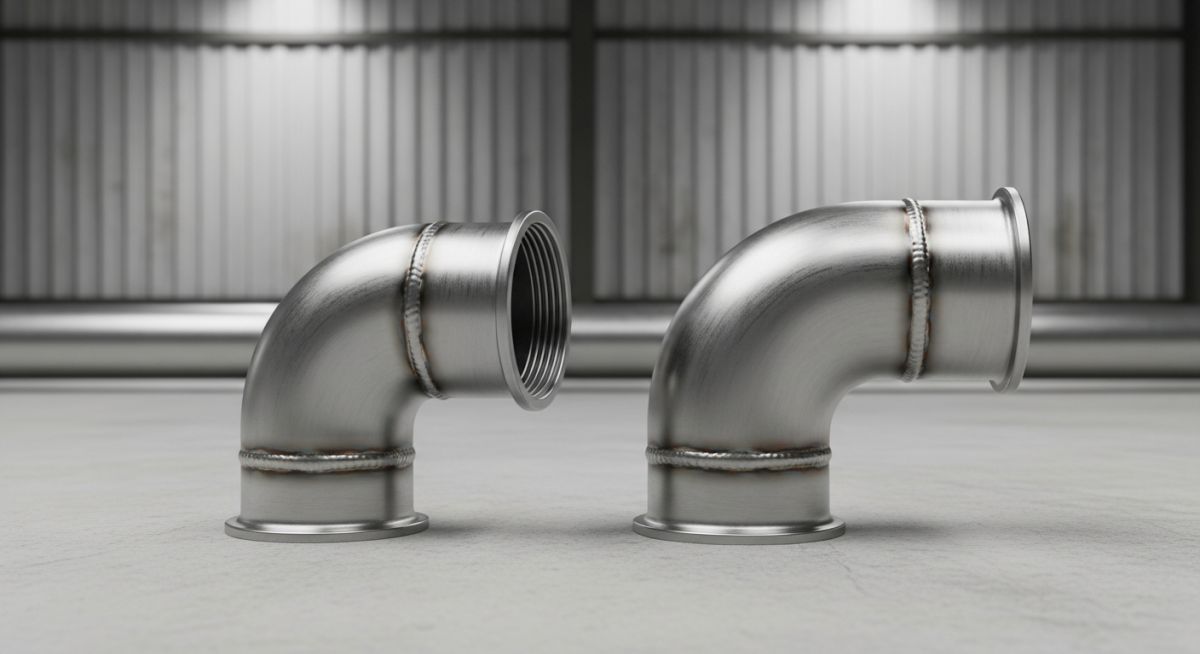
When we look at a factory-made wye fitting, we are looking at a component designed and tested to match or exceed the strength of the matching pipe. These fittings, often referred to as lateral tees or true wyes, are manufactured under ASME B16.9. The manufacturing process involves hot or cold forming, which ensures continuous grain flow and uniform wall thickness, particularly at the crotch where stress concentration is highest.
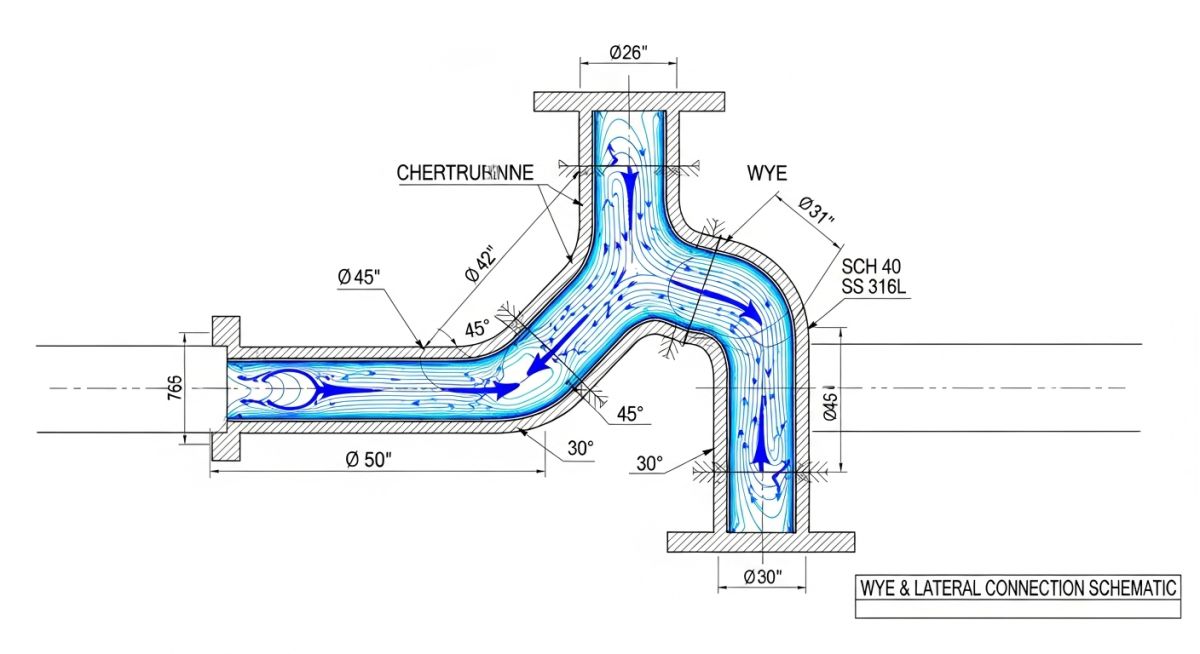
Conversely, a fabricated lateral connection is built in the field or fabrication shop by cutting an opening in the header (run) pipe at an angle—typically 45 degrees—and welding a branch pipe directly into it. This intersection creates a highly complex geometry. Because the run pipe is cut, its pressure-containing capability is compromised. To restore this strength, we must perform area replacement calculations in accordance with ASME B31.3 Section 304.3.2.
Stress Intensification and Area Replacement
The stress profile of a fabricated lateral is inherently unbalanced. The acute angle side (the crotch) experiences significantly higher stress concentration than the obtuse angle side. In piping stress analysis software like CAESAR II, the Stress Intensification Factor (SIF) for a fabricated lateral is often double that of a standard forged wye fitting.
To compensate for this, we must calculate the required reinforcement area (A_r):
Where d_1 is the effective length of the opening, t_h is the nominal thickness of the header, and theta is the angle between the branch and the run. Because sin(theta) decreases as the angle becomes more acute, the required reinforcement area increases dramatically compared to a standard 90-degree tee. If the available area (A_a) in the header and branch walls is insufficient, a reinforcement pad (re-pad) must be welded around the branch.
Do not use fabricated lateral connections with reinforcement pads in severe cyclic service. The fillet welds on the re-pad act as severe stress risers, making them highly susceptible to fatigue cracking under thermal or mechanical cycling. Always specify forged wye fittings for these applications.
Fluid Dynamics and Pressure Drop
From a fluid dynamics perspective, both configurations aim to reduce turbulence by introducing fluid at an angle rather than a sharp 90-degree turn. However, the internal surface finish of a forged wye is smooth and continuous. Fabricated laterals often suffer from internal weld protrusion, mismatch, or sharp edges at the cut line. This increases the resistance coefficient (K-factor), leading to higher pressure drops and accelerated localized erosion-corrosion in high-velocity systems.
Comparing Wye Fitting vs Lateral Connection Specifications
When specifying these components in your piping material specifications (PMS), you must align them with the correct manufacturing standards. Below is a comprehensive engineering comparison table detailing the physical and operational differences.
| Design Parameter | Forged Wye Fitting (ASME B16.9) | Fabricated Lateral Connection |
|---|---|---|
| Primary Standard | ASME B16.9 / MSS SP-75 | ASME B31.3 / ASME B31.1 |
| Stress Intensification (SIF) | Low to Moderate (Smooth transitions) | High (Severe at acute crotch) |
| Flow Efficiency | Excellent (Minimal turbulence) | Moderate (Affected by weld quality) |
| NDT Requirements | Standard RT/UT on butt welds | Mandatory PT/MT on crotch weld |
| Procurement Lead Time | Long (Specialized forging) | Short (Fabricated on-site) |
To assist piping designers in mapping these components within 3D modeling software (such as SP3D or CADWorx), this matrix outlines the critical data attributes and standard references.
| Component Entity | Acronym / Code | Physical Parameter | Standard Reference |
|---|---|---|---|
| Butt-Welding Wye | WYE-BW | Wall Thickness (Sch 40/80/XS) | ASME B16.9 |
| Reinforced Lateral | LAT-REPAD | Pad Width & Thickness | ASME B31.3 Sec 304.3 |
| Latrolet Fitting | LATR | Branch Outlet Rating (3000#/6000#) | MSS SP-97 |
Field Inspection Checklist for Branch Connections
During my site audits, I often find that fabricated laterals are welded without verifying the actual cut angle or the fit-up gap. This checklist is designed to prevent those field errors.
Pre-Welding & Fit-Up Verification
-
Verify that the branch angle matches the isometric drawing (typically 45 degrees) within a tolerance of +/- 1 degree. -
Check the root gap and bevel angle of the fabricated lateral cut to ensure full penetration welding is achievable. -
Ensure the reinforcement pad (if required) has a 1/4″ NPT vent hole tapped to allow gas escape during welding and testing. -
Confirm that the welder is qualified under ASME Section IX for the specific material and position. -
Perform Dye Penetrant Testing (PT) on the root pass of the crotch weld before completing the cover passes.
Field Case Study: Real-World Application
At a natural gas compressor station in Texas, a 12-inch branch connection on a 24-inch gas header was experiencing severe vibration. The original design specified a fabricated 45-degree lateral connection with a reinforcement pad. Within 18 months of operation, the station experienced a gas leak. Non-destructive testing revealed a 4-inch crack propagating along the acute crotch weld of the lateral connection, caused by high-cycle mechanical vibration from the reciprocating compressors.
The engineering team decided to cut out the damaged section and replace the fabricated lateral with a forged 45-degree wye fitting conforming to ASME B16.9. Finite Element Analysis (FEA) conducted during the redesign showed that the forged wye reduced the peak localized stress by 48% compared to the fabricated lateral. The smooth transition profile of the forged fitting eliminated the stress concentration point, and the station has operated without incident for over five years.
This case highlights why saving on initial material costs by choosing a fabricated lateral can lead to catastrophic operational expenses later. For high-vibration or high-pressure systems, the forged wye is always the technically superior choice.
Frequently Asked Engineering Questions
Can a fabricated lateral connection be used in high-pressure steam systems?
What is the difference between a lateral and a true wye?
How does ASME B31.3 govern the reinforcement of lateral connections?
Why do wye fittings offer better flow characteristics than tees?
When is a latrolet preferred over a fabricated lateral connection?
