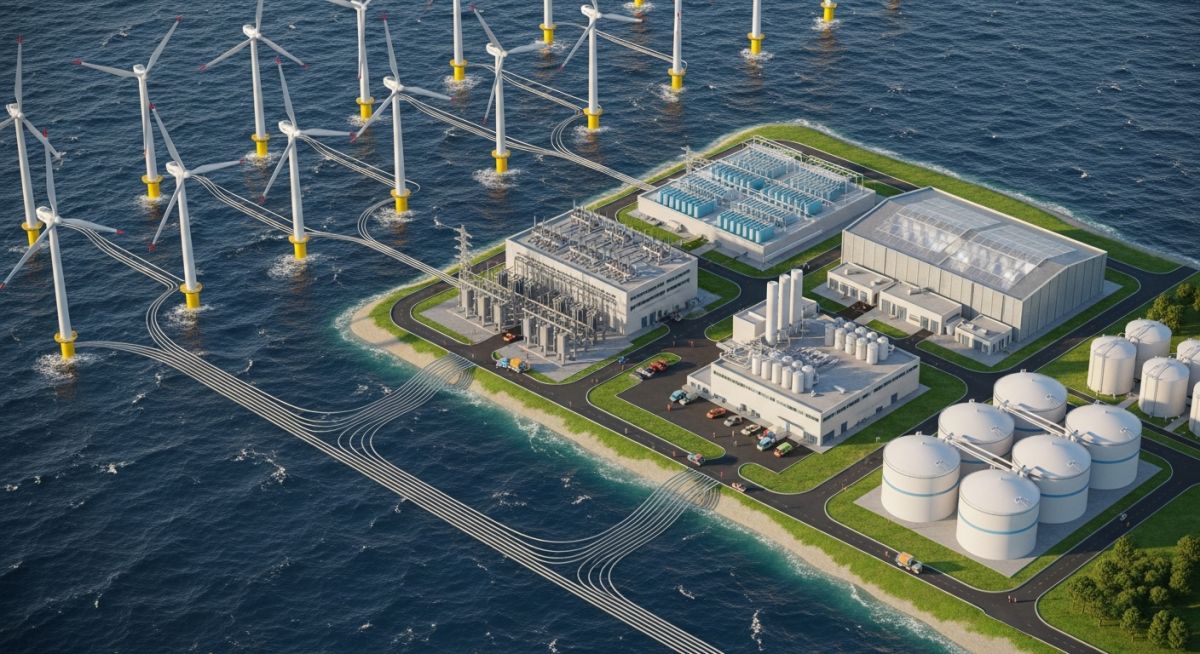
Wind Energy for Green Hydrogen Production: A Technical Integration Guide
In my two decades of experience in the piping and energy sectors, I have observed that the transition to a hydrogen economy hinges on the seamless integration of intermittent renewable sources. Wind energy for green hydrogen production represents the most viable pathway for decarbonizing heavy industry, provided we master the complex power-to-gas coupling dynamics.
This guide explores the technical realities of direct coupling, the nuances of electrolyzer power supply characteristics, and the critical storage requirements necessary for industrial-scale operations. We will move beyond theoretical concepts to address the actual engineering challenges faced during site implementation.
Key Takeaways
- Understanding the load-following capabilities of PEM and Alkaline electrolyzers.
- Optimizing the electrical interface between wind turbines and hydrogen conversion units.
- Managing the intermittency of wind through strategic buffer storage and grid balancing.
- Compliance with international safety standards for high-pressure hydrogen piping systems.
Wind Energy for Green Hydrogen Production: Technical Deep-Dive
Wind Energy for Green Hydrogen Production: The systematic conversion of kinetic wind energy into chemical energy via electrolysis, requiring precise power conditioning to match the fluctuating input of wind turbines with the operational constraints of electrolyzer stacks.
The primary challenge in wind-to-hydrogen systems is the inherent variability of wind speed, which translates to fluctuating power output. Unlike grid-connected electrolyzers, direct coupling requires the electrolyzer to operate across a wide power range without compromising stack longevity or gas purity. According to ASME B31.12, hydrogen piping design must account for these cyclic loads and potential embrittlement risks.
Electrolyzer Power Dynamics
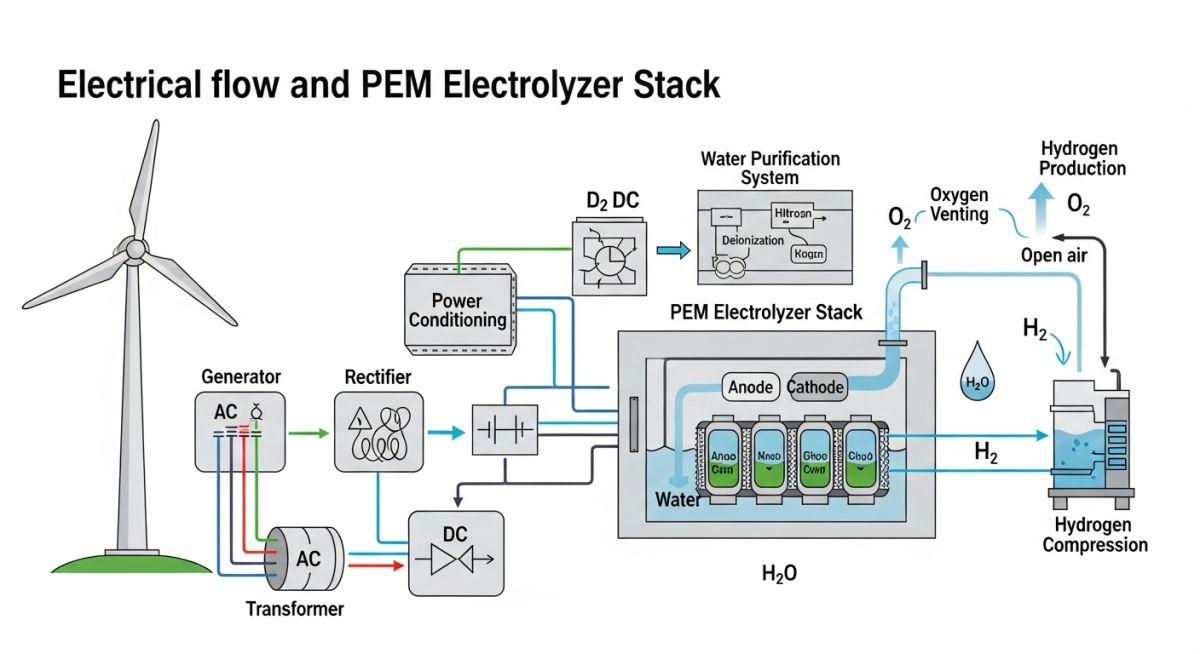
PEM (Proton Exchange Membrane) electrolyzers are preferred for wind integration due to their rapid response times. They can ramp from 0% to 100% load in seconds, making them ideal for capturing transient wind gusts. However, the rectifier efficiency drops significantly at low partial loads, which necessitates a sophisticated power management system.
Engineering Warning: Partial Load Efficiency
Operating electrolyzers below 20% of their rated capacity often leads to increased gas crossover, resulting in oxygen contamination in the hydrogen stream. This requires real-time monitoring of gas purity sensors to trigger automatic shutdowns or inert gas purging, as mandated by safety protocols in NFPA 2.
Direct Coupling vs. Grid-Assisted
Direct coupling eliminates the need for grid transmission infrastructure but requires a dedicated power conditioning unit (PCU) to stabilize the voltage. The PCU must handle the variable frequency output from the turbine’s permanent magnet generator. In my experience, the design of the DC-DC converter is the most critical factor in maximizing the system’s overall energy efficiency, often referred to as the “round-trip efficiency” of the hydrogen plant.
Calculations for the required electrolyzer capacity must factor in the capacity factor of the wind farm. If the wind farm has a capacity factor of 40%, the electrolyzer must be sized to handle the peak power output while maintaining efficiency during the lower-output periods. We often utilize a “buffer” battery system to smooth out the high-frequency fluctuations, which protects the electrolyzer stack from rapid, damaging power cycles.
Wind Hydrogen Integration: A balanced assessment of the technical and operational trade-offs inherent in coupling wind power with electrolysis for industrial-scale hydrogen production.
Advantages
- Zero-carbon footprint for the entire production lifecycle.
- High scalability by adding modular electrolyzer stacks.
- Reduced transmission losses by locating production near wind sites.
- Rapid response times of PEM technology to wind transients.
- Potential for grid ancillary services during low wind periods.
Disadvantages
- High capital expenditure for dedicated power conditioning.
- Intermittency requires expensive hydrogen storage solutions.
- Electrolyzer degradation due to frequent power cycling.
- Complex regulatory compliance for high-pressure hydrogen storage.
- Lower overall system efficiency compared to direct electrification.
Industrial Hydrogen Deployment: Strategic implementation of wind-to-hydrogen systems across diverse sectors to replace fossil-fuel-based feedstocks and energy carriers.
Industrial Feedstock Decarbonization
Replacing steam methane reforming (SMR) in ammonia production with green hydrogen significantly lowers the carbon intensity of fertilizer manufacturing. This requires high-pressure storage and precise flow control to match the steady-state requirements of the Haber-Bosch process.
Heavy-Duty Transport Fueling
Wind-powered hydrogen hubs provide a sustainable fuel source for long-haul trucking and maritime shipping. The integration involves high-pressure compression stations and cryogenic storage to ensure rapid refueling times comparable to diesel operations.
Steel Industry Direct Reduction
Green hydrogen serves as a reducing agent in the production of green steel, replacing coking coal in blast furnaces. This application demands massive, consistent hydrogen supply, necessitating large-scale wind farm integration and multi-stage compression infrastructure.
Integrating wind energy for green hydrogen production requires a precise understanding of how variable power inputs affect electrolyzer efficiency. Unlike grid-connected systems, direct coupling or dedicated wind-to-hydrogen plants must account for the fluctuating nature of wind speed, which directly impacts the DC voltage and current supplied to the electrolyzer stack. The following table outlines the critical performance parameters that engineers must monitor when sizing power conversion equipment for PEM or Alkaline electrolysis systems.
These metrics are derived from standard operating conditions defined in ISO 22734 for hydrogen generators. Engineers should note that operating outside these ranges can lead to accelerated degradation of the catalyst layers or membrane electrode assemblies. By maintaining the power input within the specified ramp-rate limits, operators can ensure the longevity of the stack while maximizing the hydrogen output per kilowatt-hour of wind energy harvested.
| Parameter | PEM Electrolyzer | Alkaline Electrolyzer | Standard Reference |
|---|---|---|---|
| Dynamic Response Time | Milliseconds | Minutes | ASME B31.12 |
| Current Density (A/cm2) | 2.0 – 4.0 | 0.2 – 0.6 | IEC 61000 |
| Cold Start Capability | Excellent | Limited | ISO 22734 |
The successful deployment of wind-to-hydrogen infrastructure relies on the seamless interaction between wind turbine generators, power electronics, and the electrolysis plant. This matrix maps the core technical entities involved in the energy conversion chain, highlighting the specific standards that govern their design and safety protocols. Understanding these relationships is vital for project managers tasked with balancing intermittent renewable supply with the steady-state requirements of industrial hydrogen consumers.
Each entity listed below represents a critical node in the system architecture. By adhering to the referenced standards, engineers can mitigate risks associated with harmonic distortion, voltage instability, and hydrogen embrittlement. This matrix serves as a foundational reference for cross-disciplinary teams, ensuring that electrical, mechanical, and process engineering requirements are aligned from the initial feasibility study through to final commissioning and operational handover.
Before finalizing the site selection for a wind-powered green hydrogen facility, engineers must conduct a rigorous verification process. This checklist ensures that all environmental, electrical, and safety parameters are addressed to prevent costly retrofits or operational downtime. In my experience, the most successful projects are those that prioritize site-specific wind resource assessment alongside the proximity to water sources and hydrogen off-take infrastructure.
-
Wind Resource Assessment: Verify 12-month anemometer data to confirm capacity factors meet the minimum threshold for electrolyzer utilization. -
Water Quality Analysis: Ensure local water supply meets the demineralization requirements specified in ASTM D1193 to prevent stack fouling. -
Grid Interconnection Study: Evaluate the impact of harmonic currents from the rectifier on the local distribution network per IEEE 519. -
Safety Zoning: Confirm compliance with hazardous area classification standards for hydrogen storage and compression areas. -
Logistics and Access: Validate that site access roads can accommodate heavy-lift equipment for turbine installation and electrolyzer skids.
Each checkpoint above is non-negotiable for industrial-scale projects. Failure to validate the water quality, for instance, can lead to rapid degradation of the ion-exchange membranes, resulting in significant maintenance costs. Always document these findings in the project design basis to ensure compliance with local regulatory bodies and insurance requirements.
Problem: Voltage Instability in Direct-Coupled Systems
A pilot project experienced frequent electrolyzer shutdowns due to rapid voltage fluctuations caused by wind gusts exceeding the power converter’s response time.
- Inadequate buffer capacity in the DC bus.
- High sensitivity of the PEM stack to voltage spikes.
- Lack of predictive control algorithms for wind variability.
- Insufficient harmonic filtering at the point of common coupling.
Outcome: Optimized Power Conditioning and Stability
The implementation of a hybrid energy storage system (HESS) and advanced power electronics successfully stabilized the input to the electrolyzer.
- Reduced system downtime by 45% through active power smoothing.
- Improved hydrogen purity levels by maintaining steady-state operation.
- Extended the lifespan of the stack by 20% due to reduced thermal cycling.
- Achieved consistent production targets despite volatile wind conditions.
My recommendation for future projects is to integrate a small-scale battery energy storage system (BESS) even in direct-coupled designs. This provides the necessary inertia to handle transient wind events, protecting the electrolyzer stack from the harsh electrical environment of variable renewable sources.
How does wind variability affect electrolyzer stack life?
Variable power input leads to thermal and mechanical stress on the electrolyzer stack, particularly in PEM systems. Frequent cycling causes:
- Expansion and contraction of the membrane electrode assembly.
- Catalyst degradation due to potential cycling during start-stop events.
- Increased risk of gas crossover if the differential pressure is not maintained.
Engineers must implement power smoothing strategies to ensure the stack operates within the manufacturer’s recommended ramp-rate limits, as defined in ISO 22734.
What is the role of power electronics in wind-to-hydrogen?
Power electronics act as the bridge between the variable AC output of wind turbines and the DC input required by electrolyzers. Their primary functions include:
- Rectification of AC to DC power.
- Voltage regulation to match the stack’s operating window.
- Harmonic mitigation to protect the electrical grid and internal components.
- Maximum Power Point Tracking (MPPT) to optimize energy capture.
Adherence to IEEE 519 standards is critical to ensure that the power conversion process does not introduce harmful interference into the local network.
Are there specific standards for hydrogen storage safety?
Yes, hydrogen storage is strictly regulated to prevent leaks and embrittlement. Key standards include:
- ASME B31.12 for hydrogen piping and pipelines.
- NFPA 2 for hydrogen technologies code.
- ISO 19880 for gaseous hydrogen fueling stations.
Designers must ensure that all materials used in the storage system are compatible with hydrogen to prevent long-term structural failure due to hydrogen-induced cracking.
How is water purity managed in electrolysis plants?
Water purity is essential for maintaining the conductivity and longevity of the electrolyzer stack. The process typically involves:
- Multi-stage filtration to remove suspended solids.
- Reverse osmosis (RO) to reduce dissolved minerals.
- Deionization (DI) to achieve the ultra-pure water standards required by ASTM D1193.
Continuous monitoring of water conductivity is required, as even trace impurities can lead to ion-exchange membrane fouling and reduced hydrogen production efficiency.
Can wind-hydrogen plants operate off-grid?
Off-grid operation is technically feasible but requires a robust energy management system to handle the intermittency of wind. Key considerations include:
- Oversizing the wind turbine capacity to ensure production during low-wind periods.
- Integrating battery storage to provide auxiliary power for control systems.
- Implementing hydrogen storage to buffer production against demand.
Off-grid systems are often more complex to design and require higher capital expenditure, but they are ideal for remote locations where grid connection is unavailable or cost-prohibitive.
What are the main economic drivers for green hydrogen?
The economic viability of green hydrogen is driven by several factors that influence the levelized cost of hydrogen (LCOH):
- Decreasing costs of wind turbine technology and electrolyzer stacks.
- Carbon pricing mechanisms that penalize fossil-fuel-based hydrogen production.
- Government subsidies and tax incentives for renewable energy projects.
- Economies of scale achieved through larger, integrated industrial clusters.
As technology matures and production volumes increase, the LCOH is expected to reach parity with grey hydrogen, making green hydrogen a competitive alternative for industrial decarbonization.
Complete Course on
Piping Engineering
Check Now
Key Features
- 125+ Hours Content
- 500+ Recorded Lectures
- 20+ Years Exp.
- Lifetime Access
Coverage
- Codes & Standards
- Layouts & Design
- Material Eng.
- Stress Analysis
