
Wind Farm O&M: Strategies for Maximum Turbine Availability
In my two decades of managing complex industrial assets, I have learned that the profitability of a wind farm is not determined by its nameplate capacity, but by its operational uptime. Effective Wind Farm O&M is the backbone of renewable energy viability, transforming reactive repairs into a streamlined, data-driven lifecycle management process.
When we look at the harsh environments where these turbines operate—often offshore or in remote high-wind corridors—the mechanical stress on gearboxes, blades, and pitch systems is immense. This guide explores how we move beyond traditional maintenance to implement advanced condition monitoring that catches failures before they cascade into catastrophic downtime.
Key Takeaways for Asset Managers:
- Transitioning from time-based to condition-based maintenance cycles.
- Leveraging vibration analysis to detect early-stage bearing degradation.
- Optimizing spare parts inventory through predictive failure modeling.
- Reducing Levelized Cost of Energy (LCOE) via proactive structural health monitoring.
Technical Deep-Dive: Wind Farm O&M Engineering
Wind Farm O&M Engineering: The integration of mechanical, electrical, and data-driven diagnostic frameworks to maintain turbine performance within the design limits specified by ASME and IEC standards.
The engineering challenge of maintaining wind turbines lies in the dynamic loading conditions. We must account for fatigue cycles on the main shaft and the thermal degradation of lubricants within the gearbox. In my experience, the most successful O&M programs utilize a hierarchical approach to maintenance, starting with routine inspections and escalating to advanced condition monitoring systems (CMS).
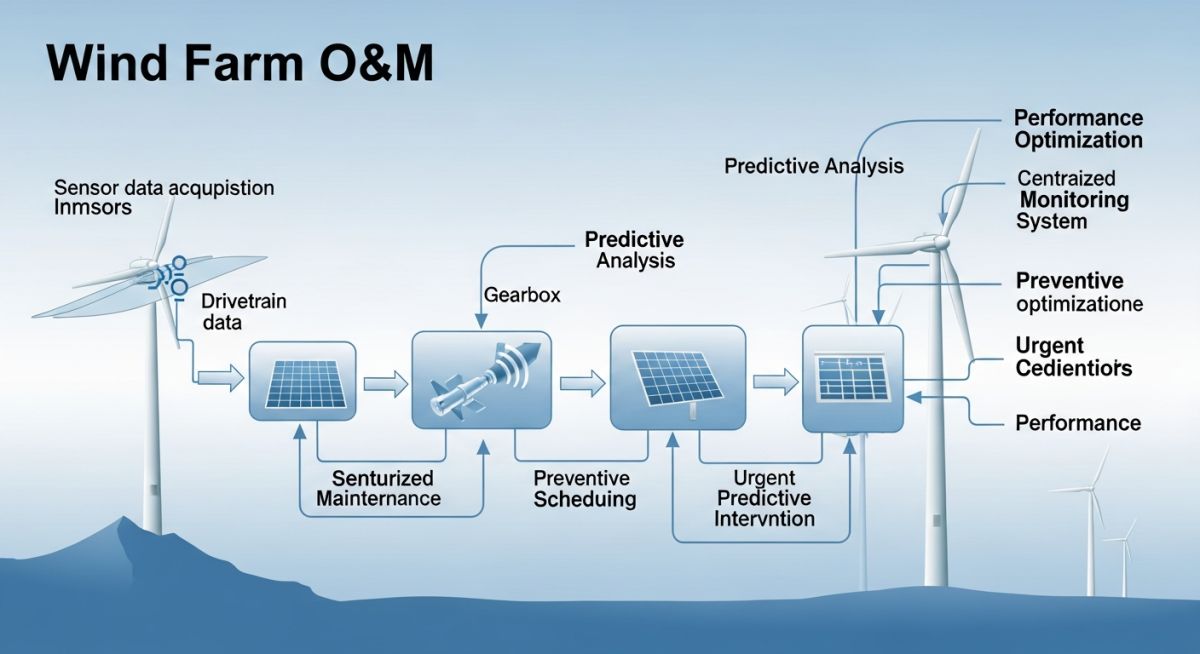
Predictive Maintenance and CMS Integration
Condition Monitoring Systems (CMS) are no longer optional; they are the primary defense against unplanned outages. By installing high-frequency accelerometers on the gearbox housing and main bearings, we can capture vibration signatures that deviate from the baseline. The standard for this analysis is often governed by ISO 10816, which provides guidance on evaluating machine vibration.
Field Warning: Data Overload
A common pitfall is the collection of excessive raw data without a clear diagnostic algorithm. I have seen teams drown in terabytes of vibration data while missing a simple lubrication failure. Focus your CMS on specific failure modes: gear tooth pitting, bearing spalling, and generator winding insulation breakdown.
Structural Stress and Fatigue Calculations
When evaluating the structural health of the tower and foundation, we utilize the Palmgren-Miner linear damage hypothesis. The cumulative fatigue damage (D) is calculated as the sum of the ratios of the number of cycles at a specific stress range (ni) to the number of cycles to failure at that same stress range (Ni). If D approaches 1.0, the component is nearing its design life limit.
For the drivetrain, we monitor the torque ripple. Excessive torque ripple, often caused by grid fluctuations or wind shear, accelerates the wear on the planetary gear stages. We mitigate this by adjusting the pitch control logic to dampen the aerodynamic input during high-turbulence events, effectively extending the Mean Time Between Failures (MTBF).
Operational Maintenance Trade-offs: A comparative analysis of proactive versus reactive maintenance strategies in large-scale wind energy infrastructure.
Advantages
- Extended asset lifespan through early detection of mechanical fatigue.
- Significant reduction in emergency repair costs and logistics.
- Improved safety by minimizing high-risk manual inspections.
- Optimized energy production through higher availability factors.
- Better alignment with insurance and warranty compliance requirements.
Disadvantages
- High initial capital expenditure for sensor and software deployment.
- Requirement for specialized personnel to interpret complex diagnostic data.
- Potential for false positives leading to unnecessary maintenance interventions.
- Complexity in integrating legacy turbine control systems with modern CMS.
- Data security risks associated with remote monitoring and cloud connectivity.
Industry-Specific O&M Deployments: Strategic implementation of maintenance protocols across diverse wind energy environments and operational scales.
Offshore Wind Farm Reliability
Offshore environments demand extreme reliability due to the high cost of vessel mobilization for repairs. We implement redundant sensor arrays and automated lubrication systems to minimize the need for human intervention in harsh marine conditions.
Remote Onshore Grid Stability
In remote, grid-constrained locations, O&M focuses on power electronics and pitch system synchronization. By monitoring the converter thermal profile, we prevent premature failure of IGBT modules, ensuring the turbine remains a stable contributor to the local grid.
Aging Fleet Life Extension
For turbines approaching their 20-year design life, O&M shifts to structural health monitoring of the tower and blade root connections. We use strain gauge data to validate that the remaining fatigue life is sufficient for continued operation, often allowing for a 5-10 year life extension.
In my two decades of field experience, I have observed that the transition from reactive to proactive maintenance is the single most significant factor in reducing the Levelized Cost of Energy (LCOE). The following table outlines the standard maintenance intervals for critical wind turbine components, aligned with IEC 61400-25 standards for monitoring and control. These intervals are not merely suggestions; they represent the minimum threshold required to maintain original equipment manufacturer (OEM) warranty compliance and ensure structural integrity under cyclic loading conditions.
When reviewing these intervals, consider the specific environmental stressors of your site, such as high-salinity coastal air or extreme desert temperature fluctuations. These factors often necessitate a reduction in the time between inspections to prevent premature degradation of lubrication systems and pitch bearing seals. Always cross-reference these intervals with your specific turbine model’s technical manual, as newer direct-drive architectures may have significantly different requirements compared to traditional gearbox-driven units.
| Component | Maintenance Action | Standard Interval |
|---|---|---|
| Gearbox Oil | Spectroscopic Analysis | Every 6 Months |
| Blade Leading Edge | Visual/Drone Inspection | Annual |
| Yaw System | Torque Verification | Every 12 Months |
| Main Bearing | Vibration Analysis | Continuous/Monthly |
Effective asset management requires a clear understanding of the interconnected systems that define wind farm performance. This matrix maps the primary technical entities involved in O&M, linking physical hardware to the digital monitoring protocols that govern their operational health. By standardizing these definitions, engineering teams can ensure that data collected from the field is actionable and consistent across the entire fleet.
The integration of these entities into a centralized SCADA (Supervisory Control and Data Acquisition) system is essential for modern predictive maintenance. When we map these components against their respective failure modes, we can prioritize maintenance resources toward the assets that pose the highest risk to availability. This systematic approach allows for the optimization of spare parts inventory, ensuring that critical components are available before a failure occurs, thereby minimizing downtime and maximizing energy capture.
| Entity | Acronym | Standard Reference |
|---|---|---|
| Condition Monitoring System | CMS | ISO 13373 |
| Supervisory Control and Data Acquisition | SCADA | IEC 61400-25 |
| Mean Time Between Failures | MTBF | Internal KPI |
Site Verification Protocol: Before initiating any major maintenance campaign, I mandate a rigorous site verification process to ensure safety and operational readiness. This checklist serves as the final gatekeeper for field technicians, ensuring that all environmental, mechanical, and safety parameters are accounted for before the turbine is locked out and tagged out (LOTO).
- Safety Clearance: Verify LOTO procedures are documented and verified by two independent technicians per OSHA 1910.147.
- Environmental Check: Confirm wind speeds are below the maximum threshold for safe nacelle access (typically 12-15 m/s).
- Tool Calibration: Ensure all torque wrenches and diagnostic sensors have valid calibration certificates within the last 12 months.
- Data Backup: Perform a full dump of the turbine SCADA logs to the central server to preserve pre-maintenance performance data.
- Spare Parts Audit: Confirm that all required consumables (lubricants, filters, seals) are on-site and match the specific turbine serial number.
Following this checklist is non-negotiable. In my experience, the majority of “unexpected” maintenance delays are caused by missing a simple pre-check item, such as an uncalibrated tool or an incomplete safety permit. By standardizing this verification, we reduce the risk of human error and ensure that every maintenance hour spent on the turbine is productive and safe.
Problem: Recurring Gearbox Bearing Failure
A 50MW wind farm experienced premature gearbox bearing failures across 15% of its fleet within the first three years of operation.
- Inadequate lubrication intervals during high-wind seasons.
- Vibration data was being collected but not analyzed for trend deviations.
- OEM maintenance manual did not account for site-specific turbulence intensity.
- Lack of real-time oil particle monitoring.
Outcome: Predictive Maintenance Implementation
By shifting to a condition-based monitoring strategy, the site achieved a 40% reduction in unscheduled downtime over the following 24 months.
- Installed real-time oil debris sensors on all gearboxes.
- Automated vibration threshold alerts integrated into the SCADA system.
- Adjusted lubrication schedules based on actual load data rather than calendar time.
- Reduced major component replacement costs by 25% through early detection.
My recommendation for similar sites is to prioritize the installation of high-fidelity sensors on the drivetrain. The cost of these sensors is negligible compared to the expense of a full gearbox replacement, and the data they provide is the foundation of a truly predictive O&M strategy.
Frequently Asked Engineering Questions
How does vibration analysis detect bearing failure?
- Early stage: Increased energy in the high-frequency bands.
- Mid stage: Appearance of bearing defect frequencies (BPFO/BPFI).
- Late stage: Increased overall vibration levels and temperature spikes.
By utilizing ISO 10816 standards, we can quantify these deviations and schedule maintenance before catastrophic failure occurs.
What is the role of SCADA in predictive maintenance?
- Real-time monitoring of power curves and temperature gradients.
- Automated alarm generation based on pre-set threshold violations.
- Data logging for long-term trend analysis and reliability engineering.
Without a robust SCADA implementation, predictive maintenance is impossible because you lack the historical data required to train machine learning models or establish accurate performance baselines.
Why is oil analysis critical for gearbox health?
- Detection of metallic wear particles (iron, copper, aluminum).
- Monitoring of lubricant viscosity and additive depletion.
- Identification of water contamination or oxidation products.
This data allows us to intervene before the wear particles cause secondary damage to the gear teeth or bearings, significantly extending the service life of the gearbox.
How do I optimize spare parts inventory?
- Class A: High criticality, long lead time (e.g., main bearings, gearboxes). Keep on-site or in regional hubs.
- Class B: Medium criticality, moderate lead time (e.g., pitch actuators, sensors). Maintain minimum stock levels.
- Class C: Low criticality, short lead time (e.g., filters, seals). Use Just-In-Time (JIT) procurement.
By using historical failure data, you can refine these levels to ensure you are not over-investing in parts that rarely fail while ensuring you are never caught without a critical component.
What are the best practices for blade maintenance?
- Use drone-based high-resolution photography for annual inspections.
- Apply protective leading-edge tapes or coatings before erosion reaches the structural laminate.
- Monitor lightning protection system (LPS) continuity to prevent strike damage.
Addressing minor surface damage early prevents moisture ingress, which can lead to delamination and catastrophic structural failure over time.
How does site environment affect O&M strategy?
- Coastal: Focus on corrosion protection and salt-resistant sealants.
- Desert: Focus on cooling system efficiency and sand-filtration maintenance.
- High-Turbulence: Focus on structural bolt torque checks and drivetrain fatigue monitoring.
Always tailor your maintenance intervals and component selection to the specific environmental stressors of your site to ensure long-term asset reliability.
Complete Course on
Piping Engineering
Check Now
Key Features
- 125+ Hours Content
- 500+ Recorded Lectures
- 20+ Years Exp.
- Lifetime Access
Coverage
- Codes & Standards
- Layouts & Design
- Material Eng.
- Stress Analysis

📚 Recommended Resources: Wind Farm O&M
Read these Guides
- 📄 Onshore Wind Farms: Engineering Design, Components, and Site Selection Criteria
- 📄 Solar Power Plants O&M: Essential Strategies for Peak Performance
- 📄 Green Hydrogen and Green Ammonia Energy Carriers: The Engineering Guide (2026)
- 📄 API Standards: The Complete 2026 Engineering Guide (API 610, 650 & 570