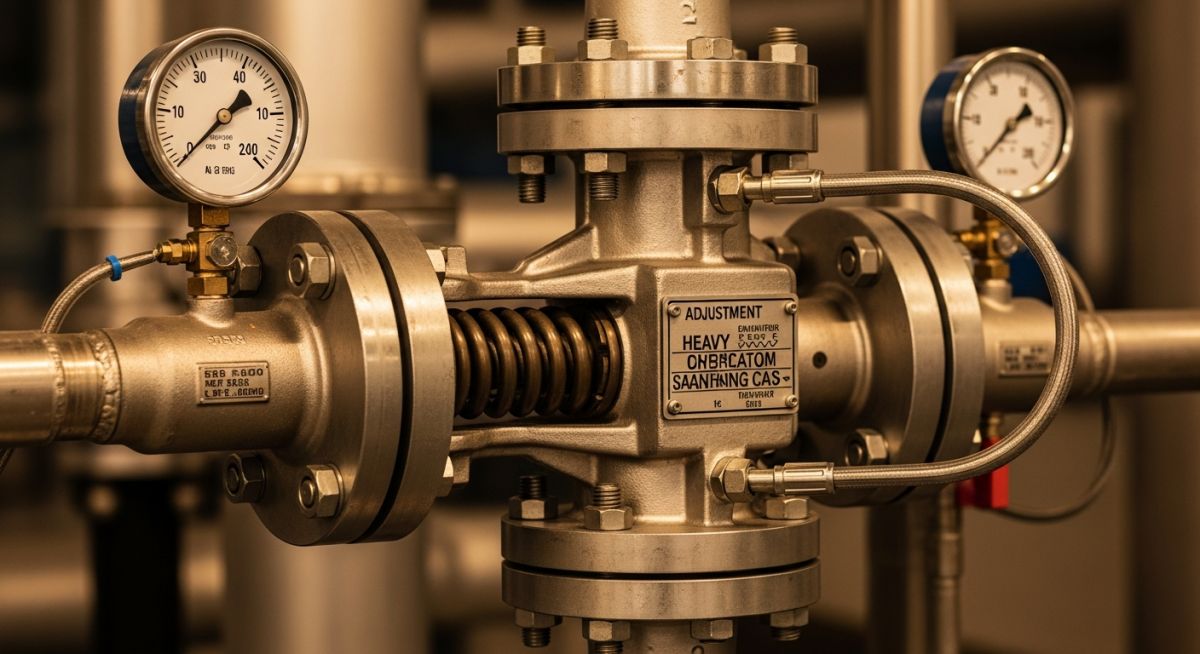
What is Pressure Reducing Valve? Its Types, Applications, and Advantages
I have seen many pressure problems on site blamed on pumps, boilers, compressors, or operators, while the real issue was sitting quietly in the line: a badly selected or badly installed Pressure Reducing Valve. When this valve works well, nobody notices it. When it fails, downstream gauges start jumping, steam traps suffer, instruments trip, safety valves lift, and production teams start chasing ghosts.
In my experience, a Pressure Reducing Valve, or PRV, is not just a small item in a piping material take-off. It is a pressure control device that takes higher inlet pressure and maintains a lower, controlled outlet pressure. But here is the catch, the valve does not magically “cut pressure” once and forget the job. It keeps modulating as flow demand, inlet pressure, and downstream consumption change.
In the field, I treat every PRV station as a small control system. The valve, upstream strainer, pressure gauges, isolation valves, bypass line, drain, downstream safety valve, pipe supports, and commissioning procedure all decide whether the outlet pressure remains steady or turns into a maintenance headache.
Key Takeaways on Pressure Reducing Valve
- A Pressure Reducing Valve controls downstream pressure. It reduces high inlet pressure to a lower set outlet pressure for safe and stable operation.
- Direct-acting PRVs are simple and fast. I prefer them for smaller loads, stable flow, instrument air branches, water lines, and compact utility services.
- Pilot-operated PRVs handle larger and changing loads better. I use them where tighter pressure control is needed in steam, gas, water, and process utility systems.
- A PRV is not a pressure relief valve. A PRV controls normal downstream pressure, while a relief valve protects equipment against overpressure.
- Most PRV failures are not valve failures. Wrong sizing, debris, wet steam, bypass leakage, missing gauges, and poor commissioning create many of the problems I see on site.
Featured Snippet: Pressure Reducing Valve Definition
A Pressure Reducing Valve is an automatic control valve that reduces higher upstream pressure to a stable, lower downstream pressure. It adjusts its opening based on outlet pressure demand, protecting downstream piping, instruments, equipment, and users from excessive pressure during normal operating conditions.
Field Check
3-Question Pressure Reducing Valve Quiz
I use these three questions when I want to know whether an engineer understands a pressure reducing station or is only repeating catalogue language. Select one answer in each slide. The correct option turns green, the wrong selection turns red, and the field note opens below the options.
1. What is the main job of a Pressure Reducing Valve?
Functions of Pressure Reducing Valve
In my experience, the first mistake people make is thinking that a Pressure Reducing Valve only “drops pressure”. That statement is too weak for real piping work. A PRV continuously throttles the flow path so that the downstream pressure stays near the set pressure while inlet pressure and downstream demand keep changing.
When I review a PRV station on a P&ID, I do not see a single valve. I see a small pressure-control assembly. The upstream pressure gauge tells me what energy is available. The strainer tells me whether dirt will destroy the seat. The downstream pressure gauge tells me whether the valve is controlling or hunting. The bypass line tells me whether operations can accidentally defeat the complete philosophy.
Field Warning
I never accept a PRV station without upstream and downstream pressure indication. Without gauges, the technician is almost blind. If downstream pressure is high, nobody can quickly separate a passing PRV, leaking bypass valve, wrong set pressure, blocked sensing line, oversized valve, or backpressure from another connected header.
What a Pressure Reducing Valve Actually Does
- Maintains lower downstream pressure: I use a PRV when downstream equipment, instruments, coils, hoses, or utility branches cannot safely or efficiently work at full upstream pressure.
- Absorbs upstream pressure fluctuation: If the inlet pressure moves within the valve’s operating range, the PRV modulates to keep outlet pressure controlled.
- Improves process stability: Steam heaters, pneumatic tools, atomising air systems, water distribution zones, and fuel gas users behave better when pressure does not swing.
- Reduces leakage and mechanical stress: High pressure across glands, threaded joints, hose connections, instrument tubing and small-bore branches increases leakage risk.
- Creates pressure zoning: I often split large water, air, gas, or steam networks into pressure zones so that every consumer receives only the pressure it needs.
But here is the catch, a Pressure Reducing Valve controls normal operating pressure. It is not the same as overpressure protection. If the downstream side can be exposed to pressure above its design limit due to PRV failure, bypass leakage, thermal expansion, fire case, blocked outlet, or backflow from another source, I still review a dedicated protection device.
Types of Pressure Reducing Valve
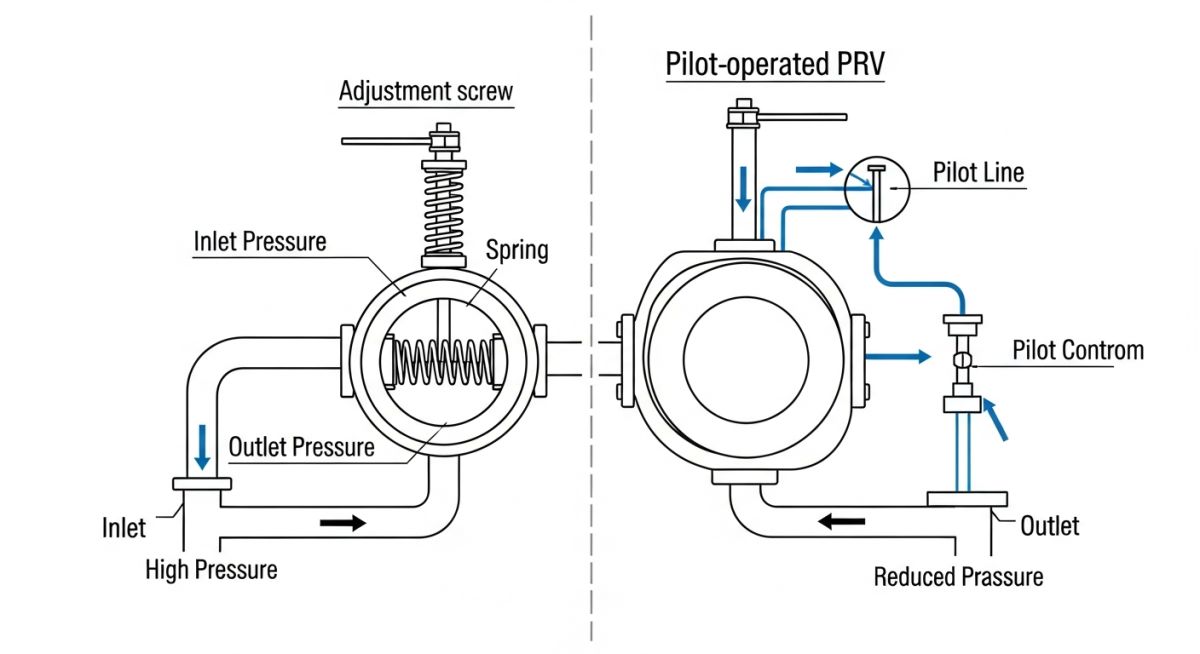
In normal piping discussions, I divide a Pressure Reducing Valve into two broad types: direct-acting pressure reducing valve and pilot-operated pressure reducing valve. Both reduce pressure, but they behave very differently when flow demand changes.
A direct-acting PRV is simpler. It uses the downstream pressure acting against a spring-loaded diaphragm, bellows, or piston to move the valve plug. A pilot-operated PRV uses a smaller pilot valve to control the loading pressure on a larger main valve. In the field, this difference decides stability, capacity, droop, maintenance effort, and cost.
Direct-acting PRV
- Simple construction
- Fast mechanical response
- Good for smaller and steadier loads
- Lower cost in many small services
- More visible droop under rising flow
Pilot-operated PRV
- Better pressure accuracy
- Handles larger flow variation
- Good for steam headers and main utility lines
- More parts and more commissioning care
- Usually higher purchase and maintenance cost
Direct-acting Pressure Reducing Valve
A direct-acting pressure reducing valve is the valve I prefer when the duty is small, the flow is not wildly changing, and the user needs a rugged, compact, self-contained pressure regulator. It does not need instrument air, electrical power, controller tuning, or an external actuator package.
The downstream pressure acts directly on a diaphragm, bellows, or piston. The spring pushes in one direction and the outlet pressure pushes in the opposite direction. When downstream pressure falls below the set pressure, the valve opens more. When downstream pressure rises above the set pressure, the valve throttles towards closed position.
My Field Rule for Direct-acting PRVs
I do not use a direct-acting PRV only because it is cheaper. I use it when the allowed downstream pressure variation is wide enough. If the process complains when pressure drops during high flow, I start checking whether a pilot-operated PRV is more suitable.
How a Direct-acting PRV Behaves
Direct-acting valves usually show more droop. Droop means the downstream pressure must fall below the set pressure to open the valve further and pass higher flow. On paper, this may look acceptable. In the plant, this can create complaints like “pressure is fine at no load but low during consumption”.
- Good services: instrument air take-offs, small nitrogen branches, small water lines, compact gas supply lines, local utility users, laboratory services, and low-to-medium flow duties.
- Weak services: large steam consumers, wide turndown headers, systems needing very tight pressure band, and services where pressure droop directly affects product quality.
- Maintenance concern: dirt on the seat can cause passing. I always insist on clean commissioning and a correctly installed strainer upstream.
Pilot-operated Pressure Reducing Valve
A pilot-operated pressure reducing valve is my preferred option when the plant needs higher capacity and tighter downstream pressure control. Instead of the main valve reacting directly with a large spring force, a smaller pilot valve senses downstream pressure and controls the main valve loading pressure.
This arrangement gives better sensitivity. A small change in downstream pressure is handled by the pilot, and the main valve moves with more authority. That is why I see pilot-operated PRVs on larger steam pressure reducing stations, gas distribution systems, large water systems, and process utility headers.
Field Warning
A pilot-operated PRV is not a fit-and-forget item. If the pilot line is blocked, impulse tapping is placed badly, upstream strainer is ignored, condensate enters the pilot, or the valve is oversized, the station can hunt, chatter, pass, or fail to open properly.
Where I Prefer Pilot-operated PRVs
- Steam pressure reducing stations: especially where the load changes between warm-up, partial production, and peak production.
- Fuel gas and natural gas let-down: where downstream equipment needs stable pressure and flow can vary.
- Large water distribution zones: where a single small direct-acting valve would create poor control or high noise.
- Compressed air headers: where wide demand swings make direct-acting control unstable or too droopy.
In the field, we do this differently: I check the minimum controllable flow, normal flow, peak flow, inlet pressure range, outlet set pressure, downstream design pressure, fail-open or fail-closed concern, noise, velocity, and whether a downstream relief valve is needed. Selecting a PRV only by line size is a shortcut that often creates expensive site problems.
Applications of Pressure Reducing Valve
I have seen Pressure Reducing Valve installations in almost every utility and process area: steam, water, compressed air, nitrogen, fuel gas, hydraulic oil, fire water auxiliaries, HVAC, building services, and small instrument panels. The service changes, but the field questions remain similar: what pressure is available, what pressure is needed, what happens if the valve fails, and who can safely adjust it?
Steam systems
I use PRVs to reduce boiler or main header pressure to lower process pressures for heat exchangers, jacketed vessels, tracing, unit heaters, and plant distribution branches.
Water systems
I use PRVs for building zones, high-rise floors, pump discharge let-down, process water branches, and equipment that cannot take full supply pressure.
Gas and air systems
I use PRVs on compressed air, nitrogen, natural gas, fuel gas, purge gas, and instrument air branches to keep downstream users inside their pressure band.
Hydraulic PRV Application
In hydraulic circuits, I use pressure reducing valves to limit pressure in one branch while the main system can still operate at a higher pressure. This is common when one actuator, brake, clamp, or motor shift circuit needs lower pressure than the main hydraulic supply.
Advantages of Pressure Reducing Valve
A correctly selected Pressure Reducing Valve gives more than pressure reduction. It improves operating behaviour, protects downstream components during normal operation, reduces leakage tendency, and helps operators run the plant with fewer pressure complaints.
- Stable downstream pressure: process users get a controlled pressure instead of full header pressure.
- Lower utility wastage: overpressure often causes steam leakage, air leakage, water hammer, noise, and poor control at user equipment.
- Better equipment life: seals, diaphragms, tubing, hoses, traps, gauges, and small-bore fittings face less mechanical stress.
- Safer operating envelope: operators are not forced to throttle manual valves to create artificial pressure drops.
- Cleaner pressure zoning: one high-pressure source can serve multiple lower-pressure users through separate PRV stations.
Field Warning
I do not allow operators to use a half-open gate valve as a “pressure reducing arrangement”. A throttled isolation valve can be noisy, unstable, erosive, and unsafe. It also gives no automatic correction when flow changes.
Pressure Reducing Valve Codes and Standards I Check
I do not treat the PRV catalogue as the complete design basis. The catalogue helps with model selection, but the project code, valve standard, test standard, pressure protection philosophy, material class, and line rating decide whether the installation is acceptable.
| Standard or code | Where I use it around a PRV | Field check |
|---|---|---|
| ASME B31.3 Process Piping | I use it for process piping design basis, materials, fabrication, assembly, examination, inspection, and testing around the PRV station. | I check whether downstream piping rating and pressure protection philosophy match the credible PRV failure case. |
| ASME B16.34 Valves | I use it when checking valve pressure-temperature rating, materials, marking, testing, and end connection suitability. | I confirm the selected PRV body rating is not lower than the connected piping class and service temperature requirement. |
| API 598 Valve Inspection and Testing | I use it when purchase specifications invoke valve inspection, examination, and pressure test requirements for industrial valves. | I review hydrotest, seat test, shell test, and inspection records before accepting the valve at site or warehouse. |
| API 520 Part I Pressure-Relieving Devices | I use it for sizing and selection basis of pressure-relieving devices where downstream overpressure protection is required. | I do not let anyone replace a relief valve with a PRV in the protection study. |
| ISO 4126-1 Safety Valves | I refer to it for general safety valve product requirements when a safety valve is part of the downstream protection arrangement. | I separate pressure control duty from excessive-pressure protection duty during design review. |
| IEC 60534-1 Industrial-process Control Valves | I use the IEC 60534 family when the PRV package behaves more like a control valve package and control-valve terminology, sizing, testing, or performance language is needed. | I check whether the vendor data uses control valve terms correctly, especially flow coefficient, rangeability, noise, and test scope. |
My PRV Review Checklist Before Issue for Construction
- I verify inlet pressure range, outlet set pressure, minimum flow, normal flow, and peak flow.
- I check that the PRV size is selected by capacity and controllability, not by line size alone.
- I confirm upstream strainer, pressure gauges, isolation valves, bypass arrangement, and drain or trap provisions.
- I check whether downstream safety valve or relief valve is required for PRV failed-open or bypass-open case.
- I review noise, cavitation, flashing, wet steam, dirt, water hammer, pipe support, and commissioning flushing requirements.
Pressure Reducing Valve Sizing Calculator
I use this quick calculator as a first-pass field check for liquid service. It estimates the required Kv and Cv from flow rate, specific gravity, and pressure drop across the Pressure Reducing Valve. It is not a vendor sizing sheet. In the field, we do this differently: I use this number to catch obvious wrong selections before I send the datasheet to the valve manufacturer.
Field Warning Before Using This Calculator
Do not use this calculator for final sizing of steam, gas, flashing liquid, severe cavitation, slurry, two-phase service, or noise-limited service. For those cases, I ask the vendor for IEC 60534 or project-approved sizing with trim data, recovery factor, noise prediction, velocity check, and cavitation review.
Liquid Service Pre-check
PRV Kv and Cv Estimator
Required Kv
10.21
Based on Q × √(SG / ΔP)
Required Cv
11.80
Approximate conversion from Kv
Target rated Kv
13.61
For selected travel basis
Field Interpretation
- Pressure drop across PRV: 6.00 bar
- Pressure drop ratio: 54.5%
- Suggested rated Kv band: 12.76 to 17.01
- My field reading: High pressure drop. I would check noise, cavitation, staged reduction, and vendor trim limits before accepting this PRV.
What I Check After This Number
- Minimum controllable flow against valve turndown.
- Noise and vibration near the downstream spool.
- Cavitation, flashing, or two-stage pressure reduction need.
- Downstream relief valve for failed-open PRV or open bypass case.
- Vendor Cv curve, body rating, trim material, and leakage class.
Formula Used in This Calculator
For liquid service, I use:
Kv = Q × √(SG / ΔP)
Where Q is flow in m3/h, SG is liquid specific gravity, and ΔP is pressure drop in bar. Cv is displayed as an approximate conversion from Kv. For final selection, I still ask for manufacturer sizing based on project conditions and the applicable valve sizing standard.
Learn Piping Engineering the Field Way
Want to Read PRV Stations Like a Site Engineer?
I have seen engineers memorise valve names but struggle when a PRV station hunts, passes, chatters, lifts a downstream safety valve, or fails during commissioning. My piping engineering course is built around those real field decisions: P&IDs, line sizing, valve selection, pressure protection, piping layouts, material classes, isometrics, and site troubleshooting.
Course Focus
- Pressure control and PRV station review
- Piping design basis and line class thinking
- Valve, flange, fitting, and material selection
- Site checks that prevent commissioning pain
Field Case Study
Pressure Reducing Valve Failure I Caught Before It Became a Shutdown Problem
The Site Problem
I was reviewing a steam pressure reducing station during pre-commissioning. The station was meant to reduce steam from 10.5 barg to 3.5 barg for a process heating package. On paper, the Pressure Reducing Valve looked acceptable. The line size matched the P&ID, the valve tag matched the purchase order, and the bypass line was installed exactly where the drawing showed it.
But here is the catch, the downstream safety valve was missing from the installed spool. The construction team said the PRV itself would control the downstream pressure, so the package was safe. That is the kind of sentence that makes me stop the walkdown.
Raw Field Warning
I do not treat a Pressure Reducing Valve as overpressure protection. If the PRV fails open, if the bypass valve leaks, or if an operator cracks the bypass during start-up, the downstream line can see upstream pressure. A controlled pressure during normal running is not the same thing as protection against an abnormal pressure case.
What I Checked on the P&ID and Line List
- I checked the downstream piping class and found it was rated for the lower pressure service, not the full 10.5 barg upstream condition.
- I checked the bypass valve size and found it could pass enough steam to overpressure the downstream equipment if left open during start-up.
- I checked the PRV failure mode with the vendor data and did not accept it as a protection device.
- I checked the downstream equipment design pressure and found the heating package could not be exposed to the full upstream header pressure.
I then raised a design query. My note was simple: the pressure reducing station needed downstream overpressure protection unless the downstream piping and equipment were rated for the maximum credible upstream pressure. I linked the review basis to ASME B31.3 Process Piping for the piping design and pressure basis, and to API 520 Part I pressure-relieving device sizing and selection for the relief device review.
Pressure Reducing Valve FAQs
These are the questions I usually hear during design reviews, site walkdowns, commissioning, and troubleshooting calls. I have answered them in the same way I explain them to a piping engineer standing beside a noisy PRV station with two pressure gauges and an impatient operations team.
What is the main purpose of a Pressure Reducing Valve?
In my experience, the main purpose of a Pressure Reducing Valve is to take a higher and sometimes fluctuating upstream pressure and maintain a lower downstream pressure suitable for the user equipment.
I do not describe it as a one-time pressure drop device. It is a self-acting pressure control valve. When downstream demand changes, the valve opening changes. When upstream pressure moves within the working range, the valve still tries to hold the downstream set pressure. But here is the catch, the downstream system still needs its own design pressure review under the project piping code such as ASME B31.3 Process Piping.
What is the difference between direct-acting and pilot-operated Pressure Reducing Valve?
A direct-acting pressure reducing valve responds directly to downstream pressure through a diaphragm, bellows, or piston working against a spring. I use it for smaller duties, stable flow, compact installations, and places where some pressure droop is acceptable.
A pilot-operated pressure reducing valve uses a smaller pilot valve to control the main valve. I prefer it when flow changes widely and the downstream pressure band must stay tighter. Emerson notes that pilot-operated regulators give better accuracy and larger flow capability than direct-operated regulators in many demanding services, while direct-operated regulators are simpler and suitable for many lighter applications.
In the field, we do this differently: I do not select either type by valve size alone. I check minimum flow, normal flow, peak flow, inlet pressure range, outlet set pressure, turndown, noise, maintenance access, and downstream protection.
Why does downstream pressure increase above the PRV set pressure?
When I see downstream pressure rising above set pressure, I first suspect a passing valve seat, dirt trapped on the seat, damaged diaphragm or bellows, wrong sensing connection, blocked pilot path, or a leaking bypass valve. Swagelok troubleshooting guidance also points engineers towards identifying whether downstream pressure is rising beyond target pressure or falling below target pressure before selecting the repair path.
On steam service, I also check wet steam, missing separator, failed steam trap, wrong warm-up procedure, and condensate damage. A PRV seat can be blamed for a problem that actually started with bad upstream steam conditioning.
Field warning: If downstream pressure is high, I never touch the adjustment screw first. I check whether the bypass valve is passing. A leaking bypass can make a good PRV look faulty.
Can a Pressure Reducing Valve replace a pressure relief valve?
No. I do not accept a Pressure Reducing Valve as a normal replacement for a pressure relief valve. A PRV controls downstream pressure during normal operation. A relief valve protects equipment from excessive pressure when an abnormal case occurs.
If a PRV fails open, if the bypass valve is opened, or if the downstream side is exposed to upstream pressure through another route, the downstream piping and equipment may need a relief device or another approved protection method. For relief-device sizing and selection, I refer to API 520 Part I for pressure-relieving devices where applicable to the project scope.
But here is the catch, some engineered pressure-reducing arrangements may use special override pilots or approved protection logic in specific code contexts. I never assume that from a catalogue line. I ask for the project code basis, vendor documentation, and authority acceptance before signing the design.
What data do I need before selecting a Pressure Reducing Valve?
Before I select a Pressure Reducing Valve, I collect the actual process data. A valve datasheet without minimum, normal, and maximum flow is weak. A PRV selected only from line size is a site problem waiting for commissioning.
- Fluid: steam, water, gas, air, nitrogen, hydraulic oil, chemical, or mixed service.
- Pressure: minimum and maximum inlet pressure, required outlet pressure, and downstream design pressure.
- Flow: minimum, normal, maximum, start-up, warm-up, and upset flow where relevant.
- Temperature: operating, design, start-up, and possible low-temperature cases.
- Risk checks: noise, cavitation, flashing, wet steam, dirt, erosion, vibration, and relief requirement.
For valve sizing language and control-valve behaviour, I cross-check vendor data against recognised sizing practice such as IEC 60534 industrial-process control valve terminology when the project uses that basis.
What are the site installation checks for a Pressure Reducing Valve?
My site check starts with flow direction, pressure gauges, upstream strainer, isolation valves, bypass philosophy, drain or trap points, pipe supports, access for maintenance, and downstream relief protection. Armstrong installation guidance for a water PRV, for example, calls for a strainer before the PRV and pressure gauges before and after the PRV, which matches what I expect to see during a proper walkdown.
On steam, I also check separator location, steam trap discharge, warm-up bypass discipline, slope, condensate pockets, and whether the sensing line or pilot connection can flood. On gas, I check venting, leak path, regulator orientation, impulse line cleanliness, and lock-up pressure behaviour.
My field rule: If a PRV station has no upstream gauge, no downstream gauge, no strainer, and an unlocked bypass valve, I do not call it a complete pressure reducing station. I call it a future troubleshooting job.
Complete Course on
Piping Engineering
Check Now
Key Features
- 125+ Hours Content
- 500+ Recorded Lectures
- 20+ Years Exp.
- Lifetime Access
Coverage
- Codes & Standards
- Layouts & Design
- Material Eng.
- Stress Analysis
