
What is HAZOP Analysis? Mechanism, Advantages, and Applications
In my 20-plus years of executing piping layouts and process plant designs, I have stood in the crosshairs of complex commissioning phases where a single overlooked valve could mean catastrophic failure. I have learned that safety is not an afterthought; it is baked into the piping and instrumentation diagrams (P&IDs) from day one. That is where a Hazard and Operability study comes into play. It is the ultimate stress-test of our design intent on paper before we ever cut a single length of carbon steel or weld a flange.
When we gather a multidisciplinary team in a room for a study, we are not just looking for obvious design flaws. We are systematically hunting down the hidden, non-obvious deviations that occur when process variables drift. Whether you are dealing with high-pressure hydrocarbon lines or simple utility systems, understanding this methodology is your primary defense against loss of containment, equipment damage, and plant downtime.
- The exact step-by-step mechanism of selecting nodes and applying guide words.
- How to calculate risk rankings using severity and likelihood matrices.
- Real-world applications across chemical, oil and gas, and pharmaceutical facilities.
- The critical documentation required to satisfy regulatory safety audits.
How Does HAZOP Analysis Protect Industrial Plants?
The core mechanism of this methodology relies on a simple yet incredibly robust concept: the “design intent.” Every line, vessel, pump, and valve in a process plant is designed to operate under specific parameters. We define these parameters by temperature, pressure, flow rate, and chemical composition. A deviation occurs when the system drifts away from this design intent.
To make this process manageable, we break the entire plant down into small, logical sections called Nodes. A node might be a suction line from a storage tank to a transfer pump, or the overhead vapor line of a distillation column. Once a node is selected, the team applies a combination of Guide Words (such as No, More, Less, Reverse) and Process Parameters (such as Flow, Pressure, Temperature) to generate potential deviations.
Never allow your team to rush through node selection. Selecting nodes that are too large or complex will cause you to miss subtle interactions, such as transient pressure surges or reverse flow scenarios. Keep your nodes focused, typically bounded by major equipment or control loops.
For every identified deviation, the team must answer three fundamental questions:
- What is the Cause? What physical event could trigger this deviation? (e.g., control valve stuck open, pump mechanical seal failure).
- What are the Consequences? What happens if this deviation occurs without intervention? (e.g., vessel overpressure, runaway reaction, toxic gas release).
- What Safeguards exist? What design features are already in place to prevent or mitigate this scenario? (e.g., safety relief valves, high-pressure alarms, safety instrumented systems).
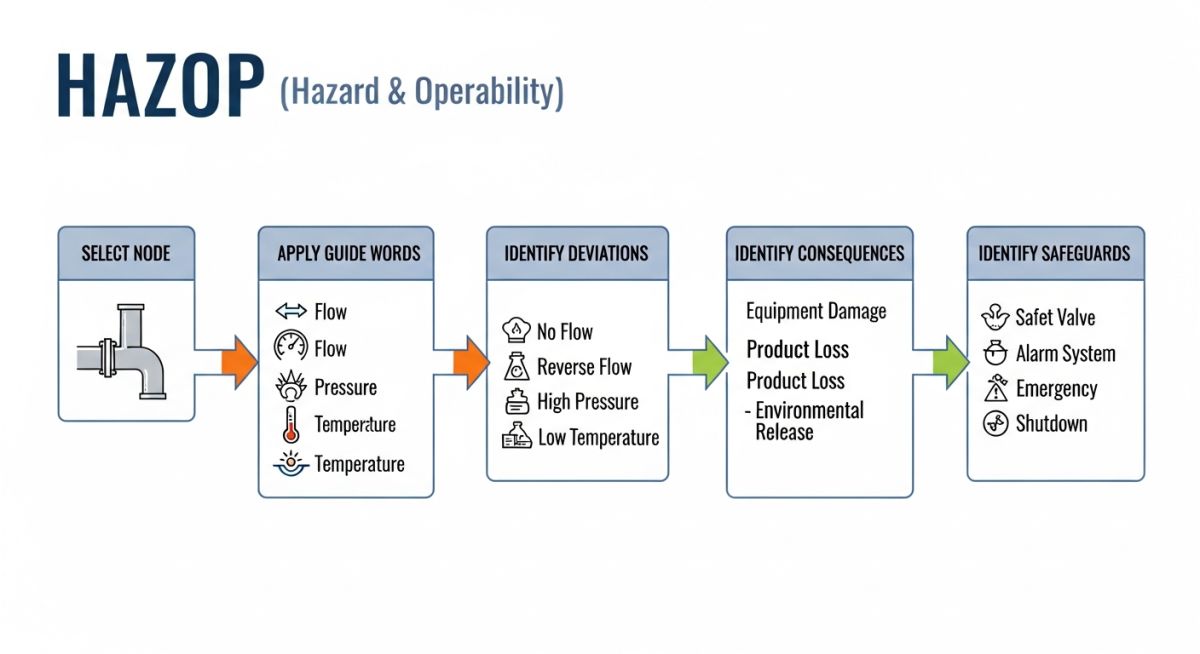
If the existing safeguards are deemed insufficient to reduce the risk to an acceptable level, the team issues a formal Recommendation. This recommendation must be tracked to closure before the plant can safely proceed to the construction or operation phase. This process aligns directly with international standards such as IEC 61882, which governs the application of hazard and operability studies.
To quantify the risk during these sessions, we use a standard Risk Assessment Matrix. The risk score is calculated using a straightforward formula:
Where Severity represents the worst-case consequence to people, environment, and assets, and Likelihood represents the frequency of the initiating cause. If the resulting Risk Score exceeds the company’s tolerable risk threshold, additional engineering controls must be implemented.
The table below outlines how guide words combine with process parameters to create standard deviations, along with typical industrial causes that I have encountered in the field.
| Guide Word | Parameter | Deviation | Typical Industrial Cause |
|---|---|---|---|
| No / Less | Flow | No Flow / Low Flow | Line blockage, pump failure, closed isolation valve, control valve failure. |
| More | Pressure | High Pressure | Downstream blockage, thermal expansion, runaway reaction, utility failure. |
| Reverse | Flow | Reverse Flow | Check valve failure, high downstream pressure, siphon effect. |
| As Well As | Composition | Contamination | Ingress of utility fluids, catalyst carryover, raw material impurity. |
This matrix maps the core technical entities, regulatory standards, and physical parameters that govern process safety management systems globally.
| Entity / Acronym | Technical Definition | Governing Standard | Practical Application |
|---|---|---|---|
| PSM | Process Safety Management | OSHA 1910.119 | Regulatory framework for managing highly hazardous chemicals. |
| SIS | Safety Instrumented System | IEC 61511 | Automated safety controls designed to bring a plant to a safe state. |
| P&ID | Piping and Instrumentation Diagram | PIC001 / ISA 5.1 | The primary engineering drawing used as the basis for HAZOP reviews. |
| LOPA | Layer of Protection Analysis | IEC 61511-3 | Semi-quantitative risk assessment used to evaluate safeguard adequacy. |
How to Prepare for HAZOP Analysis Sessions?
A study is only as good as the data you feed into it. If your drawings are outdated or your design parameters are incorrect, your team will waste valuable hours analyzing scenarios that do not exist, or worse, missing real hazards. I always insist on a rigorous readiness review before bringing the study team together.
-
P&ID Accuracy Verification: Ensure all drawings are approved for design (AFD) and reflect the exact physical layout, including line sizes, valve types, and instrument tags.
-
Process Design Basis: Compile the heat and material balances (HMB), process flow diagrams (PFDs), and equipment datasheets.
-
Operating Philosophy: Document the startup, shutdown, normal operation, and emergency shutdown procedures.
-
Multidisciplinary Team Selection: Confirm attendance from Process, Piping, Instrumentation, Operations, and Safety disciplines.
-
Facility Siting & Layout: Provide plot plans and hazardous area classification drawings to evaluate spatial risks.
Field Case Study: Real-World Application
During a design review for a refinery expansion project, a closed-loop hydrocarbon transfer line was designed without a thermal relief valve. The line could be isolated at both ends during maintenance while containing liquid hydrocarbon. If exposed to solar radiation, the liquid would expand, leading to rapid pressure buildup. The initial design lacked any safeguard for this thermal expansion scenario, presenting a high risk of line rupture and subsequent fire.
The study team applied the deviation “More Temperature / More Pressure” to the isolated line node. The team identified that solar heating could raise the pressure beyond the piping design limit of 19.3 barg. The recommendation was to install a balanced-bellows thermal relief valve routed safely to the flare header. This engineering control reduced the risk score from a critical Category 4 to an acceptable Category 1, preventing a potential loss of containment.
This case highlights why we do not rely on operators remembering to drain lines. Passive, engineered safeguards identified during a systematic study are always superior to administrative controls.
Frequently Asked Engineering Questions
Why is HAZOP Analysis Critical for Safety?
What is the difference between HAZOP and HAZID?
Who should be included in a HAZOP study team?
How often should a HAZOP analysis be re-evaluated?
Can a HAZOP study replace quantitative risk assessment?
What are the limitations of a HAZOP study?
How do you document the findings of a study?
Complete Course on
Piping Engineering
Check Now
Key Features
- 125+ Hours Content
- 500+ Recorded Lectures
- 20+ Years Exp.
- Lifetime Access
Coverage
- Codes & Standards
- Layouts & Design
- Material Eng.
- Stress Analysis