
What is PSSR or Pre-Startup Safety Review?
In my 20+ years of commissioning piping systems and managing heavy industrial assets, I have stood on many cold-eyes walkdowns. There is a distinct, heavy tension in the air right before you introduce hydrocarbons or high-pressure steam into a newly built or modified unit. That exact moment is where disaster strikes if your engineering controls fail. A Pre-Startup Safety Review is your final, unyielding line of defense. It is not a mere paper-pushing exercise; it is a rigorous physical and administrative gatekeeper that ensures every weld, valve, instrument loop, and operating procedure is verified and signed off by competent engineering minds before the first molecule of process fluid enters the boundary limit.
Key Takeaways from This Guide
- Understand the regulatory mandates under OSHA 29 CFR 1910.119(i).
- Learn how to calculate and verify critical piping stress and pressure test parameters before signing off.
- Access field-tested checklists and a real-world engineering case study of PSSR execution.
- Discover how to categorize and resolve Type A (pre-startup) versus Type B (post-startup) punch list items.
Why Perform a Pre-Startup Safety Review?
Pre-Startup Safety Review Mandate: A regulatory and operational requirement designed to verify that modified or newly constructed piping systems, pressure vessels, and control loops are physically complete and safe to operate under design conditions.
When we modify a piping system or build a new process unit, we introduce variables that can compromise the original design intent. Under the Process Safety Management (PSM) framework, specifically OSHA standards, a formal PSSR is legally required for new facilities and for modified facilities when the modification is significant enough to require a change in the process safety information.
The Four Pillars of PSSR Compliance
To satisfy both regulatory bodies and internal asset integrity standards, your PSSR must conclusively prove four distinct elements:
- Construction and Equipment Integrity: Physical verification that all piping, vessels, and instruments match the approved Piping and Instrumentation Diagrams (P&IDs) and comply with design codes such as ASME B31.3 for process piping and ASME Section VIII for pressure vessels.
- Operational and Safety Procedures: Confirmation that written operating, maintenance, emergency, and safety procedures are fully drafted, reviewed, and officially issued.
- Process Hazard Analysis (PHA) Resolution: Verification that all recommendations stemming from the Hazard and Operability (HAZOP) study or other PHAs have been resolved, implemented, and documented.
- Personnel Training: Documented proof that every operator, maintenance technician, and safety officer assigned to the unit has completed training on the new process dynamics, emergency shutdown systems, and specific hazards.
In my field experience, the most common failure mode of a commissioning team is treating the PSSR as a checklist to be signed off in an air-conditioned office. If your team does not physically walk the lines, verify hanger pin removals, and check valve orientations against the P&ID, you are bypassing the safety barrier. A paper sign-off without physical verification is an invitation to a catastrophic loss of containment.
Engineering Calculations: Verifying Hydrostatic Test Pressures
Before the PSSR team can sign off on the mechanical integrity of a piping system, they must audit the hydrostatic test records. Let us look at how we verify the minimum hydrostatic test pressure for a carbon steel piping system (ASTM A106 Grade B) under ASME B31.3 Clause 345.4.2.
The formula for the minimum hydrostatic test pressure is:
Where:
- Pt: Minimum hydrostatic test gauge pressure (psig).
- P: Internal design gauge pressure (psig). Let us assume a design pressure of 300 psig.
- St: Allowable stress at component test temperature (typically ambient, 70°F). For ASTM A106 Grade B, St is 20,000 psi.
- S: Allowable stress at component design temperature. Let us assume a design temperature of 500°F. For ASTM A106 Grade B at 500°F, S is 18,900 psi according to ASME B31.3 Table A-1.
Let us calculate the required test pressure:
Pt = 450 * 1.0582
Pt = 476.2 psig
The PSSR team must verify that the actual field hydrotest was executed at a pressure not less than 476.2 psig, held for a minimum of 10 minutes, and documented with calibrated pressure gauges. If the test pressure was lower, or if the temperature correction factor was ignored, the PSSR must be flagged with a Type A finding, halting startup.
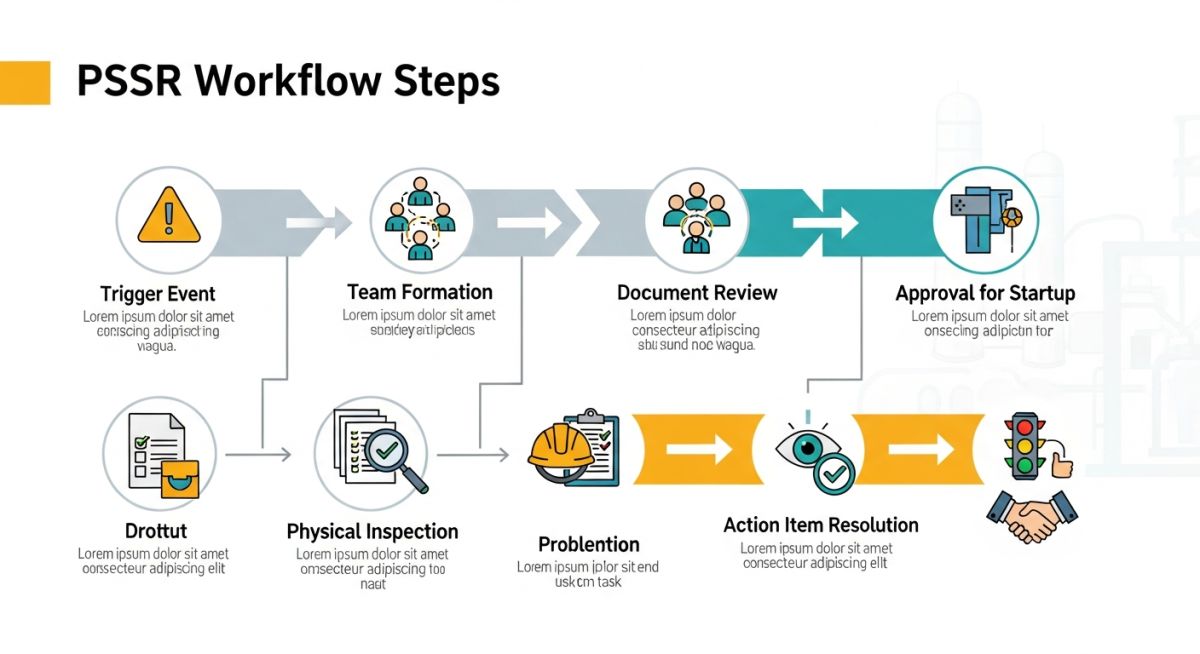
PSSR Verification Thresholds: The specific operational, pressure, and chemical volume limits that trigger a formal safety review under OSHA PSM mandates.
| Equipment / System Type | Design Standard | Minimum Verification Parameter | Required Documentation |
|---|---|---|---|
| Process Piping Systems | ASME B31.3 | Hydrostatic test pressure (1.5x design) or Pneumatic test (1.1x design) | Signed test charts, NDE reports, weld maps |
| Pressure Vessels | ASME Section VIII Div 1 | Relief valve sizing, set pressure verification, and code stamping | U-1 Manufacturer’s Data Report, RV calibration certificates |
| Emergency Shutdown (ESD) | IEC 61511 / ISA 84 | Loop checks, logic solver validation, and response time testing | Functional safety assessment, cause-and-effect matrix logs |
| Rotating Equipment | API 610 / API 617 | Shaft alignment, seal flush system verification, rotation checks | Alignment sheets, lube oil analysis, run-test logs |
| Entity / Acronym | Technical Definition | Physical Parameter / Limit | Reference Standard |
|---|---|---|---|
| MOC | Management of Change – formal process to document modifications | Applies to all changes to chemicals, technology, equipment, and procedures | OSHA 1910.119(l) |
| PSV / PRV | Pressure Safety Valve / Pressure Relief Valve | Set pressure must not exceed Maximum Allowable Working Pressure (MAWP) | API 520 / API 521 |
| SIL | Safety Integrity Level – measure of safety instrumented function performance | SIL 1 to SIL 4 (Probability of Failure on Demand limits) | IEC 61508 |
| HAZOP | Hazard and Operability Study – structured system evaluation | Identifies deviations from design intent using guide words | OSHA 1910.119(e) |
How to Execute the PSSR Checklist
PSSR Field Checklist: A structured protocol used by commissioning teams to physically verify piping integrity, valve alignments, and instrument calibrations before startup.
Before signing off on the PSSR certificate, the lead commissioning engineer must walk the system with this checklist. Every item must be physically verified. Do not accept verbal confirmations from subcontractors.
Pre-Startup Physical Verification Checklist
Executing a Pre-Startup Safety Review Successfully
PSSR Execution Strategy: The systematic deployment of multi-disciplinary engineering teams to audit, verify, and sign off on physical plant assets prior to commissioning.
To understand how these principles apply in the field, let us look at a real-world project where a rigorous PSSR prevented a major safety incident during a refinery expansion.
Field Case Study: Real-World Application
The Problem: The Forgotten Spring Hanger Lockpins
During a fast-tracked hydrotreater expansion project, a new 12-inch high-pressure steam line was installed. The construction contractor completed the piping installation, hydrotested the line successfully, and insulated the piping. However, during the rush to meet the commissioning schedule, the contractor forgot to remove the travel lockpins from three critical spring hangers near the steam turbine inlet.
Without removing these lockpins, the spring hangers acted as rigid supports. If steam had been introduced, the thermal expansion of the piping would have generated massive, unpredicted bending moments on the turbine nozzle, exceeding the allowable limits of API 617 and risking a catastrophic casing crack or flange blowout.
The Outcome: PSSR Intervention and Resolution
As the lead piping engineer on the PSSR team, I conducted a physical walkdown of the steam line. I noticed that the spring hanger indicators were not sitting at the designated “cold” position and that the red shipping lockpins were still fully engaged. I immediately flagged this as a Type A (Pre-Startup) Punch List Item.
The startup was officially put on hold. The construction crew was mobilized to remove the lockpins, and we re-verified the cold settings of the hangers. A subsequent hot walkdown during steam blow operations confirmed that the piping expanded as designed, and the spring hangers moved smoothly into their “hot” operating positions without overloading the turbine nozzle.
Direct Engineering Recommendation
Never allow schedule pressure to downgrade a Type A finding to a Type B finding. If a finding affects the mechanical integrity, pressure relief, or emergency shutdown capability of a system, it must be resolved before any process fluid is introduced. Establish a clear, unalterable definition of Type A and Type B findings in your commissioning execution plan.
Frequently Asked Engineering Questions
What is the difference between a PSSR and a standard piping walkdown?
When is a PSSR legally required in industrial plants?
What is the difference between Type A and Type B PSSR findings?
Who should be included in the PSSR team?
How does PSSR integrate with the Management of Change (MOC) process?
Can a PSSR be bypassed for minor piping modifications?
===
Complete Course on
Piping Engineering
Check Now
Key Features
- 125+ Hours Content
- 500+ Recorded Lectures
- 20+ Years Exp.
- Lifetime Access
Coverage
- Codes & Standards
- Layouts & Design
- Material Eng.
- Stress Analysis
