What Is a Castle Nut? Uses, Working, and Differences
In my 20 years of managing piping systems, heavy rotating machinery, and high-vibration industrial installations, I have seen countless fasteners fail due to dynamic loading. Standard nuts, even when paired with split lock washers, often back off when subjected to continuous harmonic vibrations. That is where the castle nut (sometimes referred to as a castellated nut) becomes an invaluable asset in your engineering toolkit.
Unlike friction-dependent locking methods, this fastener relies on physical interference. By pairing the nut with a pre-drilled bolt and a cotter pin, you create a positive lock that cannot fail unless the shear strength of the pin itself is exceeded. In this guide, I will break down the exact mechanics, design standards, and field applications of this classic mechanical component.
Key Engineering Takeaways
- Positive Mechanical Lock: Provides absolute resistance to rotational backing-off, making it ideal for safety-critical applications.
- ASME & DIN Compliance: Designed and manufactured under strict dimensional standards such as ASME B18.2.2 and DIN 935.
- Visual Inspection Advantage: Allows maintenance teams to instantly verify joint integrity without specialized testing equipment.
- Temperature Resistance: Free from the thermal degradation limits that plague nylon-insert locknuts.
What Is a Castle Nut?
Castle Nut Design: A mechanical locking fastener characterized by its crown-like slots that align with a drilled hole in a mating bolt to secure critical rotating assemblies.
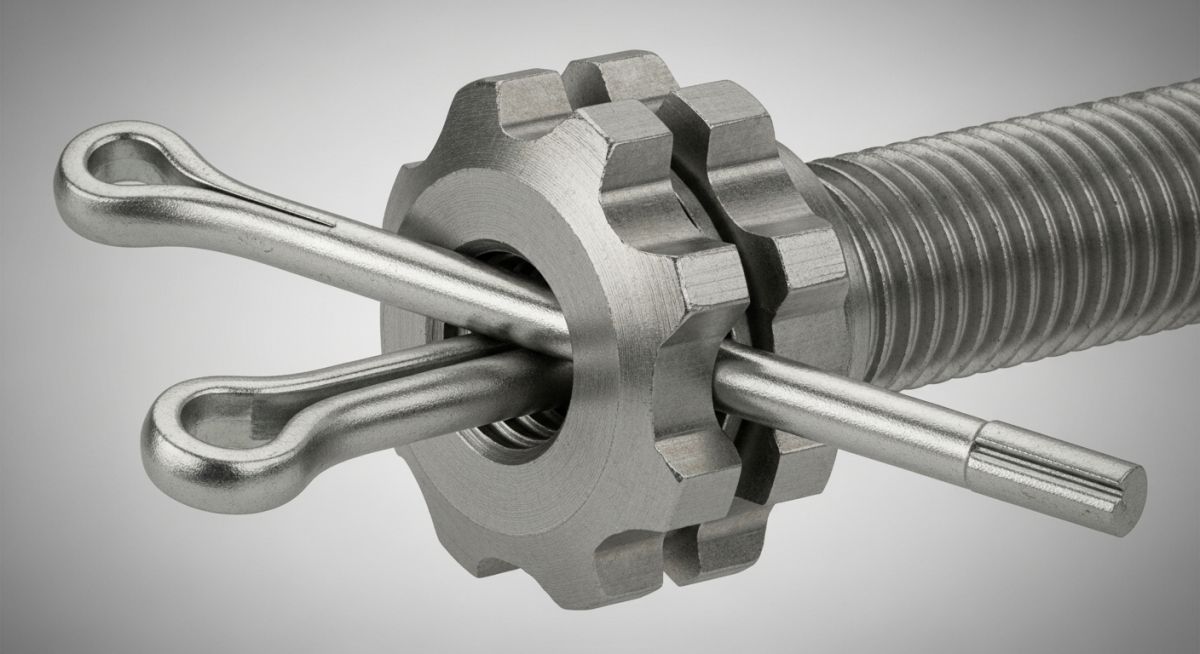
The name “castle nut” comes from its physical appearance. The upper portion of the nut features a cylindrical collar with slots cut into it, resembling the battlements of a medieval castle. This unique geometry serves a highly functional purpose. The lower portion of the nut is a standard hexagon, allowing you to apply torque with standard wrenches, while the upper castellated section remains free to receive a locking pin.
In industrial piping and mechanical design, we specify these fasteners when the cost of a joint failure is catastrophic. For instance, on reciprocating compressor rods, high-pressure valve actuators, or heavy-duty flange connections subject to thermal cycling, standard locking methods fall short. The castle nut provides a fail-safe mechanism that maintains joint preload even when the initial tension relaxes slightly.
Working of a Castle Nut
Castle Nut Mechanics: The physical alignment of the nut’s slots with a transverse hole in the bolt shank, followed by the insertion and deformation of a cotter pin, which physically blocks any relative rotation between the nut and the bolt.
The working principle relies entirely on mechanical interference. When you torque the nut onto a bolt containing a pre-drilled radial hole, you must align one of the slots (or notches) with the hole. Once aligned, you insert a cotter pin (or safety wire) through the slot, through the bolt, and out the other side. By bending the prongs of the cotter pin around the nut, you lock the assembly in place.
In my years on site, I have often seen technicians make the mistake of over-torqueing a nut just to get the slots to align with the bolt hole. This can over-stress the bolt threads, leading to plastic deformation or thread stripping. Conversely, backing off the nut to align the hole reduces the required design preload. Always torque to the minimum specified value, and if the holes do not align, use shim washers or try a different nut to achieve alignment within the acceptable torque range.
Mathematically, the shear resistance of the locking assembly is governed by the shear strength of the cotter pin. The shear stress (tau) on the cotter pin can be calculated using the formula:
Where F_rotational is the rotational force trying to back off the nut, and A_pin is the cross-sectional area of the cotter pin. Because the pin passes completely through the bolt, it acts in double shear, doubling its effective resistance to rotational failure.
Why Choose a Castle Nut over Other Fasteners?
Positive Locking Reliability: The absolute mechanical interference provided by a castellated system, which outperforms friction-based locking methods like nylon-insert locknuts or split washers in high-temperature and high-vibration environments.
When comparing locking fasteners, engineers must evaluate environmental conditions, temperature, and vibration profiles. Nylon-insert locknuts (Nyloc) are excellent for general use, but they fail at temperatures exceeding 120 degrees Celsius (250 degrees Fahrenheit). Anaerobic thread-locking compounds (liquid threadlockers) can degrade in the presence of certain industrial solvents or extreme heat.
The castle nut, being entirely metallic, maintains its locking capability up to the temperature limit of the base metal itself. Furthermore, unlike split lock washers—which the SAE has shown to be largely ineffective once high preloads are reached—the castellated system provides a physical stop. It is a true “positive lock” that does not rely on friction or spring tension to remain secure.
Materials for Castle Nuts
Fastener Material Selection: The selection of specific alloys, such as carbon steel, stainless steel, or silicon bronze, to match the mechanical strength and corrosion resistance requirements of the surrounding piping or structural system.
Selecting the right material is critical to prevent galvanic corrosion and ensure adequate tensile strength. In marine or highly corrosive chemical environments, I always specify Grade 316 stainless steel castle nuts. For high-strength structural applications, Grade 8 carbon steel (or ASTM A194 Grade 2H for high-temperature piping) is the standard.
Castle Nuts vs. Slotted Nuts
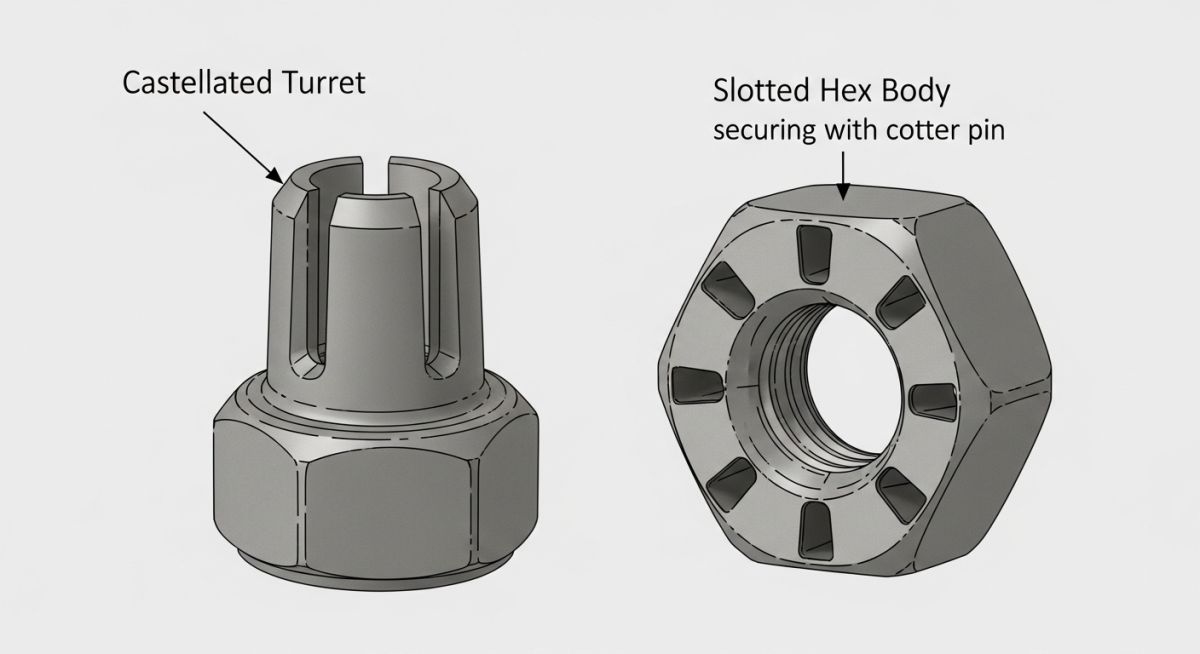
Castellated Geometry Differences: The structural distinction where a castle nut features slots cut into a raised cylindrical collar, whereas a slotted nut has slots cut directly into the flat hexagonal body.
Many engineers use these terms interchangeably, but they are structurally distinct. On a true castle nut, the slots are located on a raised cylindrical portion (the “castle”) that has a diameter slightly smaller than the width across the flats of the hex portion. This design ensures that the wrench can fully engage the hexagonal flats without slipping or damaging the slots.
On a slotted nut, the slots are cut directly into the hexagonal flats of the nut body. This reduces the effective height of the hex flats, meaning your wrench has less surface area to grip, increasing the risk of rounding off the corners during high-torque applications.
To ensure interchangeability and structural integrity, castle nuts are manufactured to precise dimensional standards. Below are the key engineering specifications for standard hex castle nuts according to ASME B18.2.2 (Imperial) and DIN 935 (Metric).
| Nominal Size (D) | Thread Pitch (Coarse/Fine) | Width Across Flats (F) | Total Height (H) | Slot Width (W) | Recommended Cotter Pin Dia. |
|---|---|---|---|---|---|
| 1/4″ | 20 tpi / 28 tpi | 0.438″ | 0.281″ | 0.078″ | 1/16″ |
| 1/2″ | 13 tpi / 20 tpi | 0.750″ | 0.563″ | 0.141″ | 1/8″ |
| 3/4″ | 10 tpi / 16 tpi | 1.125″ | 0.813″ | 0.203″ | 3/16″ |
| M12 (Metric) | 1.75 mm / 1.25 mm | 19.00 mm | 15.00 mm | 3.50 mm | 3.20 mm |
| M20 (Metric) | 2.50 mm / 1.50 mm | 30.00 mm | 22.00 mm | 4.50 mm | 4.00 mm |
Technical Mapping & Specifications Matrix
| Parameter | Specification / Standard | Engineering Significance |
|---|---|---|
| Thread Class | Class 2B (Unified) / 6H (Metric) | Ensures standard fit and prevents cross-threading during field assembly. |
| Hardness Range | Rockwell C24 to C38 (Grade 8) | Guarantees high tensile strength and resistance to thread stripping under load. |
| Locking Type | Positive Mechanical Interference | Zero reliance on friction; remains locked even if joint preload is completely lost. |
| Applicable Codes | ASME B18.2.2, DIN 935, ISO 7035 | Governs dimensional tolerances, slot depths, and material testing protocols. |
Installation Checklist for a Castle Nut
Castle Nut Installation Protocol: A systematic field verification procedure ensuring correct torque application, slot alignment, and cotter pin securing to prevent catastrophic joint failure.
In my experience, the majority of field failures involving castellated fasteners do not stem from material defects. Instead, they occur due to poor installation practices, such as reusing worn cotter pins or failing to align the slots correctly. Use this checklist on your job site to ensure every joint is secured to engineering specifications.
Step-by-Step Field Verification
-
Inspect Bolt Hole Integrity: Verify that the radial hole in the bolt is clean, free of burrs, and not deformed. Burrs can prevent the cotter pin from sliding through smoothly.
-
Apply Initial Torque: Torque the castle nut to the minimum specified engineering value using a calibrated torque wrench. Do not lubricate the threads unless specified by the design data sheet.
-
Check Slot Alignment: Check if one of the castellated slots aligns perfectly with the bolt hole. If it does not, tighten the nut slightly further (up to the maximum allowable torque limit) to achieve alignment.
-
Insert a New Cotter Pin: Always use a brand-new cotter pin of the correct diameter (refer to the dimensional table). Reusing old cotter pins introduces micro-cracks due to work hardening, which can lead to premature shear failure.
-
Bend and Secure: Bend the prongs of the cotter pin firmly. One prong should wrap over the top of the bolt shank, and the other should wrap down against the flat of the nut. Cut off any excess length to prevent snagging hazards.
Field Case Study: Real-World Application
At a mineral processing plant, a heavy-duty slurry pump experienced repeated failures. The impeller shaft nut, which was a standard heavy hex nut secured with a high-strength thread-locking compound, kept backing off due to intense low-frequency vibrations and thermal cycling. This backing-off caused the impeller to rub against the pump casing, resulting in catastrophic shaft damage and costing the plant over 45,000 in downtime and replacement parts per incident.
I was called in to analyze the failure. We replaced the standard shaft with a custom-machined shaft featuring a pre-drilled radial hole. We then installed a Grade 8 carbon steel castle nut, torqued to 250 lb-ft, and secured it with a 316 stainless steel cotter pin.
The results were immediate. The positive mechanical lock completely eliminated the rotational backing-off. During the next scheduled maintenance turnaround 18 months later, the assembly was inspected; the cotter pin was fully intact, and the joint preload had remained perfectly stable. This simple, low-cost retrofit saved the plant hundreds of thousands of dollars in potential lost production.
Frequently Asked Engineering Questions
What is a castle nut, and why is it called that?
What is the difference between a castle nut and a slotted nut?
Can I reuse a cotter pin with a castle nut?
How do I handle alignment issues if the slots do not line up with the bolt hole?
Are castle nuts suitable for high-temperature applications?
What standards govern the dimensions of these fasteners?
===FAQ_BLOCK===
Complete Course on
Piping Engineering
Check Now
Key Features
- 125+ Hours Content
- 500+ Recorded Lectures
- 20+ Years Exp.
- Lifetime Access
Coverage
- Codes & Standards
- Layouts & Design
- Material Eng.
- Stress Analysis


