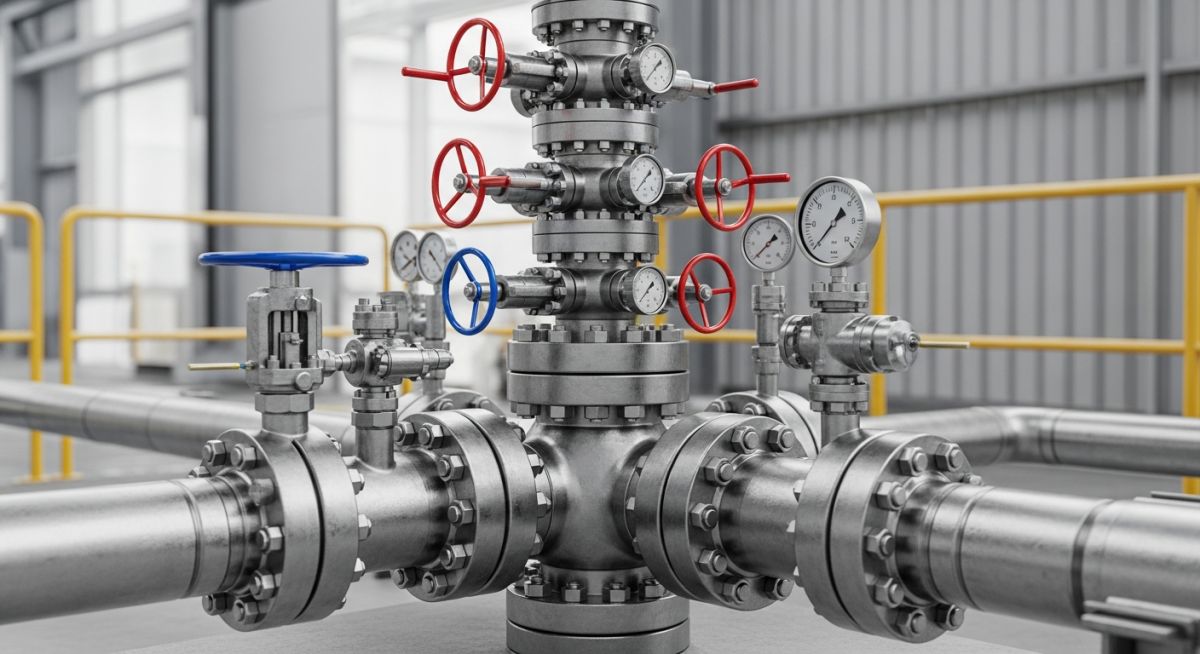
Understanding Wellhead and Christmas Tree Systems in Oil and Gas
In my 20 years of managing high-pressure piping systems and wellhead installations, I have seen many young engineers confuse these two distinct components. They often treat them as a single piece of equipment. On the construction site, however, they serve entirely different purposes. The wellhead is the structural foundation of your well, while the christmas tree is the control center for production.
When you are dealing with surface pressures exceeding 10,000 psi, understanding the boundary between these two systems is not just academic. It is a matter of operational safety and regulatory compliance. Let us break down their functions, components, and design codes so you can confidently specify, inspect, and operate them in the field.
Key Engineering Takeaways
- The wellhead is installed during drilling to suspend casing strings and seal the wellbore.
- The christmas tree is installed after completion to control fluid flow and provide intervention access.
- Both systems must comply with API Specification 6A for pressure and temperature ratings.
- The tubing hanger acts as the physical and functional bridge between the wellhead and the tree.
Complete Course on
Piping Engineering
Check Now
Key Features
- 125+ Hours Content
- 500+ Recorded Lectures
- 20+ Years Exp.
- Lifetime Access
Coverage
- Codes & Standards
- Layouts & Design
- Material Eng.
- Stress Analysis
What Distinguishes the Wellhead and Christmas Tree?
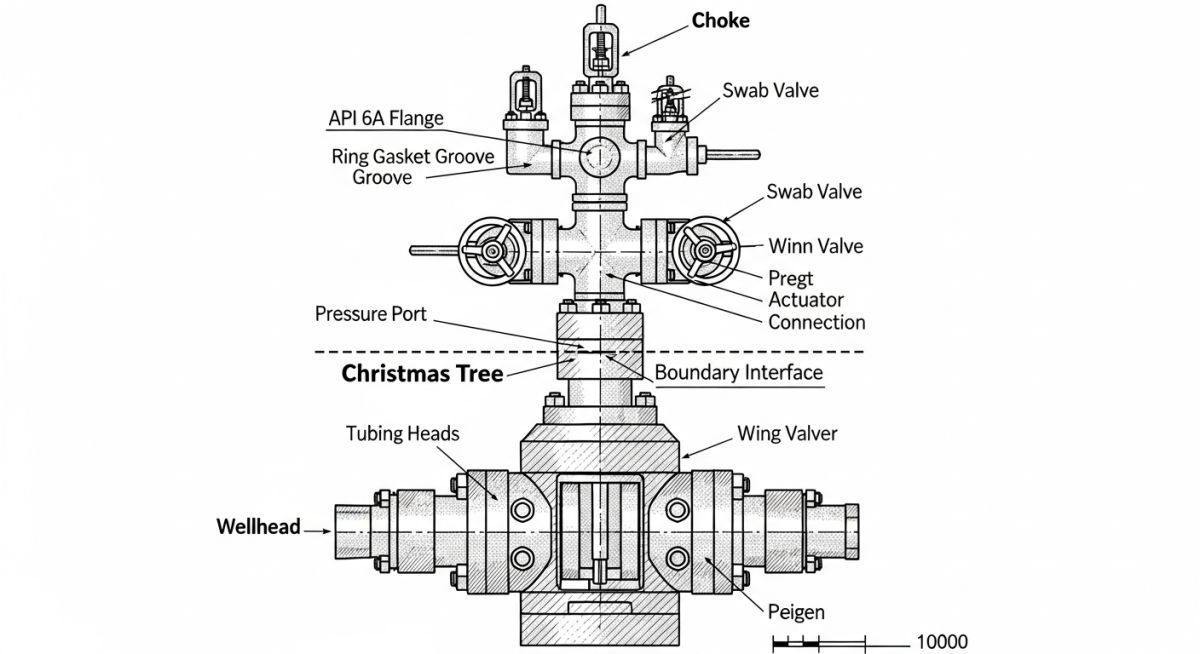
To understand the difference, we must look at the sequence of operations. The wellhead is the permanent metal structure welded or threaded onto the conductor pipe during the earliest stages of drilling. It remains in place for the entire life of the well. Its primary job is to support the massive hanging weight of the casing strings and to seal off the annular spaces between them.
The christmas tree, on the other hand, is bolted or clamped to the top of the wellhead assembly after the well is completed. If the wellhead is the foundation, the tree is the plumbing manifold. It regulates the flow of oil, gas, or water out of the well, and allows operators to inject chemicals or perform wireline and coiled tubing interventions.
Structural Load and Pressure Calculations
As a piping engineer, I always look at the mechanical loads. The wellhead must support the combined weight of the casing strings. Let us calculate the suspended load of a typical casing string to understand the forces at play.
Example: Casing Hanger Load Calculation
Casing Size: 9-5/8 inches
Unit Weight: 47 lb/ft
Total Depth: 12,000 feet
Mud Density: 11.5 ppg (pounds per gallon)
1. Calculate Air Weight (W_air):
W_air = 47 lb/ft * 12,000 ft = 564,000 lbs
2. Calculate Buoyancy Factor (BF) in 11.5 ppg mud:
BF = 1 – (Mud Density / Steel Density)
BF = 1 – (11.5 / 65.5) = 0.824
3. Calculate Buoyed Weight (W_buoyed):
W_buoyed = 564,000 lbs * 0.824 = 464,736 lbs (approx. 210.8 Metric Tons)
This massive load of 464,736 lbs is suspended entirely by the casing hanger inside the casing head. The wellhead body must transfer this load safely to the conductor pipe and the surrounding soil without collapsing or deforming the casing.
If the casing hanger is not set correctly or if the wellhead bowl is contaminated with drilling mud, the hanger slips can fail. This causes the casing string to drop, leading to catastrophic wellbore collapse and loss of primary pressure containment. Always clean and inspect the wellhead bowl before landing the hanger.
The Anatomy of a Christmas Tree
The christmas tree consists of a series of gate valves and a choke valve. The lower master valve is your primary barrier; it is rarely operated and is kept open during production. The upper master valve is the secondary barrier, used for routine isolation. The wing valves control daily flow, while the choke valve regulates the pressure and flow rate of the fluids.
How Do API 6A Specifications Apply?
When specifying equipment under API 6A, you must select the correct material class and temperature rating based on the well fluid composition and environmental conditions. The table below outlines the standard API 6A material classes for wellhead and tree components.
| Material Class | Minimum Service Conditions | Primary Material Requirements |
|---|---|---|
| AA – General Service | Non-corrosive fluids | Carbon or low-alloy steel |
| BB – General Service | Slightly corrosive (CO2) | Stainless steel lined or solid stainless |
| DD – Sour Service | Sour service (H2S), non-corrosive | Alloy steel complying with NACE MR0175 |
| EE – Sour Service | Sour service (H2S) and corrosive (CO2) | Stainless steel complying with NACE MR0175 |
| HH – Extreme Sour | Highly corrosive and sour fluids | Nickel-based alloys (Inconel 625 cladding) |
To help you map out your system design, I have compiled this technical specifications matrix. It links each major component to its primary function, design code, and typical field pressure ratings.
| Component | Primary Function | Design Code | Pressure Ratings (psi) |
|---|---|---|---|
| Casing Head | Suspends surface casing; seals annulus | API 6A / ISO 10423 | 2,000 to 10,000 |
| Tubing Spool | Suspends production tubing; provides alignment | API 6A | 5,000 to 15,000 |
| Master Valve | Primary wellbore isolation barrier | API 6A / API 6D | 5,000 to 20,000 |
| Choke Valve | Regulates flow rate and downstream pressure | API 6A / API 17D | Up to 15,000 |
Commissioning the Wellhead and Christmas Tree Safely
Before you hand over a well to the production team, you must perform a rigorous commissioning sequence. In my experience, skipping even a minor step on this checklist can lead to gas migration or valve leaks that are incredibly expensive to remediate once the well is online.
Pre-Commissioning Field Checklist
-
Visual Inspection: Verify that all flange bolts are fully engaged and torqued to the specified values in accordance with API 6A guidelines.
-
Ring Gasket Verification: Ensure that only new, unused BX or RX ring gaskets are installed. Never reuse a metal ring gasket.
-
Hydrostatic Testing: Perform a high-pressure hydrostatic test of the entire assembly to 1.5 times the rated working pressure for at least 15 minutes.
-
Valve Functionality: Cycle all gate valves on the christmas tree from fully open to fully closed to verify smooth operation and correct torque limits.
-
Annulus Monitoring: Confirm that pressure gauges are installed on all casing and tubing head side outlets to monitor for gas migration.
Field Case Study: Real-World Application
The Problem: Sustained Casing Pressure (SCP)
On a high-pressure gas well in the Middle East, the operations team noticed a steady pressure build-up of 1,200 psi in the production casing annulus (Annulus A). Initial diagnostics suggested either a failure of the production packer downhole or a leak in the tubing hanger seal inside the wellhead spool. If the tubing hanger seal was leaking, it meant gas was bypassing the primary barrier and pressurizing the wellhead housing.
The Outcome: Diagnostic and Remediation
I was called in to analyze the seal integrity. We performed a selective pressure test of the tubing hanger secondary pack-off seal using the wellhead injection port. The test confirmed that the elastomer seal had degraded due to high-temperature gas exposure.
Instead of killing the well and pulling the tubing, we utilized the wellhead’s active sealant injection system. We injected a high-viscosity, API 6A-approved polymer sealant directly into the hanger seal channel. This successfully restored the barrier, reducing the annulus pressure to zero and saving the operator an estimated 1.5 million dollars in workover costs.
This case highlights why choosing the correct elastomer material for your wellhead seals is just as important as the steel itself. For high-temperature, high-pressure (HTHP) wells, always specify Viton or metal-to-metal seals over standard nitrile rubber.
Frequently Asked Engineering Questions
What is the main difference between a wellhead and a christmas tree?
Which API standard governs wellhead and christmas tree design?
What is the purpose of the swab valve on a christmas tree?
Can a wellhead be reused on another well?
What is the difference between API 6A and API 6D valves?
Why are there two master valves on some christmas trees?
