Significance of Space Velocity of Reactor in Refinery Process Design
During a heavy diesel hydrotreater turnaround back in my early days on the field, we throttled the unit throughput down to 50% capacity due to upstream unit upsets. We kept the reactor temperatures constant, thinking we were playing it safe. Within three weeks, the pressure drop across the top bed shot up by 40% and our catalyst was severely coked. Why? Because we completely ignored how a collapsing space velocity of reactor alters the physical fluid dynamics, over-cracking the molecules and choking the catalyst sites. In the field, you cannot treat a reactor like a static tank. Fluid throughput and catalyst volume exist in a volatile, time-dependent balance.
What You Will Learn From This Field Guide
- The fundamental definition and mechanical limits of Liquid and Gas Space Velocities.
- How space velocity directly controls desulfurization kinetics and unreacted feed slip.
- The hidden trap of partial feed vaporization when liquid hourly space velocity falls too low.
- Practical engineering methods to calculate reactor space-time versus standard residence time.
WHAT IS IT ALL ABOUT
The space velocity of reactor indicates the volume or mass of feed processed per unit volume of catalyst within a specific hour. It acts as the inverse of space-time, directly controlling the reaction contact time. Optimizing space velocity ensures high chemical conversion while preventing secondary cracking, accelerated catalyst coking, and partial feed vaporization.
Table of Contents

Learn From Flashcards: Core Reactor Metrics & Field Realities
Hover over or click a card below to reveal direct, experience-tested engineering answers and standard references.
What exactly does the space velocity of reactor measure on the operational floor?
Reveal Field Link →It benchmarks the volumetric flow rate processed per hour against the total loaded volume of catalyst inside the reaction chamber.
Why does a lower LHSV accelerate catalyst coke fouling during turndowns?
Reveal Field Link →Lower LHSV extends the fluid residence time, triggering secondary thermal cracking of heavy chains into sticky carbonaceous coke deposits.
What is the primary operational definition and application of GHSV?
Reveal Field Link →Gas Hourly Space Velocity, calculated by dividing the gas volumetric flow rate at standard conditions by the catalyst volume.
How does a high liquid space velocity of reactor cause chemical product slippage?
Reveal Field Link →It drastically shortens contact time, preventing heteroatoms from reaching active metal sites before escaping the bed.
How does partial feed vaporization alter the real working LHSV profile?
Reveal Field Link →Vaporization transforms liquids into high-velocity gas fractions, replacing liquid kinetics with rapid gas-phase space velocities.
What international engineering standards govern reactor testing and catalyst metrics?
Reveal Field Link →ASTM D6196 along with standard API practice manuals control standardizing fluid hourly velocities and gas calibration baselines.
Why does relying entirely on calculated space velocity hide internal liquid channeling?
Reveal Field Link →Space velocity treats the catalyst as a perfectly uniform block, ignoring uneven flow distribution or dead zones.
What is the exact unit dimension and mathematical expression for standard LHSV?
Reveal Field Link →It is expressed as inverse hours (h-1), resulting from dividing volumetric flow (m3/h) by catalyst volume (m3).
How do you define catalytic space-time relative to the space velocity of reactor?
Reveal Field Link →Space-time is the mathematical reciprocal of space velocity, defining the theoretical time required to process one reactor volume of feed.
Why is true hydrodynamic residence time fundamentally different from space-time?
Reveal Field Link →True residence time adjusts for the bed’s structural void fraction and real-time internal fluid densities at operating pressures.
What happens to LHSV parameters during aggressive plant capacity debottlenecking?
Reveal Field Link →LHSV increases proportionally with higher throughput, reducing contact time and forcing you to run the reactor hotter.
How does low space velocity impact exothermic reaction profiles across a catalyst bed?
Reveal Field Link →Slower flow concentrates exothermic reactions near the top of the bed, creating sharp, localized thermal hot spots.
Field Engineering Assessment
Testing Core Knowledge on Reactor Space Velocity Parameters
What is the Fundamental Space Velocity of Reactor?
In my years on the processing floor, I have seen many young engineers treat a reactor like a standard blending tank. They assume that if you know the vessel volume, you can easily guess the holding time. That is a dangerous mistake when dealing with heterogeneous catalysis. The space velocity of reactor defines the exact mathematical relationship between your raw feed processing rate and the active volume of catalyst loaded inside that chamber. It tells you how many volumes of feed can be processed by one unit volume of catalyst in exactly one hour.
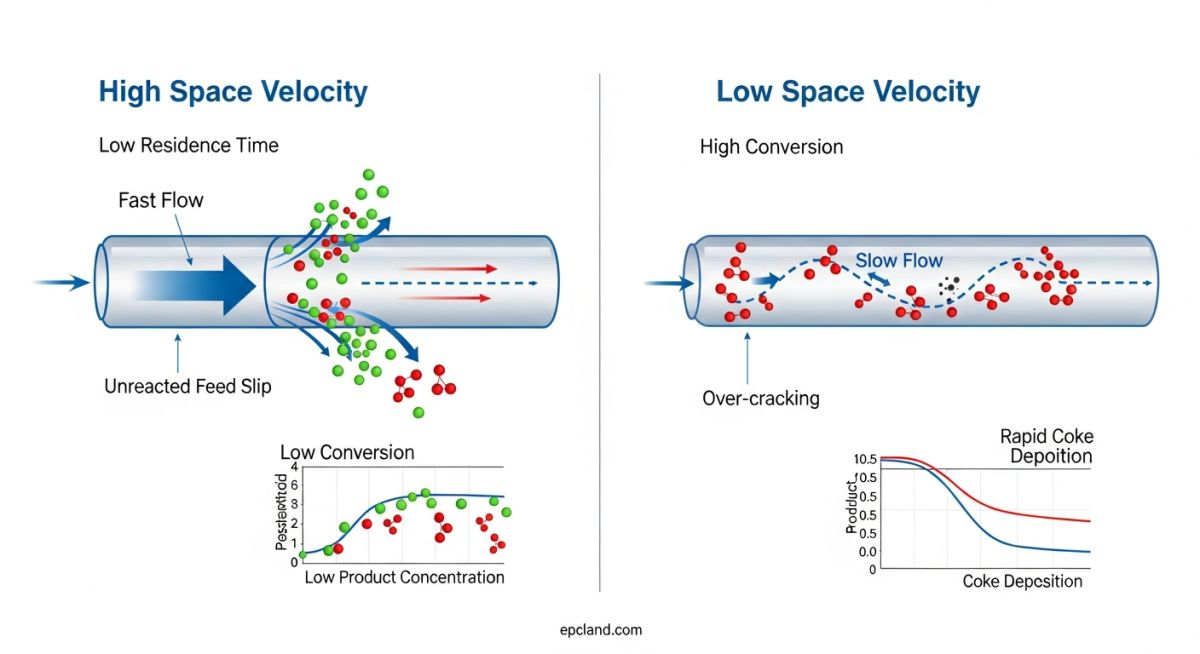
Think of it as the speed limit for your chemical kinetics. If you pump fluid through too quickly, the molecules breeze right past the active metal sites without changing form. If you run it too slowly, you starve the catalyst bed and trigger unwanted secondary reactions.
Types of Space Velocities inside Industrial Reactors
Depending on whether you are running a heavy liquid stream, a high-pressure gas system, or a mixed-phase unit, you will shift between different processing metrics. In the refinery, we primarily manage operations using two distinct benchmarks:
- Liquid Hourly Space Velocity (LHSV): This measures the liquid feed volumetric flow rate at standard reference conditions (typically 15 °C) divided by the volume of active catalyst. It is the go-to metric for hydrotreaters and hydrocrackers.
- Gas Hourly Space Velocity (GHSV): This tracks gas volumetric flow rates. Because gases compress and expand dramatically with process shifts, GHSV must always be calculated using normalized standard temperature and pressure parameters (0 °C and 1 bar absolute).
How LHSV Alters Hydrotreating Kinetics and Chemical Conversions
When managing hydrotreating units, shifting the LHSV changes your entire product purity profile. Increasing the fluid throughput reduces the contact time between your oil and the active catalyst sites. This change causes a sharp drop in desulfurization and denitrogenation efficiencies.
But here is the catch that many office-bound design engineers miss. When you push your throughput higher during plant capacity debottlenecking, your LHSV climbs. To keep your product on spec, you are forced to raise the reactor bed temperatures to speed up the reaction kinetics. Doing this accelerates your catalyst deactivation curves, shortening your runtime before the next turnaround.
The Impact of Liquid Space Velocity of Reactor on Feed Vaporization
Let us look at a physical issue that often occurs during low-load operations. When a refinery cuts throughput, engineers usually look at the lower LHSV and expect higher conversions. On paper, that is exactly what should happen.
In the field, things work differently. If you are processing a lighter fraction like naphtha or light kerosene, cutting the liquid flow rate significantly reduces your mass flux. At typical reactor operating temperatures, this drop can cause sudden, premature vaporization of your feed.
Instead of a steady liquid film coating your catalyst, a portion of the feed flashes into gas. This vapor moves through the bed gaps at much higher velocities than the liquid phase, drastically lowering the effective contact time. This creates dry catalyst zones that are highly vulnerable to localized overheating and rapid deactivation.
Complete Course on Piping Engineering by Atul Singla on EPCLAND
Step off the whiteboard and onto the processing floor. Learn the real-world engineering standards, hydraulic calculations, and reactor piping designs used to build multi-billion dollar refinery units.
Balancing Space Velocity of Reactor and Desulfurization Conversion
When you are running a Hydrodesulfurization (HDS) unit, managing the space velocity of reactor is a non-stop balancing act between throughput targets and product purity. The conversion kinetics follow power-law models where the product sulfur concentration depends heavily on the available contact time.
If your refinery pushes throughput above design capacity, the space velocity climbs, and your sulfur conversion profile drops. To maintain Euro VI or ultra-low sulfur diesel (ULSD) specifications, you must raise the reactor temperature to boost catalyst activity. However, operating at these elevated temperatures accelerates structural deactivation, shortening the lifespan of your catalyst bed.
Critical Correlation: Space Velocity of Reactor and Catalyst Coke Laydown
Dropping your space velocity too low introduces a serious operational risk: accelerated catalyst coke laydown. During plant turndowns, a very low LHSV significantly extends the time hydrocarbons spend inside the reactor bed.
This extended contact time causes the heavy hydrocarbons to over-crack, forming large polycyclic aromatics that deposit onto the catalyst as sticky, carbonaceous coke. This coke coating blinds the active metal sites and plugs the porous paths, driving up the bed’s differential pressure and ending your run prematurely.
Step-by-Step Calculation of Space Velocity of Reactor
Calculating space velocity accurately requires using the correct liquid reference states. The standard formula for Liquid Hourly Space Velocity is:
For gas streams, Gas Hourly Space Velocity uses a normalized flow rate to account for compressibility:
| Process Parameter | High Space Velocity Condition | Low Space Velocity Condition | Field Mitigation Method |
|---|---|---|---|
| Reactant Contact Time | Shortened contact time | Extended contact time | Adjust feed pump rates based on design charts |
| Chemical Conversion Profile | Reduced conversion (Product slip) | Elevated conversion (Over-cracking) | Modify bed operating temperatures |
| Catalyst Coking Velocity | Low coking tendency | Severe catalyst coke deposition | Inject hydrogen quench gas streams |
| Feed Vaporization Risks | Stable liquid wetting profile | High risk of dry-out flashing | Maintain minimum liquid mass flux targets |
What is Space-Time in Heterogeneous Catalysis?
Space-time (τ) is the exact mathematical inverse of your space velocity. It represents the theoretical time required to process one complete reactor volume of feed fluid through the bed under reference inlet conditions.
The Practical Field Difference: Residence Time vs. Space-Time
On the refinery floor, relying entirely on space-time can get you into trouble. Space-time treats the reactor as an empty vessel. To calculate the true hydrodynamic residence time, you must factor in the structural bed void fraction (ε) and actual operating fluid densities. The fluids travel only through the open gaps between catalyst pellets, making the true residence time much shorter than basic space-time suggests.
Atul Singla’s Field Space Velocity Calculator
Instantly evaluate LHSV, Space-Time, and estimated true residence times.
The Catalyst Killer: How an Unmonitored LHSV Turndown Coked a Diesel Hydrotreater Bed
When I was working on a refinery stabilization run out East, we faced an upstream logistics bottleneck that forced us to cut feed rates to our primary gas oil hydrotreater by 60%. The management team wanted to maintain product volumes at all costs, so we kept the furnace firing hot to maximize desulfurization metrics. On paper, our calculated liquid hourly space velocity dropped from a design value of 1.8 h-1 down to a sluggish 0.72 h-1. The immediate laboratory results looked spectacular; sulfur slips dropped to zero.
But here is the catch that hit us hard three weeks later. The extended contact time gave the heavy hydrocarbon fractions way too long inside the catalyst pores. Without the velocity needed to sweep the bed clean, high temperatures triggered rapid thermal cracking. Heavy polymers began building up directly onto the active molybdenum metal sites.
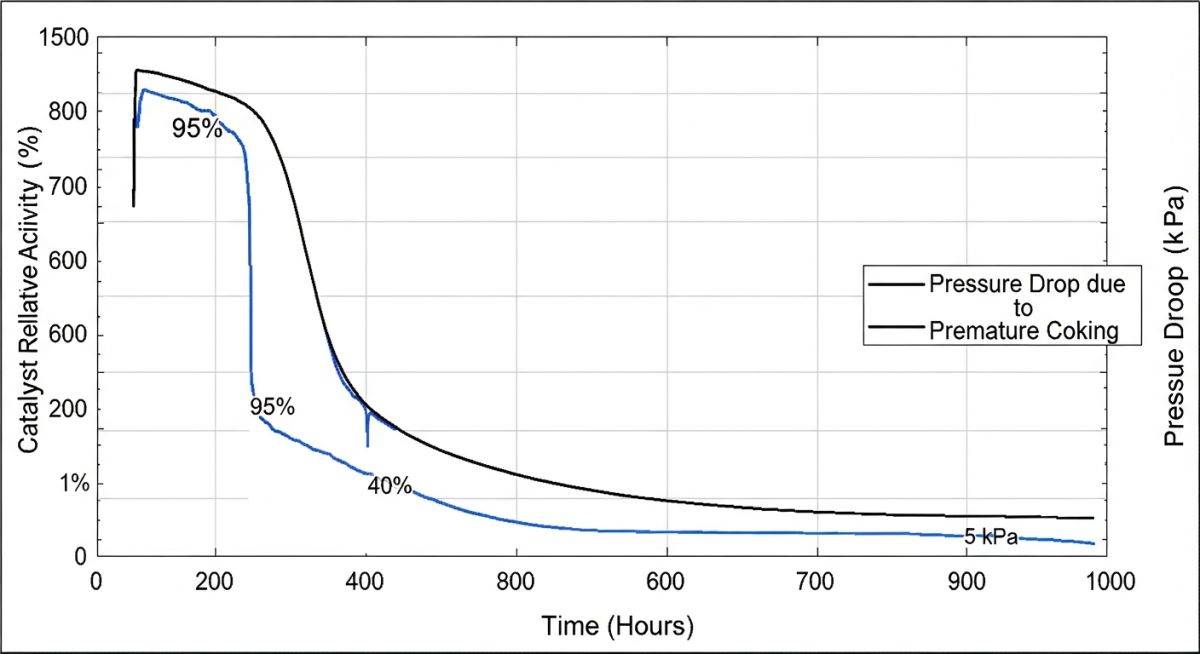
The first sign of real trouble was a sudden increase in the reactor’s differential pressure. The pressure drop shot up across the top catalyst layer, telling us fluid channels were plugging fast. When we finally shutdown and skimmed the bed, the top 20% of our multi-million dollar catalyst loading looked like a solid block of hard carbon charcoal.

Atul Singla
I am a veteran Piping Engineer focusing on refinery design, reactor optimization, and EPC project management execution. Over years of hands-on plant operations, I have managed massive catalyst changeouts, resolved severe hydrotreater imbalances, and designed piping hydraulics across the globe. Through EPCLAND, I share raw, field-tested engineering realities that bridge the gap between design theory and real-world execution.
Authority FAQ: Field Realities of **Space Velocity of Reactor** Management
Direct, experience-backed answers to the most complex space velocity anomalies encountered during plant operations.
1. Can you bypass high space velocity limits simply by increasing the reactor run temperature? ↓
2. Why does GHSV require reference standard conditions while LHSV does not? ↓
3. How does internal liquid channeling mock our calculated LHSV parameters? ↓
4. What is the impact of catalyst shape and size variations on space-time conversions? ↓
5. During a plant turndown, when is the risk of catalyst coking at its highest? ↓
6. How do multi-bed quench gas injections impact downstream space velocities? ↓
📚 Recommended Resources: Space Velocity of Reactor
Related posts:
![Split view of liquid pipeline terminal and gas compressor station representing ASME B31.4 vs B31.8 design standards.]()
B31.4 vs B31.8: Comparing ASME Pipeline Design Standards
![3D engineering visualization showing primary gravity loads on pipe supports versus secondary thermal expansion loads in a process plant.]()
Primary vs Secondary Loads in Piping Systems: Engineering Design Guide
![3D cross-section of a steel pipe undergoing mechanical stress and material strain analysis for industrial piping design.]()
Stress or Strain: Which Comes First in Piping Design?
![Technical diagram of the RFNBO-based sustainable aviation fuel production process for ReFuelEU Aviation compliance.]()
ReFuelEU Aviation and RFNBO-Based Sustainable Aviation Fuel Compliance Guide
![Process flow diagram of an e-Methanol plant showing green hydrogen and CO2 capture inputs meeting RFNBO compliance standards.]()
RFNBO Requirements for e-Methanol Projects: A Technical Compliance Guide
![Technical diagram of a mass balance accounting system for RFNBO production facilities under EU renewable energy directives.]()
Mass Balance Approach in RFNBO Certification: A Technical Guide