Understanding the Ratio of Specific Heats in Compressible Flow
In my 20 years of designing high-pressure piping systems, I have seen minor mathematical assumptions lead to catastrophic field failures. One parameter that engineers frequently oversimplify is the ratio of specific heats (gamma = C_p/C_v). Often treated as a constant 1.4 for air or 1.3 for natural gas, this ratio is actually a dynamic variable that changes with temperature and pressure. Ignoring its variability can lead to undersized relief valves, inaccurate compressor head calculations, and destructive acoustic fatigue in piping manifolds.
When I review process datasheets for offshore platforms or refinery expansions, the first thing I check is how the process simulation handled the gas properties. If the design team assumed a static specific heat ratio across a wide operating envelope, it flags an immediate risk. In this guide, I will share my practical field experience on why this ratio is the cornerstone of compressible flow design and how you can avoid costly mistakes in your piping and instrumentation layouts.
Key Engineering Takeaways
- Understand how molecular structure directly dictates the baseline value of gamma.
- Learn the mathematical impact of gamma on sonic velocity and choked flow calculations.
- Discover why real-gas deviations require dynamic thermodynamic modeling rather than ideal gas assumptions.
- Identify the specific industry standards, such as API 520 and ASME B31.3, where gamma plays a decisive role.
Complete Course on
Piping Engineering
Check Now
Key Features
- 125+ Hours Content
- 500+ Recorded Lectures
- 20+ Years Exp.
- Lifetime Access
Coverage
- Codes & Standards
- Layouts & Design
- Material Eng.
- Stress Analysis
Why Ratio of Specific Heats Governs Compressible Flow
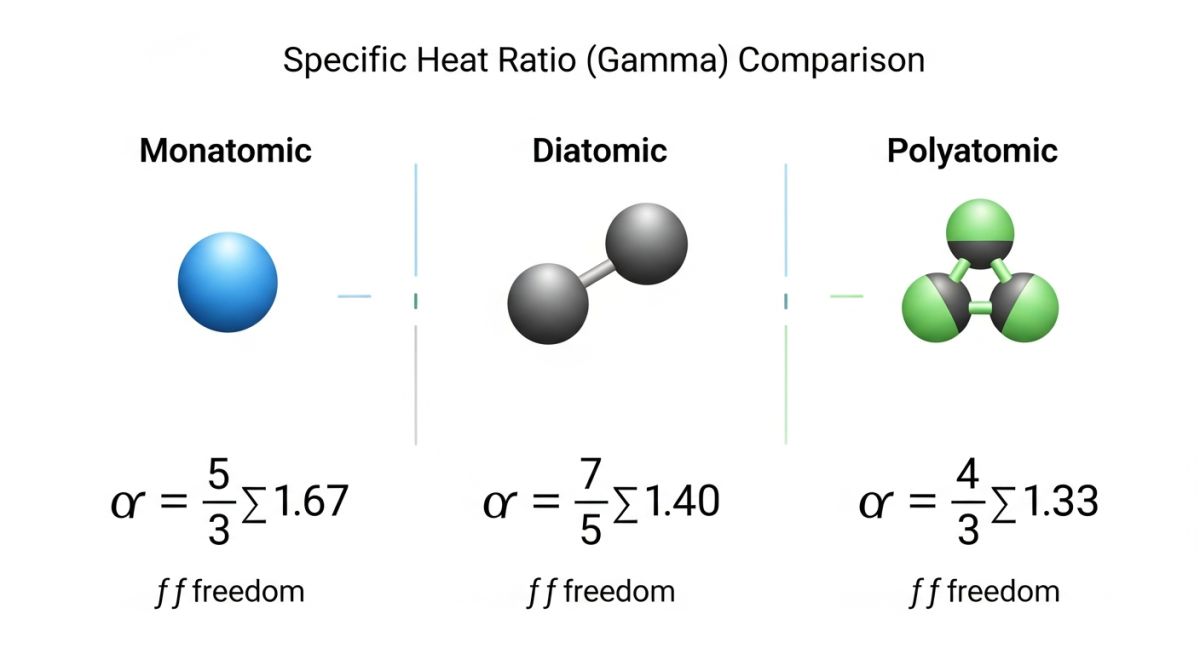
To understand why the ratio of specific heats is so critical, we must look at the molecular level. The specific heat at constant pressure (C_p) is always greater than the specific heat at constant volume (C_v) because a gas expanding at constant pressure must perform work on its surroundings. The ratio, gamma = C_p/C_v, represents the relative efficiency of a gas in converting thermal energy into work or kinetic energy.
For an ideal gas, the degrees of freedom of the molecule dictate this ratio. Monatomic gases (like Helium or Argon) have 3 translational degrees of freedom, yielding a gamma of approximately 1.67. Diatomic gases (like Nitrogen, Oxygen, or Air) have additional rotational degrees of freedom, resulting in a gamma of 1.40. Polyatomic gases (such as Carbon Dioxide or Methane) have vibrational degrees of freedom that absorb energy without raising temperature, dropping the gamma value to 1.30 or lower.
The Speed of Sound and Mach Number
In compressible fluid dynamics, the speed of sound (c) is the velocity at which small pressure disturbances propagate through a medium. It is calculated using the following thermodynamic relationship:
Where:
• γ = Ratio of specific heats (dimensionless)
• R = Universal gas constant (8.314 J/mol·K)
• T = Absolute temperature (Kelvin)
• M = Molecular weight of the gas (kg/mol)
Because the speed of sound is directly proportional to the square root of gamma, any error in selecting your specific heat ratio propagates directly into your Mach number (M = v/c) calculations. If your Mach number exceeds 0.3, you must treat the flow as compressible. If it approaches 1.0, you reach choked flow conditions, which is a critical design threshold for relief systems.
Isentropic Expansion and Compressor Design
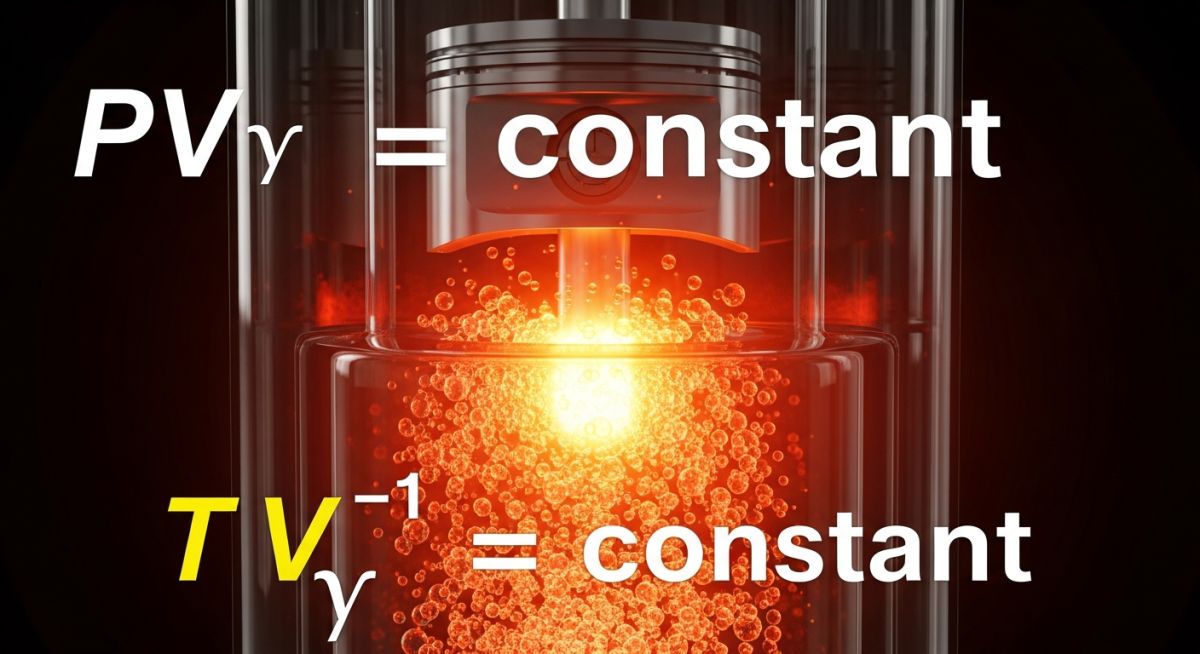
In centrifugal and reciprocating compressors, the compression process is often modeled as isentropic (reversible adiabatic). The relationship between pressure and temperature during this process is governed by:
If you are designing a compressor station for a gas with a high specific heat ratio, the discharge temperature will rise rapidly. This requires interstage cooling to prevent damage to seals and piping materials. Conversely, gases with low specific heat ratios (like heavy hydrocarbons) experience a much lower temperature rise for the same pressure ratio, which changes the thermal stress profile of the connected piping system designed under ASME B31.3.
The table below outlines the thermodynamic properties of common industrial gases at standard conditions (25°C, 1 atm). These values serve as the baseline for initial process calculations before accounting for high-pressure real-gas deviations.
| Gas Name | Formula | Molecular Weight (g/mol) | Cp (kJ/kg·K) | Cv (kJ/kg·K) | Ratio of Specific Heats (γ) |
|---|---|---|---|---|---|
| Helium | He | 4.003 | 5.193 | 3.116 | 1.667 |
| Nitrogen | N2 | 28.013 | 1.040 | 0.743 | 1.400 |
| Oxygen | O2 | 31.999 | 0.918 | 0.658 | 1.395 |
| Methane | CH4 | 16.043 | 2.225 | 1.707 | 1.304 |
| Carbon Dioxide | CO2 | 44.010 | 0.846 | 0.657 | 1.289 |
This matrix maps the core thermodynamic entities, physical parameters, and their corresponding industry standards to ensure compliance during detailed engineering phases.
| Parameter / Entity | Acronym | Primary Physical Impact | Governing Standard |
|---|---|---|---|
| Specific Heat Ratio | SHR / γ | Governs sonic velocity and isentropic temperature changes. | API STD 520 |
| Mach Number | Ma | Determines flow regime (subsonic vs. supersonic) in relief lines. | API STD 521 |
| Isentropic Coefficient | k | Used in real-gas equations of state for compressor head calculations. | ASME PTC 10 |
| Acoustic Induced Vibration | AIV | Predicts fatigue failure at piping branch connections due to high pressure drops. | EI Guidelines |
Verifying the Ratio of Specific Heats in Design
When executing a detailed piping design or auditing an existing facility, you must verify that the thermodynamic inputs match the actual operating conditions. Use this checklist during your design reviews to ensure compliance with ASME B31.3 and API 520/521.
Piping Design Verification Steps
-
Verify Gas Composition: Ensure that the process simulation uses the actual gas mixture composition rather than a generic “air” or “methane” approximation.
-
Check Temperature Dependency: Confirm that the specific heat ratio is modeled as a function of temperature, especially for systems operating above 150°C where vibrational modes activate.
-
Assess Real-Gas Deviations: For operating pressures exceeding 20 barg, ensure that the isentropic expansion coefficient (k) is used instead of the ideal gas gamma.
-
Audit Relief Valve Sizing: Cross-reference the relief valve datasheets to ensure the gamma value used matches the relieving temperature and pressure, not the normal operating conditions.
-
Evaluate Acoustic Induced Vibration (AIV): If the pressure drop across a restriction orifice or control valve is high, verify that the acoustic power calculations utilize the correct sonic velocity based on the local gamma.
Applying the Ratio of Specific Heats in Projects
In my career, I have seen how theoretical thermodynamic principles directly impact physical steel in the field. Below is a detailed breakdown of a project where an incorrect assumption regarding the specific heat ratio almost led to a major safety incident.
The Problem: Severe Vibration in a Natural Gas Compressor Station
During the commissioning of a natural gas compressor station in western Canada, the facility experienced severe, low-frequency piping vibrations whenever the compressor went into recycle mode. The engineering team had designed the bypass and surge control system assuming a constant specific heat ratio (gamma) of 1.30 for the natural gas mixture.
However, the actual gas composition was rich in heavy hydrocarbons (ethane and propane), and the compressor operated at a high pressure of 95 barg. At these conditions, the real-gas behavior deviated significantly from ideal gas assumptions. The actual isentropic exponent (k) at operating conditions was closer to 1.15, not 1.30.
The Outcome: Dynamic Modeling and Piping Remediation
Because the design team used an incorrect specific heat ratio, they overestimated the speed of sound in the gas mixture. This led to an incorrect calculation of the sonic velocity through the restriction orifice in the bypass line. The actual flow was transitioning into a highly turbulent, non-choked state that generated massive pressure pulsations, matching the mechanical natural frequency of the piping span.
I was brought in to troubleshoot the system. We recalculated the system dynamics using the Peng-Robinson equation of state to determine the true, pressure-dependent specific heat ratio. We resized the restriction orifice based on the corrected sonic velocity and added targeted pipe supports to shift the mechanical natural frequency. Once implemented, the vibration levels dropped by 85%, ensuring safe and continuous operation.
This project reinforced a vital lesson: never trust a default thermodynamic value in a software package. Always perform a sensitivity analysis on your gas properties, especially when dealing with high pressures or complex hydrocarbon mixtures.
Frequently Asked Engineering Questions
What is the difference between the ideal gas gamma and the real gas isentropic exponent?
How does temperature affect the ratio of specific heats?
Why is gamma critical for sizing pressure relief valves (PRVs)?
Can we assume a constant gamma for flare header design?
How does the specific heat ratio influence acoustic induced vibration (AIV)?
Which equation of state is best for calculating real-gas specific heat ratios?
===
