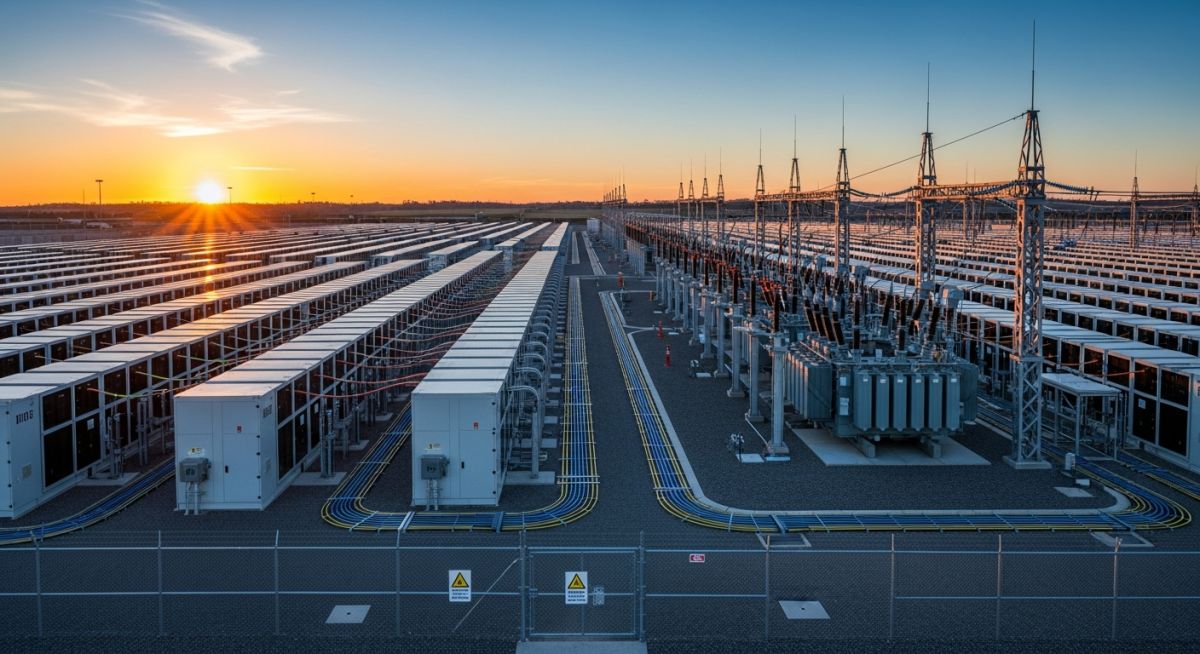
Strategic Site Selection Criteria for BESS Facilities
In my two decades of experience managing complex energy infrastructure, I have learned that the success of a Battery Energy Storage System (BESS) is determined long before the first container is placed on site. Selecting the right location is not merely about land availability; it is a rigorous engineering exercise that balances grid interconnection capacity, geotechnical stability, and environmental risk mitigation.
A poorly chosen site can lead to catastrophic project delays, ballooning civil costs, or even total asset failure due to thermal runaway risks or flooding. This guide provides the technical framework required to evaluate potential sites against industry standards, ensuring your project meets the stringent requirements of modern power grids.
Key Takeaways for Project Success
- Prioritize proximity to high-voltage substations to minimize transmission loss and interconnection costs.
- Conduct comprehensive geotechnical surveys to prevent differential settlement of heavy battery enclosures.
- Ensure site elevation remains above the 100-year flood plain to protect sensitive power electronics.
- Verify local zoning and environmental constraints early to avoid costly permitting bottlenecks.
Technical Analysis of BESS Site Selection Criteria
BESS Site Selection Criteria: The technical process of optimizing site layout based on electrical impedance, soil bearing capacity, and thermal management requirements as defined by IEEE 1635 and NFPA 855 standards.
When evaluating a site, the primary constraint is often the electrical interconnection. I calculate the “Interconnection Efficiency Ratio” by comparing the distance to the Point of Interconnection (POI) against the voltage drop across the collector system. For a typical 100MW BESS, keeping the distance under 500 meters is critical to maintaining system efficiency above 98%.
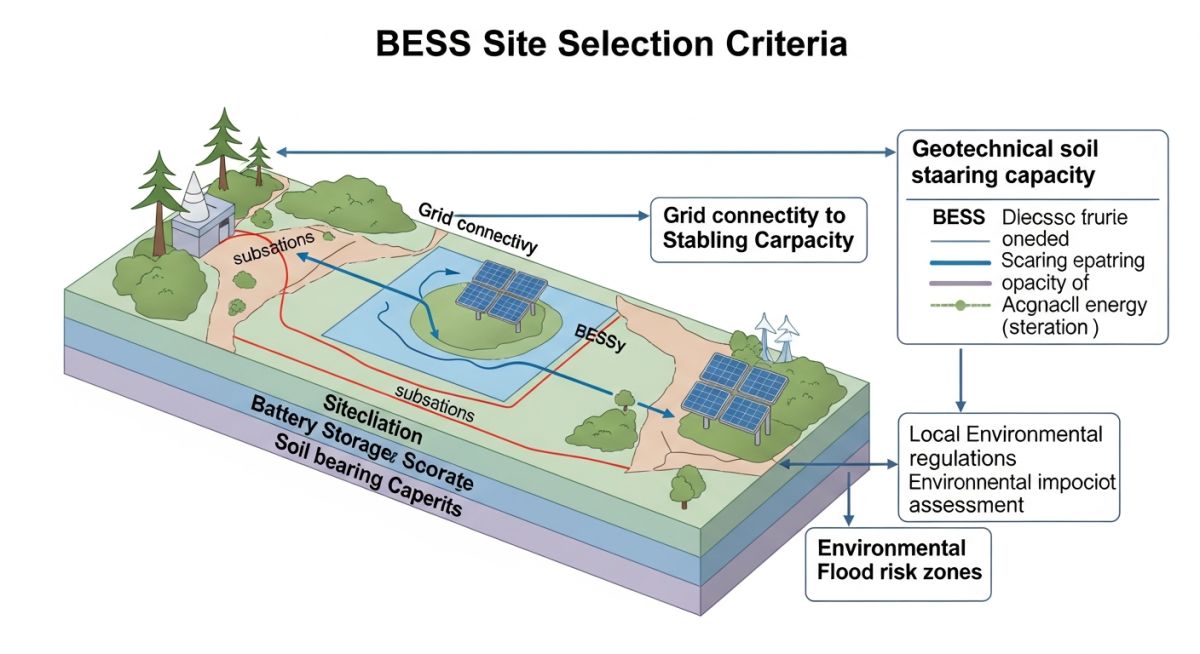
Geotechnical and Civil Engineering Parameters
Battery enclosures are exceptionally heavy, often exceeding 20,000 kg per unit. I mandate a minimum soil bearing capacity of 150 kPa for standard slab-on-grade foundations. If the site consists of expansive clays or loose fill, the risk of differential settlement increases, which can compromise the structural integrity of the battery racks and internal cooling piping.
Field Warning: Thermal Runaway Mitigation
Never place BESS units in low-lying areas prone to pooling. Water ingress into the battery management system (BMS) or power conversion system (PCS) cabinets can lead to short circuits. Always ensure a minimum 1% site grading away from all equipment pads to facilitate rapid drainage.
Grid Connectivity and Electrical Infrastructure
The site must accommodate the physical footprint of the substation and the required clearance for high-voltage switchgear. I utilize the ASCE 7 standards for wind and seismic loading to design the support structures for the overhead lines connecting the BESS to the grid. Failure to account for these loads can lead to catastrophic failure of the interconnection infrastructure during extreme weather events.
Furthermore, the thermal environment of the site dictates the cooling system design. In high-ambient temperature regions, I calculate the derating factor for the inverters. If the site ambient temperature exceeds 40 degrees Celsius, the cooling load increases exponentially, requiring larger HVAC units and potentially more land area for equipment spacing to ensure adequate airflow.
Strategic Site Evaluation: The comparative assessment of site-specific benefits versus inherent operational risks to optimize the long-term return on investment for energy storage assets.
Advantages of Optimized Selection
- Reduced civil works costs through natural site grading.
- Lower transmission losses via proximity to existing substations.
- Enhanced safety profiles by avoiding flood-prone zones.
- Faster permitting timelines due to minimal environmental impact.
- Improved thermal efficiency in naturally shaded or ventilated areas.
Disadvantages of Poor Site Selection
- High foundation costs due to poor soil bearing capacity.
- Increased risk of equipment damage from environmental hazards.
- Regulatory delays caused by proximity to sensitive habitats.
- Higher operational costs due to inefficient cooling requirements.
- Potential for grid interconnection rejection due to capacity limits.
Industrial Infrastructure Deployment: The application of rigorous site selection criteria across diverse sectors to ensure reliable energy storage integration and grid stability.
Utility-Scale Grid Balancing
Large-scale BESS facilities are deployed at transmission nodes to manage frequency regulation and peak shaving. These sites require massive land footprints and direct access to 115kV or higher voltage lines, necessitating careful evaluation of electromagnetic interference and noise mitigation for nearby residential zones.
Renewable Energy Co-location
Integrating BESS directly with solar or wind farms optimizes the use of existing interconnection infrastructure. The site selection here focuses on maximizing the shared footprint while ensuring that the battery cooling systems do not interfere with the thermal performance of the solar arrays or wind turbine foundations.
Industrial Microgrid Resilience
Manufacturing plants utilize BESS to provide uninterruptible power and reduce demand charges. Site selection in these environments is constrained by existing plant layouts, requiring creative engineering to integrate high-density storage within tight industrial footprints while maintaining fire safety separation distances.
Selecting a site for Battery Energy Storage Systems (BESS) requires a rigorous evaluation of physical and electrical constraints. The following table outlines the critical engineering parameters that dictate the feasibility of a project site, ensuring compliance with NFPA 855 and local grid interconnection standards. These metrics serve as the baseline for preliminary site assessment and risk mitigation strategies.
Engineers must prioritize these values during the feasibility phase to avoid costly redesigns or permitting delays. By aligning site characteristics with these thresholds, project teams can ensure that the structural, thermal, and electrical requirements of the BESS containers are fully supported by the underlying infrastructure.
| Parameter | Recommended Threshold | Standard Reference |
|---|---|---|
| Soil Bearing Capacity | Minimum 1500 psf (72 kPa) | ASTM D2487 |
| Flood Plain Elevation | Base Flood Elevation + 2 ft | FEMA FIRM |
| Grid Interconnection Distance | Less than 2 miles | IEEE 1547 |
| Ambient Temperature Range | -20C to +45C | IEC 62619 |
The following matrix maps the core technical entities involved in BESS site selection to their respective regulatory and physical domains. Understanding these relationships is vital for cross-disciplinary coordination between civil, electrical, and environmental engineering teams during the project lifecycle.
Each entity represents a specific risk vector or operational requirement that must be documented in the project’s ASCE-compliant design reports. By mapping these entities, we ensure that no critical site constraint is overlooked during the initial site selection criteria review process.
| Entity | Primary Function | Standard |
|---|---|---|
| BMS (Battery Management System) | Thermal and State-of-Charge monitoring | UL 1973 |
| PCS (Power Conversion System) | DC to AC power inversion | UL 1741 |
| HVAC/Thermal Management | Cell temperature regulation | ASHRAE 90.1 |
BESS Site Selection Criteria Verification: Before finalizing a site acquisition, I mandate a comprehensive site walk-down using this standardized checklist. This process ensures that all environmental, geotechnical, and grid-related variables are accounted for, minimizing the risk of “stranded assets” due to unforeseen site conditions.
- Geotechnical Stability: Verify soil compaction reports and ensure the site is free from liquefaction risks per ASTM D2487 standards.
- Flood Risk Assessment: Confirm the site is outside the 100-year flood zone and verify drainage patterns to prevent pooling around battery containers.
- Grid Connectivity: Validate the proximity to the point of interconnection (POI) and ensure the existing substation has sufficient capacity for the proposed BESS injection.
- Environmental Constraints: Conduct a Phase I Environmental Site Assessment (ESA) to identify potential soil contamination or protected habitat zones.
- Access Requirements: Confirm that site access roads can support heavy-haul transport vehicles (up to 80,000 lbs) for delivery of battery enclosures.
- Expansion Potential: Evaluate the site footprint to ensure space for future battery augmentation or additional PCS units as demand grows.
Each item on this checklist must be signed off by the lead project engineer. If any item fails, a mitigation plan must be developed before proceeding to the procurement phase. This rigorous approach is the only way to guarantee long-term operational safety and financial viability for grid-scale energy storage projects.
The Problem: Unforeseen Geotechnical Failure
During the development of a 50MW BESS facility, the project team encountered significant soil settlement issues that were not identified in the preliminary desktop study.
- Inadequate soil boring density during initial site selection.
- Presence of high-plasticity clay layers causing differential settlement.
- Failure to account for seasonal water table fluctuations.
- Resulting structural cracks in the concrete equipment pads.
The Outcome: Successful Remediation and Redesign
By implementing a deep foundation system and improving site drainage, the project was successfully commissioned within the revised timeline.
- Installation of helical piles to bypass unstable soil layers.
- Implementation of a robust sub-surface drainage network.
- Successful load testing of the foundation system per ASCE 7.
- Zero structural failures reported after 24 months of operation.
My recommendation for future projects is to always perform site-specific geotechnical borings at every proposed container location, rather than relying on regional soil maps. This small upfront investment prevents catastrophic foundation failure and ensures the longevity of the BESS infrastructure.
What is the minimum distance from a substation for BESS?
- Longer cable runs increase voltage drop and require larger conductor sizes.
- Increased distance raises the cost of trenching and conduit installation.
- Proximity to the substation simplifies the protection and control coordination required by IEEE 1547.
How does flood risk impact BESS site selection?
- Sites must be elevated at least 2 feet above the Base Flood Elevation (BFE).
- Engineers must review FEMA Flood Insurance Rate Maps (FIRM) for every potential site.
- If a site is in a flood-prone area, elevated concrete pads or pier foundations are mandatory to protect the equipment.
Why is geotechnical testing critical for BESS?
- Differential settlement can misalign internal battery racks and cooling systems.
- Soil bearing capacity must be verified to prevent long-term structural degradation.
- Geotechnical reports inform the design of the foundation, which is the most expensive civil component of the project.
What environmental permits are required for BESS?
- Phase I Environmental Site Assessments are standard to identify legacy contamination.
- Stormwater Pollution Prevention Plans (SWPPP) are required to manage runoff during construction.
- Local zoning boards may require noise impact studies due to the constant operation of HVAC cooling fans.
How do I evaluate expansion potential for BESS?
- Ensure the site layout includes “future-proof” space for additional battery blocks.
- Verify that the initial substation interconnection agreement allows for future capacity upgrades.
- Consider the physical footprint of auxiliary equipment like transformers and switchgear when planning site layout.
What are the fire safety requirements for BESS sites?
- Minimum separation distances between containers are required to prevent fire spread.
- Sites must have adequate fire department access and water supply for emergency response.
- Gas detection and ventilation systems are mandatory to mitigate the risk of explosive gas accumulation.
Complete Course on
Piping Engineering
Check Now
Key Features
- 125+ Hours Content
- 500+ Recorded Lectures
- 20+ Years Exp.
- Lifetime Access
Coverage
- Codes & Standards
- Layouts & Design
- Material Eng.
- Stress Analysis