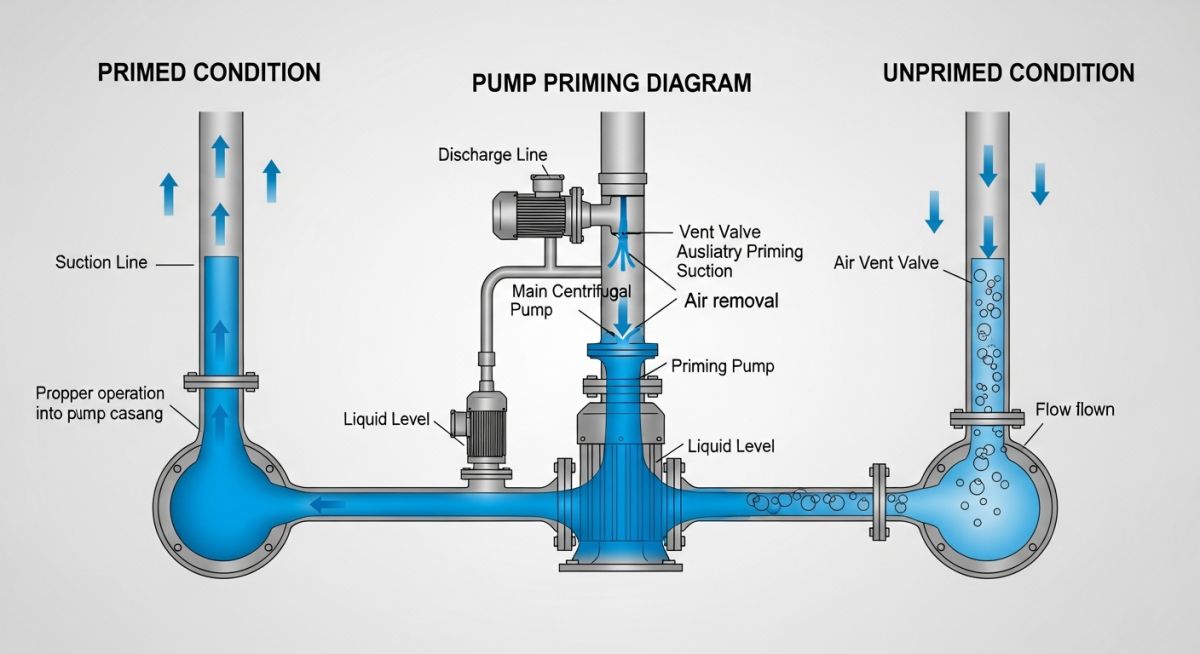
Pump Priming Explained with Methods and Industrial Applications
In my experience handling commissioning of large utility systems in methanol plants and water systems, I have seen pump failures within minutes simply due to improper priming. Many engineers underestimate this step, assuming that once a pump is installed, it will start delivering flow immediately — this is not true, especially for centrifugal pumps.
I still remember a commissioning case where a firewater pump failed repeatedly. The entire system was mechanically sound, but the suction line contained air pockets. The pump never developed suction head, resulting in seal failure. That incident reinforced one fundamental engineering reality — without priming, a centrifugal pump is just rotating metal with no hydraulic work.
Key Engineering Takeaways
- Pump priming removes air and establishes continuous liquid column in suction line
- Centrifugal pumps cannot self-initiate suction without priming
- Improper priming leads to cavitation, dry running, and seal failure
- Different industrial priming methods exist based on site constraints
- Self-priming pumps reduce dependency on external priming systems
Interactive Engineering Quiz
Q1: What is the primary purpose of pump priming?
Complete Course on
Piping Engineering
Check Now
Key Features
- 125+ Hours Content
- 500+ Recorded Lectures
- 20+ Years Exp.
- Lifetime Access
Coverage
- Codes & Standards
- Layouts & Design
- Material Eng.
- Stress Analysis
Why pump priming is technically required
Pump Priming Requirement: Pump priming is required to eliminate air or vapor from the suction system and establish a continuous liquid column so that the pump can generate sufficient suction head and begin hydraulic energy transfer as per centrifugal pump working principles.
In centrifugal pumps, the impeller imparts velocity to fluid. However, if air is present, the density reduces drastically. Since pressure generation depends on fluid density, air-filled systems cannot develop suction head.
Basic head equation used:
H = (P / ρg) + (V² / 2g) + Z
Where:
- H = Total head developed
- P = Pressure
- ρ = Fluid density
- V = Velocity
- Z = Elevation
When air is present in suction:
- Density reduces almost 800–1000 times
- Generated suction pressure becomes negligible
- Pump fails to lift liquid
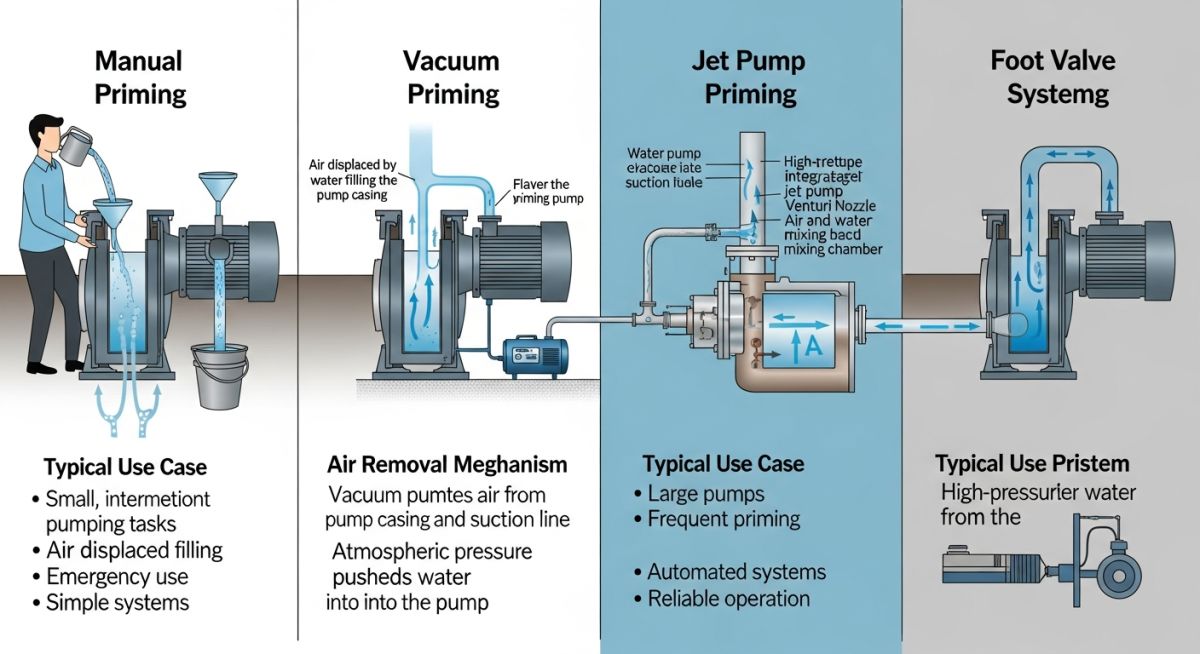
Pump priming methods used in industries
Pump Priming Methods: Pump priming methods are engineered techniques used to evacuate air from the pump casing and suction piping using manual, mechanical, or fluid dynamic systems depending on plant layout and process criticality.
Manual pump priming procedure on site
This is commonly used during commissioning:
- Open vent plugs on pump casing
- Fill suction line using external source
- Allow trapped air to escape
- Close vent once liquid overflows
Vacuum based pump priming system
Vacuum pumps are used to evacuate air:
- Creates negative pressure in suction line
- Atmospheric pressure pushes liquid upward
- Reliable for deep sump applications
Foot valve assisted priming system
A non-return valve installed at suction prevents backflow:
- Keeps suction line always flooded
- Reduces repetitive priming requirement
Jet pump and ejector priming system
Uses high velocity fluid to create suction:
- No moving parts involved
- Works in hazardous zones
| Parameter | Primed Condition | Unprimed Condition |
|---|---|---|
| Fluid Density | 1000 kg/m³ (water) | ~1.2 kg/m³ (air) |
| Suction Pressure | Develops normally | No suction generated |
| Pump Output | Stable flow | Zero or fluctuating |
| Seal Condition | Lubricated | Dry run failure |
| Pump Type | Priming Required | Reason | Typical Use |
|---|---|---|---|
| Centrifugal Pump | Yes | Cannot handle air | Water systems, cooling plants |
| Positive Displacement Pump | No | Creates suction naturally | Oil transfer, chemicals |
| Self-Priming Pump | No (initial fill required) | Internal recirculation design | Sewage, industrial drainage |
Pump priming checklist for site execution
Pump Priming Checklist: Pump priming checklist is a structured pre-startup verification process used to ensure that the suction line, pump casing, and associated components are completely filled with liquid and free from air pockets before commissioning as per ISO hydraulic system practices.
In my field commissioning work, I never allow a centrifugal pump to start unless this checklist is physically verified. Many failures occur not due to design errors but due to incomplete priming verification.
✅ Pre-Startup Pump Priming Checklist
- Suction line filled completely: Ensure no trapped air pockets exist in horizontal sections
- Pump casing vented: Open vent plugs and confirm continuous liquid overflow
- Foot valve condition checked: Verify non-return functionality to retain liquid column
- All suction joints leak-proof: Even small air ingress can break priming
- NRV and isolation valves aligned: Incorrect valve alignment leads to dry running
- Suction strainer cleaned: Blockage reduces NPSHa and affects priming stability
- Level of source tank adequate: Avoid vortex formation and air entrainment
- Vacuum system operational (if installed): Ensure proper suction evacuation
- Priming liquid compatibility checked: Avoid flashing or vapor formation
- Mechanical seal flushed: Prevent overheating during startup
Validation rules from field practice
- No air bubbles should be seen in sight glass or return lines
- Minimum suction pressure must match design NPSH requirement
- Priming should sustain at least 10–15 minutes without drop
- Test run should show stable discharge without fluctuation
Pump priming checklist for site execution
Pump Priming Checklist: Pump priming checklist is a structured pre-startup verification process used to ensure that the suction line, pump casing, and associated components are completely filled with liquid and free from air pockets before commissioning as per ISO hydraulic system practices.
In my field commissioning work, I never allow a centrifugal pump to start unless this checklist is physically verified. Many failures occur not due to design errors but due to incomplete priming verification.
✅ Pre-Startup Pump Priming Checklist
- Suction line filled completely: Ensure no trapped air pockets exist in horizontal sections
- Pump casing vented: Open vent plugs and confirm continuous liquid overflow
- Foot valve condition checked: Verify non-return functionality to retain liquid column
- All suction joints leak-proof: Even small air ingress can break priming
- NRV and isolation valves aligned: Incorrect valve alignment leads to dry running
- Suction strainer cleaned: Blockage reduces NPSHa and affects priming stability
- Level of source tank adequate: Avoid vortex formation and air entrainment
- Vacuum system operational (if installed): Ensure proper suction evacuation
- Priming liquid compatibility checked: Avoid flashing or vapor formation
- Mechanical seal flushed: Prevent overheating during startup
Validation rules from field practice
- No air bubbles should be seen in sight glass or return lines
- Minimum suction pressure must match design NPSH requirement
- Priming should sustain at least 10–15 minutes without drop
- Test run should show stable discharge without fluctuation
When is pump priming actually required
Pump Priming Requirement Timing: Pump priming is required whenever the suction line or casing contains air or vapor pockets and the system is not naturally flooded, particularly before initial startup and after maintenance shutdowns in centrifugal systems.
- Before first commissioning of new pump systems
- After maintenance or seal replacement
- When suction tank is below pump level
- After prolonged shutdown causing evaporation
Centrifugal vs positive displacement pump priming
Pump Priming Difference: Pump priming requirement differs based on pump design where centrifugal pumps require external priming while positive displacement pumps generate suction due to volumetric chamber expansion.
In my project executions, centrifugal pumps always demanded strict priming validation, whereas PD pumps like gear or screw pumps pulled fluid naturally, even with minor air presence.
What is a self priming pump concept
Self Priming Pump Definition: A self-priming pump is a modified centrifugal pump that retains liquid internally and recirculates it to evacuate air from suction lines without external priming systems after initial filling.
These pumps combine air-liquid separation chambers and recirculation passages to automatically restore priming condition during intermittent operation.
Precautions for self priming pump operation
Self Priming Pump Safety: Self priming pumps require proper initial filling and must never run dry beyond design limits to avoid overheating and internal recirculation failure.
- Initial casing fill is mandatory
- Avoid extended dry running beyond 2–3 minutes
- Maintain suction tightness to prevent air ingress
- Monitor temperature rise during operation
Advantages of self priming centrifugal pumps
Self Priming Pump Benefits: Self priming pumps reduce dependency on external priming systems and improve operational flexibility in intermittent and remote installations.
- Reduced manual intervention
- Lower installation complexity
- Improved uptime in remote systems
Limitations of self priming centrifugal pumps
Self Priming Pump Limitations: Self priming pumps have lower efficiency and limited suction lift capability due to internal recirculation and air handling design constraints.
- Reduced efficiency compared to standard pumps
- Limited lift height
- Higher maintenance if solids present
Field Case Study: Real-World Application
My Recommendation: Always treat priming verification as a mandatory commissioning step, not an optional check. Most failures originate from air ingress, not pump design faults.
Frequently Asked Engineering Questions
Why cannot centrifugal pumps handle air?
How long can a pump run without priming?
What is the easiest method of pump priming?
Can self priming pumps completely eliminate priming?
What is the role of a foot valve?
How to detect loss of pump priming?
