
Mastering Process Safety Management for Industrial Facility Integrity
In my two decades of experience navigating high-pressure piping and chemical processing plants, I have learned that safety is not merely a checklist—it is the bedrock of operational continuity. When we discuss Process Safety Management (PSM), we are talking about the technical discipline of preventing the unintended release of hazardous materials that could lead to fire, explosion, or toxic exposure.
Engineers often focus on the mechanical design of a pipe or vessel, but PSM forces us to look at the “system of systems.” It requires us to integrate mechanical integrity, management of change, and rigorous hazard analysis into every phase of the plant lifecycle. This guide explores how we bridge the gap between theoretical safety standards and the gritty reality of field operations.
Key Takeaways for Engineering Teams:
- Strict adherence to OSHA 1910.119 for all covered processes.
- Integration of Mechanical Integrity (MI) programs with predictive maintenance.
- Rigorous Management of Change (MOC) protocols to prevent “drift” in safety parameters.
- Utilization of quantitative risk assessment to prioritize capital expenditure on safety systems.
Technical Deep-Dive: Process Safety Management (PSM) and Process Safety
Process Safety Management (PSM) engineering: The application of rigorous analytical methods and standardized safety protocols to identify, evaluate, and control hazards associated with the processing of highly hazardous chemicals in industrial environments.
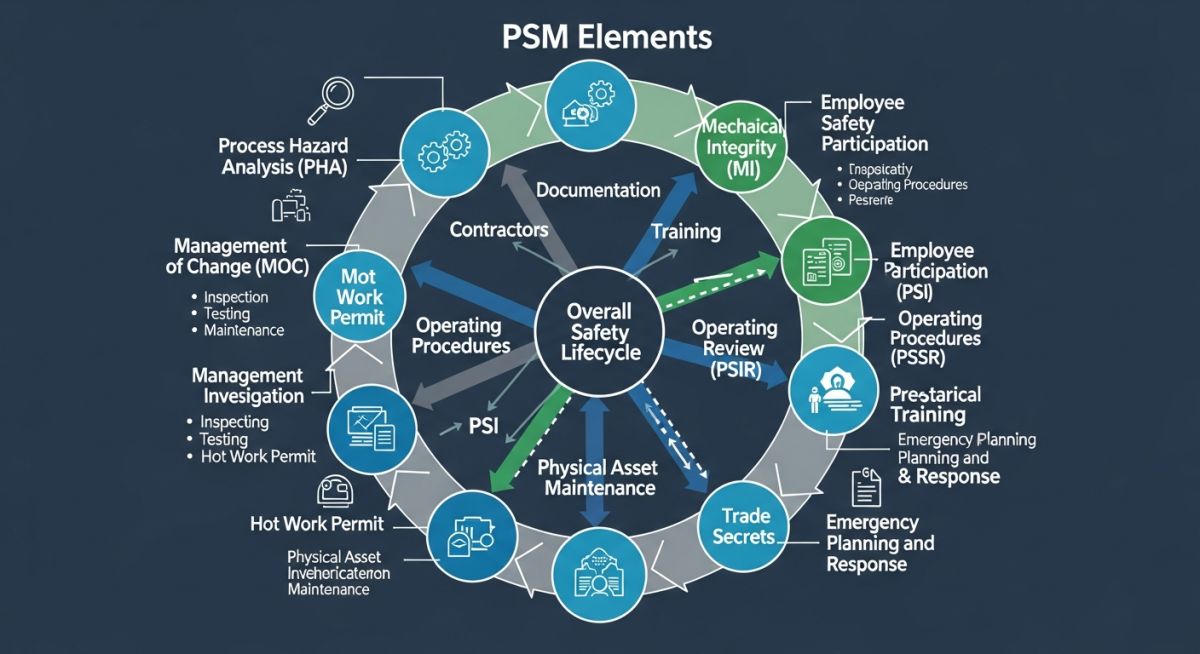
At the core of any robust PSM program lies the Process Hazard Analysis (PHA). As engineers, we utilize methodologies like HAZOP (Hazard and Operability Study) to systematically examine every node in a piping and instrumentation diagram (P&ID). We look for deviations—such as “more flow,” “less pressure,” or “reverse flow”—and determine the consequences of these deviations on the mechanical integrity of the system.
Mechanical Integrity (MI) is perhaps the most critical technical pillar. Under OSHA 1910.119(j), we are required to maintain the integrity of pressure vessels, piping systems, relief devices, and emergency shutdown systems. This is not just about inspection; it is about establishing a “fitness-for-service” assessment based on API 579 standards.
Engineering Calculation Note: Relief Valve Sizing
When calculating the required relief capacity for a blocked outlet scenario, we must account for the expansion of the fluid under fire exposure. The heat input (Q) is calculated using the formula Q = 21000 * F * A^0.82, where F is the environmental factor and A is the wetted surface area. Failure to accurately model the latent heat of vaporization for the specific process fluid often leads to undersized relief systems, a common violation in legacy plant audits.
Management of Change (MOC) is where most facilities fail. Any modification to the process—whether it is a change in catalyst, a change in piping material, or a change in control logic—must undergo a formal review. I have seen countless incidents where a simple “like-for-like” replacement of a valve resulted in a material incompatibility issue because the MOC process was bypassed.
Finally, we must address the “Human Element” in PSM. Engineering controls are only as effective as the operating procedures that govern them. We must ensure that our Standard Operating Procedures (SOPs) are updated in real-time to reflect the current state of the plant. If the P&ID does not match the field installation, the PHA is fundamentally flawed, and the facility is operating in a state of unquantified risk.
PSM implementation benefits: A structured approach to risk reduction that enhances operational reliability, ensures regulatory compliance, and protects capital assets from catastrophic failure.
Advantages
- Significant reduction in the probability of Loss of Primary Containment (LOPC) events.
- Improved operational efficiency through standardized maintenance and inspection intervals.
- Enhanced legal defensibility during regulatory audits and insurance risk assessments.
- Clearer communication of process hazards to frontline operators and maintenance staff.
Disadvantages
- High initial administrative burden to document and maintain the 14 elements of PSM.
- Potential for “analysis paralysis” where excessive documentation slows down necessary field repairs.
- Requires significant cultural shift to move from reactive maintenance to proactive safety management.
- High cost of specialized training and software tools required for effective PHA and MOC tracking.
Industrial safety deployment: The strategic application of PSM principles across diverse chemical and energy sectors to manage high-pressure, high-temperature, and toxic process streams.
Refinery Hydroprocessing Units
Hydroprocessing units operate at extreme pressures and temperatures, necessitating strict adherence to PSM for hydrogen management. We implement rigorous MOC for any piping modifications to prevent hydrogen embrittlement and ensure the integrity of high-alloy steel components.
Ammonia Storage and Distribution
Anhydrous ammonia facilities rely on PSM to manage the toxic release potential of large-scale storage tanks. Our focus here is on the mechanical integrity of relief valves and the automated detection systems that trigger emergency isolation in the event of a leak.
Petrochemical Polymerization Reactors
Polymerization processes are highly exothermic and prone to runaway reactions if cooling systems fail. PSM provides the framework for Safety Instrumented Systems (SIS) that automatically quench the reaction when critical temperature thresholds are breached.
In my two decades of field experience, I have observed that effective Process Safety Management (PSM) relies heavily on the transition from lagging indicators to leading indicators. While lagging indicators like the Total Recordable Incident Rate (TRIR) tell us what went wrong, leading indicators provide the predictive intelligence necessary to prevent a catastrophic release before it occurs. The table below outlines the critical performance metrics that every facility manager must track to maintain compliance with OSHA 1910.119.
These metrics are not merely administrative burdens; they are the pulse of your process safety culture. By monitoring the frequency of pressure relief valve testing, the backlog of critical safety work orders, and the completion rate of Management of Change (MOC) reviews, you gain a quantitative view of your facility’s risk profile. I recommend reviewing these data points during monthly safety committee meetings to ensure that deviations from the safety baseline are addressed immediately through corrective action plans.
| Metric Category | Key Performance Indicator | Target Frequency |
|---|---|---|
| Mechanical Integrity | Critical Equipment Inspection Backlog | Zero Overdue Items |
| Process Safety | MOC Review Cycle Time | Under 30 Days |
| Operational Discipline | SOP Periodic Review Completion | 100% Annually |
The complexity of modern chemical processing requires a structured approach to data management and regulatory alignment. This matrix serves as a technical bridge between the physical assets on the plant floor and the high-level regulatory requirements mandated by global safety standards. By mapping specific engineering entities to their corresponding ASME and API standards, we ensure that every component—from a simple relief valve to a complex distributed control system—is documented and maintained within its design envelope.
I have found that engineers often struggle with the intersection of legacy equipment and modern safety requirements. This matrix clarifies the relationship between hardware, software, and the governing safety protocols. Use this as a reference when conducting your next Process Hazard Analysis (PHA) to ensure that all safety-critical elements are properly identified and that their maintenance intervals are aligned with the manufacturer’s recommendations and industry best practices.
| Entity | Standard Reference | Primary Function |
|---|---|---|
| Pressure Relief Systems | API 520/521 | Overpressure Protection |
| Storage Tanks | API 650 | Containment Integrity |
| Safety Instrumented Systems | IEC 61511 | Automated Risk Mitigation |
Process Safety Management Compliance Verification: Ensuring your facility meets the rigorous demands of OSHA 1910.119 requires a systematic approach to site verification. I have developed this checklist to help you audit your current safety posture against industry-standard expectations. Use this during your quarterly internal audits to identify gaps in documentation, training, or physical equipment integrity.
-
PHA Currency: Verify that the Process Hazard Analysis (PHA) has been revalidated within the last five years by a qualified team. -
MOC Documentation: Confirm that every physical or procedural change has a signed-off Management of Change (MOC) form, including updated P&IDs. -
Mechanical Integrity: Ensure all safety-critical equipment (e.g., relief valves, interlocks) is tagged and included in the preventive maintenance schedule. -
Operating Procedures: Audit Standard Operating Procedures (SOPs) to ensure they reflect current field conditions and include clear emergency shutdown steps. -
Training Records: Validate that all operators have completed refresher training on process safety and emergency response within the required intervals.
When performing these checks, do not rely solely on digital records. Walk the floor. Compare the P&IDs against the actual piping configuration. If you find a bypass line that isn’t on the drawing, you have an immediate MOC violation. My experience shows that the most dangerous risks are often the ones that have been “normalized” over time. Treat every discrepancy as a potential precursor to an incident and document the path to resolution immediately.
The Problem: Uncontrolled Pressure Surge in a Hydrocarbon Feed Line
A mid-sized refinery experienced a near-miss incident when a downstream block valve was closed too rapidly, causing a pressure surge that exceeded the design pressure of the upstream piping.
- Lack of automated surge protection logic in the control system.
- Inadequate training on the specific risks of rapid valve closure for high-viscosity fluids.
- Outdated P&IDs that failed to show the correct pressure rating of the upstream piping segment.
- Failure to conduct a thorough PHA for the specific valve operation sequence.
The Outcome: Implementation of Robust Safety Controls
Following the incident, the facility successfully overhauled its operational safety protocols and physical infrastructure to prevent recurrence.
- Installed automated slow-close actuators on all critical block valves.
- Updated the PHA to include transient pressure analysis for all high-flow lines.
- Implemented a mandatory MOC review for any changes to valve closure timing.
- Achieved a 100% compliance rate for operator training on surge mitigation procedures.
My recommendation based on this case is to always perform a transient analysis during the design phase of any piping system. Never assume that standard valve operation times are safe for all fluid types. If you are retrofitting an existing system, prioritize the installation of pressure-relieving devices or automated control logic that prevents the operator from creating a dangerous surge condition.
What is the primary goal of Process Safety Management?
- Maintaining the containment of hazardous materials within the process equipment.
- Ensuring that design, operation, and maintenance are aligned with safety standards.
- Reducing the likelihood of low-frequency, high-consequence events.
- Protecting the surrounding community and environment from industrial accidents.
How often should a Process Hazard Analysis be revalidated?
- Revalidate immediately following any major process change or incident.
- Conduct interim reviews if new process safety information becomes available.
- Ensure the team includes personnel with direct operational experience.
- Document all findings and track the closure of recommendations to completion.
What constitutes a change under the MOC process?
- Changes to process chemistry or raw material specifications.
- Modifications to control system logic or safety instrumented systems.
- Changes to operating limits, such as temperature or pressure setpoints.
- Temporary bypasses or “jumpers” installed during maintenance activities.
Why is mechanical integrity critical for PSM?
- Prevents leaks caused by corrosion, erosion, or fatigue.
- Ensures that safety devices like relief valves function on demand.
- Maintains the reliability of pumps, vessels, and piping systems.
- Provides the foundation for all other process safety controls.
How do I handle legacy equipment in a PSM audit?
- Verify the current condition through non-destructive testing (NDT).
- Compare existing design parameters against current ASME codes.
- Document the rationale for continued use if full compliance is not feasible.
- Implement enhanced monitoring or reduced operating limits to mitigate risk.
What is the role of the operator in PSM?
- Reporting abnormal process conditions before they escalate.
- Following established SOPs without unauthorized deviations.
- Participating in PHA sessions to provide real-world operational insights.
- Maintaining situational awareness during startup, shutdown, and emergency events.
📚 Recommended Resources: Process Safety Management
Read these Guides


Complete Course on
Piping Engineering
Check Now
Key Features
- 125+ Hours Content
- 500+ Recorded Lectures
- 20+ Years Exp.
- Lifetime Access
Coverage
- Codes & Standards
- Layouts & Design
- Material Eng.
- Stress Analysis
