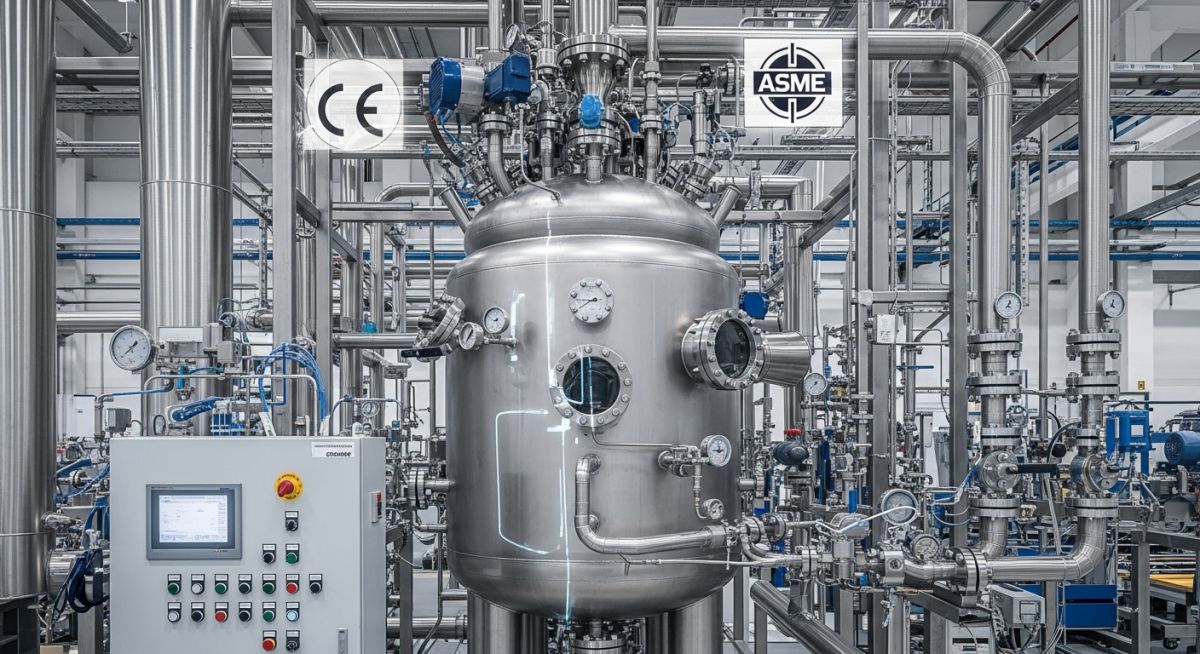
What is the Pressure Equipment Directive (PED)? | PED vs ASME
In my 20 plus years of managing piping systems and pressure vessel fabrication across Europe and North America, I have seen many brilliant engineers stumble when crossing the regulatory bridge between the US and the EU. The transition from the highly prescriptive rules of the ASME Boiler and Pressure Vessel Code to the performance-based requirements of the European Union’s Pressure Equipment Directive (PED) is a common source of project delays, cost overruns, and compliance failures.
Understanding how these two systems interact is not just an academic exercise; it is a commercial necessity. If you are exporting skid-mounted equipment, designing chemical plants, or manufacturing valves for the global market, you must master the nuances of both frameworks. Let us break down the technical realities of the PED, map its hazard categories, and compare its core philosophy directly with ASME.
Key Engineering Takeaways
- The PED is a legally mandated directive in the EU, whereas ASME is a voluntary standard unless adopted by local jurisdictions.
- Equipment classification under PED depends on fluid state, fluid group hazard level, volume, and maximum allowable pressure.
- ASME materials require a formal Particular Material Appraisal (PMA) to prove compliance with European safety objectives.
- Hydrostatic test pressure calculations differ significantly between the two standards, requiring careful verification.
- Early involvement of a Notified Body (NoBo) is the most effective way to prevent costly retrospective compliance issues.
How Does the Pressure Equipment Directive Apply?
Pressure Equipment Directive Application: The Pressure Equipment Directive applies to the design, fabrication, and conformity assessment of pressure equipment and assemblies with a maximum allowable pressure greater than 0.5 bar. This legal framework categorizes equipment into hazard categories based on fluid state, fluid group, volume, or nominal size to determine the required level of third-party inspection.
To achieve compliance with the PED 2014/68/EU Directive, a manufacturer must first determine where their equipment falls within the hazard spectrum. The directive defines four distinct hazard categories, ranging from Category I (lowest risk) to Category IV (highest risk). Equipment that falls below Category I is classified under Sound Engineering Practice (SEP) and cannot bear the CE mark, though it must still be safe for operation.
The Hazard Categorization Process
The classification process is highly systematic. As a design engineer, I follow these exact steps to determine the hazard category:
- Identify the Equipment Type: Determine if the item is a vessel, steam generator, piping system, or a safety accessory.
- Determine the State of the Fluid: Classify the fluid as a gas (including liquefied gases, gases dissolved under pressure, and vapors) or a liquid (with a vapor pressure at the maximum allowable temperature of not more than 0.5 bar above normal atmospheric pressure).
-
Classify the Fluid Group:
- Group 1 (Hazardous): Fluids that are explosive, extremely flammable, highly flammable, flammable, pyrophoric, toxic, or oxidizing.
- Group 2 (Non-Hazardous): All other fluids, including steam, water, and non-toxic gases.
- Calculate the Physical Parameters: For vessels, calculate the product of the Maximum Allowable Pressure (PS in bar) and the Volume (V in liters). For piping, calculate the product of PS and the Nominal Size (DN).
- Consult the Conformity Assessment Graphs: Map these values onto the appropriate PED Annex II graph to find the category.
Never assume a fluid is Group 2 without verifying its chemical safety data sheet. I once witnessed a project where a nitrogen-rich process gas containing trace amounts of hydrogen sulfide was classified as Group 2. Because hydrogen sulfide is highly toxic, the fluid actually belonged to Group 1. This mistake pushed the piping system from Category II to Category III, requiring a completely different conformity module and invalidating weeks of fabrication work because the welder qualifications had not been witnessed by a Notified Body.
Conformity Assessment Modules
Once the category is established, the manufacturer must select a conformity assessment module. These modules dictate the level of involvement of a Notified Body (NoBo), which is an independent third-party organization authorized by European member states to verify compliance.
- Category I (Module A): Internal production control. The manufacturer self-declares compliance and applies the CE mark without NoBo intervention.
- Category II (Modules A2, D1, E1): Requires NoBo involvement for unexpected visits or quality system monitoring.
- Category III (Modules B+C2, B+D, B+F, H): Requires NoBo design examination, type examination, or full quality assurance certification.
- Category IV (Modules B+D, B+F, G, H1): The highest level of scrutiny. Module G covers unit verification, where the NoBo examines every single item of equipment individually.
The Particular Material Appraisal (PMA)
One of the most significant technical hurdles when using ASME materials under the PED is material qualification. The PED requires materials to have “safe behavior” and to be documented via one of three routes: a Harmonized European Standard (EN), a European Approval for Materials (EAM), or a Particular Material Appraisal (PMA).
Because ASME materials (such as SA-516 Gr. 70 or SA-106 Gr. B) are not listed in harmonized European standards, you must perform a PMA. This is a detailed technical document where the manufacturer proves that the ASME material satisfies the Essential Safety Requirements (ESRs) of the PED. This includes verifying that the material has sufficient ductility (minimum 14% elongation after fracture) and impact strength (minimum 27 Joules at the lowest operating temperature).
Comparing Pressure Equipment Directive and ASME Codes
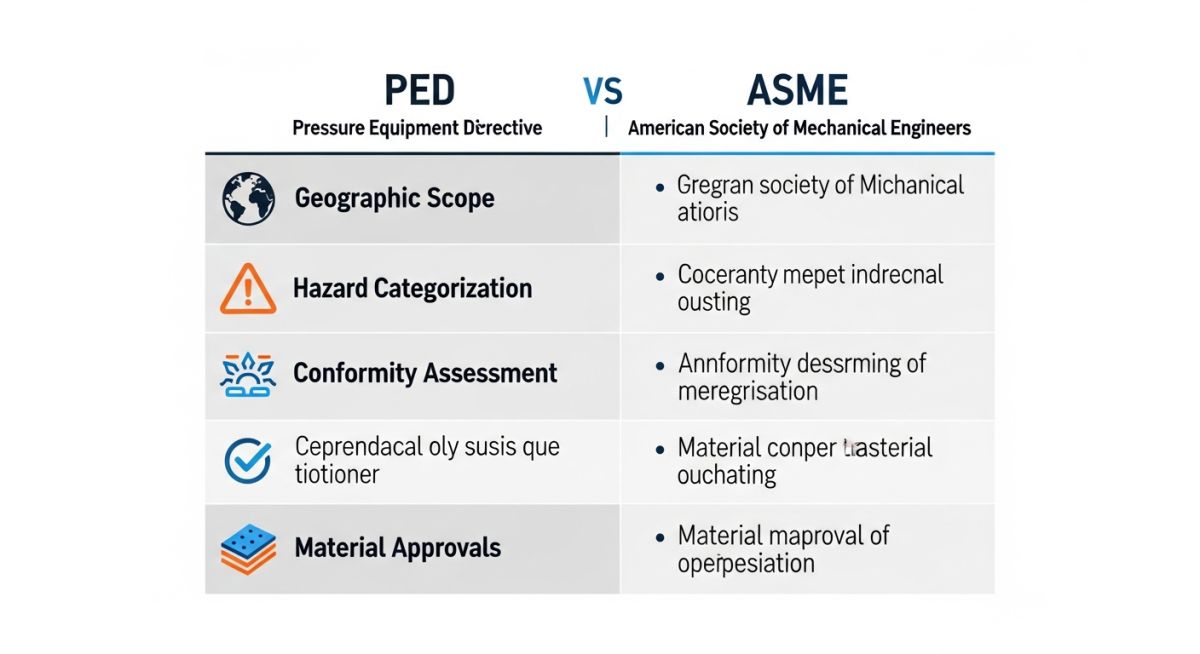
PED vs ASME Comparison: The comparison between the Pressure Equipment Directive and the ASME Boiler and Pressure Vessel Code highlights the fundamental difference between a legally mandated, performance-based safety directive and a highly prescriptive, rules-based engineering standard. While PED defines broad safety objectives, ASME provides specific, detailed formulas and design rules to achieve compliance.
To help you navigate these differences, I have compiled a comprehensive comparison table based on my field experience managing dual-certified projects.
| Technical Parameter | Pressure Equipment Directive (PED) | ASME BPVC Section VIII Div 1 |
|---|---|---|
| Legal Status | Mandatory law across the European Economic Area (EEA). | Voluntary standard unless adopted by local state or national laws. |
| Design Philosophy | Performance-based. Sets Essential Safety Requirements (ESRs) without prescribing specific design formulas. | Prescriptive rules-based. Provides exact formulas, allowable stresses, and design configurations. |
| Material Qualification | Requires Harmonized Standards, EAMs, or Particular Material Appraisals (PMA). | Requires materials listed in ASME Section II. Non-ASME materials are generally prohibited. |
| Third-Party Inspection | Performed by a Notified Body (NoBo) selected by the manufacturer. | Performed by an Authorized Inspector (AI) commissioned by the National Board. |
| Hydrostatic Test Pressure | Typically Pt = 1.43 * PS or Pt = 1.25 * PS * (fa / ft), whichever is greater. | Typically Pt = 1.3 * MAWP * (S_test / S_design). |
| Welder & NDT Approval | Must be approved by a Recognized Third-Party Organization (RTPO) for Categories II, III, and IV. | Qualified by the manufacturer in accordance with ASME Section IX. |
| Entity / Acronym | Technical Definition | Regulatory Reference | Compliance Impact |
|---|---|---|---|
| NoBo (Notified Body) | Independent conformity assessment body designated by an EU member state. | PED Article 24 | Mandatory for design review and fabrication oversight in Categories II, III, and IV. |
| PMA (Particular Material Appraisal) | A document defining the suitability of a non-harmonized material for pressure equipment. | PED Annex I, Section 4.2.c | Required for all ASME materials used in PED-compliant equipment. |
| SEP (Sound Engineering Practice) | A classification for low-risk equipment that does not meet the threshold for Category I. | PED Article 4, Paragraph 3 | Must be safe, but cannot bear the CE mark or undergo NoBo review. |
| ESR (Essential Safety Requirements) | The mandatory safety objectives regarding design, manufacturing, and materials. | PED Annex I | The core legal requirements that must be satisfied to achieve compliance. |
| RTPO (Recognized Third-Party Org.) | An independent body approved to qualify welding procedures and NDT personnel. | PED Article 20 | Required for welding and NDT approvals in Categories II, III, and IV. |
How to Verify Pressure Equipment Compliance?
Conformity Assessment Verification: The systematic validation of design calculations, material certificates, welder qualifications, and non-destructive testing procedures against the applicable PED module. This process ensures that all pressure equipment entering service complies with the Essential Safety Requirements of Directive 2014/68/EU.
When I perform a site audit or review a manufacturer’s data book for PED compliance, I use a rigorous verification protocol. Skipping even a minor step can lead to a non-compliance finding, which can halt plant commissioning or lead to equipment rejection at the border.
Site Verification Checklist
-
Fluid Group and State Validation: Verify that the process fluid has been correctly classified as Group 1 or Group 2, and that the state of the fluid (gas or liquid) matches the design basis.
-
Hazard Category Calculation: Re-calculate the PS x V or PS x DN values to confirm the correct hazard category and selected conformity module.
-
Material Traceability (PMA): Ensure all ASME materials have a completed Particular Material Appraisal (PMA) that has been reviewed and accepted by the Notified Body.
-
Welding Procedure Qualifications (WPQR): Confirm that all welding procedures are qualified in accordance with ISO 15614 or ASME Section IX, and have been endorsed by an RTPO.
-
NDT Personnel Certification: Verify that non-destructive testing personnel are certified to ISO 9712 or equivalent, and approved by an RTPO for Category III and IV equipment.
-
Hydrostatic Proof Test: Witness the final hydrostatic test and verify that the test pressure meets the minimum requirements of PED Annex I, Section 3.2.2.
-
CE Marking and Declaration: Confirm that the nameplate contains the CE mark followed by the Notified Body’s four-digit identification number, and that a formal Declaration of Conformity is issued.
Field Case Study: Real-World Application
A US-based skid manufacturer designed and fabricated a chemical dosing system destined for a refinery in Germany. The engineering team designed the entire piping system to ASME B31.3 and the pressure vessels to ASME Section VIII Division 1. They assumed that because ASME is a globally recognized standard, the equipment would be accepted without issue.
However, they failed to perform a Particular Material Appraisal (PMA) for the ASME-grade materials (SA-106 Gr. B piping and SA-240 316L plate) and did not involve a Notified Body (NoBo) during the design or fabrication phases. Upon arrival at the Rotterdam port, customs officials rejected the shipment because the equipment lacked the mandatory CE marking and did not comply with the Pressure Equipment Directive.
I was brought in as a consultant to resolve this compliance crisis. Because the equipment was already fabricated, we had to execute a retrospective conformity assessment under Module G (Unit Verification). This required a massive engineering effort:
- We performed a retrospective Particular Material Appraisal (PMA) to prove that the ASME materials met the ductility and impact requirements of the PED.
- We had to perform supplementary non-destructive testing (NDT) using RTPO-approved technicians to verify weld quality.
- We coordinated with a European Notified Body to review the design calculations, witness a repeat hydrostatic test at the port warehouse, and issue the conformity certificate.
While we successfully cleared the equipment for entry into Germany, the mistake cost the client 45,000 in port storage fees, testing costs, and consultant fees, along with a six-week project delay. This case highlights why integrating PED requirements during the initial design phase is a financial necessity.
My direct recommendation for any global project is to establish a compliance matrix on day one. If your equipment is bound for Europe, do not treat the PED as an afterthought. Design to ASME rules if required, but overlay the PED Essential Safety Requirements from the very beginning.
Frequently Asked Engineering Questions
Can I use ASME materials for a PED-compliant pressure vessel?
What is a Notified Body (NoBo) and when do I need one?
What is Sound Engineering Practice (SEP) under the PED?
How does the hydrostatic test pressure calculation differ between PED and ASME?
Are welding procedures qualified under ASME Section IX acceptable for PED?
Is a CE mark mandatory for all pressure equipment sold in Europe?
===
Complete Course on
Piping Engineering
Check Now
Key Features
- 125+ Hours Content
- 500+ Recorded Lectures
- 20+ Years Exp.
- Lifetime Access
Coverage
- Codes & Standards
- Layouts & Design
- Material Eng.
- Stress Analysis
