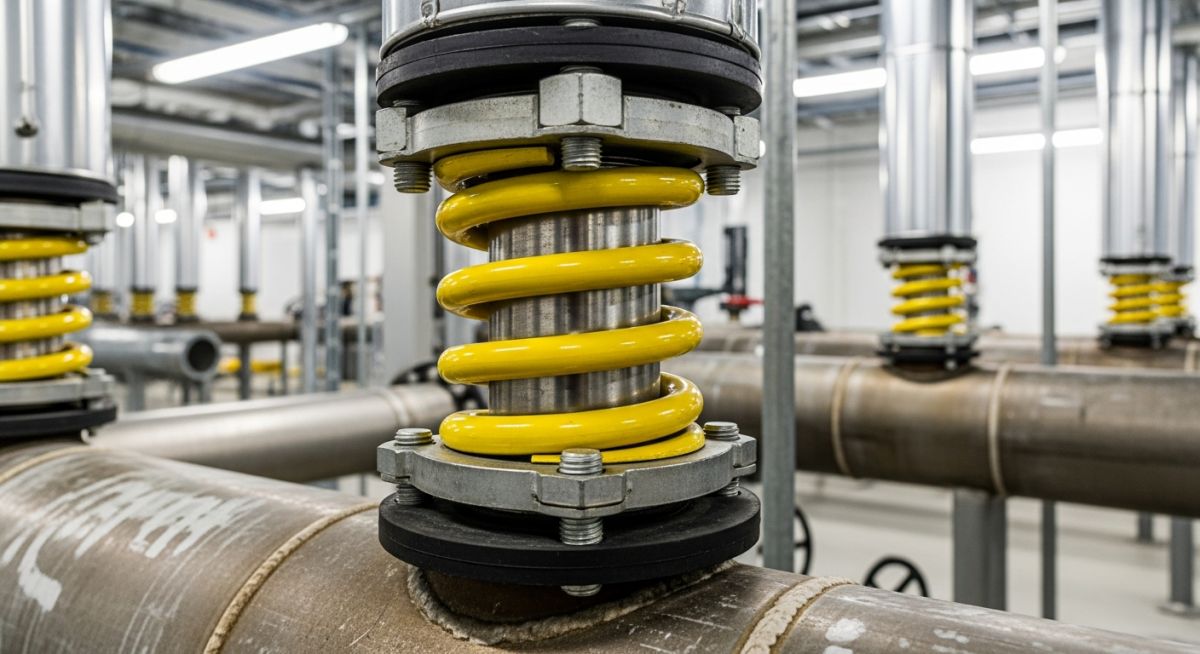
What Are Piping Vibration Isolators and How Do They Work
In my 20-plus years of troubleshooting piping systems, I have seen minor vibrations escalate into catastrophic plant shutdowns. I vividly recall a petrochemical facility in Gujarat back in 2008 where a reciprocating compressor discharge line was vibrating so violently that the welds on the first bypass branch cracked, spraying hot hydrocarbon gas. The root cause? The original design team used rigid, non-isolated pipe hangers right up to the compressor nozzle. They completely ignored the dynamic forces.
We resolved that issue by replacing those rigid supports with custom-engineered spring hangers and elastomeric isolators, dropping the vibration velocity from a dangerous 45 mm/s to under 3.5 mm/s. Piping vibration isolators are not optional accessories; they are the primary defense mechanism for your piping network, protecting sensitive instruments, reducing structural noise, and preventing fatigue failures.
Key Engineering Takeaways
- Decoupling dynamic energy prevents fatigue failures at critical weld joints.
- Spring isolators handle low-frequency, high-amplitude vibrations typical of heavy rotating machinery.
- Elastomeric pads excel at high-frequency noise attenuation and structural acoustic decoupling.
- Incorrect pre-loading can lock up isolators, rendering them completely useless.
- Compliance with ASME B31.3 and MSS SP-58 is mandatory for industrial safety.
Complete Course on
Piping Engineering
Check Now
Key Features
- 125+ Hours Content
- 500+ Recorded Lectures
- 20+ Years Exp.
- Lifetime Access
Coverage
- Codes & Standards
- Layouts & Design
- Material Eng.
- Stress Analysis
Why We Install Piping Vibration Isolators
To understand why we need these devices, we must look at the physics of dynamic systems. Every piece of rotating equipment—whether it is a double-suction centrifugal pump, a screw compressor, or a diesel generator—generates a disturbing frequency (fd) based on its operating speed (RPM). If this disturbing frequency matches the natural frequency (fn) of the connected piping system, resonance occurs. Under resonance, amplitude multiplies exponentially, leading to rapid mechanical fatigue.
The Governing Mathematics of Isolation
The natural frequency of an isolated piping system is calculated using the following formula:
Where:
• fn = Natural frequency of the isolated system (Hertz)
• k = Stiffness of the isolator (Newtons per meter)
• m = Supported mass of the piping and fluid (kilograms)
Our primary goal is to keep the transmissibility ratio (T) as low as possible. Transmissibility is the ratio of the force transmitted through the isolator to the force applied by the vibrating equipment. It is defined mathematically as:
To achieve effective isolation (where T is less than 1.0, meaning we are reducing the transmitted force), the ratio of the disturbing frequency to the natural frequency (fd / fn) must be greater than the square root of 2 (approximately 1.414). In professional piping design, we target an isolation efficiency of 90% or higher, which requires a frequency ratio of 3.16 or greater.
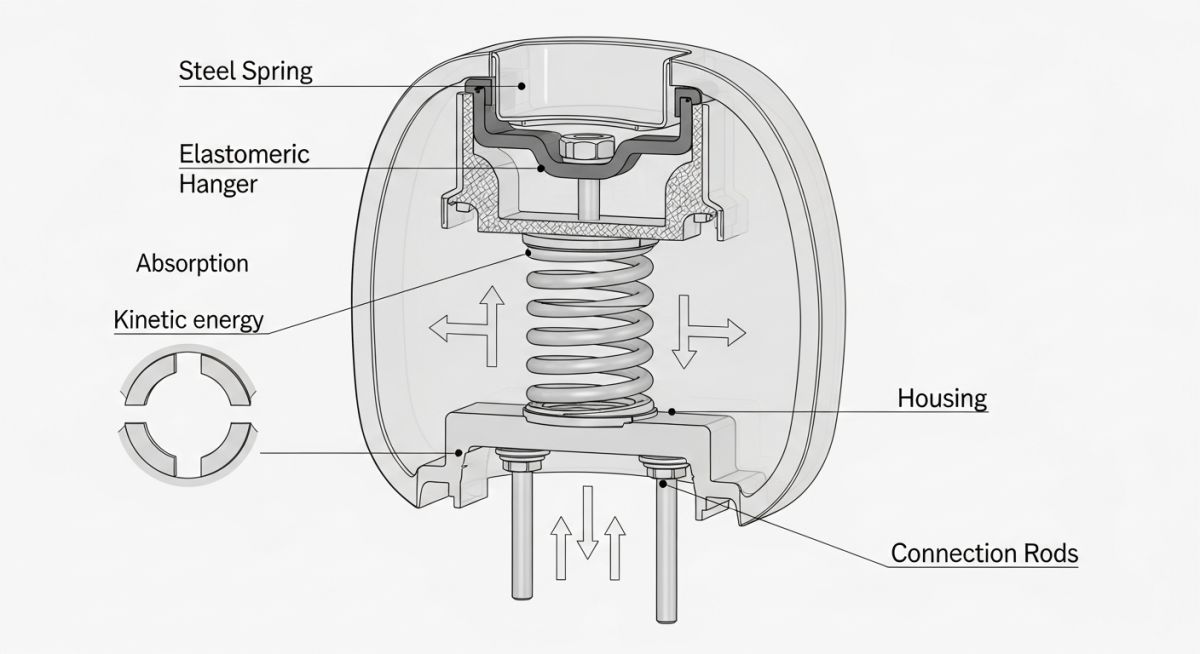
Primary Types of Piping Vibration Isolators
Depending on the frequency spectrum and environmental conditions, we select from three primary categories of isolators:
- Spring Isolators: Best for low-frequency vibrations (below 1200 RPM / 20 Hz). They offer high static deflections (25mm to 75mm) and are highly effective for heavy piping loads.
- Elastomeric & Neoprene Isolators: Ideal for high-frequency, low-amplitude vibrations and acoustic noise. They provide excellent high-frequency attenuation but are limited by temperature and chemical exposure.
- Metal Bellows & Expansion Joints: Installed inline with the piping to absorb axial, lateral, and angular movements while simultaneously dampening fluid-borne pressure pulsations.
Performance Metrics of Piping Vibration Isolators
Selecting the correct isolator requires balancing physical constraints, chemical compatibility, and dynamic performance. The table below outlines the operational boundaries of standard industrial isolation components.
| Isolator Type | Static Deflection (mm) | Isolation Efficiency (%) | Max Temp Limit (°C) | Primary Application |
|---|---|---|---|---|
| Open Spring Hangers | 25 to 75 | 90% – 98% | 180 (with thermal shields) | Low-frequency reciprocating compressor lines |
| Neoprene-in-Shear Mounts | 5 to 13 | 75% – 85% | 80 | High-frequency HVAC chilled water pumps |
| Wire Rope Isolators | 10 to 30 | 80% – 92% | 260 | Corrosive, high-temperature marine piping |
| Elastomeric Pads | 2 to 5 | 60% – 75% | 70 | Flat pipe shoe support interfaces |
Technical Mapping & Specifications Matrix
To ensure compliance with international standards, engineers must map physical parameters to the correct regulatory codes. The matrix below links key design entities to their governing standards.
| Entity / Acronym | Physical Parameter | Applicable Standard | Engineering Role |
|---|---|---|---|
| MSS SP-58 | Hanger Load Capacity | MSS Standards | Governs design, selection, and installation of pipe supports |
| ASME B31.3 Sec. 319 | Piping Flexibility Analysis | ASME Codes | Defines limits for thermal expansion and dynamic stress |
| ASHRAE Chapter 49 | Sound & Vibration Control | ASHRAE Guidelines | Provides selection criteria for building services piping |
| EJMA Standards | Bellows Fatigue Life | EJMA | Calculates cycle life of metallic expansion joints |
Site Inspection Checklist for Isolators
During my field audits, I have found that over 60% of spring hangers are either bottomed out or completely unloaded due to poor installation practices. Use this checklist on-site to verify that your isolation system is fully functional before starting up any rotating machinery.
Pre-Commissioning Verification Steps
-
Verify Travel Clearance: Ensure the spring coils have at least 12mm of additional travel capacity beyond the calculated hot operating position to prevent bottoming out.
-
Remove Shipping Restraints: Confirm that all travel stops, red shipping pins, and temporary locking bars have been removed from the spring casings.
-
Check Angular Alignment: Verify that hanger rods are vertical within a 4-degree tolerance limit to prevent lateral binding.
-
Inspect Elastomeric Elements: Check neoprene pads for surface cracking, hardening, or chemical degradation from oil spills.
-
Confirm Expansion Joint Alignment: Ensure that inline bellows are installed without any initial lateral offset exceeding the manufacturer’s limits.
-
Validate Anchor Points: Verify that structural anchors on the non-isolated side of the bellows are rigid enough to withstand the pressure thrust forces.
Field Case Study: Real-World Application
The Problem: Resonance in Boiler Feed Pump Piping
At a 600MW supercritical thermal power plant, the main boiler feed pump (BFP) discharge piping was experiencing severe structural vibration. The pump operated at 4200 RPM (70 Hz), and the vibration levels on the 12-inch discharge line reached an alarming 38 mm/s RMS. This high-amplitude vibration was transmitting directly into the structural steel of the turbine building, causing severe rattling of the control room floor plates and cracking the casing of a critical pressure transmitter.
The Solution: Dynamic Isolation Retrofit
I was called in to perform a dynamic vibration analysis. We discovered that the first three pipe hangers were rigid rod hangers, which had a natural frequency of approximately 68 Hz—almost a perfect match for the pump’s operating speed. We designed a retrofit solution:
- Replaced the rigid hangers with custom-engineered variable spring hangers designed for a static deflection of 32mm.
- This shifted the natural frequency of the piping system down to 8.8 Hz, creating a frequency ratio (fd / fn) of 7.95.
- Installed a high-pressure metallic expansion joint with tie rods directly at the pump discharge nozzle to decouple fluid-borne pressure pulsations.
The Outcome: After commissioning the new isolation system, the vibration velocity on the discharge piping dropped from 38 mm/s to 2.1 mm/s, well within the “good” range of the ISO 10816-3 standard. The structural noise in the control room was completely eliminated, and the pressure transmitter has operated without a single failure for over four years.
Frequently Asked Engineering Questions
What is the difference between a variable spring hanger and a constant spring hanger?
How do I select the correct static deflection for a spring isolator?
Can neoprene isolators be used in outdoor piping systems?
What is the purpose of tie rods on a piping expansion joint?
How does temperature affect the performance of piping vibration isolators?
How often should piping vibration isolators be inspected?
===
