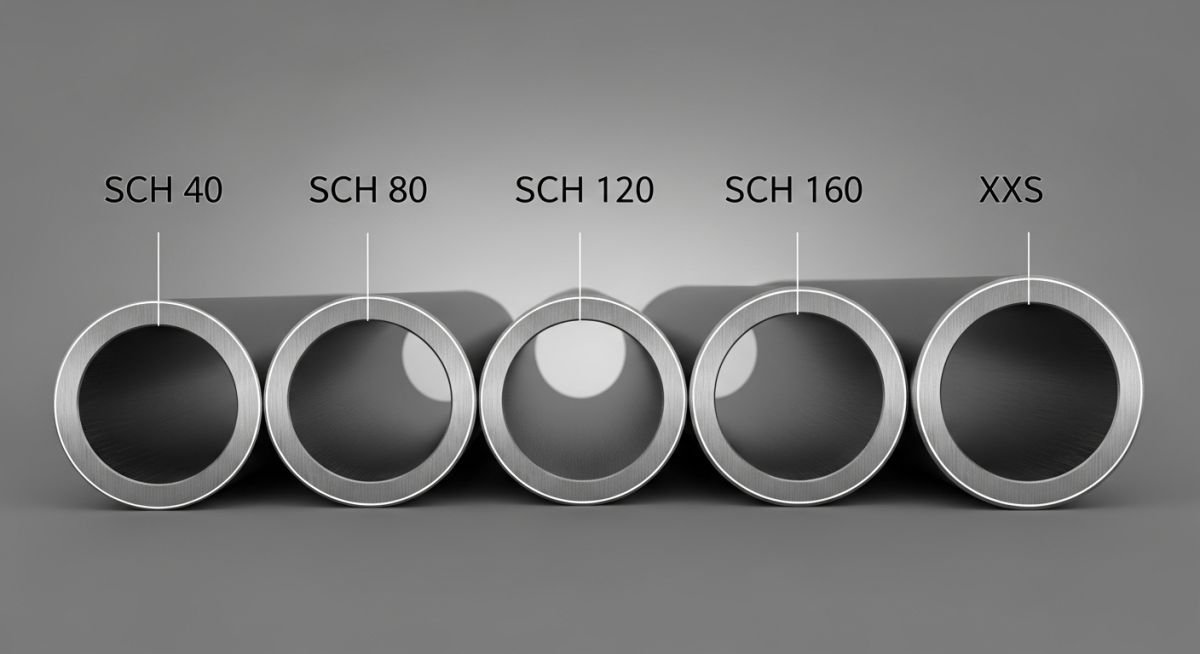
Understanding the Meaning of Pipe Schedule for Industrial Piping Systems
In my two decades of field experience, I have seen countless junior engineers confuse nominal pipe size with actual wall thickness. The “meaning of Pipe Schedule” is not merely a catalog number; it is the primary variable in the hoop stress equation that determines whether a piping system will safely contain process fluids or suffer a catastrophic rupture under pressure.
When we specify a pipe, we are balancing material costs against safety factors. Whether you are selecting Schedule 40 for utility water or Schedule 80 for high-pressure steam, understanding how these dimensions correlate to wall thickness is the bedrock of safe piping design. This guide breaks down the technical nuances of these standards to ensure your next project meets all regulatory requirements.
Key Takeaways for Piping Engineers:
- Pipe Schedule is a dimensionless number that increases as wall thickness increases for a given nominal pipe size.
- ASME B36.10 provides the definitive dimensional data for carbon and alloy steel pipes.
- Higher schedules (e.g., 80 vs 40) provide greater pressure ratings but increase weight and material procurement costs.
- Always verify the pressure-temperature rating of your chosen schedule against the specific process fluid and operating conditions.
Technical Analysis of Pipe Schedule and Wall Thickness
Pipe Schedule Dimensional Standards: The technical framework governing pipe wall thickness, where the schedule number represents a rounded value of the ratio of the service pressure to the allowable stress of the material.
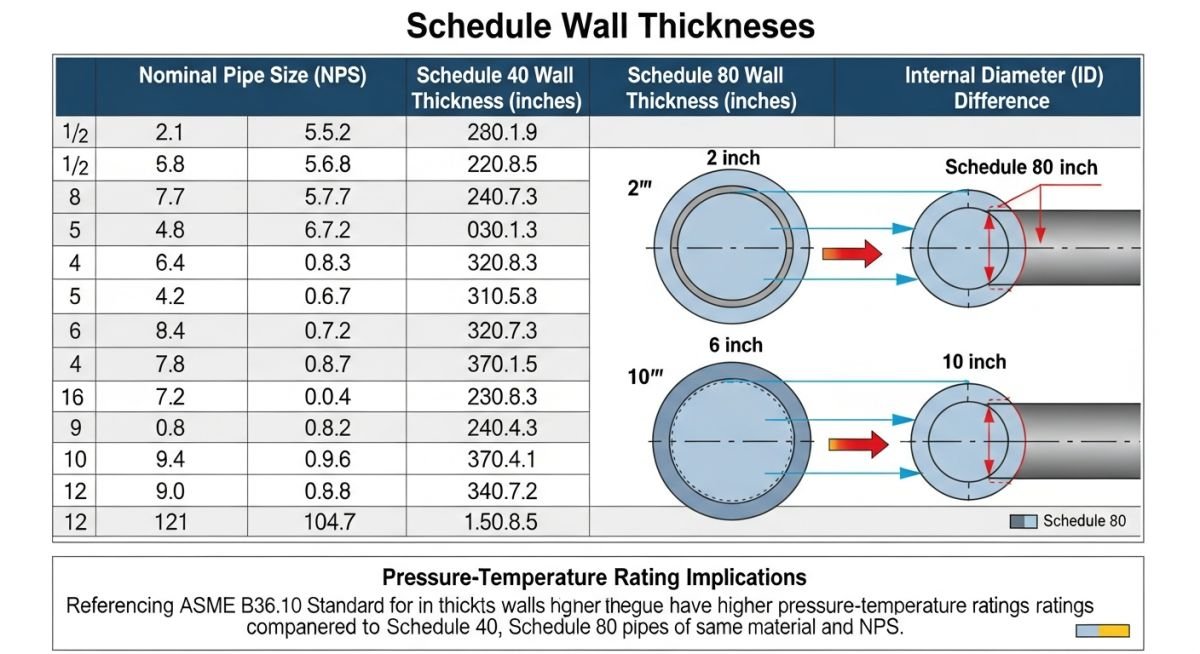
The fundamental relationship between pipe schedule and wall thickness is governed by ASME B36.10M. Unlike nominal pipe size (NPS), which remains constant for a given pipe diameter, the wall thickness changes as the schedule number increases. For example, a 4-inch NPS pipe will have a significantly thicker wall in Schedule 80 compared to Schedule 40, directly impacting the internal cross-sectional area and the pipe’s ability to withstand internal pressure.
To calculate the required wall thickness, we utilize the Barlow formula or the more precise ASME B31.3 pressure design equation. The design pressure (P) is limited by the allowable stress (S) of the material, the joint quality factor (E), and the wall thickness (t). As the schedule increases, the value of (t) increases, allowing the pipe to handle higher internal pressures without exceeding the material’s yield strength.
Engineering Warning: Corrosion Allowance
Never select a pipe schedule based solely on the calculated pressure requirement. You must add a corrosion allowance (CA) to the calculated minimum wall thickness. In my experience, failing to account for internal erosion or chemical corrosion leads to premature wall thinning, rendering the pipe schedule insufficient for the design life of the facility.
When comparing Schedule 40 and 80, we observe that Schedule 40 is often referred to as “standard weight” for smaller diameters, while Schedule 80 is “extra strong.” However, this terminology is outdated and can be misleading. Always refer to the specific wall thickness in millimeters or inches as defined in the ASME tables. For high-pressure steam or hydrocarbon processing, the increased wall thickness of Schedule 80 provides a necessary buffer against vibration-induced fatigue and external mechanical impact.
Furthermore, the weight per foot of the pipe increases linearly with the wall thickness. This has significant implications for pipe support design. A system designed for Schedule 40 that is upgraded to Schedule 80 during the procurement phase may exceed the load-bearing capacity of existing pipe racks or support steel. Always perform a structural re-verification if the pipe schedule is modified after the initial stress analysis.
Pipe Schedule Selection Trade-offs: The strategic evaluation of wall thickness versus system performance, balancing pressure containment requirements against material procurement, installation labor, and structural support limitations.
Advantages of Higher Schedules
- Enhanced pressure containment for high-energy fluid systems.
- Increased resistance to external mechanical damage and impact.
- Greater longevity in services with high corrosion or erosion rates.
- Reduced vibration amplitude in high-velocity process lines.
- Improved structural rigidity for long-span pipe supports.
Disadvantages of Higher Schedules
- Significantly higher material procurement and shipping costs.
- Increased dead weight requiring more robust support structures.
- Reduced internal flow area for a given nominal pipe size.
- Greater difficulty in field fabrication and welding due to thickness.
- Potential for increased thermal stress due to higher wall mass.
Industrial Piping Implementation: The practical application of pipe schedule standards across diverse sectors, ensuring that every piping system is optimized for its specific pressure, temperature, and chemical environment.
High-Pressure Steam Distribution
In power generation facilities, Schedule 80 or higher is mandatory for main steam headers to withstand extreme thermal cycling and high internal pressures. The thicker wall minimizes the risk of creep-fatigue failure and ensures compliance with ASME B31.1 power piping codes.
Hydrocarbon Processing Units
Refineries utilize varying pipe schedules to manage the transition from low-pressure storage to high-pressure reactor loops. Selecting the correct schedule is critical for maintaining the integrity of hazardous fluid containment systems under fluctuating process conditions.
Utility Water and Fire Protection
For standard utility lines, Schedule 40 is typically sufficient, providing an economical balance between material cost and structural durability. These systems prioritize flow capacity and ease of installation over the extreme pressure ratings required in process-critical lines.
Selecting the correct pipe schedule requires a granular understanding of how wall thickness variations influence the internal flow area and the structural pressure containment capacity of the piping system. In my two decades of field experience, I have observed that engineers often conflate nominal pipe size with actual outer diameter, leading to critical errors in flow velocity calculations and support spacing.
The following table provides a comparative analysis of common schedules for a 4-inch nominal pipe size. Note that the outer diameter remains constant across all schedules to ensure compatibility with standard fittings and flanges, while the internal diameter decreases as the schedule number increases to accommodate higher internal pressures.
| NPS (Inches) | Schedule | Wall Thickness (Inches) | Pressure Rating Class |
|---|---|---|---|
| 4.0 | 40 | 0.237 | Standard |
| 4.0 | 80 | 0.337 | Extra Strong |
| 4.0 | 160 | 0.531 | Double Extra Strong |
When reviewing these values, always cross-reference the ASME B36.10 standard. Discrepancies in wall thickness can significantly alter the weight per foot of the pipe, which directly impacts the design of pipe racks and the selection of spring hangers in high-temperature service environments.
The following matrix maps the critical technical entities involved in pipe schedule specification. Understanding these relationships is vital for maintaining compliance with ASME B31.3 process piping codes, especially when dealing with corrosive fluids or high-pressure steam lines where wall thinning due to erosion or corrosion allowance is a primary design consideration.
Each entity represents a specific constraint or parameter that must be validated during the piping material specification (PMS) phase of a project. Failure to align these parameters often results in premature system failure or non-compliance during regulatory inspections.
| Entity | Standard Reference | Primary Function |
|---|---|---|
| NPS | ASME B36.10 | Standardized sizing for pipe diameter |
| Schedule | ASME B36.10 | Wall thickness designation |
| Corrosion Allowance | ASME B31.3 | Added thickness for material loss |
By integrating these entities into your design workflow, you ensure that the piping system remains within the allowable stress limits defined by the material’s yield strength at operating temperature. Always verify that the chosen schedule provides sufficient margin for both pressure containment and mechanical loads.
Verification of pipe schedule on-site is a non-negotiable step in quality assurance. During my site visits, I have seen numerous instances where incorrect pipe schedules were installed, leading to catastrophic failures during hydrostatic testing. This checklist serves as a baseline for field engineers to validate material compliance against the approved Piping Material Specification (PMS).
-
01.
Verify the stencil markings on the pipe exterior against the project material requisition and ASME B36.10 requirements. -
02.
Perform ultrasonic thickness (UT) measurements at three distinct points around the circumference to ensure wall thickness meets the minimum schedule requirement. -
03.
Confirm that the pipe schedule matches the rating of the connected flanges and fittings to prevent step-changes in internal bore diameter. -
04.
Check for any signs of mechanical damage or ovality that could compromise the structural integrity of the pipe wall under pressure. -
05.
Validate that the corrosion allowance specified in the design documents has been accounted for in the final wall thickness selection.
If any discrepancies are found, the pipe must be quarantined immediately. Never assume that a pipe is the correct schedule based solely on visual inspection; the wall thickness must be physically measured and compared against the standard charts to ensure the system can handle the design pressure and temperature cycles safely.
Field Case Study: Real-World Application
Problem: Premature Wall Thinning in High-Pressure Steam Line
- Incorrect pipe schedule selection for high-velocity steam service.
- Failure to account for erosion-corrosion in the initial design phase.
- Inadequate wall thickness leading to localized stress concentrations at pipe bends.
- System pressure exceeded the allowable stress limits for the installed Schedule 40 pipe.
Outcome: Successful Remediation and System Integrity Restoration
- Upgraded piping to Schedule 80 to provide increased wall thickness and pressure containment.
- Implemented a rigorous ultrasonic testing schedule to monitor wall loss over time.
- Reduced flow velocity by optimizing pipe routing and diameter transitions.
- Achieved full compliance with ASME B31.3 standards, ensuring long-term operational safety.
My recommendation for similar projects is to always perform a thorough stress analysis that accounts for both internal pressure and external thermal expansion. When in doubt, opting for a higher schedule provides a necessary safety buffer that can prevent costly downtime and hazardous leaks in the future.
Frequently Asked Engineering Questions
How does pipe schedule affect pressure rating?
- Higher schedules provide a larger cross-sectional area to resist hoop stress.
- Increased thickness allows for higher operating temperatures before material yield strength degrades.
- Standardization via ASME B36.10 ensures that pressure ratings are predictable across different manufacturers.
Why is Schedule 40 the most common choice?
- It provides adequate wall thickness to prevent damage during standard installation and handling.
- The availability of Schedule 40 components is higher, reducing procurement lead times and project costs.
- It serves as the baseline for many ASME B31.3 piping design calculations.
When should I upgrade to Schedule 80?
- Required for high-pressure steam lines to prevent wall thinning and potential rupture.
- Used in hazardous chemical processing where containment integrity is paramount.
- Recommended for high-vibration environments to increase the natural frequency of the piping system.
Does pipe schedule change the outer diameter?
- The internal diameter is the only dimension that changes as the schedule increases.
- This consistency allows for uniform support spacing and standardized pipe rack design.
- Always verify the bore diameter when transitioning between different schedules to avoid flow turbulence.
How is corrosion allowance integrated into schedule?
- Corrosion allowance is typically defined by the project’s material specification based on fluid chemistry.
- Failure to account for this leads to premature pipe wall thinning and potential failure.
- Refer to ASME B31.3 for specific guidance on calculating required thickness with corrosion factors.
What is the role of ASME B36.10?
- It serves as the primary reference for pipe dimensions in the piping engineering industry.
- The standard facilitates the interchangeability of components from different global suppliers.
- It is the foundation upon which all pressure-temperature ratings for piping systems are built.
📚 Recommended Resources: Pipe Schedule
Read these Guides
- 📄 A Comprehensive Guide to Pipe Schedule Charts: Understanding ANSI, ASME, and ASTM Standards
- 📄 What is Pipe: Pipe Schedule, Various Types Plastic, Jacketed & Tracing
- 📄 API 5L Pipe: Grades, Specifications, and Schedule Chart (2026)
- 📄 ASME B31.3 Pipe Thickness Calculation: Formula, Examples & Schedule Selection
🎓 Advanced Training



Complete Course on
Piping Engineering
Check Now
Key Features
- 125+ Hours Content
- 500+ Recorded Lectures
- 20+ Years Exp.
- Lifetime Access
Coverage
- Codes & Standards
- Layouts & Design
- Material Eng.
- Stress Analysis
