Why Job Safety Analysis Saves Lives on Industrial Construction Sites
In my 20-plus years of managing piping installations and heavy industrial construction projects, I have seen how a single overlooked hazard can halt a multi-million dollar project—or worse, cost a life. I remember a project in 2014 where a crew was preparing to lift a 12-ton pre-fabricated pipe rack. The rigging plan was approved, the weather was clear, and the crane was certified. However, the team skipped a detailed step-by-step safety review of the ground conditions near the outriggers.
Because they did not perform a localized assessment, they missed a recently backfilled trench. As the crane swung, the ground gave way. Fortunately, the operator caught the load in time, but the near-miss cost us three days of downtime and a complete re-evaluation of our safety protocols. That incident cemented my belief that safety is not an administrative burden; it is the foundation of sound engineering. A rigorous safety review is the most effective tool we have to prevent these field failures.
Key Takeaways for Field Engineers
- Understand the exact mechanics of breaking down complex tasks into discrete, manageable steps.
- Learn how to calculate risk priority numbers using probability and severity matrices.
- Identify the specific roles and responsibilities of the safety review team.
- Access a field-tested, code-compliant sample format for immediate deployment.
How Does Job Safety Analysis Prevent Site Accidents?
To build an effective safety protocol, we must break down the work into sequential steps. In my experience, the most common mistake engineers make is writing a safety review that is too broad. A step like “install piping” is not a single step; it is a sequence of ten or more distinct actions, each carrying unique risks.
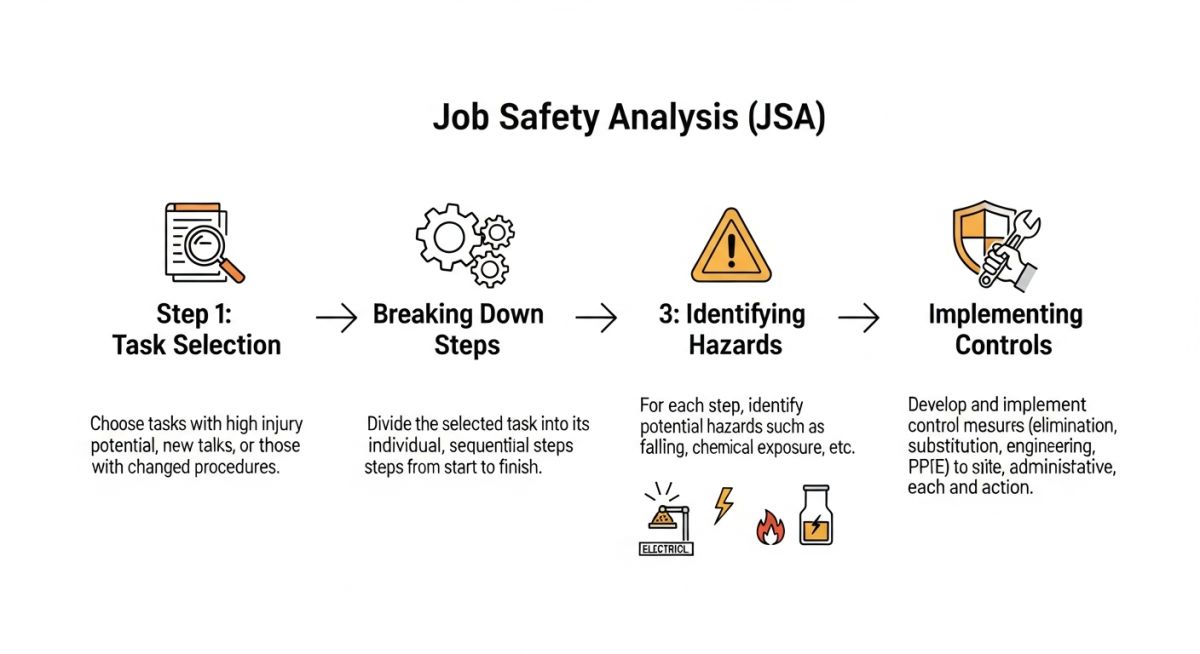
The Four-Step JSA Process
An industry-standard safety review follows a strict four-step sequence. Skipping or combining these steps compromises the integrity of the entire risk assessment.
- Select the Job: Focus on jobs with high accident frequencies, high potential for severe injury, or newly introduced processes.
- Break Down the Job: List the steps in the order they occur. Avoid being too detailed (which leads to an unmanageable document) or too general (which misses hazards).
- Identify Hazards: For each step, ask what could go wrong. Consider mechanical, electrical, chemical, thermal, and ergonomic hazards.
- Develop Controls: Establish preventive measures based on the hierarchy of controls: Elimination, Substitution, Engineering Controls, Administrative Controls, and Personal Protective Equipment (PPE).
Quantifying Risk: The Engineering Calculations
To make our safety reviews objective, we use a quantitative Risk Priority Number (RPN). This removes personal bias from the safety assessment.
The formula for calculating the Risk Priority Number is:
Where:
- Probability Rating: Scaled from 1 (Rare) to 5 (Almost Certain).
- Severity Rating: Scaled from 1 (Negligible/Minor First Aid) to 5 (Catastrophic/Fatality or Major Structural Failure).
Any task that yields a Risk Priority Number greater than or equal to 12 requires immediate engineering controls or administrative intervention before work can proceed. For example, if we are lifting a heavy spool over a live high-pressure steam line:
- Probability of drop (due to rigging complexity) = 3 (Possible)
- Severity of rupture (live steam line explosion) = 5 (Catastrophic)
- Risk Priority Number = 3 multiplied by 5 = 15
Since 15 exceeds our threshold of 12, we must implement an engineering control, such as depressurizing the steam line or installing a structural protective crash deck, to reduce the severity or probability before starting the lift.
Rigging Safety Factor Calculations
When lifting piping components, we must calculate the Safe Working Load (SWL) of our rigging equipment to ensure compliance with ASME B30.20.
For general rigging, a safety factor of 5 is standard. If a wire rope sling has a Minimum Breaking Strength of 50 metric tons, its Safe Working Load is:
If the piping spool weighs 9.5 metric tons, this sling is technically acceptable, but it operates near its limit. In my practice, I prefer a safety margin of at least 20 percent below the Safe Working Load for critical lifts.
What Are the Job Safety Analysis Risk Ratings?
The table below outlines the standard risk matrix used to determine whether a task requires additional engineering controls. This matrix aligns with ANSI/ASSP Z590.3 guidelines for prevention through design.
| Severity / Probability | Rare (1) | Unlikely (2) | Possible (3) | Likely (4) | Almost Certain (5) |
|---|---|---|---|---|---|
| Catastrophic (5) | 5 (Medium) | 10 (High) | 15 (Critical) | 20 (Critical) | 25 (Critical) |
| Major (4) | 4 (Low) | 8 (Medium) | 12 (High) | 16 (Critical) | 20 (Critical) |
| Moderate (3) | 3 (Low) | 6 (Low) | 9 (Medium) | 12 (High) | 15 (Critical) |
| Minor (2) | 2 (Low) | 4 (Low) | 6 (Low) | 8 (Medium) | 10 (High) |
| Negligible (1) | 1 (Low) | 2 (Low) | 3 (Low) | 4 (Low) | 5 (Medium) |
This technical mapping links common industrial activities to their regulatory standards, physical parameters, and required safety controls.
| Activity / Entity | Regulatory Standard | Physical Parameter / Limit | Mandatory Control Measure |
|---|---|---|---|
| Confined Space Entry | OSHA 1910.146 | Oxygen: 19.5% to 23.5% | Continuous gas monitoring, forced ventilation, standby watch. |
| Heavy Rigging & Lifting | ASME B30.9 / B30.20 | Wind Speed limit: 30 km/h | Written lift plan, physical barrier tape, outrigger pad verification. |
| Hot Work (Welding/Cutting) | NFPA 51B | Combustibles distance: 35 feet | Fire watch present during work and for 30 minutes post-completion. |
| Working at Heights | OSHA 1926.501 | Fall protection height: 6 feet | Full-body harness, double-lanyard with shock absorber, 100% tie-off. |
How to Verify Your Job Safety Analysis On-Site?
Before any tool touches metal, the field supervisor and the engineering lead must walk the site to verify that the safety review is not just a piece of paper, but an active shield. Use this checklist to verify compliance with OSHA 1926.
Pre-Start Field Verification Checklist
Field Case Study: Real-World Application
The Problem: High-Pressure Nitrogen Tie-In
During a refinery turnaround, a mechanical crew was tasked with installing a new bypass valve on a 12-inch high-pressure nitrogen line. The schedule was tight, and the crew was under pressure to complete the tie-in within a 12-hour window. The initial safety review was completed in a hurry, listing “cut pipe” as a single step. The crew did not verify the physical isolation of the upstream valve, assuming the operations team had completed the Lockout/Tagout (LOTO) process.
The Outcome: Atul Singla’s Intervention
I arrived at the site just as the welder was preparing to strike an arc. I halted the work and asked to see the safety review. Seeing the lack of detail, I gathered the crew and performed a step-by-step safety review on the spot. When we reached the “verify isolation” step, I insisted on physically checking the pressure gauge downstream of the isolation valve.
The gauge read 15 PSI—the line was not fully depressurized. The upstream isolation valve was leaking. Had they cut into that line, the sudden release of nitrogen would have displaced oxygen in the immediate area, causing rapid asphyxiation, or the pipe could have whipped, causing fatal injuries. We stopped, re-isolated the line, verified zero pressure, and completed the job safely.
This experience taught the entire site that a safety review is not a bureaucratic exercise. It is a practical tool that directly protects lives when executed with engineering discipline.
Frequently Asked Engineering Questions
What is the primary difference between a JSA and a JHA?
Who should participate in the safety review team?
How often should a safety review be updated?
What are the legal requirements for safety reviews under OSHA?
How do you handle unexpected hazards not listed in the safety review?
Can a safety review be used for routine maintenance tasks?
======
Complete Course on
Piping Engineering
Check Now
Key Features
- 125+ Hours Content
- 500+ Recorded Lectures
- 20+ Years Exp.
- Lifetime Access
Coverage
- Codes & Standards
- Layouts & Design
- Material Eng.
- Stress Analysis