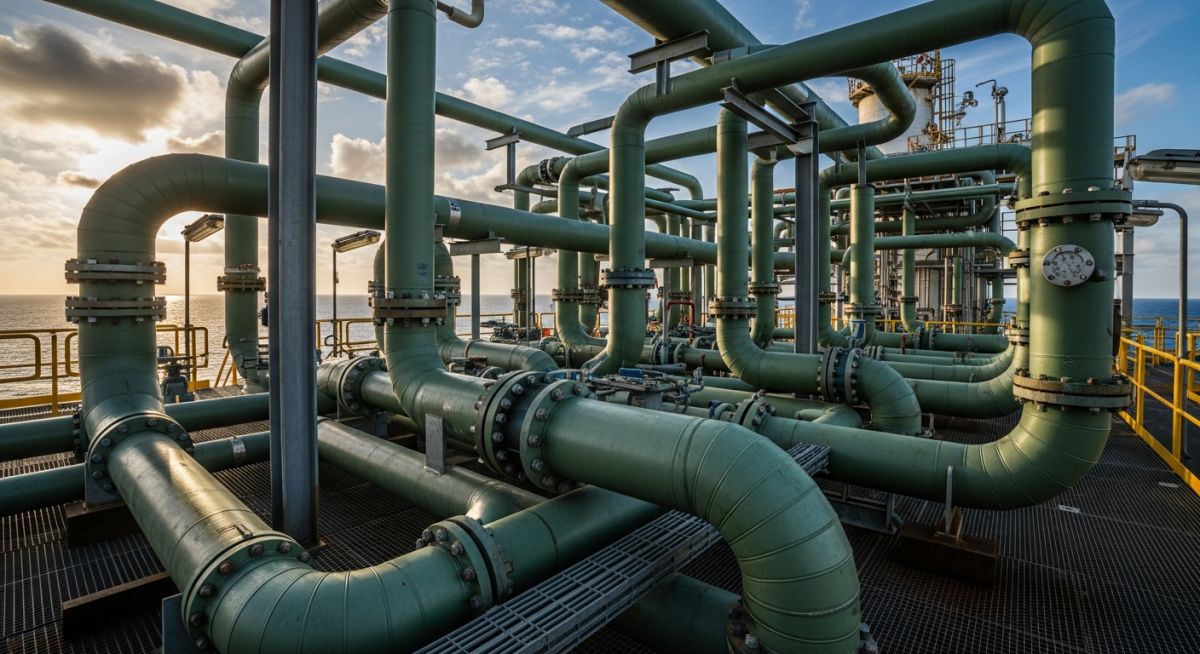
What is New in the ISO 14692-2017 GRP Piping Standard
In my 20 plus years of piping engineering experience, I have seen glass-reinforced plastic (GRP) transition from a niche, poorly understood material to a mainstream solution for corrosive environments. For a long time, traditional carbon steel piping engineers treated GRP as a “black box.” The older 2002 edition of the standard left too many gaps, which frequently resulted in either overly conservative, expensive designs or catastrophic field failures due to poor joint qualification.
When the updated standard was released, it completely changed how we qualify, design, and install these composite systems. This revision is not just a minor face-lift; it is a complete overhaul of the mechanical design envelope, safety factors, and site installation verification protocols. If you are still designing GRP systems using the old 2002 guidelines, you are likely exposing your project to significant structural risks or unnecessary material costs.
Key Engineering Takeaways
- Unified Design Envelope: The updated standard introduces a standardized method for generating the multi-axial design envelope, eliminating manufacturer-specific inconsistencies.
- Stricter Qualification: Regression testing under ASTM D2992 now requires rigorous 10,000-hour hydrostatic testing to validate long-term strength.
- Enhanced Safety Factors: Revised partial safety factors account for temperature, chemical degradation, and cyclic fatigue with greater precision.
- Bonder Certification: Field installation rules mandate formal, documented qualification for all bonders to prevent joint delamination.
How Does ISO 14692-2017 Redefine GRP Design?
GRP Design Envelope: The design envelope methodology under the updated standard establishes a multi-axial stress limit based on long-term hydrostatic pressure testing and regression analysis. This approach ensures that combined hoop and axial stresses remain within qualified safety margins during transient and steady-state operations.
The core philosophy of the updated standard revolves around the four-part structure, which spans from initial material selection to long-term asset operation. In my experience, the most critical changes lie in Part 2 (Qualification and Manufacture) and Part 3 (System Design).
1. The Multi-Axial Design Envelope
Unlike isotropic steel, GRP is highly anisotropic. Its strength depends heavily on the winding angle of the glass fibers (typically around 55 degrees). The updated standard mandates a standardized trapezoidal design envelope. This envelope maps the allowable combination of hoop stress (from internal pressure) and axial stress (from bending, thermal expansion, and pressure thrust).
The design stress limit is calculated using the following plain-text formula:
Where:
- f_design: The final allowable design stress for the piping system.
- f_qualification: The baseline qualified long-term strength derived from 10,000-hour regression testing.
- A1: Temperature derating factor, accounting for the reduction in resin mechanical properties at elevated operating temperatures.
- A2: Chemical resistance factor, based on the specific fluid transported (e.g., produced water, crude oil, acid service).
- A3: Cyclic fatigue factor, applied if the system experiences frequent pressure or thermal cycles.
- A4: Sustained loading factor, accounting for long-term creep under continuous stress.
- A5: System-specific factor, addressing localized stress concentrations or unique installation conditions.
- gamma_df: The overall design safety factor, which is strictly defined based on the criticality of the service.
2. Stricter Regression Testing Protocols
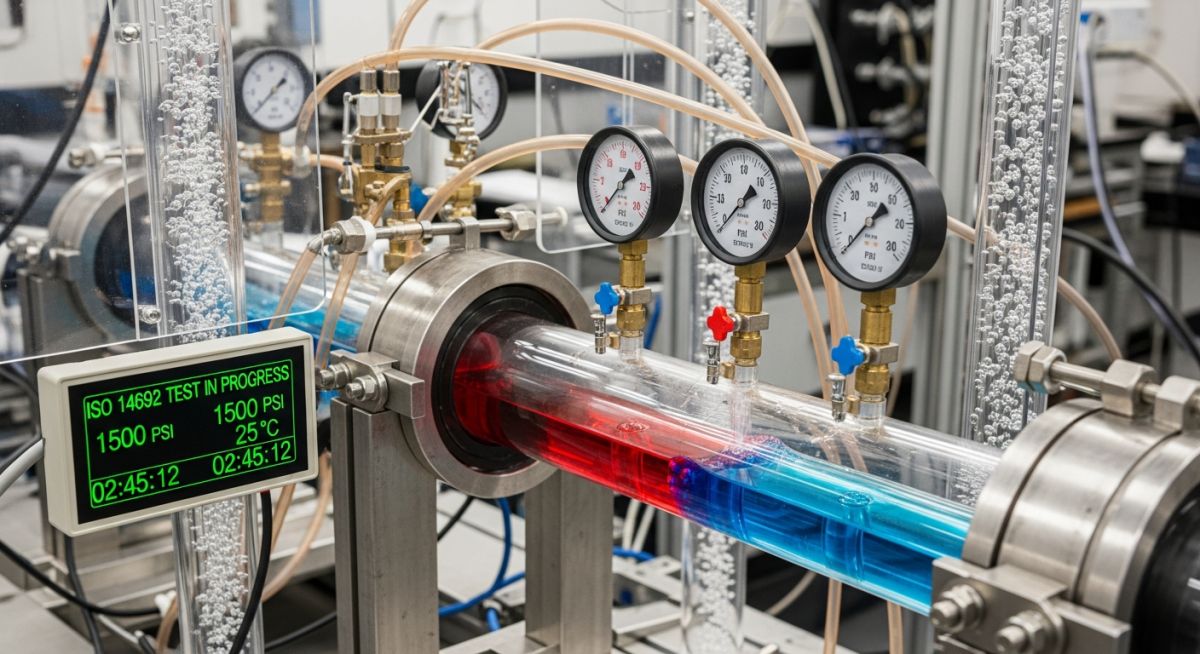
Under the older standard, manufacturers could sometimes extrapolate short-term test data to claim high long-term pressure ratings. The updated standard closes these loopholes. It requires continuous hydrostatic pressure testing up to 10,000 hours in accordance with ISO 14692-2. This rigorous testing establishes the Long-Term Hydrostatic Strength (LTHS) with a high degree of statistical confidence, ensuring the piping survives its intended 20-year or 25-year design life.
3. Stress Analysis Integration
One of the biggest practical challenges in GRP piping design is stress analysis. Traditional software like CAESAR II requires accurate input of orthotropic material properties (such as axial modulus, hoop modulus, Poisson’s ratio, and shear modulus). The updated standard provides clear guidelines on how to extract these properties from manufacturer data sheets and apply them to the stress model, preventing the common mistake of treating GRP as an isotropic material.
To help you transition your engineering workflows, I have compiled the key differences in design factors, testing requirements, and stress limits between the older 2002 edition and the updated 2017 standard.
| Design Parameter | ISO 14692:2002 Edition | ISO 14692:2017 Edition | Engineering Impact |
|---|---|---|---|
| Qualification Testing | Allowed short-term data extrapolation with high uncertainty. | Mandatory 10,000-hour regression testing (ASTM D2992). | Eliminates premature creep and stress-rupture failures. |
| Design Safety Factor (gamma_df) | Fixed global safety factor, often leading to over-design. | Variable partial safety factors based on service criticality. | Optimizes wall thickness for non-hazardous utility lines. |
| Temperature Derating | Vague guidelines; left to manufacturer discretion. | Strict derating curves based on Glass Transition Temperature (Tg). | Prevents structural softening in high-temperature services. |
| Bonder Qualification | Basic training recommended, but rarely audited. | Mandatory certified training, visual testing, and hydrotesting. | Drastically reduces field joint failures during commissioning. |
This matrix maps the core technical entities, structural acronyms, and physical parameters defined across the different parts of the updated standard.
| Entity / Acronym | Technical Definition | Physical Parameter / Unit | Standard Reference |
|---|---|---|---|
| GRE | Glass Reinforced Epoxy (high chemical and temperature resistance). | Density: 1800 to 2000 kg/m³ | ISO 14692-2 |
| GRP | Glass Reinforced Plastic (general term including polyester and vinyl ester). | Elastic Modulus: 10 to 20 GPa | ISO 14692-1 |
| LTHS | Long-Term Hydrostatic Strength (extrapolated strength at 20 years). | Pressure / Stress (MPa) | ISO 14692-2 |
| HDB | Hydrostatic Design Basis (categorized strength value for design). | Stress (MPa) | ASTM D2992 |
How to Verify ISO 14692-2017 Site Compliance?
Site Compliance Verification: Field inspection of GRP piping requires systematic validation of joint bonding, curing temperatures, and support spacing against qualified design parameters. This process ensures that field-fabricated joints achieve the same mechanical strength as the factory-cured pipe spool.
In my experience, more than 80% of GRP piping failures occur at field joints due to poor installation practices. The updated standard places a heavy emphasis on field quality control. Use this checklist on your construction site to ensure full compliance with Part 4 requirements.
Field Quality Control Checklist
-
Bonder Qualification: Verify that every bonder has a valid, up-to-date training certificate specifically for the joint type (adhesive bonded, lamination, or rubber seal lock joint) and resin system being installed.
-
Environmental Control: Ensure that joint bonding is performed under shelter if rain, dust, or direct sunlight is present. Relative humidity must be below 85%, and temperature must be within the manufacturer’s specified limits.
-
Curing Cycle Verification: Monitor and record the heating blanket temperature and cure time for adhesive joints. Never rely on ambient temperature curing unless explicitly qualified by the manufacturer.
-
Support Alignment and Spacing: Check that pipe supports are lined with elastomer pads to prevent abrasion. Ensure that support spacing matches the stress analysis report and that valves are independently supported to avoid overloading the GRP pipe.
-
Hydrostatic Testing: Perform the field hydrotest at 1.5 times the design pressure (or as specified by the design code). Hold the pressure for a minimum of 4 hours while inspecting all joints for weeping or pressure drops.
Field Case Study: Real-World Application
The Problem: Catastrophic Joint Separation
During the commissioning of a produced water injection line in a Middle Eastern oil field, a 12-inch GRE line suffered a catastrophic joint separation at a 90-degree elbow. The system was designed under the older 2002 edition of the standard. The stress analysis had treated the GRP pipe as an isotropic material, failing to account for the combined axial-hoop stress interaction during transient surge pressures (water hammer). The joint was also bonded by an uncertified field crew, resulting in poor resin wet-out and incomplete curing.
The Outcome: Redesign and Compliance
I was brought in to lead the failure investigation and redesign. We completely rebuilt the stress model using the updated design envelope methodology. We incorporated transient surge analysis and updated the support configuration to include structural guides that restricted excessive axial movement.
Furthermore, we implemented a strict bonder qualification program on-site, requiring every joint to be visually inspected and checked for Barcol hardness before hydrotesting. The redesigned system successfully passed a 24-hour hydrotest and has been operating trouble-free for over five years.
Direct Recommendation: Always perform a dynamic surge analysis for GRP systems in liquid service. GRP has a lower modulus of elasticity than steel, which reduces the water hammer pressure wave velocity, but its lower joint strength makes it highly vulnerable to axial thrust forces at bends and tees.
Frequently Asked Engineering Questions
What are the primary differences between GRE and GRP under the updated standard?
How does the updated standard handle temperature derating?
Why is the design envelope critical for GRP piping stress analysis?
What are the qualification requirements for bonders under Part 4?
How does the updated standard address surge and water hammer pressures?
Can I use the updated standard for buried GRP piping systems?
Complete Course on
Piping Engineering
Check Now
Key Features
- 125+ Hours Content
- 500+ Recorded Lectures
- 20+ Years Exp.
- Lifetime Access
Coverage
- Codes & Standards
- Layouts & Design
- Material Eng.
- Stress Analysis