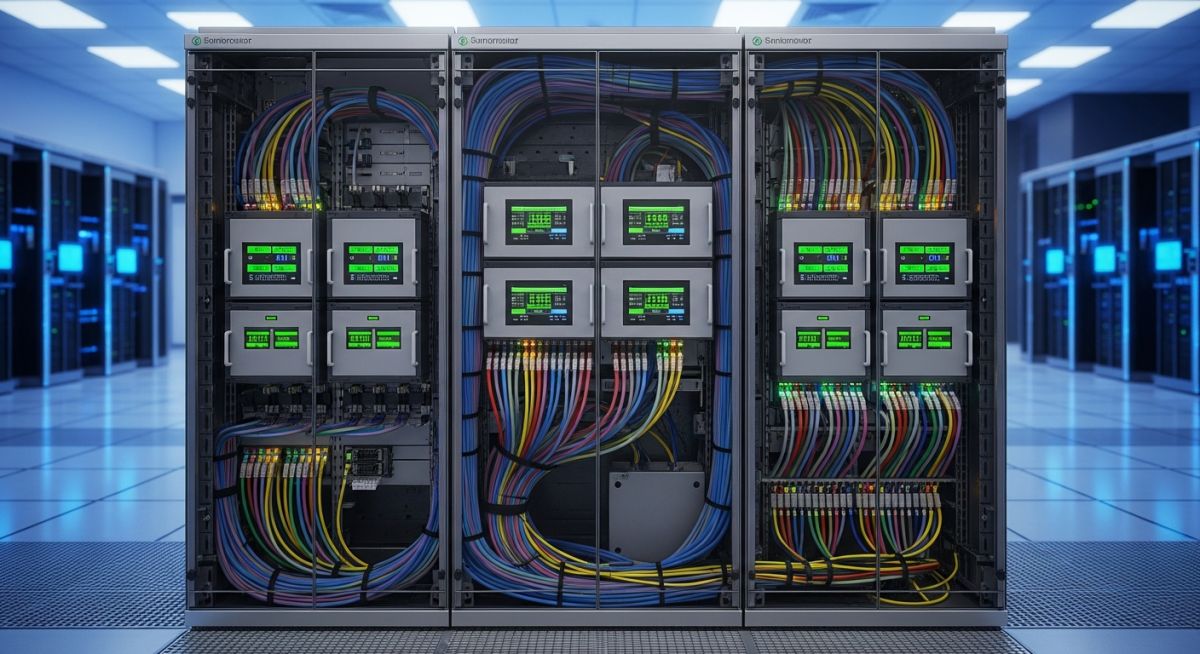
Uninterruptible Power Supply Systems: Industrial Design and Reliability
In my two decades of managing complex industrial infrastructure, I have learned that the stability of a facility is only as robust as its weakest power link. An Uninterruptible Power Supply (UPS) is not merely a battery backup; it is a sophisticated power conditioning system that isolates sensitive instrumentation and control systems from the inherent volatility of industrial grids.
Whether you are designing for a petrochemical refinery or a high-speed manufacturing line, understanding the transition between static and rotary topologies is paramount. We must move beyond simple “run-time” calculations and address harmonic distortion, transient response times, and the thermal management of battery banks. This guide dissects the engineering requirements for integrating these systems into your plant’s electrical distribution architecture.
Key Engineering Takeaways
- Distinguish between double-conversion static systems and kinetic energy-based rotary UPS.
- Apply NEMA PE 1 standards for evaluating UPS performance metrics.
- Calculate battery autonomy based on actual load profiles, not just nameplate ratings.
- Implement redundant bypass configurations to ensure maintenance does not compromise system uptime.
Technical Deep-Dive: Uninterruptible Power Supply Architecture
Uninterruptible Power Supply system engineering: The systematic integration of rectifiers, inverters, and energy storage media to maintain voltage and frequency stability, governed by IEC 62040 performance requirements.
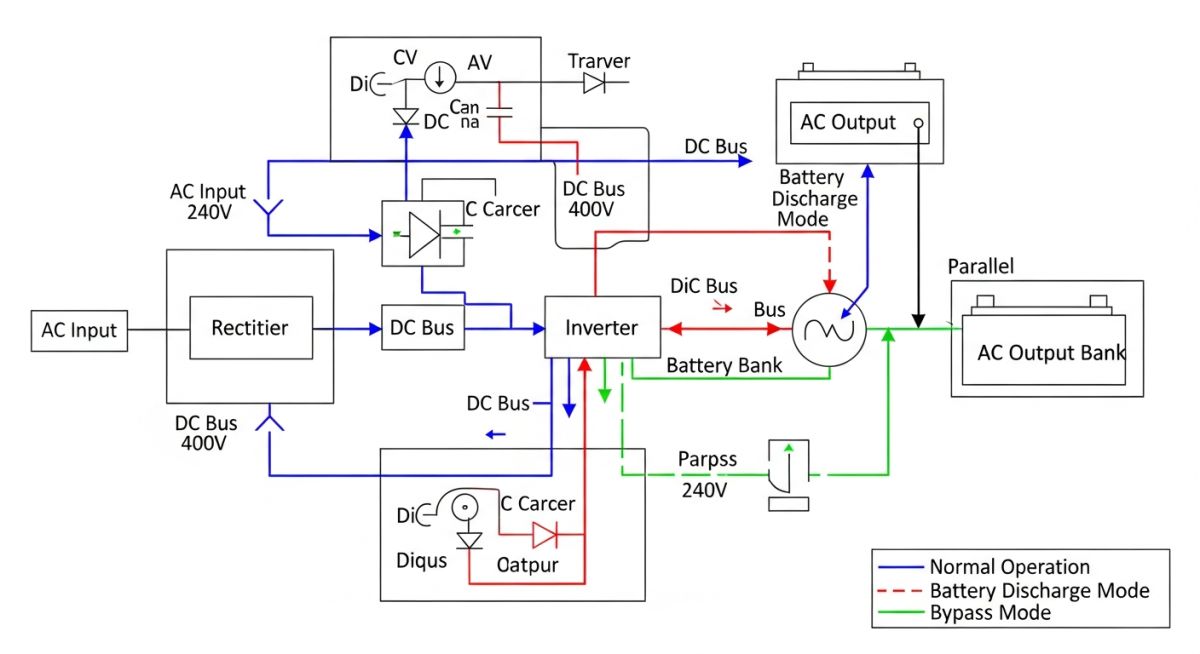
The core of modern industrial reliability lies in the double-conversion (online) topology. In this configuration, the incoming AC utility power is rectified into DC, which then feeds the inverter to reconstruct a pure sine wave. This process effectively strips away voltage spikes, sags, and harmonic noise before the power reaches the critical load.
When calculating the required capacity, I always emphasize the difference between apparent power (kVA) and real power (kW). Industrial loads often exhibit power factors between 0.8 and 0.9. If your UPS is rated for 100 kVA at 0.8 power factor, it can only support 80 kW of real load. Failing to account for this leads to premature inverter tripping during startup inrush currents.
Field Warning: Inrush Current Management
Many engineers overlook the crest factor of the load. If your equipment has a high peak current demand, the UPS inverter must be sized to handle the peak without dropping the output voltage. Always verify the manufacturer’s overload capacity curve against your specific motor or transformer startup profiles.
Battery integration remains the most frequent point of failure. I recommend utilizing VRLA (Valve Regulated Lead Acid) batteries for standard applications, but for high-temperature environments, NiCd (Nickel-Cadmium) or Lithium-ion solutions are superior. The sizing calculation follows the formula: Capacity = (Load x Autonomy) / (Efficiency x Depth of Discharge x Temperature Correction Factor). Never ignore the temperature correction factor; a 10-degree Celsius rise above the standard 25 degrees can reduce battery life by 50 percent.
For high-inertia industrial environments, rotary UPS systems offer a distinct advantage. By utilizing a flywheel to store kinetic energy, these systems eliminate the chemical degradation issues associated with battery banks. They are particularly effective in environments where frequent, short-duration power dips are common, as they can cycle indefinitely without the wear-and-tear experienced by electrochemical storage.
UPS System Performance Trade-offs: A comparative analysis of static and rotary topologies regarding operational efficiency, maintenance cycles, and total cost of ownership in industrial environments.
Advantages
- Isolation: Double-conversion provides total electrical isolation from utility noise.
- Response: Zero-millisecond transfer time ensures no interruption to sensitive PLC logic.
- Scalability: Modular static UPS units allow for N+1 redundancy configurations.
- Conditioning: Active harmonic filtering improves overall plant power quality.
Disadvantages
- Thermal Load: High heat dissipation requires dedicated HVAC in battery rooms.
- Maintenance: Battery banks require periodic impedance testing and replacement.
- Complexity: Rotary systems require specialized mechanical maintenance for bearings.
- Footprint: Large battery strings consume significant floor space in control rooms.
Industrial Infrastructure Deployment: Strategic implementation of power protection systems across critical sectors to maintain operational continuity and safety compliance.
Petrochemical Distributed Control Systems
In refinery environments, DCS and SIS (Safety Instrumented Systems) require absolute power stability to prevent emergency shutdowns. We deploy redundant static UPS systems to ensure that even a momentary loss of utility power does not trigger a false trip of the safety logic solvers.
High-Speed Pharmaceutical Packaging
Precision motion control and vision inspection systems are highly susceptible to voltage sags. By integrating rotary UPS systems, we provide the necessary ride-through capability to keep high-speed lines synchronized during grid instability, preventing costly product waste.
Data Center Infrastructure Management
Critical server racks require conditioned power to prevent data corruption and hardware damage. We utilize high-efficiency modular UPS arrays that allow for hot-swapping power modules, ensuring that maintenance activities never require a system-wide power down.
Selecting the appropriate Uninterruptible Power Supply architecture requires a granular understanding of how different topologies handle transient disturbances and total power loss. In my two decades of field experience, I have observed that engineers often default to standard double-conversion units without evaluating the specific harmonic distortion requirements or the thermal load profiles of the downstream critical equipment. The following table delineates the operational characteristics of common UPS configurations, focusing on efficiency ratings, switching times, and their suitability for sensitive industrial instrumentation.
When reviewing these parameters, pay close attention to the “Transfer Time” column. For high-speed digital control systems or sensitive PLC networks, even a 4-millisecond interruption can trigger a system reset or data corruption. Always cross-reference these values with the IEEE 1100 Emerald Book guidelines for grounding and power quality in sensitive electronic environments to ensure your selection aligns with the site-specific power quality index.
| Topology | Efficiency | Transfer Time | Best Application |
|---|---|---|---|
| Offline/Standby | 95-98% | 4-10 ms | Non-critical workstations |
| Line-Interactive | 92-96% | 2-4 ms | Server rooms/Small IT |
| Double-Conversion | 88-94% | 0 ms | Industrial PLC/DCS |
Note that efficiency ratings are highly dependent on the load percentage. Operating a double-conversion unit at 30% capacity significantly degrades the efficiency curve, leading to unnecessary heat dissipation and increased cooling requirements in the electrical room.
The complexity of modern power protection systems necessitates a structured approach to component identification and standard compliance. This matrix maps the critical physical entities within an Uninterruptible Power Supply system to their respective international standards and primary functional roles. By standardizing these definitions, we reduce the risk of miscommunication during the procurement and commissioning phases of large-scale industrial projects.
I frequently emphasize to my junior engineers that the “Battery Management System” (BMS) is not merely an accessory but a core component of the reliability chain. Without active cell balancing and thermal monitoring, the battery bank becomes the single point of failure. Referencing IEC 62040 standards ensures that your design documentation covers the necessary safety and performance benchmarks for both the inverter and the energy storage medium.
| Entity | Standard | Primary Function |
|---|---|---|
| Inverter | IEC 62040-3 | DC to AC conversion |
| Rectifier | IEEE 519 | AC to DC conversion |
| Static Switch | IEC 62040-1 | Bypass transfer logic |
Uninterruptible Power Supply Site Verification: Proper installation is the foundation of system longevity. This checklist covers the essential physical and electrical parameters required to validate a site before the arrival of the UPS hardware. Failure to verify these points often leads to delayed commissioning or premature component failure due to environmental stress.
- 1. Verify ambient temperature remains between 20 and 25 degrees Celsius to maximize battery life per IEEE 1184.
- 2. Confirm floor loading capacity meets the structural requirements for heavy lead-acid or lithium-ion battery cabinets.
- 3. Ensure cable entry points are sealed to prevent dust ingress, which can cause tracking on high-voltage inverter boards.
- 4. Validate that the grounding system impedance is below 1 ohm to protect sensitive logic circuits from transient surges.
- 5. Check that the ventilation system provides sufficient air changes per hour to prevent hydrogen gas accumulation during battery charging cycles.
During my site audits, I often find that the most common oversight is the lack of adequate clearance for maintenance access. Always ensure that the manufacturer’s recommended service clearance is maintained on all sides of the unit. If the UPS is located in a high-vibration area, such as near large rotating machinery, verify that the mounting base includes vibration isolation pads to protect the internal capacitors and control boards from mechanical fatigue.
Problem: Chronic Inverter Failure in a Remote Pumping Station
- Frequent power quality fluctuations caused by unstable local grid conditions.
- Inadequate cooling in the electrical enclosure leading to thermal runaway in the battery bank.
- High harmonic distortion from variable frequency drives (VFDs) interfering with the UPS control logic.
- Lack of periodic maintenance leading to undetected electrolyte leakage in lead-acid cells.
Outcome: System Stabilization and Reliability Improvement
- Installed an active harmonic filter to mitigate VFD-induced noise.
- Upgraded the HVAC system to maintain a constant 22 degrees Celsius environment.
- Implemented a remote monitoring system for real-time battery health diagnostics.
- Reduced unplanned downtime by 85% over a 24-month operational period.
The recommendation here is clear: treat the Uninterruptible Power Supply as a critical system component rather than a “set and forget” device. Regular thermal imaging of the electrical connections and impedance testing of the battery strings are mandatory for maintaining the high availability required in industrial environments.
How does battery temperature affect UPS lifespan?
- Increased internal resistance leads to higher heat generation during discharge.
- Accelerated grid corrosion occurs at higher temperatures, reducing capacity.
- Thermal runaway risks increase significantly in poorly ventilated cabinets.
What is the difference between static and rotary UPS?
- Static UPS is ideal for low-to-medium power applications with high precision requirements.
- Rotary UPS provides superior fault-clearing capability for heavy industrial motor loads.
- Rotary systems are generally more robust in harsh environments but require more mechanical maintenance.
Why is double-conversion preferred for industrial loads?
- Provides a constant, clean sine wave output regardless of input quality.
- Eliminates transfer time during power outages, ensuring zero-millisecond switching.
- Protects sensitive PLC and DCS equipment from high-frequency noise.
How do I calculate the required battery runtime?
- Always apply a 20% safety margin to account for battery aging over time.
- Use the manufacturer’s discharge tables rather than simple linear calculations.
- Consider the end-of-discharge voltage to prevent permanent battery damage.
What is the role of the static bypass switch?
- Ensures continuous power even during internal inverter faults.
- Allows for maintenance of the UPS without shutting down the critical load.
- Provides high current capacity for clearing downstream branch circuit faults.
Are lithium-ion batteries suitable for industrial UPS?
- Requires a sophisticated Battery Management System (BMS) for safety.
- Offers a significantly smaller footprint, saving valuable floor space.
- Provides more consistent performance across a wider temperature range.
Complete Course on
Piping Engineering
Check Now
Key Features
- 125+ Hours Content
- 500+ Recorded Lectures
- 20+ Years Exp.
- Lifetime Access
Coverage
- Codes & Standards
- Layouts & Design
- Material Eng.
- Stress Analysis

📚 Recommended Resources: Uninterruptible Power Supply
Read these Guides
- 📄 Power Systems in Data Centres: Engineering Reliability and Design Standards
- 📄 Understanding Data Centre Types: Enterprise, Colocation, Hyperscale, and Edge
- 📄 How Data Centres Work: Infrastructure and Operations Engineering Overview
- 📄 Data Centres Explained: A Comprehensive Engineering Design Guide