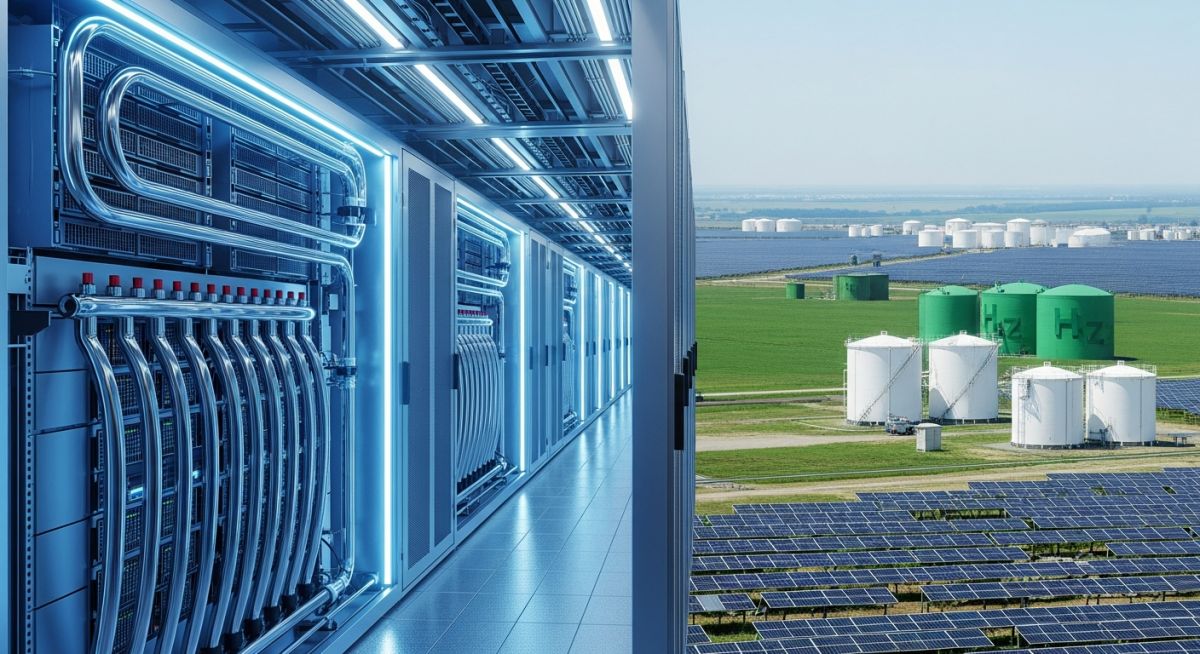
Future of High-Density Data Centres: AI and Thermal Engineering
In my two decades of experience within the piping and mechanical engineering sector, I have witnessed a seismic shift in how we approach facility design. The rise of AI-driven workloads has rendered traditional air-cooled data centres obsolete. We are no longer dealing with standard server loads; we are managing massive, high-density heat fluxes that require a fundamental rethink of fluid dynamics and power distribution.
This guide explores the technical intersection of high-density computing and sustainable engineering. We will examine how modern facilities are moving beyond legacy cooling to embrace direct-to-chip liquid cooling and how they integrate with decentralized energy sources like small modular reactors to maintain uptime.
Key Engineering Takeaways
- Transitioning from air-cooled to liquid-cooled infrastructure is mandatory for racks exceeding 30kW.
- Power Usage Effectiveness (PUE) targets are now pushing below 1.1 through heat recovery integration.
- Modular power systems are essential for scaling AI clusters without compromising grid stability.
Engineering High-Density Data Centres for AI
High-Density Data Centres: These facilities utilize advanced thermal management systems to handle power densities exceeding 50kW per rack, requiring precise fluid control and structural load management as defined by ASME B31.3 piping standards.
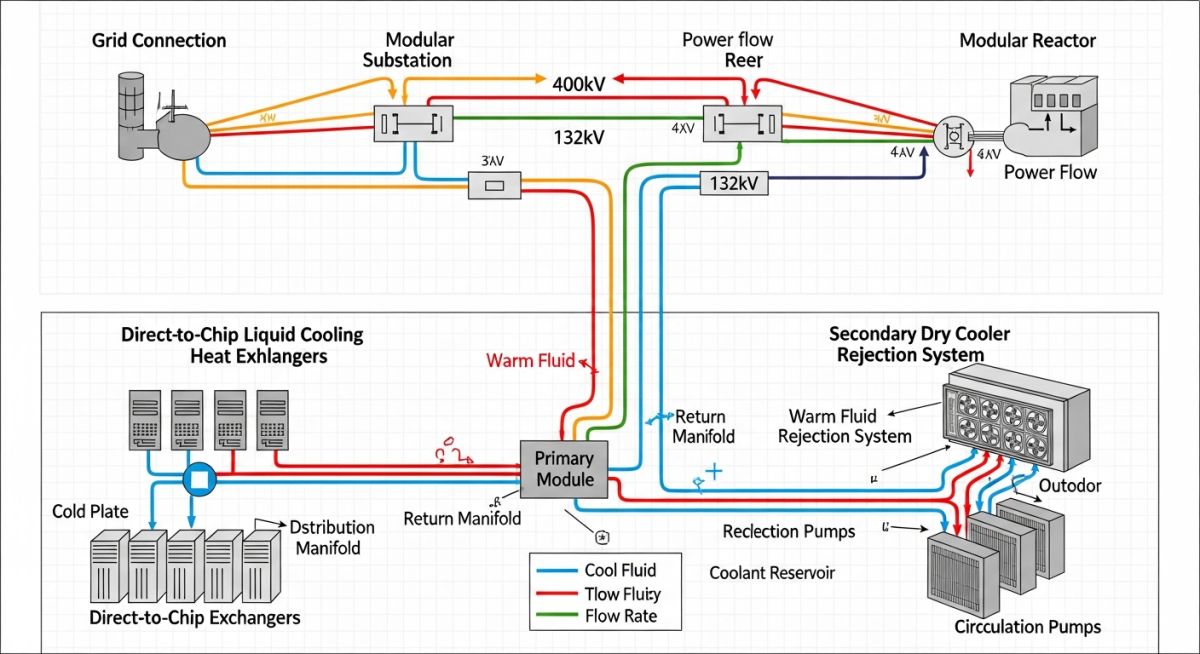
Designing for high-density computing requires a rigorous approach to heat rejection. When a rack hits 50kW, the volumetric flow rate of air required to maintain safe operating temperatures becomes physically impossible to manage within standard raised-floor architectures. I have found that the transition to direct-to-chip (DTC) liquid cooling is the only viable path forward.
Thermodynamic Load Calculations
To calculate the required coolant flow rate, we utilize the fundamental heat transfer equation: Q = m * Cp * deltaT. In a typical DTC system, where Q is the heat load in kW, m is the mass flow rate, and Cp is the specific heat capacity of the coolant (typically a water-glycol mixture), we must maintain a deltaT that prevents thermal shock to the silicon while maximizing heat rejection efficiency.
Calculation Parameters:
- Target Heat Load (Q): 50,000 W
- Coolant Specific Heat (Cp): 3,800 J/kgK (approx. for 25% glycol)
- Temperature Rise (deltaT): 10 K
- Mass Flow Rate (m) = Q / (Cp * deltaT) = 50,000 / 38,000 = 1.31 kg/s
This mass flow rate dictates the pipe sizing for the coolant distribution units (CDUs). Under ASHRAE guidelines, we must ensure that the pressure drop across the manifold does not exceed the pump’s head capacity. I often specify stainless steel piping for these loops to prevent corrosion and ensure long-term compatibility with the glycol inhibitors.
Field Warning: Thermal Expansion and Vibration
In high-density environments, the vibration from high-speed pumps can induce fatigue in small-bore piping. Always implement flexible connectors and seismic bracing in accordance with local building codes to prevent catastrophic coolant leaks near sensitive server hardware.
Furthermore, the integration of AI clusters necessitates a modular approach to power. We are seeing a move toward 415V AC distribution directly to the rack, reducing the number of transformation steps and improving overall system efficiency. This requires careful coordination with electrical engineers to ensure that the harmonic distortion from high-frequency switching power supplies does not impact the facility’s power quality.
High-Density Infrastructure Trade-offs: Evaluating the technical and operational impacts of transitioning to liquid-cooled, high-density computing environments requires a balanced assessment of thermal efficiency versus system complexity.
Advantages
- Significant reduction in PUE by eliminating energy-intensive CRAC fans.
- Higher compute density per square foot, reducing total facility footprint.
- Improved CPU/GPU reliability due to stable, lower operating temperatures.
- Potential for waste heat recovery to support district heating systems.
Disadvantages
- Increased mechanical complexity and risk of fluid-related hardware damage.
- Higher initial capital expenditure for specialized piping and CDU infrastructure.
- Requirement for specialized maintenance staff trained in fluid systems.
- Complex seismic and structural requirements for heavy liquid-filled piping loops.
High-Density Computing Deployment: Modern industrial and research sectors are leveraging high-density data centre architectures to solve complex computational challenges while maintaining strict sustainability targets.
AI Model Training Clusters
Large-scale language model training requires massive GPU arrays that generate extreme heat loads. By utilizing direct-to-chip cooling, these clusters can maintain peak performance without thermal throttling, ensuring that training cycles are completed within the required timeframes.
Scientific Research and Simulation
High-performance computing (HPC) facilities for climate modeling and molecular dynamics rely on high-density racks to process petabytes of data. Liquid cooling allows these facilities to pack more compute power into smaller footprints, which is essential for university and government research labs with limited space.
Edge Computing for Autonomous Systems
Autonomous vehicle networks require localized, high-density processing power to handle real-time sensor data. These edge data centres are often deployed in modular, containerized units where liquid cooling is the only way to manage the heat generated by high-performance edge processors in confined spaces.
In my two decades of engineering, I have observed that the transition to high-density computing necessitates a fundamental shift in how we quantify facility performance. Traditional metrics like Power Usage Effectiveness (PUE) are no longer sufficient when rack densities exceed 30 kW per cabinet. We must now integrate Water Usage Effectiveness (WUE) and Carbon Usage Effectiveness (CUE) to provide a holistic view of the environmental footprint.
The following table outlines the critical design thresholds for modern high-density environments. These values reflect current ASHRAE TC 9.9 guidelines for thermal management and power distribution. Engineers must ensure that their cooling infrastructure—whether liquid-to-chip or immersion-based—is sized to handle these peak heat loads without compromising the reliability of the underlying silicon.
| Metric | Standard Range | Engineering Impact |
|---|---|---|
| Rack Density | 30 to 100+ kW | Requires liquid cooling integration |
| PUE Target | 1.05 to 1.20 | Efficiency via heat recovery |
| Coolant Temp | 18 to 45 Celsius | Warm water cooling optimization |
By adhering to these benchmarks, we mitigate the risk of thermal throttling in AI-accelerated hardware. Always remember that the cooling loop design must account for the specific heat capacity of the dielectric fluid or water-glycol mixture used in the secondary circuit.
The complexity of modern data centre ecosystems requires a rigorous mapping of physical assets to their respective regulatory and operational standards. As we integrate AI-driven workloads, the interaction between power generation, thermal management, and structural integrity becomes increasingly interdependent. This matrix serves as a reference for the primary technical entities involved in high-density infrastructure design.
I have categorized these entities based on their role in the facility lifecycle, from power intake to heat rejection. Each entity is linked to the relevant IEEE or ISO standard to ensure compliance during the procurement and installation phases. Proper alignment of these components is the only way to guarantee the uptime required for mission-critical AI training clusters.
| Entity | Acronym | Standard Reference |
|---|---|---|
| Small Modular Reactor | SMR | IAEA Safety Standards |
| Direct-to-Chip Cooling | DTC | ASHRAE TC 9.9 |
| Uninterruptible Power Supply | UPS | IEC 62040 |
This matrix is not exhaustive but provides the foundational framework for site-specific engineering. When selecting vendors, verify that their equipment certifications match these international standards to avoid costly retrofits during the commissioning phase.
Site verification for high-density facilities is a multi-disciplinary effort that demands absolute precision. In my experience, the most common failures occur at the interface between the mechanical cooling loops and the electrical distribution busbars. This checklist is designed to ensure that your site meets the rigorous demands of modern AI-driven computing environments.
-
[ ]
Structural Load Capacity: Verify that the raised floor or slab can support the increased weight of liquid-cooled racks and heavy coolant distribution units (CDUs). -
[ ]
Coolant Loop Integrity: Perform pressure testing on all secondary loops to ASME B31.3 standards to prevent catastrophic leaks near sensitive electronics. -
[ ]
Power Redundancy: Confirm that the N+1 or 2N power architecture is isolated from the cooling control systems to prevent cascading failures during a utility outage. -
[ ]
Thermal Zoning: Validate that the hot aisle containment system is airtight to maintain the required pressure differentials for efficient heat rejection. -
[ ]
Emergency Shutdown Protocols: Ensure that the fire suppression system is compatible with the dielectric fluids used in immersion cooling tanks.
Before final sign-off, conduct a full-load simulation. This involves running the cooling system at 110% of the design capacity to identify potential bottlenecks in the heat exchanger performance or pump head pressure. Document all findings in the site commissioning report to satisfy insurance and regulatory requirements.
Field Case Study: Real-World Application
The Challenge: Thermal Throttling in AI Clusters
A major hyperscale facility faced persistent thermal throttling in their GPU-heavy AI training racks, leading to a 15% reduction in compute throughput.
- Inadequate airflow volume in traditional air-cooled aisles.
- High ambient humidity causing condensation on cold plates.
- Inconsistent coolant flow rates across the rack manifold.
- Lack of real-time telemetry for individual chip temperatures.
The Outcome: Optimized Liquid Cooling Integration
By retrofitting the facility with a direct-to-chip liquid cooling system, we achieved a stable operating environment and restored full compute capacity.
- Reduced PUE from 1.55 to 1.12 within six months.
- Eliminated thermal throttling, increasing AI training speed by 18%.
- Lowered total facility energy consumption by 22%.
- Improved rack density from 15 kW to 65 kW per cabinet.
My recommendation for similar projects is to prioritize modular cooling units that allow for incremental upgrades. Do not attempt to force high-density loads into legacy air-cooled infrastructure; the cost of failure far outweighs the investment in liquid-to-chip technology.
Frequently Asked Engineering Questions
What is the primary benefit of liquid cooling for AI?
- Enables higher rack densities exceeding 50 kW.
- Reduces fan power consumption, which is a major contributor to PUE.
- Allows for higher operating temperatures, facilitating heat reuse in district heating systems.
- Minimizes the physical footprint of the cooling infrastructure.
How do SMRs integrate with data centre power grids?
- Provides consistent, carbon-free power for 24/7 AI training operations.
- Reduces reliance on aging utility grids that may struggle with massive load spikes.
- Can be co-located with large-scale data centres to minimize transmission losses.
- Requires strict adherence to IAEA safety and security protocols.
What are the risks of immersion cooling?
- Material compatibility issues with certain plastics and elastomers.
- Increased maintenance complexity when accessing hardware submerged in dielectric fluid.
- Potential for fluid contamination if the filtration system is not properly maintained.
- Stringent fire safety requirements for the storage and handling of large volumes of fluid.
How is PUE calculated for high-density sites?
- Include all cooling pumps, CDUs, and heat rejection fans in the total facility power.
- Ensure that IT power measurements are taken at the rack level for accuracy.
- Account for the energy used in heat recovery systems if applicable.
- Standardize measurements according to The Green Grid guidelines.
What is the role of hydrogen in data centres?
- Provides zero-emission backup power during utility outages.
- Can be integrated with electrolyzers to store excess renewable energy.
- Offers a higher energy density than traditional battery storage systems.
- Requires specialized infrastructure for hydrogen storage and safety management.
How do we manage thermal transients in AI?
- Use thermal storage tanks to buffer the cooling loop against sudden load spikes.
- Implement predictive control algorithms that adjust pump speeds before the load hits.
- Ensure the cooling system has sufficient thermal inertia to handle rapid transitions.
- Monitor chip-level temperatures with high-frequency telemetry to trigger proactive cooling adjustments.
Complete Course on
Piping Engineering
Check Now
Key Features
- 125+ Hours Content
- 500+ Recorded Lectures
- 20+ Years Exp.
- Lifetime Access
Coverage
- Codes & Standards
- Layouts & Design
- Material Eng.
- Stress Analysis

📚 Recommended Resources: High-Density Data Centres
Read these Guides
- 📄 Liquid Cooling for AI Data Centres: Engineering High-Density Thermal Solutions
- 📄 Designing a Modern Data Centre: Engineering and EPC Best Practices
- 📄 Optimizing Data Centre Energy Efficiency and PUE Calculation Standards
- 📄 Renewable Energy for Data Centres: Engineering Sustainable Infrastructure Solutions