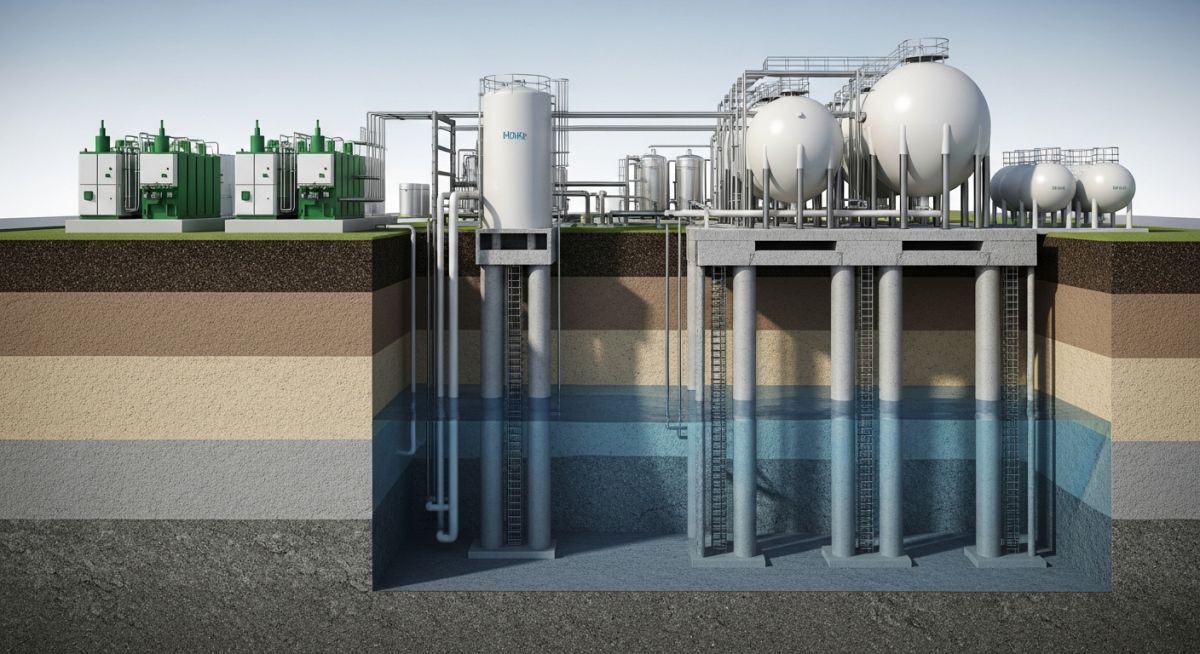
Geotechnical Risks in Green Hydrogen Projects: A Technical Guide
In my two decades of experience managing heavy industrial infrastructure, I have observed that the most overlooked failure points in green hydrogen projects often lie beneath the surface. While engineers focus heavily on electrolyzer efficiency and high-pressure piping, the geotechnical reality of the site—ranging from soft alluvial deposits to aggressive chemical soil profiles—can compromise the entire facility’s foundation.
Green hydrogen plants require massive, vibration-sensitive equipment and high-pressure storage vessels that demand precise settlement control. Ignoring site-specific soil mechanics leads to differential settlement, which in turn induces secondary stresses on critical piping manifolds. This guide explores the technical nuances of managing these subsurface risks to ensure long-term operational safety.
Key Takeaways for Project Success:
- Prioritize deep-borehole testing to identify liquefaction potential in seismic zones.
- Implement cathodic protection early to mitigate aggressive soil corrosion on buried steel.
- Design foundation systems based on site-specific soil-structure interaction models rather than generic bearing capacity values.
- Establish rigorous groundwater monitoring to prevent buoyancy issues during construction.
Managing Geotechnical Risks in Green Hydrogen Projects
Geotechnical Risks in Green Hydrogen: The comprehensive evaluation of subsurface hazards, including soil compressibility, groundwater table fluctuations, and chemical aggressiveness, required to maintain structural stability for hydrogen infrastructure under ASME B31.12 requirements.
When we design foundations for hydrogen electrolyzers, we are not just supporting static weight; we are managing dynamic loads and thermal expansion cycles. The primary challenge is the interaction between the soil’s shear strength and the foundation’s bearing pressure. If the soil modulus of subgrade reaction is overestimated, the resulting differential settlement can cause misalignment in high-pressure hydrogen piping, leading to potential fatigue or leakage.
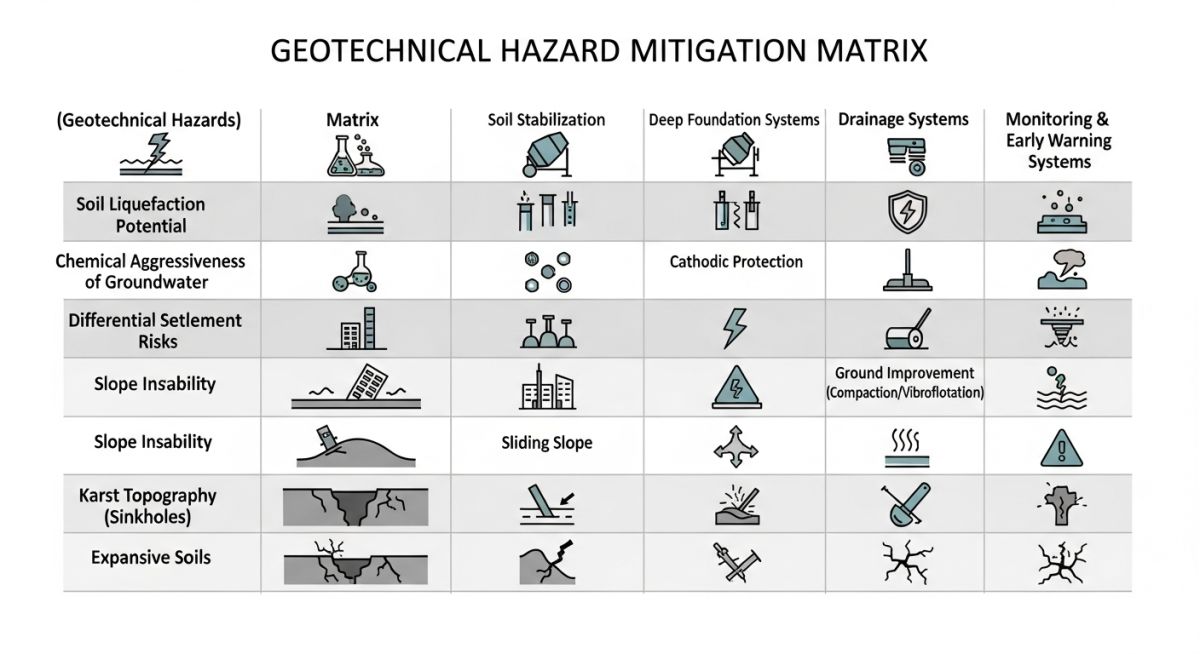
Soft Soil and Settlement Analysis
In soft, cohesive soils, primary consolidation settlement is the primary concern. We calculate the settlement using the compression index (Cc) and the initial void ratio (e0). The total settlement (S) is defined by the formula S = (H / (1 + e0)) * Cc * log10((P0 + deltaP) / P0), where H is the layer thickness, P0 is the initial effective overburden pressure, and deltaP is the induced stress from the foundation.
Field Warning: Differential Settlement Limits
For hydrogen storage tanks, differential settlement must be strictly controlled to prevent buckling of the shell. I typically enforce a maximum angular distortion limit of 1/500 for rigid foundations to protect the integrity of the piping connections and the tank base plate.
Aggressive Soil and Corrosion Mitigation
Hydrogen facilities often involve extensive buried steel piping. If the soil resistivity is low (typically below 2000 ohm-cm), the soil is considered highly corrosive. We must perform chemical analysis for sulfates, chlorides, and pH levels. High sulfate concentrations require Type V sulfate-resistant cement for all concrete foundations to prevent chemical degradation of the foundation matrix.
Furthermore, the presence of stray currents from nearby power substations—common in green hydrogen plants powered by renewable grids—can accelerate cathodic disbondment. I recommend installing a robust impressed current cathodic protection (ICCP) system, verified by periodic potential measurements against a copper/copper-sulfate reference electrode, as outlined in NACE standards.
Geotechnical Risk Mitigation Strategy: The balance between upfront site investigation costs and the long-term operational reliability of hydrogen infrastructure assets.
Advantages of Proactive Mitigation
- Reduces long-term maintenance costs by preventing foundation-related piping stress.
- Ensures compliance with stringent safety codes for high-pressure hydrogen storage.
- Optimizes foundation design, potentially reducing concrete and steel volume.
- Minimizes project delays caused by unforeseen subsurface obstructions or soil failure.
- Enhances the structural lifespan of vibration-sensitive electrolyzer equipment.
Disadvantages of Inadequate Assessment
- High risk of catastrophic structural failure due to soil liquefaction or settlement.
- Increased probability of hydrogen leaks at flange connections due to pipe misalignment.
- Significant cost overruns during construction due to emergency soil stabilization.
- Potential for long-term corrosion of buried assets in aggressive soil environments.
- Regulatory non-compliance leading to project shutdown or permit revocation.
Geotechnical Engineering Applications: The deployment of specialized soil stabilization and foundation techniques across diverse hydrogen production environments and industrial site conditions.
Offshore Wind-to-Hydrogen Integration
In offshore hydrogen production, geotechnical risks involve complex seabed soil profiles and cyclic wave loading. We utilize suction caisson foundations that require precise soil shear strength data to resist overturning moments while maintaining structural stability in saturated marine sediments.
Brownfield Industrial Site Repurposing
Converting existing industrial sites to hydrogen hubs often reveals legacy soil contamination and buried debris. We perform extensive ground-penetrating radar (GPR) surveys and soil chemical testing to ensure that new foundations do not interact negatively with legacy contaminants or compromised soil structures.
High-Pressure Hydrogen Storage Facilities
Storage tanks require massive, rigid mat foundations to distribute heavy loads across large areas. We implement deep soil mixing or stone columns to improve the bearing capacity of the underlying strata, ensuring that the tank remains perfectly level to prevent stress concentrations in the shell.
In my two decades of managing heavy industrial site development, I have observed that the primary failure mode for hydrogen production facilities is not the process equipment itself, but the underlying soil-structure interaction. When designing foundations for electrolyzer skids or high-pressure storage vessels, engineers must strictly adhere to ASCE 7 and ASTM D2487 standards to quantify soil bearing capacity and settlement potential.
The following table outlines critical geotechnical parameters that dictate foundation selection. These values are derived from typical site investigation reports for greenfield hydrogen projects. Note that these are baseline indicators; site-specific GSA testing is mandatory to validate these assumptions against local seismic and hydrological conditions.
| Soil Classification | Allowable Bearing (kPa) | Settlement Risk | Mitigation Strategy |
|---|---|---|---|
| Dense Sand/Gravel | 300 – 500 | Low | Standard Spread Footing |
| Stiff Clay | 150 – 250 | Moderate | Mat Foundation/Piles |
| Soft Organic Silt | < 75 | High | Soil Replacement/Deep Piles |
Engineers must prioritize the “Settlement Risk” column when designing for sensitive hydrogen compression equipment, where differential settlement can lead to piping misalignment and catastrophic seal failure.
The complexity of integrating hydrogen production into existing industrial zones requires a rigorous mapping of geotechnical entities against international engineering standards. My experience suggests that failing to align these variables early in the FEED (Front-End Engineering Design) phase leads to significant cost overruns during the construction phase.
This matrix provides a technical cross-reference for project managers and lead engineers to ensure that every geotechnical risk factor is mapped to a specific regulatory or testing standard. By utilizing this framework, you can ensure that your site investigation scope is comprehensive and defensible during the permitting process.
| Entity/Parameter | Standard Reference | Primary Impact |
|---|---|---|
| Standard Penetration Test (SPT) | ASTM D1586 | Soil Density/Bearing Capacity |
| Groundwater Chemistry | ISO 15589 | Corrosion/Material Selection |
| Consolidation Testing | ASTM D2435 | Long-term Settlement Prediction |
Always verify that your laboratory testing partners are accredited for these specific standards, as the accuracy of your foundation design is entirely dependent on the quality of the raw geotechnical data provided.
Before breaking ground on any green hydrogen facility, I mandate a comprehensive site verification process. Geotechnical risks in green hydrogen projects are often hidden beneath the surface, and a failure to identify them early can compromise the integrity of high-pressure hydrogen storage systems. Use this checklist to ensure your site investigation is robust and compliant with industry best practices.
- Subsurface Profiling: Ensure boreholes extend at least 1.5 times the width of the largest foundation footprint per ASCE guidelines.
- Groundwater Monitoring: Install piezometers to track seasonal water table fluctuations, which can impact soil bearing capacity and foundation buoyancy.
- Corrosivity Analysis: Test soil resistivity and pH levels to determine if cathodic protection is required for buried steel piping and foundation reinforcement.
- Seismic Hazard Assessment: Evaluate site-specific peak ground acceleration (PGA) to design for potential liquefaction in loose, saturated sandy soils.
- Slope Stability: If the site is near water bodies or uneven terrain, conduct a slope stability analysis to prevent catastrophic soil movement during heavy rainfall events.
Validation of these checkpoints is not merely a box-ticking exercise; it is the foundation of your risk management strategy. If any item fails, you must pause construction and re-evaluate the foundation design parameters. In my experience, the cost of additional site investigation is always lower than the cost of remediating a failed foundation after the hydrogen plant is operational.
The Problem: Unforeseen Settlement in Electrolyzer Hall
- Initial site investigation failed to identify a thin layer of compressible organic peat at 4 meters depth.
- Differential settlement occurred during the installation of heavy electrolyzer skids, causing piping flange leaks.
- The project faced a 3-month delay due to the need for emergency soil stabilization and foundation underpinning.
- Lack of deep-borehole sampling in the specific footprint of the compressor building led to inaccurate load-bearing assumptions.
The Outcome: Successful Remediation and Future-Proofing
- Implemented a jet-grouting program to stabilize the peat layer, restoring structural integrity.
- Redesigned the foundation to a rigid mat system, distributing loads more effectively across the soil profile.
- Installed real-time settlement monitoring sensors to provide early warning of any future soil movement.
- Updated the site investigation protocol to mandate continuous sampling for all future hydrogen project phases.
My recommendation based on this case is clear: never rely on regional geological maps alone. Always perform site-specific, high-density borehole testing, especially when dealing with heavy, vibration-sensitive hydrogen production equipment.
Frequently Asked Engineering Questions
How do I mitigate geotechnical risks in green hydrogen projects involving soft soils?
- Utilizing deep foundation systems like driven piles or drilled shafts to bypass compressible layers.
- Implementing ground improvement techniques such as stone columns or deep soil mixing to increase the shear strength of the soil.
- Designing rigid mat foundations to bridge localized soft spots and ensure uniform load distribution.
What are the primary groundwater challenges for hydrogen plant foundations?
- Perform buoyancy calculations for all underground storage tanks and pits to ensure they do not float during high water table events.
- Test groundwater for sulfates and chlorides, which can degrade concrete foundations and corrode steel reinforcement.
- Use sulfate-resistant cement (Type V) and protective coatings for all buried concrete elements.
How does soil corrosivity impact hydrogen infrastructure design?
- Conduct soil resistivity testing per NACE standards to categorize the site’s corrosivity.
- Install sacrificial anodes or impressed current cathodic protection (ICCP) systems for all metallic structures in contact with soil.
- Ensure proper electrical isolation between dissimilar metals to prevent galvanic corrosion.
What are the risks associated with rock excavation for hydrogen plants?
- Perform seismic refraction surveys to map the depth to bedrock and identify potential fault lines.
- Use controlled blasting techniques or mechanical rock breaking to minimize vibration transmission to sensitive electrolyzer skids.
- Assess rock mass quality (RMR) to determine the need for rock bolting or shotcrete support in deep excavations.
How do I ensure foundation stability against seismic events?
- Design foundations to resist lateral loads using shear keys or battered piles.
- Evaluate the potential for soil liquefaction in saturated, loose granular soils and implement ground improvement if necessary.
- Follow ASCE 7 seismic design categories to determine the required level of structural ductility.
What is the role of geotechnical monitoring during construction?
- Install inclinometers to monitor lateral soil movement near deep excavations.
- Use settlement plates to track the consolidation of soil under heavy storage vessels.
- Establish trigger levels for all instrumentation; if readings exceed these thresholds, work must stop for an immediate engineering review.
Complete Course on
Piping Engineering
Check Now
Key Features
- 125+ Hours Content
- 500+ Recorded Lectures
- 20+ Years Exp.
- Lifetime Access
Coverage
- Codes & Standards
- Layouts & Design
- Material Eng.
- Stress Analysis

📚 Recommended Resources: Geotechnical Risks in Green Hydrogen
Read these Guides
- 📄 Site Grading Design for Green Hydrogen Plants: Engineering Best Practices
- 📄 Essential Foundation Design Inputs for Hydrogen Plant Geotechnical Reports
- 📄 Earthworks for Green Hydrogen Plants: Site Grading and Drainage Design
- 📄 Geotechnical Considerations for Electrolyzer Facilities: A Foundation Design Guide