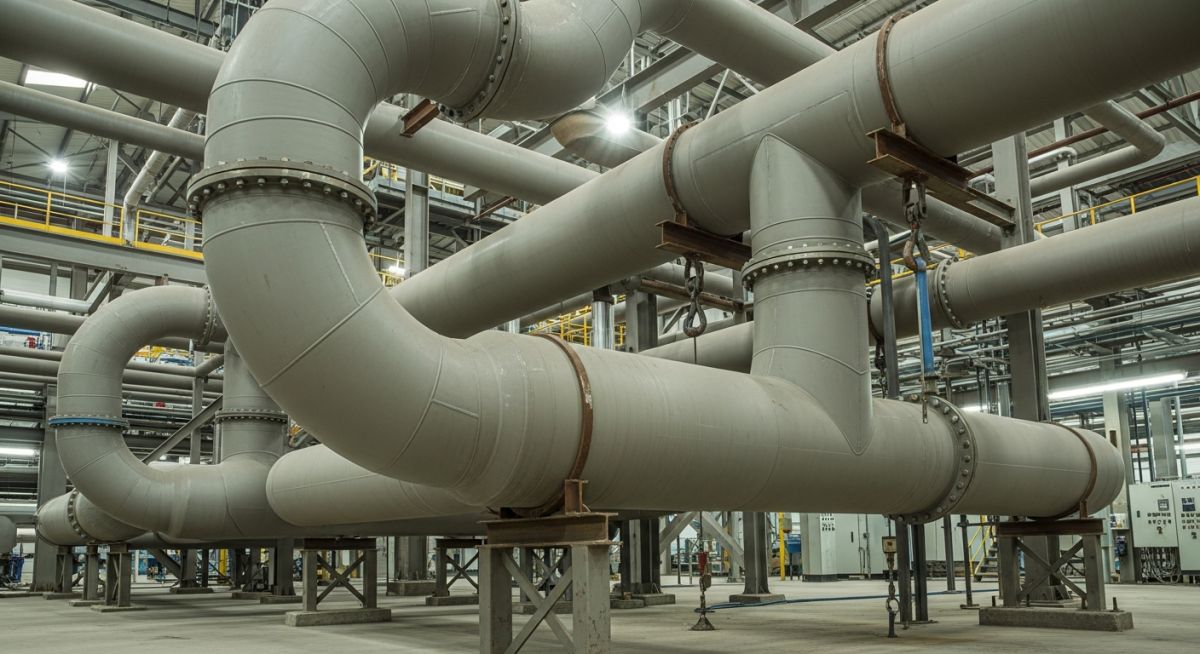
Introduction to FRP Pipes: Properties, Applications, Specifications, Codes, Joining & More
In my 20+ years of experience across refinery, water treatment, and chemical EPC projects, I have seen FRP pipes transition from a niche material to a mainstream engineering solution. When corrosion, weight reduction, and lifecycle cost become critical factors, FRP piping systems often outperform traditional materials.
However, I’ve also witnessed failures—improper joining, incorrect support spacing, and misunderstanding of material behavior. FRP is not just “another pipe material”; it demands a completely different design and installation mindset. This guide will walk you through everything you must know as an engineer—from properties and codes to real field challenges.
✅ Key Takeaways from This Guide
- FRP pipes offer excellent corrosion resistance and long service life
- Proper joining methods are critical for system integrity
- Support spacing differs significantly from steel pipes
- Codes like ASTM and ISO govern specification and testing
- Material comparisons help in selecting FRP over steel or HDPE
FRP pipes (Fiber Reinforced Plastic pipes) are composite piping systems made from resin and reinforcing fibers, offering high strength, corrosion resistance, and lightweight properties. They are widely used in chemical plants, water systems, and offshore industries where durability and low maintenance are critical.
Interactive Engineering Quiz
Q1. What is the primary advantage of FRP pipes over carbon steel?
Applications of FRP Pipes
In my field experience across EPC projects, FRP pipes consistently prove their value in highly corrosive and chemically aggressive environments. Typical applications include cooling water systems, desalination plants, effluent transfer lines, offshore platforms, and underground piping networks.
- Chemical processing plants (acid/alkali service)
- Water treatment & desalination projects
- Fire water and cooling water systems
- Oil & gas offshore piping
- Underground sewage and drainage systems
Properties of FRP Piping Systems
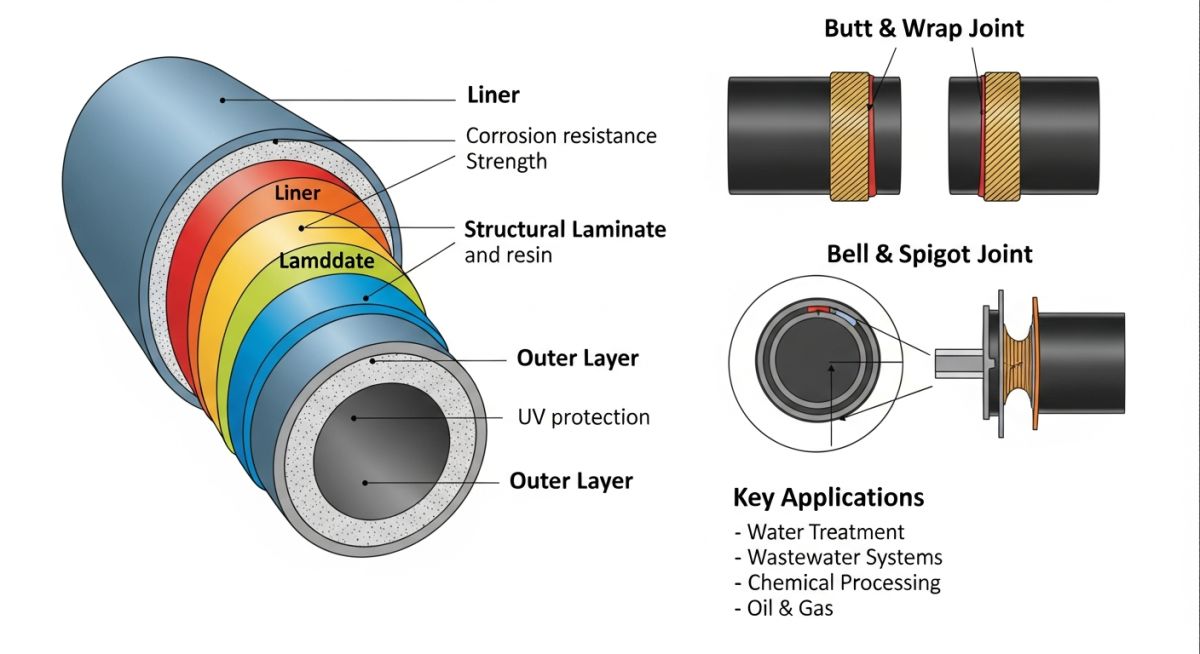
FRP (Fiber Reinforced Plastic) is a composite material composed of a polymer matrix reinforced with fibers like glass. This combination gives it a unique set of properties:
- High corrosion resistance
- Low density (lightweight)
- Good strength-to-weight ratio
- Low thermal conductivity
- Anisotropic behavior (properties vary by direction)
Joining of FRP Pipes
Unrestrained FRP Pipe Joints
- Bell and spigot joints
- Rubber gasket joints
- Adhesive bonded joints
Restrained FRP Pipe Joints
- Butt and wrap joints (widely used in field installation)
- Flanged joints
- Laminated joints
Proper curing conditions (temperature, humidity) are critical during joining. I’ve personally seen joint failures caused by rushed installations in unfavorable weather conditions.
FRP Pipe Fittings
FRP piping systems include a range of fittings such as elbows, tees, reducers, and flanges. These are typically fabricated using molding or hand lay-up techniques and must match the pipe strength class.
Codes and Standards for FRP Pipes
FRP pipes are governed by several international standards. Key references include:
- ASTM Standards (D2996, D3517, D4161)
- ISO 14692 for GRP piping systems
- ASME RTP-1 for reinforced thermoset plastic vessels
Specification of FRP Pipes
Specifications are typically defined by pressure rating, stiffness class, resin type, and reinforcement material. Engineers must align specifications with service conditions such as temperature, pressure, and chemical exposure.
Supporting of FRP Piping System
FRP requires closer support spacing compared to steel due to its lower stiffness. Support types include:
- Pipe shoes
- Saddle supports with load distribution pads
- Guide and anchor supports
| Property | Typical FRP Value | Reference Standard |
|---|---|---|
| Density | 1.5 – 2.0 g/cm³ | ASTM D792 |
| Tensile Strength | 100 – 300 MPa | ASTM D638 |
| Elastic Modulus | 7 – 20 GPa | ISO 527 |
| Operating Temperature | Up to 120°C (depends on resin) | ASME RTP-1 |
| Corrosion Resistance | Excellent | ISO 14692 |
Field Case Study: Real-World Application
In a refinery cooling water system I handled, DN600 carbon steel pipelines suffered aggressive internal corrosion within 18 months of operation. Frequent leaks led to shutdown risks and high maintenance costs. The initial design underestimated chloride levels in the circulating water, and coatings failed prematurely.
We replaced critical sections with FRP piping designed as per ISO 14692. Butt-and-wrap joints were used with strict curing control. Support spacing was redesigned using manufacturer limits. Result: zero corrosion issues and ~35% lifecycle cost savings over 5 years.
My Recommendation: Always evaluate fluid chemistry and lifecycle cost. For corrosive services, FRP pipes are not just an alternative—they are often the optimal engineering choice when designed and installed correctly.
Drawbacks of FRP Piping
- Lower modulus → higher deflection risk
- Temperature limitations based on resin system
- Installation quality highly dependent on workmanship
- Limited resistance to point loads and impact
FRP vs GRP, Steel & HDPE
FRP vs GRP: Practically, GRP is a subtype of FRP using glass fibers. In piping, both terms are often used interchangeably.
FRP vs Steel: FRP offers corrosion resistance and lower weight, whereas steel provides higher stiffness and temperature capability.
FRP vs HDPE: FRP provides higher stiffness and pressure ratings, while HDPE offers flexibility and simpler joining.
Stress Analysis of FRP Piping System
FRP stress analysis differs significantly from metallic systems due to anisotropic behavior. Typical checks include:
- Hoop stress: σ = (P × D) / (2 × t)
- Axial stress from pressure and thermal loads
- Allowable strain-based design criteria
Standards like ASME RTP-1 and ISO guidelines emphasize strain limits rather than stress limits due to composite material behavior.
Frequently Asked Engineering Questions
What is the design standard for FRP piping systems?
Why do FRP pipes fail in field installations?
Can FRP pipes handle high pressure?
What is the lifespan of FRP pipes?
Is FRP suitable for underground piping?
How is FRP different in design from steel piping?
Complete Course on
Piping Engineering
Check Now
Key Features
- 125+ Hours Content
- 500+ Recorded Lectures
- 20+ Years Exp.
- Lifetime Access
Coverage
- Codes & Standards
- Layouts & Design
- Material Eng.
- Stress Analysis



