Table of Contents

Industrial Flare System Design: Types, Components, and Sizing Criteria
In my 20-plus years of piping design, I have seen how a poorly designed relief network can shut down an entire facility or, worse, lead to catastrophic structural failure. A flare system is not merely a waste gas disposal unit; it is the ultimate safety shield of a refinery, petrochemical plant, or offshore platform. When process pressures spike beyond safe limits, the flare system must perform flawlessly under extreme thermal and hydraulic loads.
Throughout my career, I have guided engineering teams through the complex process of sizing headers, designing knock-out drums, and selecting the right flare tips. This guide shares those practical, field-tested insights to help you master the fundamentals of safety relief engineering.
Key Takeaways From This Guide
- Understand the core mechanics of relief headers and hydraulic limitations.
- Master the sizing criteria for Knock-Out Drums (KOD) using the Souders-Brown equation.
- Learn how to mitigate acoustic-induced vibration (AIV) in high-velocity piping.
- Discover the environmental and economic benefits of Flare Gas Recovery Systems (FGRS).
Complete Course on
Piping Engineering
Check Now
Key Features
- 125+ Hours Content
- 500+ Recorded Lectures
- 20+ Years Exp.
- Lifetime Access
Coverage
- Codes & Standards
- Layouts & Design
- Material Eng.
- Stress Analysis
Why Flare System Design Matters in Process Plants
Emergency Overpressure Protection: The systematic deployment of relief valves, headers, and knock-out drums to prevent catastrophic vessel rupture during plant upsets.
When an overpressure event occurs—whether due to a utility failure, external fire, or control loop malfunction—the relief valves lift to vent excess inventory. This inventory must travel through a carefully engineered network of lateral lines and main headers. If the hydraulics are restricted, backpressure will build up at the relief valves, potentially preventing them from relieving at their rated capacity.
In my field audits, I often find that engineers overlook the cumulative backpressure in headers during simultaneous relief scenarios. Designing for a single valve relief is simple; designing for a global power failure where dozens of valves lift simultaneously requires rigorous hydraulic modeling and a deep understanding of API Standard 521.
High-pressure drop across relief valves can generate extreme high-frequency acoustic energy. This energy travels down the piping, causing thin-walled pipes to fail at welded branch connections within minutes. Always check the sound power level (PWL) at the downstream reducer and ensure the piping wall thickness is sufficient to withstand AIV.
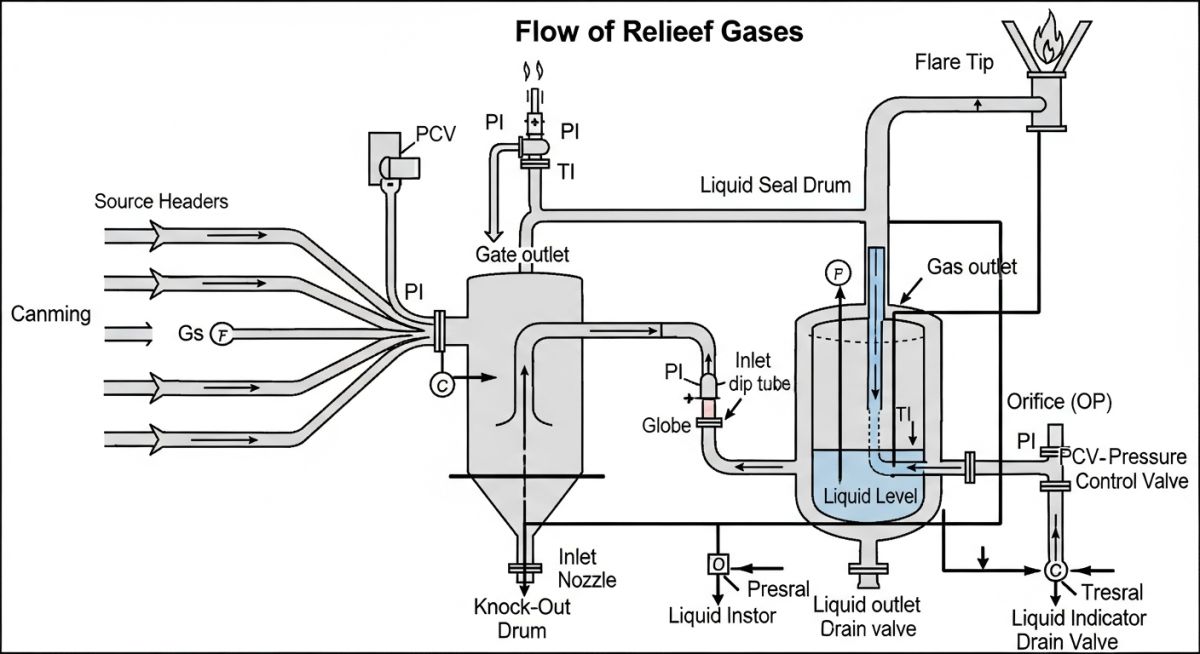
Key Parameters Governing Flare System Design Sizing
Sizing Criteria and Hydraulics: The mathematical determination of header diameters, knock-out drum volumes, and stack heights to manage fluid dynamics and thermal radiation limits.
A. Velocity and Mach Number Limits
Velocity Control: The restriction of gas velocities within relief headers to prevent erosion, high noise levels, and excessive pressure drop.
During emergency relief, gas velocities can easily approach sonic velocity (Mach 1.0). For continuous flaring, I recommend keeping the velocity below 0.2 Mach. For emergency, short-duration relief events, velocities up to 0.7 or 0.8 Mach are acceptable in the main header, but the piping must be anchored securely to handle the dynamic reaction forces.
B. Knock-Out Drum (KOD) Sizing
Liquid Separation: The process of removing liquid droplets from the gas stream to prevent burning liquid droplets from escaping the flare tip.
The sizing of a horizontal or vertical KOD is governed by the Souders-Brown equation, which determines the dropout velocity of liquid particles:
Where:
Vc = Critical dropout velocity (ft/s)
C = Sizing parameter (typically 0.15 to 0.25 ft/s depending on pressure and design)
ρL = Liquid density (lb/ft³)
ρg = Gas density (lb/ft³)
To prevent “burning rain” (liquid droplets falling from the flare stack and igniting the ground), the KOD must separate all liquid droplets larger than 300 to 600 micrometers.
Below are the standard design limits I apply during the initial sizing phase of a flare network. These values ensure safe hydraulic performance and prevent mechanical damage to the piping system.
| System Component | Continuous Flow Limit | Emergency Flow Limit | Allowable Backpressure |
|---|---|---|---|
| Conventional PRV Discharge | N/A | Mach 0.3 max | 10% of Set Pressure |
| Balanced Bellows PRV | N/A | Mach 0.5 max | 30% to 50% of Set Pressure |
| Main Flare Header | Mach 0.2 | Mach 0.7 to 0.8 | Governed by PRV limits |
| Flare Tip | Mach 0.2 | Mach 0.5 (typical) | Minimal (Atmospheric) |
| Entity Name | Primary Function | Design Code Reference | Critical Design Constraint |
|---|---|---|---|
| Pressure Relief Valve (PRV) | Overpressure protection | ASME Section VIII | Inlet pressure drop must not exceed 3% of set pressure. |
| Knock-Out Drum (KOD) | Liquid-gas separation | API Standard 521 | Must provide 20 to 30 minutes of liquid holdup volume. |
| Liquid Seal Drum | Prevents flashback | API Standard 521 | Water seal depth must exceed maximum header backpressure. |
| Flare Stack | Safe dispersion & combustion | API Standard 521 / ASME STS-1 | Thermal radiation at ground level must not exceed 1.58 kW/m². |
How to Verify Flare System Integrity
Pre-Commissioning Field Verification: The rigorous physical inspection of slope, support structures, and safety interlocks prior to introducing hydrocarbons into the relief network.
Before any flare system is put into service, a comprehensive field walkdown is mandatory. Liquid pockets in a flare header are a major hazard; when a high-velocity gas stream hits a pocket of liquid, it acts like a water hammer, tearing pipe supports off their foundations.
Essential Field Verification Steps
-
Header Slope: Verify a continuous downward slope of at least 1:500 (preferably 1:200) toward the Knock-Out Drum. No low points or pockets are permitted. -
Bellows Integrity: Inspect all expansion joints and PRV balanced bellows for mechanical damage or pinhole leaks. -
Purge Gas System: Confirm that the nitrogen or fuel gas purge system is operational to prevent air ingress into the header. -
Ignition System: Test the pilot ignition system (both manual and automatic) to ensure reliable flame propagation. -
KOD Level Alarms: Calibrate and test the high-level and high-high-level alarms on the KOD to prevent liquid carryover. -
Spring Hangers: Ensure all variable and constant spring hangers are in their “unlocked” operating position.
Resolving Liquid Carryover in Flare Systems
Liquid Carryover Mitigation: The engineering resolution of undersized knock-out drums to prevent hazardous burning liquid rain from the flare tip.
During a plant-wide emergency shutdown at a gas processing facility in Southeast Asia, burning liquid droplets were observed falling from the flare stack. This “burning rain” posed an immediate fire hazard to the surrounding process units. The existing horizontal Knock-Out Drum (KOD) was failing to separate the liquid hydrocarbons during high-velocity relief events.
I was brought in to analyze the system. Our hydraulic study revealed that the gas velocity inside the KOD exceeded the critical dropout velocity calculated by the Souders-Brown equation by 40%. We retrofitted a secondary horizontal KOD upstream of the main stack, installed high-efficiency vane pack internals to coalesce smaller droplets, and upgraded the liquid pump-out system. During the next emergency trip, liquid separation was 100% successful, and no carryover occurred.
This case highlights the importance of dynamic simulation. Standard steady-state calculations often fail to capture the transient liquid slugs that occur during the first few minutes of a relief event.
Common Queries on Flare System Design
Flare Design FAQ: Expert answers addressing critical operational queries, regulatory compliance, and hydraulic limitations in relief networks.
What is the purpose of a liquid seal drum in a flare system?
How does backpressure affect conventional vs. balanced bellows PRVs?
What is the minimum slope required for a flare header?
Why is purge gas injected into the flare header?
What is a Flare Gas Recovery System (FGRS)?
How is the height of a flare stack determined?

📚 Recommended Resources: flare system design
Read these Guides
- 📄 Mastering Centrifugal Compressor Piping Design and Key Appurtenances
- 📄 Mastering 3-Phase Separator Design Basics for Oil and Gas
- 📄 Surge Relief Valve Design Function Types and Selection Guide
- 📄 Top Piping Design Software Packages for 2026 | 2D & 3D Modelling Software Packages | Piping Design CAD Tools
🎓 Advanced Training



Related posts:
![A mechanical sucker rod pumpjack operating in an oil field at sunset]()
What is Sucker Rod Pump System in Oil Production?
![Piping material engineer reviewing technical specifications on a tablet in an industrial plant.]()
How a Piping Material Engineer Drives Industrial Project Success
![Industrial refinery plant showing various types of static equipment]()
What is Static Equipment? Types and List of Static Equipments
![Side-by-side comparison of industrial process piping and power plant steam piping systems.]()
Differences Between ASME B31.3 and B31.1: B31.3 vs B31.1
![Large industrial steel storage tank under construction with cranes and scaffolding]()
Storage Tank Construction Method Statement: Step-by-Step Engineering Guide
![Cutaway diagram of a globe control valve highlighting the internal valve trim components]()
What is a Valve Trim? Types, Components, and Selection