Deluge Valve Working Principle Components and Fire Protection Systems
In my 20+ years working across refineries, power plants, and chemical units, I have seen one system repeatedly save entire facilities from catastrophic loss—the deluge valve system. When fire spreads rapidly across high-risk zones, waiting for individual sprinklers to activate is not an option.
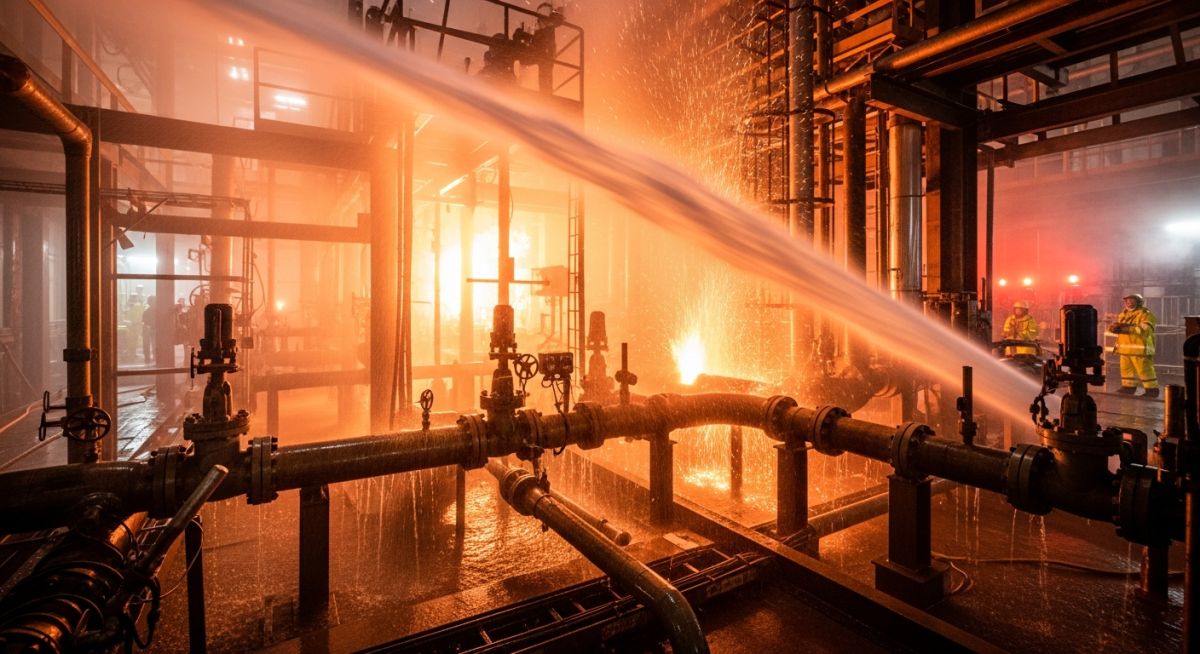
A deluge valve delivers an instant, high-volume water discharge across all nozzles simultaneously. This aggressive suppression approach makes it the backbone of fire protection in hydrocarbon processing areas, cable galleries, and aircraft hangars.
Key Engineering Takeaways
- Deluge valves control water flow in open nozzle fire protection systems
- System activates instantly across entire hazard zone
- Widely used in high-risk industrial environments
- Operates through detection systems like heat, smoke, or flame sensors
- Complies with standards like NFPA guidelines
A deluge valve is a fast-acting fire protection device used in open nozzle systems where all sprinklers discharge simultaneously. It remains closed during normal conditions and opens upon detection signals, allowing water to flow instantly across the entire protected area, ensuring rapid fire suppression in high-hazard zones.
Interactive Engineering Quiz
Q1. What is the primary function of a deluge valve?
Complete Course on
Piping Engineering
Check Now
Key Features
- 125+ Hours Content
- 500+ Recorded Lectures
- 20+ Years Exp.
- Lifetime Access
Coverage
- Codes & Standards
- Layouts & Design
- Material Eng.
- Stress Analysis
What is a deluge valve system?
Deluge Valve System Definition: A deluge valve is a hydraulically operated main control valve used in open nozzle fire protection systems, designed to release water instantly across an entire hazard area in compliance with NFPA standards.
In my field experience across refinery and power projects, a deluge valve acts as the heart of high-risk fire suppression systems. Unlike standard sprinkler systems, these valves control water discharge to open nozzles, meaning once activated, the entire protected zone gets flooded instantly.
How does a deluge valve work?
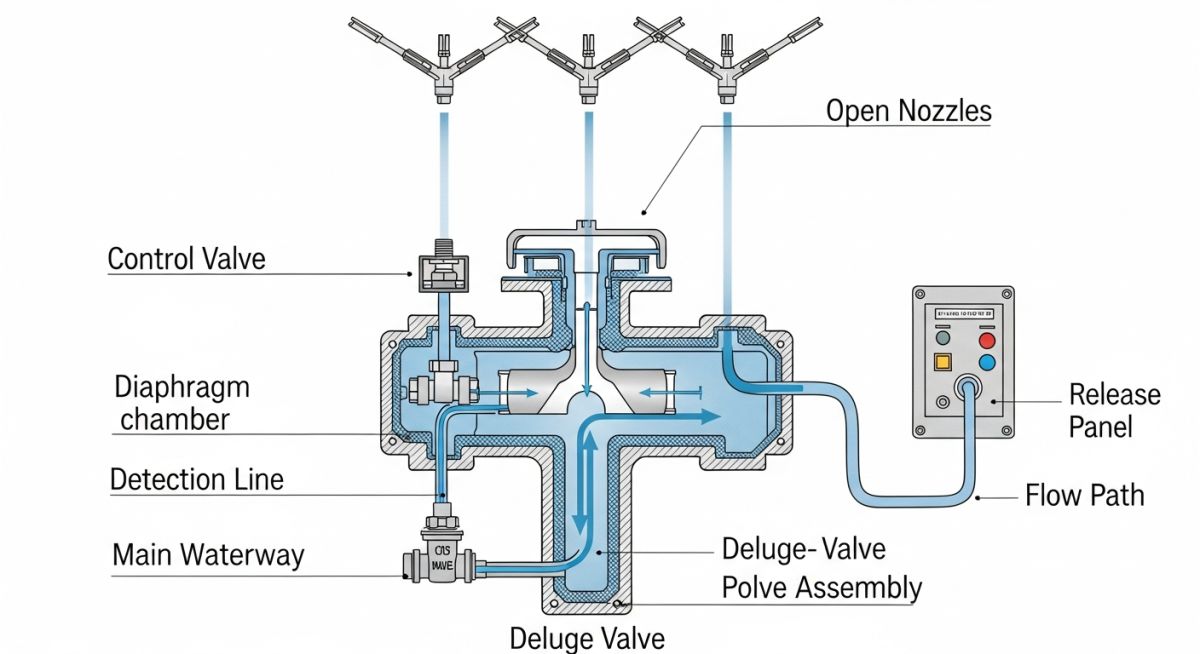
Deluge Valve Working Principle: The valve remains closed under normal conditions using hydraulic pressure and opens immediately when a detection system releases pressure, allowing full water flow across all nozzles.
The system operates through three main stages:
- Detection system senses fire through heat, smoke, or flame
- Control panel sends signal to release trim
- Valve opens and floods entire piping network instantly
What components make up deluge valves?
Deluge Valve Components Overview: A deluge system consists of a main valve body, trim line, release mechanism, detection system, and open discharge nozzles engineered per UL certification standards.
Key components include:
- Main deluge valve with diaphragm
- Release trim assembly
- Detection system (heat/smoke sensors)
- Fire alarm control panel
- Open spray nozzles
Where are deluge systems used?
Industrial Application Scope: Deluge valves are deployed in high-hazard environments requiring rapid full-area suppression such as refineries, aircraft hangars, and cable galleries under FM Global guidelines.
From my project exposure, the most critical applications include:
- Hydrocarbon processing areas
- Transformer protection systems
- Power plant cable basements
- Chemical storage and loading bays
How does deluge system compare others?
System Comparison Insight: Deluge systems differ from wet and dry sprinkler systems by enabling simultaneous discharge, ensuring maximum coverage speed under NFPA 13 guidelines.
| System Type | Nozzle Type | Activation | Response Time |
|---|---|---|---|
| Deluge System | Open | Detection System | Immediate Full Area |
| Wet Pipe System | Closed | Heat-sensitive bulbs | Gradual |
| Dry Pipe System | Closed | Air pressure drop | Moderate delay |
Deluge Valve Verification Method: A deluge valve system must be validated through hydraulic, mechanical, and detection system checks to ensure compliance with NFPA standards and FM Global guidelines. Field verification ensures the system activates instantly and delivers full-flow discharge across all open nozzles without delay.
In my experience across refinery and power plant commissioning, most deluge system failures occur not because of design flaws but due to poor on-site validation. A structured checklist ensures the valve, trim, detection loop, and actuation logic all function as a single coordinated system under emergency conditions.
Deluge Valve System Site Checklist
- Verify deluge valve orientation and installation as per approved GA drawing
- Inspect trim lines for correct connections, leakage, and pressure integrity
- Confirm diaphragm chamber maintains required hydraulic pressure
- Check release system linkage with detection panel and manual actuator
- Test heat, smoke, or flame detectors for proper signal transmission
- Validate actuation time from detection to valve opening
- Ensure all nozzles are open type and free from blockage
- Flush piping network to remove debris before commissioning
- Verify water supply pressure and flow meet design calculations
- Confirm alarm system triggers upon valve activation
- Test manual override station accessibility and functionality
- Ensure proper earthing of electrical control systems
- Validate compliance with UL certification standards
- Document functional test results and maintain commissioning records
Always treat the checklist as a mandatory engineering control rather than a documentation formality. A properly verified deluge valve system is the difference between controlled suppression and facility-wide damage.
Field Case Study: Real-World Application
In one refinery hydrocarbon pump area I handled, a sudden seal failure caused flammable liquid leakage. Within seconds, vapors ignited and the fire began spreading rapidly across adjacent equipment. The installed sprinkler system could not respond fast enough because it depended on localized heat activation.
The deluge valve system activated through flame detectors and instantly discharged water across the entire zone. The fire was suppressed within minutes, preventing escalation to nearby storage tanks and avoiding large-scale damage. This incident confirmed that full-area flooding response is non-negotiable in hydrocarbon environments.
Based on my field experience, I strongly recommend always integrating redundant detection logic and conducting full-flow testing before commissioning. A deluge valve is only as reliable as the system controlling its activation.
Frequently Asked Engineering Questions
What makes deluge valves different?
Why use open nozzle systems?
How fast do deluge valves open?
Can deluge valves activate manually?
Where are deluge systems commonly installed?
What causes deluge system failures?