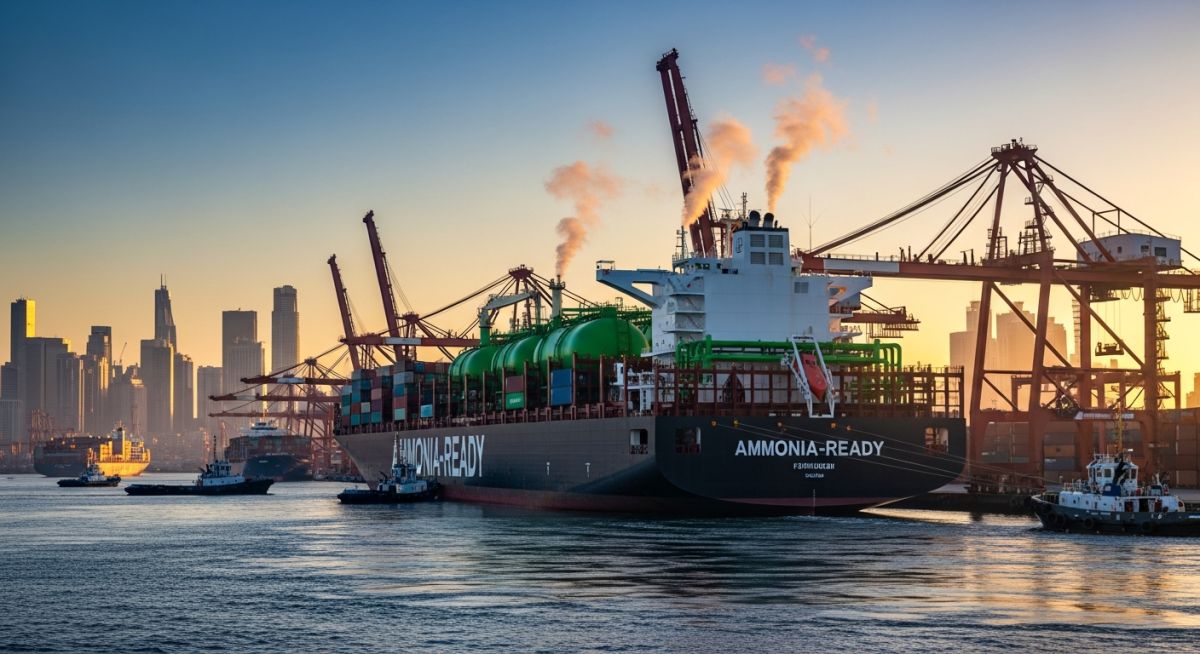
Green Ammonia as Marine Fuel: Engineering the Future of Shipping
In my two decades of piping and process engineering, I have witnessed numerous energy transitions, but the shift toward ammonia represents a unique challenge. Unlike LNG, which we have mastered through decades of boil-off gas management, ammonia introduces a lethal toxicity profile that demands a complete rethink of our shipboard piping architecture.
We are not just swapping fuels; we are re-engineering the entire fuel supply chain from bunkering manifolds to combustion chambers. This article dissects the technical realities of handling anhydrous ammonia at sea, focusing on the material compatibility, pressure-temperature envelopes, and the stringent safety barriers required to protect crew and environment.
Key Takeaways for Marine Engineers
- Ammonia requires specialized material selection to prevent stress corrosion cracking in carbon steel piping.
- Dual-fuel engine technology must account for ammonia’s low flame speed and high auto-ignition temperature.
- Safety systems must prioritize leak detection and rapid isolation, given the high toxicity of ammonia vapor.
- Regulatory compliance hinges on the IGC Code and the evolving IGF Code for low-flashpoint fuels.
Complete Course on
Piping Engineering
Check Now
Key Features
- 125+ Hours Content
- 500+ Recorded Lectures
- 20+ Years Exp.
- Lifetime Access
Coverage
- Codes & Standards
- Layouts & Design
- Material Eng.
- Stress Analysis
Technical Deep-Dive: Green Ammonia as Marine Fuel
Ammonia Fuel System Design: The design of ammonia fuel systems necessitates strict adherence to cryogenic containment principles and chemical compatibility standards to mitigate the risks of material degradation and toxic release.
When we evaluate ammonia as a marine fuel, we must first address its physical properties. Ammonia (NH3) has a lower energy density than traditional HFO, requiring roughly 3.5 times the storage volume. From a piping perspective, the primary concern is Stress Corrosion Cracking (SCC). In my experience, standard carbon steel piping, if not properly stress-relieved, is highly susceptible to cracking when exposed to anhydrous ammonia.
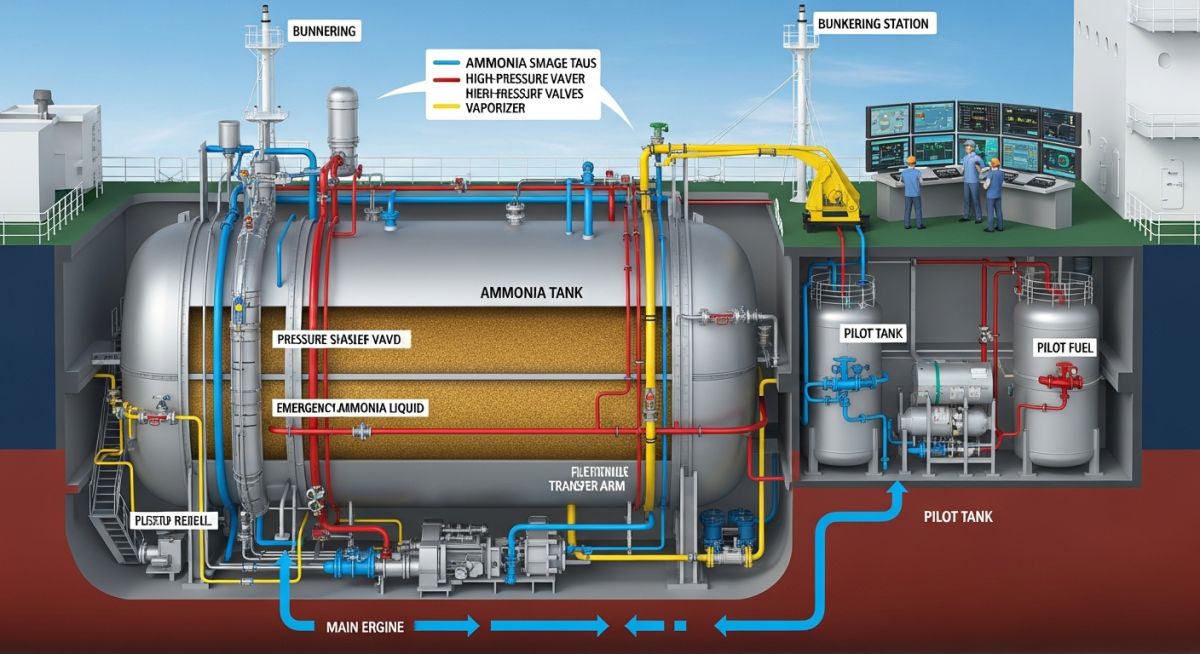
Material Compatibility and Stress Parameters
For piping systems, I specify ASTM A333 Grade 6 or similar low-temperature carbon steels, but only after rigorous post-weld heat treatment (PWHT). The residual stresses in welds are the primary initiation sites for SCC. We must ensure that the hardness of the weld and heat-affected zone (HAZ) remains below 225 HV to prevent brittle failure.
Field Warning: Ammonia Toxicity
Ammonia is classified as a toxic gas. Unlike LNG, which is flammable but non-toxic, ammonia leaks can be fatal at concentrations as low as 300 ppm. Piping design must incorporate double-walled piping with interstitial monitoring for all enclosed machinery spaces, as mandated by the IMO IGC Code.
Combustion and Engine Dynamics
Ammonia’s combustion characteristics are challenging. It has a high auto-ignition temperature (651 degrees Celsius) and a narrow flammability range. In dual-fuel engines, we typically use a pilot fuel (like MGO or biodiesel) to initiate combustion. The engine control system must manage the ammonia-to-pilot fuel ratio precisely to ensure complete combustion and minimize N2O emissions, which are potent greenhouse gases.
The fuel supply system must maintain the ammonia in a liquid state at the engine inlet. This requires a pressure-temperature control loop that keeps the ammonia above its saturation pressure. If the pressure drops, we risk cavitation in the high-pressure fuel pumps, which can lead to catastrophic seal failure and leakage.
Ammonia Fuel Performance: The adoption of ammonia as a marine fuel offers a pathway to zero-carbon shipping while presenting significant operational hurdles related to toxicity, storage volume, and combustion efficiency.
Advantages
- Zero carbon emissions at the point of combustion, supporting IMO 2050 targets.
- Established global supply chain for ammonia as a fertilizer feedstock.
- Easier to liquefy than hydrogen, requiring only -33 degrees Celsius at atmospheric pressure.
- High energy density compared to compressed hydrogen, reducing storage footprint.
Disadvantages
- Extreme toxicity requires complex, expensive double-walled piping and ventilation systems.
- High risk of Stress Corrosion Cracking (SCC) in standard carbon steel materials.
- Low flame speed necessitates pilot fuel injection, complicating engine design.
- Potential for N2O emissions, which are significantly more harmful than CO2.
Marine Ammonia Deployment: The practical application of green ammonia is currently focused on deep-sea shipping segments where high energy density and long-range capabilities are critical for operational viability.
Deep-Sea Bulk Carriers
Large bulk carriers are the primary candidates for ammonia propulsion due to their predictable routes and large deck space for fuel storage. The integration involves retrofitting existing dual-fuel engine designs to handle the specific corrosive nature of ammonia while maintaining cargo capacity.
Container Ship Fleet Decarbonization
Container vessels require high power density for trans-oceanic transit, making ammonia an ideal candidate for replacing heavy fuel oil. Engineers are currently designing modular fuel storage tanks that can be integrated into the ship’s structure without compromising container stacking efficiency.
Green Ammonia Bunkering Hubs
Infrastructure development at major ports is essential for the widespread adoption of ammonia as a marine fuel. These hubs utilize cryogenic storage terminals and specialized loading arms to transfer ammonia safely from shore to ship, adhering to strict hazardous area classification standards.
Selecting an alternative fuel requires a rigorous evaluation of physical and chemical properties that dictate storage, handling, and combustion efficiency. When comparing anhydrous ammonia to traditional heavy fuel oil or marine gas oil, engineers must account for significant differences in energy density, auto-ignition temperatures, and vapor pressure.
The following table outlines the critical parameters that influence the design of fuel supply systems, tank insulation, and engine injection timing. These values are derived from standard ISO and IMO guidelines for alternative marine fuels, highlighting the necessity for specialized cryogenic or pressurized storage solutions.
| Property | Ammonia (NH3) | Marine Gas Oil (MGO) | Unit |
|---|---|---|---|
| Lower Heating Value | 18.6 | 42.7 | MJ/kg |
| Auto-ignition Temp | 651 | 225 | Degrees Celsius |
| Boiling Point (1 atm) | -33.4 | 250-350 | Degrees Celsius |
| Flammability Limits | 15-28 | 0.6-7.5 | Volume Percent |
Engineers should note that the lower energy density of ammonia necessitates larger storage volumes to maintain equivalent operational range. Furthermore, the high auto-ignition temperature requires pilot fuel injection or advanced ignition assistance systems to ensure stable combustion within the cylinder.
The successful implementation of ammonia-fueled vessels relies on a complex ecosystem of regulatory frameworks and technical standards. This matrix maps the primary entities and standards governing the transition to carbon-neutral shipping, ensuring that all design choices align with international safety and environmental mandates.
By cross-referencing these entities, project managers can identify the specific compliance requirements for bunkering, onboard storage, and engine emission control. Adherence to these standards is non-negotiable for classification society approval and insurance underwriting in the maritime sector.
| Entity/Standard | Primary Focus | Regulatory Scope |
|---|---|---|
| IMO IGF Code | Safety for low-flashpoint fuels | Global Maritime Safety |
| ASME B31.3 | Process Piping Design | Pressure Integrity |
| IACS UR | Classification Society Rules | Vessel Certification |
| ISO 18573 | Ammonia Handling/Storage | Operational Safety |
This matrix serves as a foundational reference for technical teams. It highlights the intersection of mechanical design, such as piping integrity under ASME standards, and the overarching safety protocols mandated by the IMO.
Implementing ammonia fuel systems requires a systematic approach to site verification and risk mitigation. Before commissioning, every installation must undergo a rigorous audit to ensure that all mechanical, electrical, and safety systems meet the stringent requirements for handling toxic and corrosive substances.
-
[ ]
Pressure Boundary Integrity: Verify all piping and valves comply with ASME B31.3 for ammonia service, ensuring material compatibility to prevent stress corrosion cracking. -
[ ]
Ventilation and Gas Detection: Confirm installation of redundant ammonia sensors and high-capacity ventilation systems in all enclosed spaces, as per IMO IGF Code requirements. -
[ ]
Emergency Shutdown Systems: Validate that the ESD system is fully integrated with the engine control unit and can isolate fuel supply within the specified time limits during a leak event. -
[ ]
Bunkering Protocols: Ensure the bunkering manifold is equipped with dry-disconnect couplings and that the ship-to-shore communication link is tested for signal reliability. -
[ ]
Personnel Safety Equipment: Verify the availability of full-face respirators, chemical-resistant suits, and emergency eye-wash stations at all critical handling points.
These checkpoints are not merely administrative; they are critical safety barriers. In my experience, the most common failure points during commissioning involve improper gasket material selection and inadequate sensor calibration. Always perform a full HAZOP (Hazard and Operability Study) before introducing ammonia into the system, ensuring that every potential leak path is accounted for in the design documentation.
Field Case Study: Real-World Application
Problem: Ammonia Leakage in Fuel Supply Piping
During a pilot project involving a retrofitted ammonia-fueled vessel, the engineering team encountered persistent micro-leaks at the flange connections within the fuel supply manifold.
- Incompatibility of standard rubber gaskets with anhydrous ammonia.
- Thermal cycling causing expansion and contraction of piping joints.
- Vibration-induced loosening of fasteners in the engine room environment.
- Inadequate torque specifications for high-pressure ammonia service.
Outcome: Successful System Remediation
The team successfully resolved the leakage issues by implementing a comprehensive redesign of the fuel supply interface.
- Replacement of all gaskets with PTFE-based materials rated for ammonia.
- Installation of spring-loaded washers to maintain constant bolt tension.
- Implementation of a rigorous vibration monitoring and maintenance schedule.
- Validation of leak-tightness using helium leak detection methods.
My recommendation for future projects is to prioritize the selection of high-integrity sealing solutions from the design phase. Never underestimate the impact of thermal cycling on mechanical joints in cryogenic or pressurized fuel systems; proactive maintenance and material selection are the only ways to ensure long-term operational safety.
Frequently Asked Engineering Questions
How does ammonia storage impact vessel stability?
- Increased topside weight if tanks are deck-mounted, raising the vertical center of gravity.
- Requirement for larger ballast water compensation to maintain trim and stability.
- Structural reinforcement of the hull to support the weight of cryogenic or pressurized containment systems.
What are the primary risks of ammonia toxicity?
- Immediate respiratory distress and chemical burns upon contact with mucous membranes.
- The necessity for redundant gas detection systems calibrated to detect low-level leaks.
- Strict adherence to ISO safety standards for personal protective equipment and emergency response protocols.
Can existing engines be retrofitted for ammonia?
- Installation of dual-fuel injection systems to handle ammonia and pilot fuel.
- Upgrading cylinder liners and piston rings to resist potential corrosion.
- Modifying the exhaust gas after-treatment system to manage nitrogen oxide emissions.
How is ammonia bunkering performed safely?
- Use of dry-disconnect couplings to minimize spillage during connection and disconnection.
- Vapor return lines that route displaced ammonia gas back to the supply vessel.
- Strict exclusion zones around the bunkering manifold to protect personnel.
What are the regulatory drivers for ammonia?
- The IMO Initial Strategy on Reduction of GHG Emissions from Ships.
- Regional mandates such as the European Union Emissions Trading System (EU ETS).
- Corporate ESG goals that incentivize the transition to zero-carbon energy sources.
Is ammonia compatible with existing piping materials?
- Use of carbon steel or stainless steel for all ammonia-wetted components.
- Avoidance of brass, bronze, or galvanized steel in the fuel supply chain.
- Strict adherence to ASME material specifications to prevent stress corrosion cracking.
