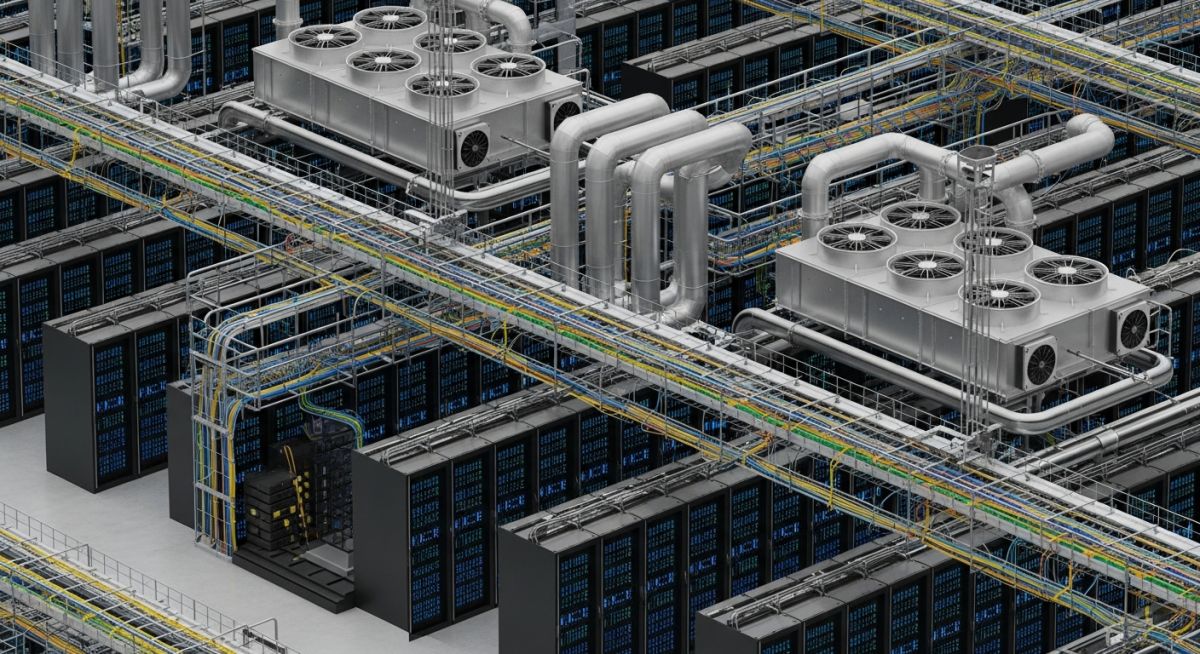
Understanding the Four Primary Data Centre Types for Engineering Infrastructure
In my two decades of managing industrial facility designs, I have observed that the selection of a data centre architecture is no longer just an IT decision; it is a fundamental civil and mechanical engineering challenge. Whether you are designing for a private enterprise, a massive hyperscale cloud provider, or a localized edge node, the physical requirements for power density, cooling efficiency, and structural integrity vary significantly.
This guide dissects the four primary data centre types—Enterprise, Colocation, Hyperscale, and Edge—to help you align your infrastructure strategy with specific operational demands. We will examine the thermal loads, power distribution requirements, and site selection criteria that define these facilities in today’s high-demand digital landscape.
Key Takeaways for Engineers:
- Enterprise facilities prioritize total control and security over scalability.
- Colocation models shift the burden of physical plant maintenance to third-party providers.
- Hyperscale data centres demand massive power grid integration and advanced liquid cooling.
- Edge computing requires modular, ruggedized designs for deployment in non-traditional environments.
Technical Analysis of Data Centre Types
Data Centre Infrastructure Engineering: The systematic integration of power, cooling, and structural systems designed to meet specific uptime requirements defined by Uptime Institute Tier classifications.
When evaluating the four primary Data Centre Types, we must first address the power density requirements. Enterprise data centres typically operate at 5-10 kW per rack, whereas modern hyperscale facilities are pushing 30-50 kW per rack, necessitating a shift from traditional air-cooled CRAC units to direct-to-chip liquid cooling. From a structural perspective, the floor loading capacity for these facilities often exceeds 1,500 kg/sqm to accommodate high-density server arrays and heavy battery backup systems.
Enterprise and Colocation Design Parameters
Enterprise data centres are often housed within existing corporate campuses. The engineering focus here is on redundancy and physical security. We typically design these with N+1 or 2N electrical redundancy to ensure business continuity. Conversely, colocation facilities function as multi-tenant environments. The engineering challenge here is the segregation of power and cooling circuits to prevent cross-contamination of environmental conditions between tenants.
Engineering Warning: Thermal Runaway
In high-density colocation environments, improper airflow management leads to localized hot spots. Always utilize CFD (Computational Fluid Dynamics) modeling to validate hot-aisle/cold-aisle containment strategies before commissioning the facility.
Hyperscale and Edge Scaling Requirements
Hyperscale data centres are defined by their massive scale, often exceeding 20 MW of power capacity. These facilities require dedicated high-voltage substations and sophisticated water management systems for evaporative cooling. The design must account for massive heat rejection loads, often utilizing closed-loop cooling towers that integrate with local water reclamation infrastructure.
Edge data centres represent the opposite end of the spectrum. These are modular, often containerized units deployed at the network periphery to reduce latency. The engineering focus shifts to ruggedization—ensuring the equipment can withstand ambient temperature fluctuations, humidity, and seismic activity without the benefit of a controlled, centralized facility environment.
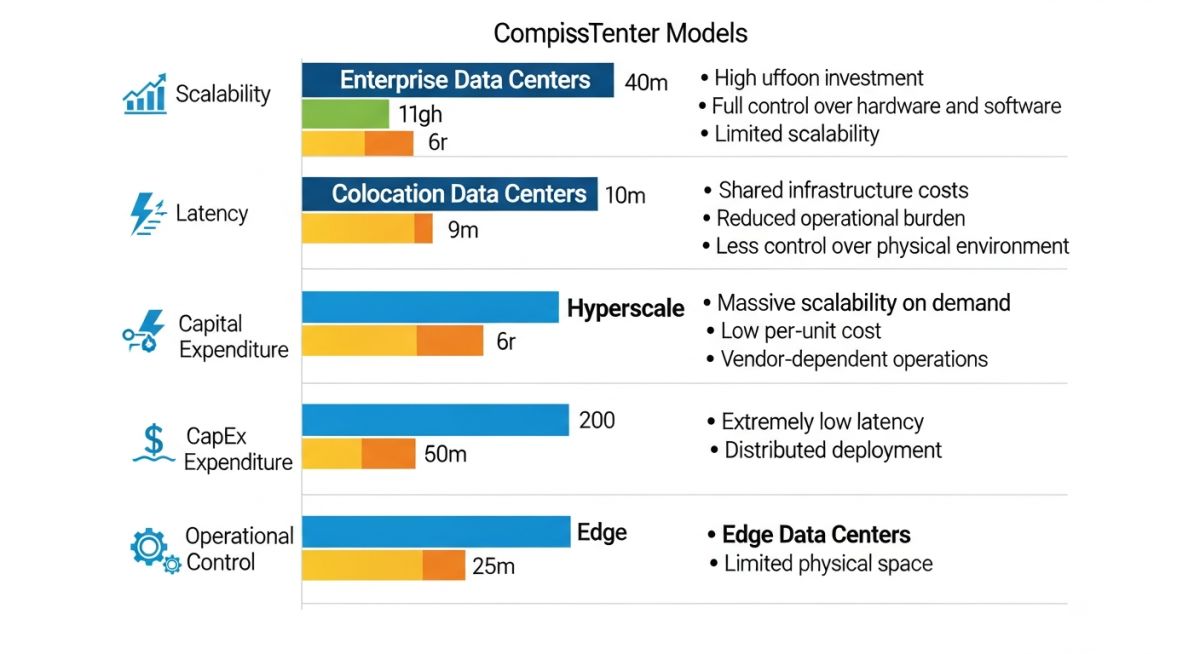
Infrastructure Performance Trade-offs: The evaluation of operational benefits versus capital expenditure and maintenance complexity across diverse data centre architectures.
Engineering Advantages
- Enterprise: Absolute control over hardware and security protocols.
- Colocation: Reduced CAPEX through shared physical infrastructure and utility costs.
- Hyperscale: Unmatched economies of scale and high-efficiency PUE (Power Usage Effectiveness).
- Edge: Significant reduction in data latency for real-time processing applications.
Engineering Disadvantages
- Enterprise: High maintenance burden and difficulty in scaling rapidly.
- Colocation: Limited customization of physical security and power distribution.
- Hyperscale: Massive environmental footprint and complex permitting requirements.
- Edge: High operational complexity due to distributed, remote site management.
Industry-Specific Deployment: The strategic application of data centre types to meet sector-specific requirements for data sovereignty, latency, and computational throughput.
Financial Services Enterprise Infrastructure
Banks and high-frequency trading firms utilize private enterprise data centres to maintain strict regulatory compliance and physical security. These facilities are engineered with hardened perimeters and dedicated, redundant power feeds to ensure zero-downtime operations during critical market hours.
Cloud Service Provider Hyperscale Deployment
Global cloud providers deploy hyperscale facilities to support massive storage and compute demands for public cloud services. These sites are strategically located near renewable energy sources to optimize PUE and reduce the carbon intensity of their massive power consumption profiles.
Autonomous Vehicle Edge Computing
Edge data centres are critical for autonomous vehicle networks, where processing sensor data in real-time is a safety requirement. These micro-data centres are deployed at cellular base stations to minimize the round-trip time for data packets, enabling instantaneous decision-making for vehicle navigation.
Healthcare Telemedicine Colocation
Healthcare providers leverage colocation facilities to store sensitive patient records while offloading the management of cooling and power systems. This allows medical institutions to focus on data security and application performance rather than the mechanical maintenance of the underlying physical plant.
Selecting the appropriate data centre architecture requires a granular understanding of how power density, latency, and scalability intersect across different facility tiers. In my experience, engineers often overlook the cooling capacity limitations inherent in legacy enterprise facilities when attempting to integrate high-density compute clusters. The following table provides a comparative analysis of key performance indicators that dictate the operational viability of each data centre type.
These metrics are derived from industry-standard benchmarks established by Uptime Institute and TIA-942 guidelines. By evaluating these parameters against your specific workload requirements, you can effectively mitigate the risk of thermal throttling or power distribution unit (PDU) overloads during peak demand cycles.
| Metric | Enterprise | Colocation | Hyperscale | Edge |
|---|---|---|---|---|
| Avg Power Density | 3-5 kW/rack | 5-15 kW/rack | 15-30+ kW/rack | 2-8 kW/rack |
| Latency Profile | Variable | Low-Medium | Optimized | Ultra-Low |
| Scalability | Limited | Modular | Massive | Localized |
Note that while Hyperscale facilities offer the highest power density, they require significant upfront investment in liquid cooling infrastructure. Conversely, Edge deployments prioritize proximity to the end-user, often sacrificing the redundant power systems found in larger, centralized data centre types.
The following matrix maps the core technical entities and structural parameters that define modern data centre engineering. Understanding these relationships is critical for compliance with ASHRAE TC 9.9 thermal guidelines and IEEE power distribution standards. Each entity represents a specific layer of the physical infrastructure stack, from the facility shell to the rack-level power distribution.
Engineers must ensure that the selected hardware components are compatible with the facility’s specific cooling methodology, whether it be traditional CRAC units or advanced immersion cooling systems. This matrix serves as a reference for aligning your project requirements with the appropriate facility classification.
| Entity | Acronym | Standard Reference |
|---|---|---|
| Power Usage Effectiveness | PUE | ISO/IEC 30134-2 |
| Computer Room Air Conditioner | CRAC | ASHRAE TC 9.9 |
| Uninterruptible Power Supply | UPS | IEC 62040 |
By maintaining strict adherence to these standards, you ensure that your infrastructure remains resilient against common failure modes such as thermal runaway or harmonic distortion in the power supply chain.
Before finalizing the design for any of the four primary data centre types, a rigorous site verification process is mandatory. In my experience, the most common project failures stem from inadequate site power availability or poor thermal management planning. This checklist ensures that your engineering team covers all critical aspects of facility readiness, from structural load-bearing capacities to network backhaul redundancy.
-
[ ]
Power Redundancy Audit: Verify that the facility meets the required Tier level (I-IV) as per Uptime Institute standards, ensuring N+1 or 2N power pathing. -
[ ]
Thermal Load Assessment: Calculate the total heat rejection requirements based on the maximum IT load, ensuring CRAC/CRAH units are sized for peak ambient temperature conditions. -
[ ]
Structural Integrity: Confirm that the raised floor or slab loading capacity supports the weight of high-density racks, typically exceeding 1,500 lbs per rack unit. -
[ ]
Network Connectivity: Validate the presence of diverse fiber entry points and carrier-neutral access to ensure low-latency connectivity for edge or hyperscale workloads. -
[ ]
Fire Suppression Compliance: Ensure the fire suppression system (e.g., clean agent or pre-action sprinkler) complies with NFPA 75 standards for data processing equipment.
Regular site audits are not merely a compliance exercise; they are a proactive measure to prevent catastrophic downtime. Always document the results of these checks in your project commissioning report to maintain a clear audit trail for stakeholders and insurance providers.
Problem: Thermal Throttling in Legacy Enterprise Facility
A mid-sized enterprise attempted to deploy high-density GPU clusters within an aging facility that lacked adequate airflow management.
- Inadequate cold aisle containment leading to air mixing.
- Insufficient floor-to-ceiling height for effective hot air exhaust.
- Power distribution units (PDUs) reaching 90% capacity, causing frequent circuit trips.
- Lack of real-time environmental monitoring sensors at the rack level.
Outcome: Infrastructure Modernization and Efficiency Gains
The engineering team implemented a phased retrofit to stabilize the environment and support the new compute load.
- Installed blanking panels and hot aisle containment systems.
- Upgraded to intelligent PDUs with remote monitoring capabilities.
- Deployed localized in-row cooling units to handle high-density hotspots.
- Achieved a 25% reduction in PUE within the first six months of operation.
My recommendation for similar scenarios is to prioritize airflow management before investing in additional cooling capacity. Often, the existing cooling infrastructure is sufficient if the air distribution path is optimized according to ASHRAE best practices.
What defines the primary difference between Colocation and Hyperscale facilities?
- Colocation offers modularity and multi-tenant security.
- Hyperscale focuses on extreme efficiency and massive compute density.
- Hyperscale facilities often utilize custom-designed hardware and cooling systems.
How does Edge computing impact traditional data centre design?
- Requires ruggedized equipment to handle variable environmental conditions.
- Prioritizes low-latency connectivity over massive storage capacity.
- Often utilizes micro-data centre form factors for rapid deployment.
What is the role of PUE in evaluating data centre efficiency?
- Helps identify energy waste in cooling and power distribution.
- Standardized by ISO/IEC 30134-2.
- Lower PUE values indicate better operational sustainability.
Why is Tier classification important for enterprise data centres?
- Tier I: Basic capacity with no redundancy.
- Tier IV: Fault-tolerant infrastructure with multiple independent power paths.
- Aligns infrastructure investment with business uptime requirements.
How do I select the right cooling strategy for my facility?
- Assess rack power density (kW/rack).
- Consider local ambient temperature and humidity.
- Evaluate the total cost of ownership (TCO) for liquid cooling systems.
What are the primary security considerations for colocation?
Complete Course on
Piping Engineering
Check Now
Key Features
- 125+ Hours Content
- 500+ Recorded Lectures
- 20+ Years Exp.
- Lifetime Access
Coverage
- Codes & Standards
- Layouts & Design
- Material Eng.
- Stress Analysis