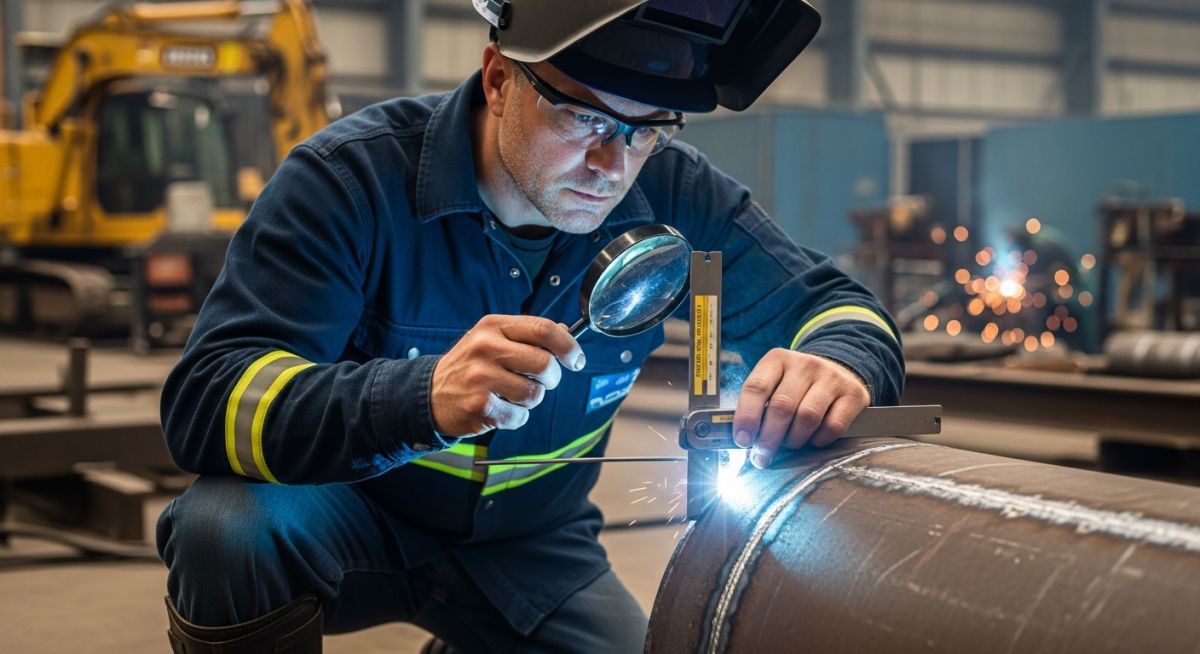
Choosing the Right Path for Welding Inspectors: CSWIP and AWS-CWI
Over my 20 years in piping engineering and quality management, I have stood on fabrication shop floors from Singapore to Houston. I have seen multi-million dollar projects grind to a halt simply because the quality control team did not understand the operational boundaries between different inspection credentials. Choosing between these two pathways is not just about passing an exam; it is about aligning your technical expertise with the specific regulatory frameworks of your target market.
On active construction sites, the welding inspector is the final line of defense against catastrophic structural failures. Whether you are verifying a complex heavy-wall piping manifold or auditing a structural steel frame, your certification dictates which codes you can legally enforce. In my experience, understanding the structural differences between these two programs is the single most important career decision a quality control professional will make.
Key Takeaways for Quality Professionals
- Geographic Dominance: AWS-CWI is the undisputed standard in North America and oil-heavy regions using American codes, while CSWIP dominates European, UK, and Commonwealth projects.
- Code Alignment: AWS-CWI focuses heavily on AWS D1.1 and ASME Section IX, whereas CSWIP is built around ISO/EN standards.
- Exam Structure: CSWIP features a highly practical hands-on physical specimen inspection, while AWS-CWI tests codebook navigation and visual inspection tools.
- Career Longevity: Both certifications require structured renewals, but their continuing education and re-examination pathways differ significantly.
- Market Value: Holding both certifications makes you a highly sought-after global asset for multinational EPC contractors.
Comparing Welding Inspectors: CSWIP and AWS-CWI Certifications
To truly appreciate the operational differences, we must look at how these certifications handle code compliance. The AWS-CWI program is governed by the American Welding Society under the AWS QC1 standard. It is designed to produce inspectors who are experts in navigating complex American codes, such as AWS D1.1 for structural steel and ASME Section IX for pressure piping and vessels.
Conversely, the CSWIP scheme, managed by TWI (The Welding Institute) in the United Kingdom, is aligned with international ISO standards. A CSWIP 3.1 (Level 2) inspector is trained to evaluate welds based on BS EN ISO 5817, which defines quality levels for imperfections in fusion-welded joints. This fundamental difference in code alignment affects how inspectors calculate acceptable defect limits on the job.
Practical Engineering Calculations: Heat Input
A key responsibility for any welding inspector is verifying that the welder adheres to the qualified Welding Procedure Specification (WPS). One of the most critical parameters to monitor is the heat input. If the heat input is too high, it can degrade the mechanical properties of the Heat-Affected Zone (HAZ), leading to brittle failure.
The standard formula used by inspectors to calculate heat input is:
The thermal efficiency factor varies depending on the welding process:
- Submerged Arc Welding (SAW): 1.0
- Shielded Metal Arc Welding (SMAW): 0.8
- Gas Metal Arc Welding (GMAW) / Flux-Cored Arc Welding (FCAW): 0.8
- Gas Tungsten Arc Welding (GTAW): 0.6
Let us look at a real-world scenario. A welder is using SMAW to deposit a pass on a structural beam. The inspector records the following parameters:
- Voltage = 24 V
- Amperage = 160 A
- Travel Speed = 120 mm/min
Applying our formula:
Heat Input = (24 x 160 x 60) / (120 x 1000) x 0.8 = 1.536 kJ/mm
If the qualified WPS specifies a maximum heat input of 1.5 kJ/mm to maintain impact toughness at sub-zero temperatures, this weld run is out of compliance. An AWS-CWI or CSWIP inspector must immediately halt the operation and instruct the welder to increase their travel speed or lower their current.
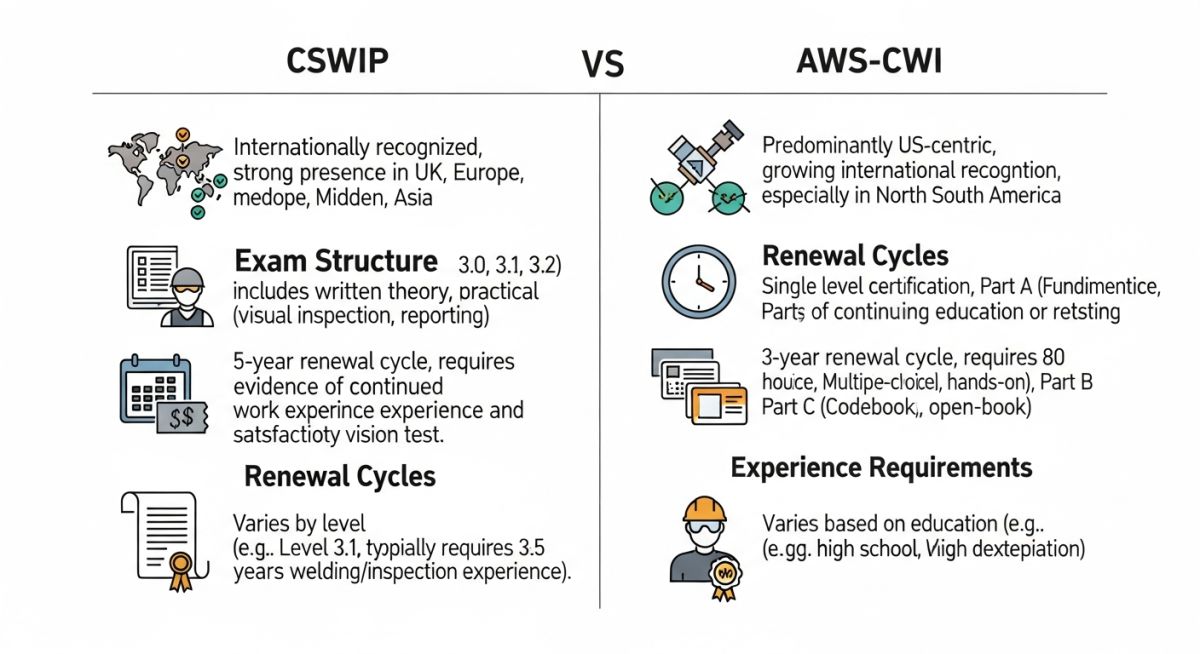
| Parameter | AWS-CWI (AWS QC1) | CSWIP 3.1 (Level 2) |
|---|---|---|
| Governing Body | American Welding Society (AWS) | TWI Certification Ltd (CSWIP) |
| Primary Code Base | AWS D1.1, API 1104, ASME Sec IX | ISO 5817, ISO 9606, EN standards |
| Exam Structure | 3 Parts (Fundamentals, Practical, Code Book) | Theory, Practical Plate/Pipe, Macro Inspection |
| Pass Criteria | Minimum 72% in each of the three parts | Minimum 70% in all individual exam sections |
| Recertification Cycle | Every 3 years (renewal), 9 years (re-exam/PDHs) | Every 5 years (renewal), 10 years (re-exam) |
| Visual Acuity | Jaeger J2 at 12 inches, color perception | Times Roman 1.6 at 300mm, color perception |
| Entity / Acronym | Technical Definition | Applicable Standard | Field Application |
|---|---|---|---|
| WPS | Welding Procedure Specification | ASME Section IX / ISO 15609 | Instruction sheet for the welder on site |
| PQR | Procedure Qualification Record | ASME Section IX / ISO 15614 | Documented test results validating the WPS |
| WPQ / WPQR | Welder Performance Qualification | AWS D1.1 / ISO 9606 | Verifies individual welder skill and limits |
| HAZ | Heat-Affected Zone | ASTM E384 (Microhardness) | Area of base metal altered by welding heat |
| NDT / NDE | Non-Destructive Testing / Evaluation | ASNT SNT-TC-1A / ISO 9712 | Volumetric and surface inspection methods |
Verifying Inspector Credentials on Active Projects
As a quality manager or project lead, you cannot afford to take credentials at face value. I have encountered situations where expired or forged certificates were submitted during mobilization. Implementing a rigorous verification protocol is a mandatory step before any inspector is permitted to sign off on a weld log.
Step-by-Step Verification Checklist
-
Verify Online Database Status:
For AWS-CWI, use the official AWS Certification Registry. For CSWIP, query the TWI Certification verification portal using the inspector’s unique registration number. -
Check Expiration and Renewal Dates:
Ensure the certificate is active. Note the 3-year (AWS) or 5-year (CSWIP) renewal windows and confirm that the inspector is not operating within a grace period without formal extension documentation. -
Validate Visual Acuity Records:
Confirm the inspector has undergone an eye examination within the last 12 months. This must include near-vision acuity (Jaeger J2 or Times Roman 1.6) and color contrast differentiation. -
Confirm Code Endorsements:
For AWS-CWI, check which specific codebook was used for Part C (e.g., AWS D1.1, API 1104, or ASME Section IX). Ensure this matches the primary construction code of your project. -
Audit Logbook and Continuity Records:
Review the inspector’s logbook to verify they have been actively engaged in welding inspection activities without a break exceeding six consecutive months.
Field Case Study: Real-World Application
This scenario highlights a common industry pitfall. The contractor assumed that because CSWIP 3.1 is a highly respected international certification, it would be universally accepted on an ASME-designed project. They failed to realize that the client’s quality specification explicitly demanded inspectors qualified under AWS QC1 or those with documented ASME code endorsements.
My recommendation for any engineering firm operating globally is to establish a clear certification mapping matrix during the project planning phase. If your project spans both structural steel (often AWS-governed) and process piping (often ASME/ISO-governed), ensure your inspection team holds a balanced mix of both AWS-CWI and CSWIP credentials, or hire dual-certified professionals to streamline the quality assurance workflow.
Career Paths for Welding Inspectors: CSWIP and AWS-CWI
If you plan to work primarily in North America, South America, or on projects heavily influenced by American oil and gas majors, the AWS-CWI is your golden ticket. If your career goals align with European offshore wind projects, North Sea oil rigs, or infrastructure projects in the Middle East and Asia-Pacific that utilize British and European standards, CSWIP 3.1 is highly advantageous.
Frequently Asked Engineering Questions
What is the primary difference in global recognition between CSWIP and AWS-CWI?
Can a CSWIP 3.1 inspector certify welds designed under AWS D1.1?
What are the renewal and recertification cycles for both schemes?
How do the exam structures compare in terms of practical testing?
Which certification is more cost-effective for an individual engineer?
What are the visual acuity requirements for both certifications?
===FAQ_BLOCK===

Complete Course on
Piping Engineering
Check Now
Key Features
- 125+ Hours Content
- 500+ Recorded Lectures
- 20+ Years Exp.
- Lifetime Access
Coverage
- Codes & Standards
- Layouts & Design
- Material Eng.
- Stress Analysis