
Capital Cost Estimation Explained: A Piping Engineering Perspective
In my two decades of managing complex piping projects, I have learned that a project’s success is rarely determined by the quality of the weld alone, but by the accuracy of the initial capital cost estimation. Many engineers view estimation as a purely administrative task, yet it is the bedrock of technical decision-making. If your estimate fails to account for material escalation, labor productivity variances, or the hidden costs of ASME B31.3 compliance, the project will inevitably face mid-stream budget crises.
This guide dissects the lifecycle of cost estimation, moving beyond simple spreadsheets into the rigorous methodologies required for modern industrial facilities. We will explore how to bridge the gap between preliminary FEED (Front-End Engineering Design) data and final EPC (Engineering, Procurement, and Construction) execution.
Key Takeaways
- Understand the five classes of estimates defined by AACE.
- Learn to integrate piping material take-offs (MTO) with labor indices.
- Identify the critical impact of piping complexity factors on total installed cost.
- Master the transition from conceptual budgeting to definitive cost control.
Capital Cost Estimation Methodologies and Technical Depth
Capital Cost Estimation Methodologies: The application of deterministic and stochastic modeling techniques to quantify project expenditures based on technical scope, engineering maturity, and market-driven economic variables.
Effective estimation requires a granular breakdown of the piping system. I typically categorize costs into Direct Field Costs (DFC) and Indirect Field Costs (IFC). DFC includes bulk materials—pipes, fittings, flanges, and valves—calculated via a detailed MTO. When performing these calculations, I always apply a “wastage factor” based on pipe diameter and material grade, typically ranging from 3% for carbon steel to 7% for exotic alloys like Inconel or Hastelloy.
The Mechanics of Piping MTO
To derive an accurate estimate, you must first establish the piping class. A ASME B31.3 piping specification dictates the wall thickness, material grade, and pressure rating. My calculation process follows these steps:
- Quantity Take-off: Extracting linear footage, count of fittings, and valve types from P&IDs and plot plans.
- Unit Pricing: Applying current market rates for materials, adjusted for regional logistics and supply chain volatility.
- Labor Productivity: Applying a man-hour factor per inch-diameter-weld. For instance, a 2-inch stainless steel pipe requires significantly more man-hours for TIG welding compared to a 12-inch carbon steel pipe.
Field Warning: The Complexity Multiplier
Never assume a linear relationship between pipe size and cost. High-pressure, high-temperature (HPHT) systems require specialized NDT (Non-Destructive Testing) and PWHT (Post-Weld Heat Treatment). These activities can increase the labor cost component by 40% to 60% compared to standard utility piping. Always include a contingency buffer for these specific technical requirements.
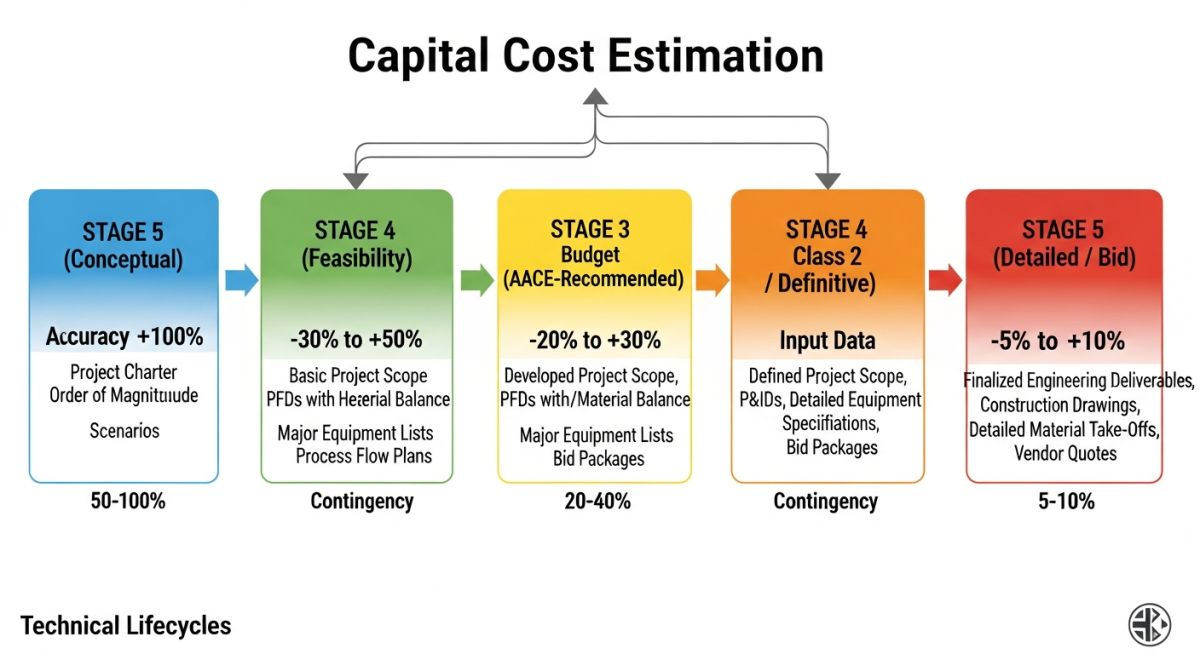
When evaluating the accuracy of your estimate, refer to the AACE Recommended Practice 18R-97. A Class 5 estimate (conceptual) typically carries an accuracy range of -50% to +100%, whereas a Class 1 estimate (definitive) should fall within -5% to +10%. Achieving Class 1 accuracy requires at least 70-80% of the engineering design to be complete, including finalized isometric drawings and vendor-certified equipment prints.
Estimation Strategic Trade-offs: The balance between the high-level agility of conceptual budgeting and the resource-intensive precision of definitive cost engineering in industrial piping projects.
Advantages
- Enables early-stage financial feasibility screening.
- Provides a baseline for tracking project scope creep.
- Facilitates procurement scheduling for long-lead items.
- Improves resource allocation for engineering man-hours.
- Reduces risk of catastrophic budget overruns.
Disadvantages
- High initial cost for detailed engineering data.
- Susceptible to market volatility in raw materials.
- Requires significant time for accurate MTO generation.
- Risk of “false precision” in early-stage estimates.
- Complexity in accounting for site-specific labor constraints.
Industrial Estimation Utility: The practical application of cost modeling across diverse sectors to ensure project economic viability and operational efficiency.
Refinery Revamp Projects
In brownfield refinery upgrades, cost estimation is critical for managing tie-in complexity. We must account for existing infrastructure constraints, which often require non-standard piping routing and extensive field verification, significantly impacting the labor-to-material ratio.
Green Hydrogen Infrastructure
Developing hydrogen-ready piping systems involves high-alloy materials and stringent leak detection requirements. Estimation here focuses on the premium cost of specialized materials and the rigorous NDT protocols mandated by emerging safety standards for hydrogen service.
Offshore Platform Piping
For offshore modules, weight and space are the primary cost drivers. Estimation models must integrate structural steel costs with piping density, as every additional kilogram of piping increases the cost of transportation and installation by a factor of three.
In my two decades of managing piping projects, I have observed that the reliability of a budget is directly tied to the maturity of the engineering data available at the time of the estimate. The AACE International standards provide a rigorous framework for classifying these estimates, ranging from Class 5 (conceptual) to Class 1 (final bid). Understanding these classes is vital for project managers to communicate risk effectively to stakeholders.
The table below outlines the typical maturity levels and expected accuracy ranges for industrial piping projects. When we move from a Class 4 estimate to a Class 3, we are essentially transitioning from a “study” phase to a “front-end engineering design” (FEED) phase. This transition requires a significant increase in the definition of piping and instrumentation diagrams (P&IDs), plot plans, and equipment specifications. Without this level of detail, the contingency buffers required to protect the project budget become prohibitively expensive, often leading to project cancellation or severe scope reduction during the execution phase.
| Estimate Class | Project Definition | Accuracy Range | Primary Purpose |
|---|---|---|---|
| Class 5 | 0% to 2% | -50% to +100% | Screening/Feasibility |
| Class 4 | 1% to 15% | -30% to +50% | Concept Study |
| Class 3 | 10% to 40% | -20% to +30% | Budget Authorization |
| Class 2 | 30% to 75% | -15% to +20% | Control/Bid |
| Class 1 | 65% to 100% | -10% to +15% | Check Estimate |
Always remember that these ranges are not just statistical probabilities; they represent the inherent risk of the unknown. As an engineer, my goal is to drive the project definition forward to reach Class 3 as quickly as possible, as this is the threshold where most financial investment decisions (FID) are made.
Effective cost management requires a clear understanding of the technical entities that drive capital expenditure. In my experience, the most common failure point in estimation is the disconnect between the piping material specification (PMS) and the actual procurement costs. By mapping these entities, we can create a standardized approach to tracking costs across different project phases.
The matrix below provides a high-level overview of the critical components and their associated standards. This mapping ensures that every line item in your estimate is traceable to a specific engineering requirement, which is essential for auditability and change management. When we track these entities, we are not just counting valves or pipe spools; we are quantifying the technical complexity of the entire facility.
| Entity Category | Key Parameters | Standard Reference |
|---|---|---|
| Piping Components | Pressure Rating, Material Grade | ASME B31.3 |
| Valves | Trim Material, Actuation Type | API 600/602 |
| Structural Steel | Weight, Coating Requirements | AISC 360 |
| Instrumentation | Signal Type, Hazardous Area Rating | ISA 5.1 |
By maintaining this matrix throughout the project lifecycle, you can quickly identify which areas of the design are driving cost overruns. It serves as a living document that bridges the gap between the initial estimate and the final project closeout.
Before finalizing any capital cost estimate, I perform a rigorous site and data verification process. This checklist is designed to catch common oversights that lead to budget gaps. In my experience, the most dangerous assumptions are those made about site conditions and existing infrastructure integration.
Verification Checkpoints
- ✓Site Access: Confirm heavy lift equipment can reach all tie-in points without major civil modifications.
- ✓Tie-in Verification: Physically verify existing pipe wall thickness and material grade per ASME B31.3.
- ✓Utility Availability: Validate that existing power, water, and instrument air headers have sufficient capacity for the new load.
- ✓Soil Conditions: Review geotechnical reports to ensure foundation cost estimates align with actual bearing capacity.
- ✓Regulatory Compliance: Include costs for environmental permitting and safety system upgrades required by local authorities.
- ✓Escalation Factors: Apply current market indices for labor and raw materials to avoid “stale” pricing.
Each item on this list must be signed off by the lead discipline engineer. If a verification step is skipped, the contingency budget must be increased by at least 5% to account for the heightened risk of unforeseen site conditions. Never rely on “as-built” drawings alone; they are often outdated or inaccurate. Always perform a field walk-down to confirm the physical reality of the site before finalizing your numbers.
I once managed a brownfield expansion project where the initial capital cost estimation failed to account for the complexity of integrating new piping into an existing, congested pipe rack. The resulting delays and rework cost the client millions in lost production time.
Problem: Inaccurate Site Integration
- Failure to perform a 3D laser scan of the existing rack.
- Underestimation of the labor hours required for “hot work” in a live plant environment.
- Ignoring the cost of temporary support structures needed during tie-in.
- Lack of coordination between the piping and electrical teams regarding cable tray interference.
Outcome: Corrective Measures and Success
- Implemented a mandatory 3D scanning requirement for all future brownfield projects.
- Reduced field rework by 40% through improved clash detection in the design phase.
- Achieved a final project cost within 5% of the revised Class 3 estimate.
- Established a cross-discipline review board to identify interferences early.
My recommendation is to always prioritize high-fidelity site data over legacy documentation. The cost of a laser scan is negligible compared to the cost of a single day of unplanned plant downtime during construction.
How do I determine the appropriate contingency for a piping project?
- Assess the maturity of the P&IDs and equipment specifications.
- Evaluate the volatility of the current market for materials like stainless steel or exotic alloys.
- Consider the complexity of the site, specifically regarding brownfield tie-ins and hazardous area requirements.
- Use a Monte Carlo simulation to determine the probability of cost overruns based on these variables.
What is the difference between CAPEX and OPEX in piping projects?
- CAPEX decisions often involve choosing between cheaper materials with higher maintenance needs versus expensive, corrosion-resistant alloys.
- A low CAPEX design might lead to high OPEX due to frequent valve replacements or pipe wall thinning.
- Engineers must perform a Life Cycle Cost Analysis (LCCA) to find the optimal balance between these two financial buckets.
- Always document the long-term maintenance implications of your design choices to justify higher initial costs to the finance department.
How does the piping material specification (PMS) impact the estimate?
- Ensure the PMS is finalized early, as late changes trigger a cascade of re-estimates for valves, fittings, and welding procedures.
- Verify that the wall thickness requirements per ASME B31.3 are optimized to avoid over-specifying materials.
- Consider the availability of long-lead items in the PMS, as supply chain delays can significantly impact the project schedule and cost.
- Standardize the PMS across the project to reduce the number of unique spare parts required for future maintenance.
Why is the “Class 3” estimate considered the gold standard?
- It provides a balance between the cost of engineering and the accuracy of the budget.
- Most stakeholders require this level of confidence before releasing the funds for procurement and construction.
- It allows for the identification of major risks and the development of mitigation strategies before the project enters the high-cost execution phase.
- It serves as the baseline for all future change management and cost tracking throughout the project.
What role does labor productivity play in capital cost estimation?
- Always adjust labor hours based on the specific site environment, such as working at heights or in confined spaces.
- Account for the “learning curve” of the construction team when implementing new technologies or complex piping systems.
- Factor in the impact of safety protocols, which can reduce daily productivity but are essential for project success.
- Use historical data from similar projects to calibrate your labor estimates, rather than relying on generic industry benchmarks.
How do I handle scope creep during the estimation process?
- Implement a formal change management process that requires approval for any deviation from the original scope.
- Clearly communicate the cost impact of every change request to the project stakeholders immediately.
- Regularly review the project progress against the original scope to identify potential creep early.
- Maintain a “scope log” that tracks all additions and deletions to ensure the final budget remains aligned with the project goals.
Complete Course on
Piping Engineering
Check Now
Key Features
- 125+ Hours Content
- 500+ Recorded Lectures
- 20+ Years Exp.
- Lifetime Access
Coverage
- Codes & Standards
- Layouts & Design
- Material Eng.
- Stress Analysis

📚 Recommended Resources: Capital Cost Estimation
Read these Guides
- 📄 Project Controls Explained: Mastering Cost, Schedule, and Risk Management
- 📄 Mastering Cost Engineering: Essential Lifecycle Management for Industrial Projects
- 📄 Mastering AACE International Standards for Successful EPC Project Cost Engineering
- 📄 Levelized Cost of Hydrogen: Engineering Economics for Industrial Decarbonization