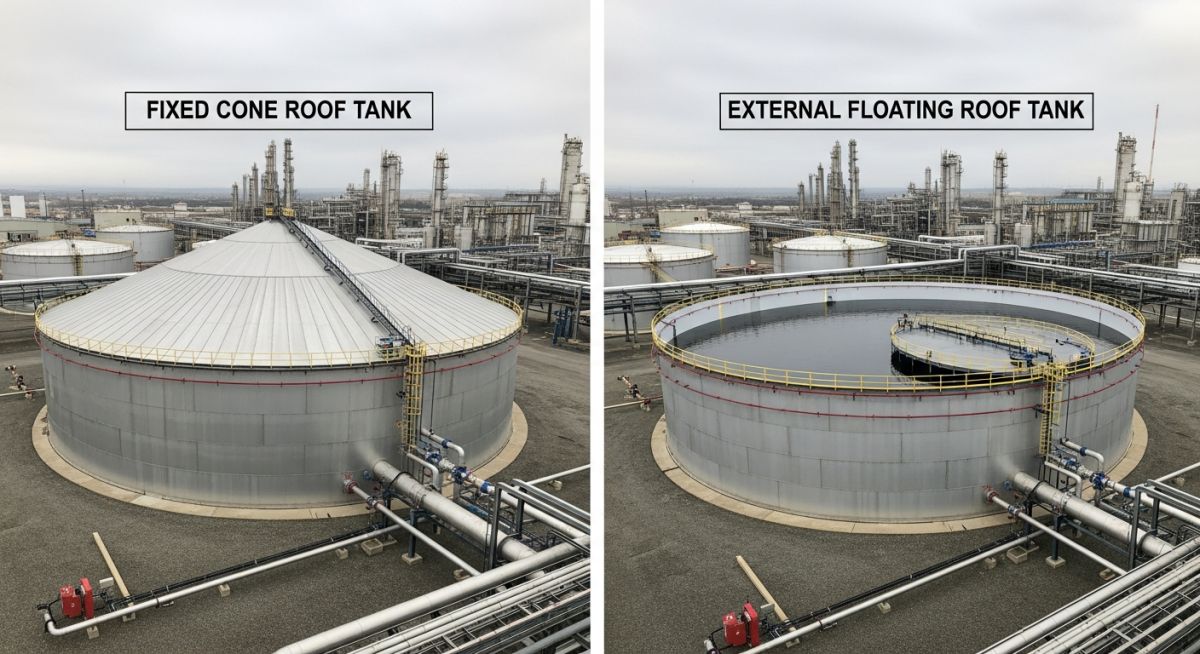
Types of Atmospheric Storage Tanks: Fixed Roof vs Floating Roof
In my 20-plus years of designing tank farms and piping systems, I have stood on top of massive 80-meter diameter tanks in the middle of summer. I can tell you firsthand: the choice between a fixed roof and a floating roof is not just a line item on a datasheet. It is a decision that dictates the safety, environmental footprint, and economic viability of your entire facility. Selecting the wrong configuration can lead to catastrophic vapor losses, structural failures, or severe regulatory penalties.
When we evaluate storage options for hydrocarbons, chemicals, or water, we must balance initial capital expenditure against long-term operational costs. This guide breaks down the structural mechanics, vapor control systems, and selection criteria that I use when designing these critical industrial assets.
Key Engineering Takeaways
- Fixed roof tanks are best for non-volatile liquids or when paired with vapor recovery units.
- Floating roof tanks eliminate the vapor space, drastically reducing volatile organic compound (VOC) emissions.
- API 650 governs the design, fabrication, and erection of these atmospheric storage vessels.
- Proper seal selection is the single most important factor in floating roof performance.
Designing Atmospheric Storage Tanks for Volatile Liquids
[Vapor Control Systems]: The selection between fixed and floating roof configurations determines how a storage facility mitigates product evaporation, controls hazardous emissions, and complies with environmental regulations.
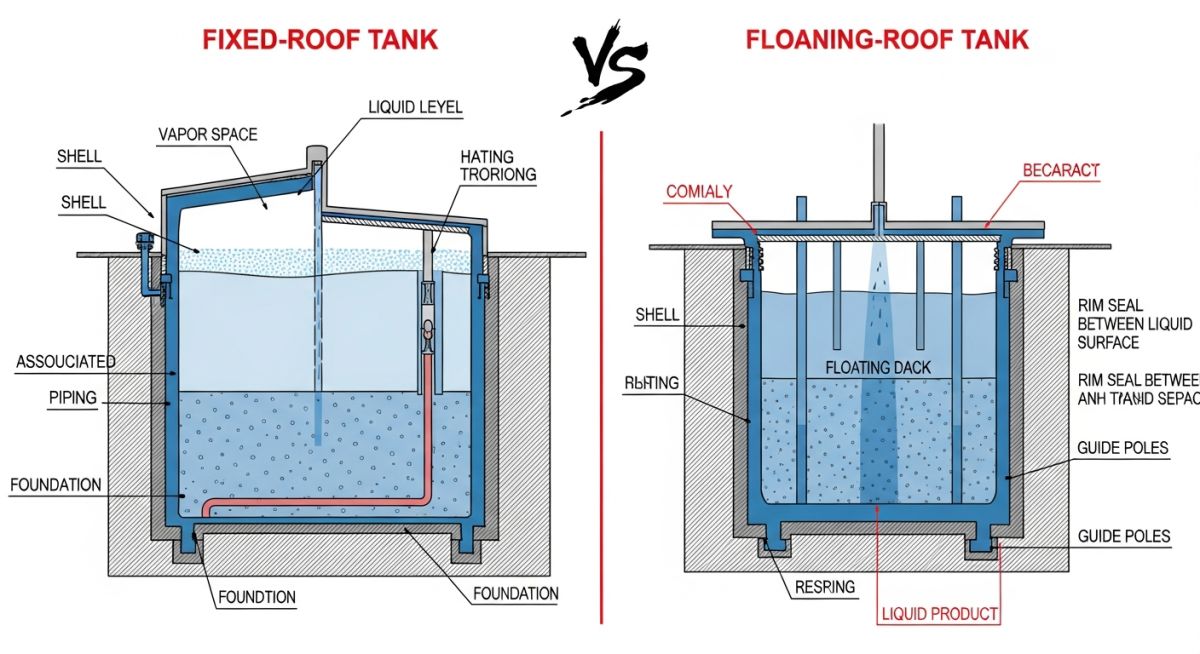
To understand why we choose one design over another, we must look at the physics of vapor spaces. In a standard fixed roof tank, a vapor space (or ullage) exists between the liquid surface and the roof. As the tank is filled, vapor is pushed out. As temperature changes, the tank “breathes,” expelling vapor during the day and drawing in air at night. This breathing cycle is a major source of product loss and environmental pollution.
Fixed Roof Tanks: Structural Variations
Fixed roof tanks are the simplest and least expensive to build. They generally fall into two categories:
- Cone Roof Tanks (CRT): These feature a conical roof with a slight slope (typically 1-in-16). They can be supported by internal columns and rafters or be self-supporting for smaller diameters.
- Dome Roof Tanks (DRT): These feature a spherical dome roof. They are usually self-supporting, relying on the shell for structural integrity, which leaves the tank interior completely free of columns.
Floating Roof Tanks: Eliminating the Ullage
Floating roof tanks solve the vapor loss problem by placing a deck directly on the liquid surface. The deck rises and falls with the liquid level, eliminating the vapor space.
- External Floating Roof Tanks (EFRT): These have no fixed roof. The floating deck is exposed to the elements. They require robust primary and secondary rim seals, as well as a sophisticated roof drainage system to handle rainwater.
- Internal Floating Roof Tanks (IFRT): These combine both designs. A floating deck sits on the liquid inside a fixed roof tank. This protects the floating deck from wind, rain, and snow, making it highly reliable but slightly more complex to vent.
Vapor Loss Calculations
To quantify the emissions from these tanks, we use the methodologies outlined in API MPMS Chapter 19. The total loss (L_T) is calculated as:
Where:
L_S = Standing storage loss (lb/year)
L_W = Working loss (lb/year)
For a fixed roof tank, standing loss is driven by daily temperature cycles. For a floating roof tank, standing loss is almost entirely replaced by rim seal losses, deck fitting losses, and deck seam losses, which are significantly lower in magnitude.
| Parameter | Fixed Roof Tanks | Internal Floating Roof (IFRT) | External Floating Roof (EFRT) |
|---|---|---|---|
| Relative CAPEX | Low (Baseline) | Medium-High | High |
| Vapor Loss Control | Poor (Requires VRU) | Excellent (95% to 99% reduction) | Excellent (90% to 98% reduction) |
| Weather Sensitivity | Low | Low | High (Rain, snow, wind) |
| Typical Products | Heavy oil, water, diesel | Gasoline, light crude, solvents | Crude oil, large volume gasoline |
| Component / Entity | Standard Reference | Physical Parameter / Limit | Engineering Function |
|---|---|---|---|
| Tank Shell Design | API 650 Sec. 5.6 | 1-foot method / Variable-design-point | Calculates shell plate thickness based on hydrostatic head. |
| Venting Requirements | API 2000 | Inbreathing / Outbreathing rates | Prevents overpressure or vacuum collapse during pump-in/out. |
| Rim Seal Systems | API MPMS Ch. 19.2 | Mechanical shoe / Wiper seals | Minimizes vapor escape from the rim gap of floating decks. |
Inspecting Atmospheric Storage Tanks During Commissioning
[Pre-Commissioning Inspection]: A systematic field verification protocol ensures structural integrity, seal alignment, and venting capacity prior to introducing hydrocarbons into the containment system.
Before any tank is handed over to operations, a rigorous inspection must be performed. In my experience, skipping these checks often leads to premature seal wear, roof binding, or environmental non-compliance.
Field Inspection Protocol
-
Verify shell roundness and verticality tolerances per API 650 Section 7.5. -
Inspect floating roof seal gaps using a feeler gauge (maximum 1/8 inch gap for primary seals). -
Test the roof drain system for blockages and check the operation of the check valves. -
Verify the installation and electrical continuity of grounding shunts on floating roofs. -
Perform a vacuum box test on all floor lap welds to detect micro-fissures.
Field Case Study: Real-World Application
The Problem
A coastal refinery was operating an old 50,000-barrel cone roof tank storing light crude oil. Due to rising ambient temperatures and increased throughput, the tank’s breathing losses escalated, resulting in severe odor complaints from nearby communities and a notice of violation from the local environmental agency. The vapor recovery unit (VRU) was constantly overloaded.
The Solution & Outcome
I was brought in to evaluate the system. We decided to retrofit the existing cone roof tank with an internal aluminum pontoon floating roof (IFRT) and install a secondary mechanical shoe seal. This eliminated the large vapor space while keeping the fixed roof to protect the deck from heavy coastal rains.
Post-retrofit testing showed a 98.2% reduction in VOC emissions. The project paid for itself within 14 months solely through recovered product that would have otherwise evaporated into the atmosphere.
Direct Recommendation: When dealing with high-ambient-temperature regions and volatile products, do not rely solely on fixed roofs with vapor recovery. Retrofitting to an IFRT is almost always the most robust and economically viable long-term solution.
Frequently Asked Engineering Questions
What is the primary difference between API 650 and API 620?
When should I choose an internal floating roof over an external one?
How do you prevent static electricity build-up in floating roofs?
What is a frangible roof joint in a fixed roof tank?
How often should tank seals be inspected?
Can a fixed roof tank be converted to a floating roof tank?
===
Complete Course on
Piping Engineering
Check Now
Key Features
- 125+ Hours Content
- 500+ Recorded Lectures
- 20+ Years Exp.
- Lifetime Access
Coverage
- Codes & Standards
- Layouts & Design
- Material Eng.
- Stress Analysis

