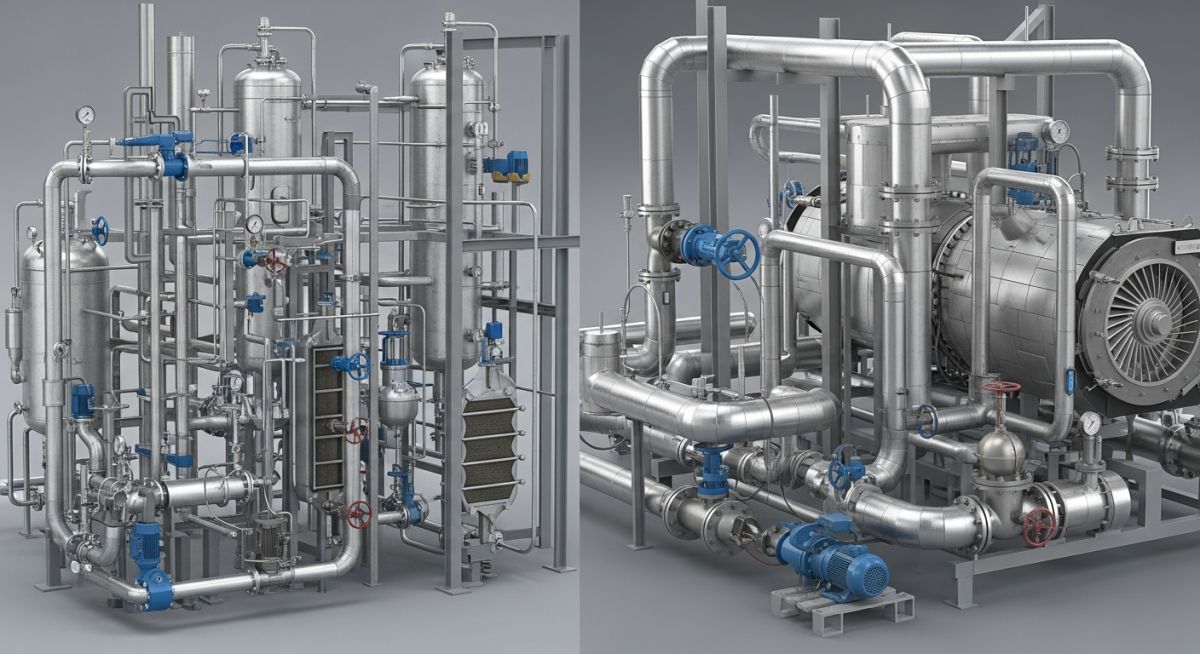
Differences Between ASME B31.3 and B31.1: B31.3 vs B31.1
In my 20 years of piping engineering, I have seen many young engineers make the mistake of treating these codes as interchangeable. They are not. Designing a refinery line using power piping rules, or vice versa, can lead to catastrophic failures or massive cost overruns. I recall a project in 2014 where a subcontractor mistakenly applied ASME B31.3 Process Piping rules to a high-pressure steam line that fell under the jurisdiction of ASME B31.1 Power Piping. The resulting wall thickness discrepancies almost halted plant commissioning. Understanding the boundary lines between these two standards is a fundamental requirement for any piping professional.
Key Takeaways
- Jurisdiction: B31.1 is for power plants and steam generation; B31.3 is for chemical, refinery, and pharmaceutical plants.
- Safety Factors: B31.1 uses a more conservative safety factor of 3.5 on tensile strength, whereas B31.3 uses a factor of 3.0.
- Fluid Categories: B31.3 categorizes fluids based on toxicity and flammability, while B31.1 focuses on steam-water cycles and high-pressure safety.
- Inspection Rules: B31.3 requires visual inspection of at least 5 percent of welds, whereas B31.1 inspection levels depend strictly on temperature and pressure thresholds.
Complete Course on
Piping Engineering
Check Now
Key Features
- 125+ Hours Content
- 500+ Recorded Lectures
- 20+ Years Exp.
- Lifetime Access
Coverage
- Codes & Standards
- Layouts & Design
- Material Eng.
- Stress Analysis
How Does ASME B31.3 vs B31.1 Compare?
The core difference between these two codes lies in how they calculate allowable stress and wall thickness. Because power plants operate under high-pressure steam cycles with severe thermal cycling, ASME B31.1 adopts a highly conservative approach. In contrast, process plants handle a massive variety of fluids, from highly toxic chemicals to simple hydrocarbons, requiring ASME B31.3 to offer a more flexible, category-based design methodology.
Wall Thickness Calculation Formulas
Let us look at the basic pressure design equations for straight pipe under internal pressure.
ASME B31.1 (Power Piping) Equation:
t = (P * D) / (2 * (S * E + P * Y)) + A
ASME B31.3 (Process Piping) Equation:
t = (P * D) / (2 * (S * E * W + P * Y))
Where:
- t: Minimum required wall thickness (excluding corrosion allowance in B31.3, while B31.1 includes an explicit mechanical allowance ‘A’).
- P: Internal design gage pressure.
- D: Outside diameter of the pipe.
- S: Allowable stress value from the respective code stress tables.
- E: Joint efficiency factor (longitudinal or spiral weld joint quality factor).
- W: Weld joint strength reduction factor (used in B31.3 for elevated temperatures, not present in the basic B31.1 equation).
- Y: Coefficient from the code tables, which depends on the material and design temperature.
- A: Additional thickness to compensate for material removed during threading, or to provide mechanical strength.
In my experience, using B31.3 allowable stress values for a steam line governed by B31.1 can result in a pipe wall that is too thin to handle the thermal shock and water hammer common in power plant operations. Always verify the jurisdictional boundaries with the local boiler inspector before finalizing your design.
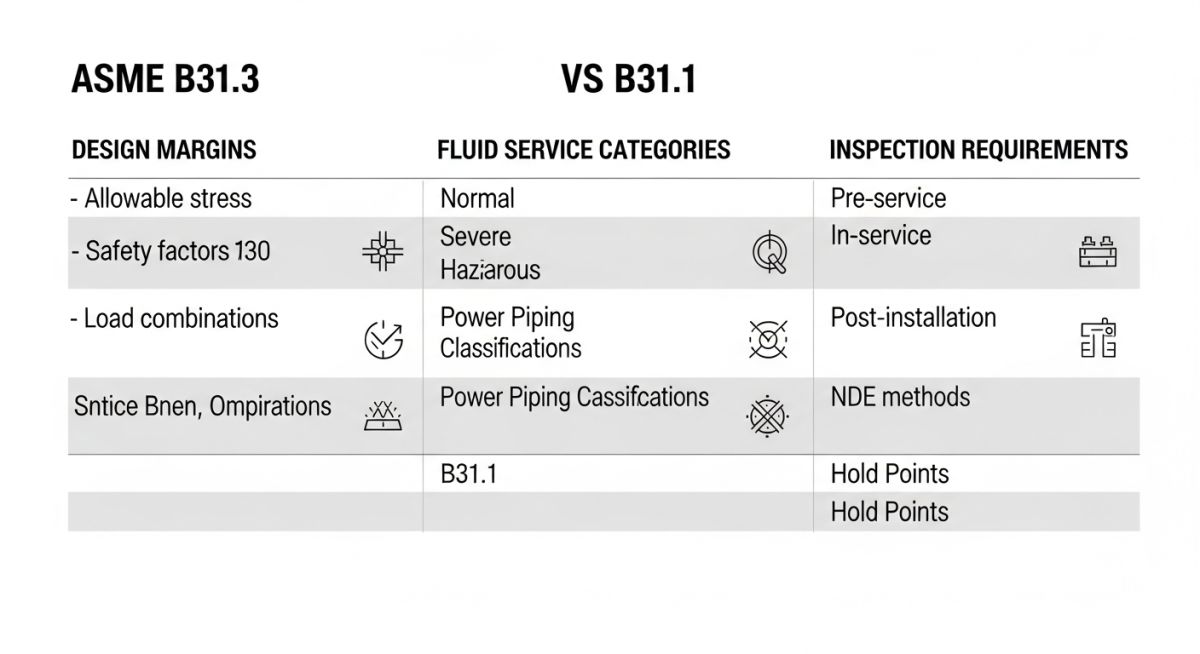
Fluid Service Categorization in ASME B31.3
Unlike B31.1, which treats all fluids with a similar level of high-pressure caution, B31.3 divides fluids into distinct categories. This classification dictates the design, inspection, and testing requirements:
- Category D Fluid Service: Non-flammable, non-toxic, and non-damaging to human tissues. The design pressure does not exceed 150 psi, and the design temperature is between -29 degrees Celsius and 186 degrees Celsius.
- Category M Fluid Service: Highly toxic fluids where a single exposure to a very small amount can cause irreversible health damage.
- High-Pressure Fluid Service: Piping designed in accordance with Chapter IX of B31.3, where the pressure exceeds that allowed by the standard ASME B16.5 Class 2500 rating.
- Normal Fluid Service: Most process plant piping that does not fall into the other categories.
To help you quickly identify the differences during your design reviews, I have compiled this comprehensive comparison table based on the latest editions of the codes.
| Design Parameter | ASME B31.1 (Power Piping) | ASME B31.3 (Process Piping) |
|---|---|---|
| Primary Application | Electric utility stations, industrial steam plants, district heating systems. | Chemical plants, petroleum refineries, gas processing terminals, paper mills. |
| Safety Factor (Tensile) | 3.5 (More conservative, thicker walls) | 3.0 (Higher allowable stress, thinner walls) |
| Fluid Categorization | None. Focuses on steam, water, and high-pressure gas. | Category D, Category M, High Pressure, High Purity, Normal Fluid. |
| Visual Inspection | 100% visual inspection of all welds. | Minimum 5% random visual inspection for normal fluid service. |
| Radiography (NDT) | Mandatory for high pressure and temperature lines (e.g., over 650 degrees Fahrenheit). | Random radiography (typically 10% to 20%) depending on fluid service. |
| Hydrostatic Test Pressure | 1.5 times the design pressure. | 1.5 times the equivalent design pressure adjusted for temperature. |
This matrix maps the core technical entities, structural acronyms, and physical parameters to their respective code sections.
| Entity / Acronym | Description | ASME B31.1 Reference | ASME B31.3 Reference |
|---|---|---|---|
| BEP | Boiler External Piping (requires ASME Section I stamping) | Paragraph 100.1.2 | Not Applicable (Excluded) |
| NBEP | Non-Boiler External Piping | Paragraph 100.1.3 | Not Applicable |
| S_h | Basic allowable stress at design temperature | Appendix A | Appendix A |
| WJUF | Weld Joint Strength Reduction Factor | Paragraph 102.4.7 | Paragraph 302.3.5(e) |
When you are on-site conducting a quality audit or preparing for a hydrotest, use this checklist to verify that the correct code rules are being applied to your piping system.
Site Verification Checklist
Confirm if the piping is Boiler External Piping (BEP). If yes, ensure ASME B31.1 is applied and an Authorized Inspector (AI) is involved.
Verify that the material heat numbers match the Mill Test Reports (MTR) and that the allowable stresses align with the correct code appendix.
Ensure welders are qualified under ASME Section IX for the specific welding procedures (WPS) required by the design code.
For B31.3, verify that the random 5% visual and radiographic inspections are properly documented. For B31.1, ensure 100% visual inspection is completed.
Recalculate the test pressure. Ensure B31.3 temperature correction factors are applied if the test temperature differs from the design temperature.
Field Case Study: Real-World Application
During the construction of a 150 MW co-generation plant, the piping contractor fabricated the main steam line (operating at 900 degrees Fahrenheit and 850 psi) using ASME B31.3 design rules instead of ASME B31.1. Because B31.3 allows higher allowable stresses, the contractor ordered Schedule 40 pipe. However, the local boiler inspector identified that this line fell under the jurisdiction of ASME B31.1 as Boiler External Piping, which required Schedule 80 pipe to meet the conservative safety factor of 3.5.
The project was halted for three weeks. I was brought in to perform a fitness-for-service assessment. We had to replace over 400 meters of installed piping with the thicker Schedule 80 pipe to comply with ASME B31.1 and secure the operating permit. The mistake cost the contractor over 180,000 dollars in material waste and labor delays.
This case highlights why understanding the exact boundaries of ASME standards is not just an academic exercise. It has massive financial and safety implications. Always clarify the code of record during the FEED (Front-End Engineering Design) phase.
Frequently Asked Engineering Questions
Can I use ASME B31.3 instead of B31.1 for steam piping?
Why does ASME B31.1 have a higher safety factor than B31.3?
What is the difference in weld inspection requirements?
How do the hydrostatic test pressures differ?
What is Boiler External Piping (BEP)?
Which code is more cost-effective for chemical plants?
===