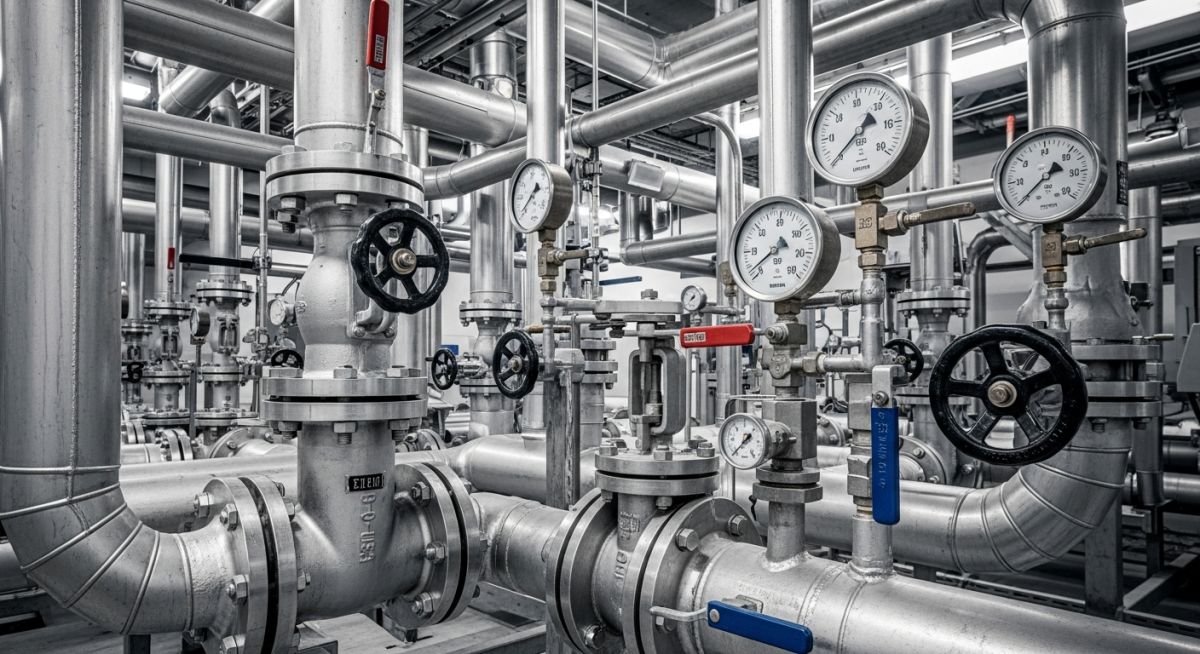
What is Indian Boiler Regulation (IBR)? ASME B31.1 vs IBR
In my 20-plus years of piping engineering, I have seen many international EPC contractors stumble when they first encounter the Indian Boiler Regulation (IBR). They assume that because their design complies with ASME B31.1, it will sail through Indian regulatory approvals. This is a costly mistake. I remember a combined-cycle power plant project in Gujarat where an entire shipment of alloy steel piping was rejected at the port because the mill test certificates lacked the mandatory Form III-A. That mistake cost the consortium three months and hundreds of thousands of dollars.
Understanding the boundary limits, material certification pathways, and design calculation differences between ASME B31.1 and IBR is not just an academic exercise—it is a legal requirement for any project built on Indian soil. Let us break down these differences from a practical, field-tested perspective so you can avoid these expensive pitfalls.
Key Takeaways for Piping Engineers
- IBR is a statutory law in India, whereas ASME B31.1 is a voluntary consensus code unless legally adopted by a local jurisdiction.
- The definition of a “boiler” under IBR includes all steam piping where the design pressure exceeds 3.5 kg/cm² (gauge) or the internal diameter exceeds 254 mm.
- Material traceability is non-negotiable; every single piping component must be accompanied by IBR Form III certificates signed by an authorized inspecting authority.
- Design calculations for wall thickness under IBR use different allowable stress criteria and safety factors compared to ASME B31.1.
- Welder qualifications and welding procedures must be pre-approved by the State Boiler Directorate before any fabrication begins.
Complete Course on
Piping Engineering
Check Now
Key Features
- 125+ Hours Content
- 500+ Recorded Lectures
- 20+ Years Exp.
- Lifetime Access
Coverage
- Codes & Standards
- Layouts & Design
- Material Eng.
- Stress Analysis
Understanding the Indian Boiler Regulation (IBR) Framework
The Indian Boiler Regulations were first enacted in 1950 under Section 28 of the Indian Boilers Act, 1923. Unlike the United States, where ASME B31.1 serves as a recommended practice that states may or may not adopt, IBR is a federal law in India. If your steam piping falls within the IBR boundary, you cannot bypass its rules.
The IBR Boundary Definition
One of the most common questions I get is: “Where does the IBR boundary stop?” Under IBR Regulation 3, the regulations apply to any steam pipe that exceeds 25.4 mm (1 inch) in internal diameter and where the design pressure exceeds 3.5 kg/cm² (gauge). This includes any feed piping that supplies water to the boiler, as well as steam piping that conveys steam from the boiler to the point of consumption (such as a steam turbine or process vessel).
Wall Thickness Calculations: ASME B31.1 vs IBR
The design formulas for determining the minimum required wall thickness of straight pipe under internal pressure reveal fundamental differences in safety philosophy.
ASME B31.1 Wall Thickness Formula (Paragraph 104.1.2):
Where:
• t = Minimum required wall thickness (inches/mm)
• P = Internal design pressure (psig/MPa)
• D = Outside diameter of pipe (inches/mm)
• S = Allowable stress value from Appendix A (psi/MPa)
• E = Joint efficiency factor
• y = Temperature coefficient (ranging from 0.4 to 0.7 depending on material and temperature)
• A = Additional thickness to compensate for corrosion, erosion, or threading (inches/mm)
IBR Wall Thickness Formula (Regulation 350):
Where:
• t = Minimum thickness of the pipe (excluding tolerance)
• P = Maximum working pressure (kg/cm²)
• D = Outside diameter of the pipe (mm)
• f = Allowable stress of the material at design temperature (kg/mm²)
• J = Joint efficiency factor (1.0 for seamless pipes)
• C = Corrosion allowance (typically 0.75 mm to 1.0 mm depending on material)
Material Certification and Traceability
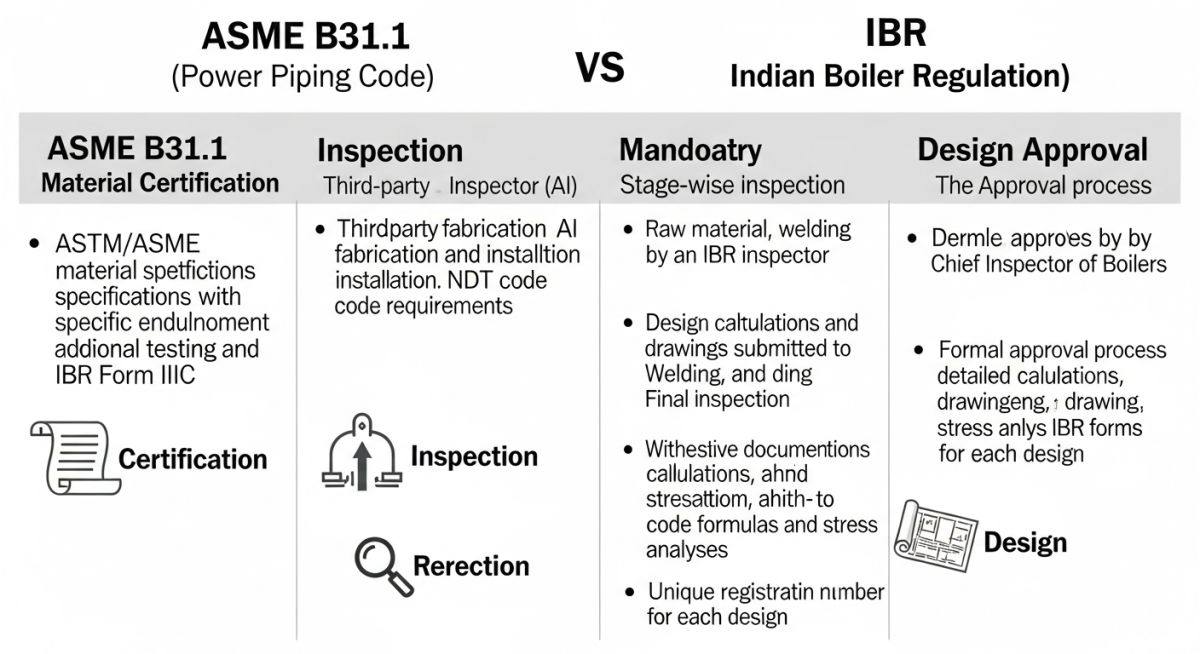
Under ASME B31.1, you can purchase ASTM-compliant piping from any reputable distributor, provided they supply a standard Mill Test Report (MTR) per EN 10204 Type 3.1. Under IBR, this is completely unacceptable.
Every single pressure-retaining component—pipes, fittings, flanges, valves, and even welding filler metals—must be manufactured under the inspection of an IBR-authorized inspecting authority. The manufacturer must issue specific statutory forms, such as Form III-A for pipes, Form III-B for tubes, and Form III-C for fittings. These forms must be countersigned by the inspector, proving that the material was tested in their presence.
| Parameter | ASME B31.1 (Power Piping) | Indian Boiler Regulation (IBR) |
|---|---|---|
| Legal Status | Voluntary consensus code (unless mandated by local state law) | Statutory federal law in India (The Boilers Act, 1923) |
| Design Scope | Power piping systems for steam, water, oil, gas, and air | Steam piping and boiler feed piping within defined limits |
| Material Certification | Mill Test Reports (MTR) per ASTM/ASME specifications | Mandatory Form III series signed by IBR-authorized inspector |
| Welder Qualification | Qualified per ASME Section IX by the manufacturer/contractor | Qualified per IBR Chapter XIII by the State Boiler Inspector |
| Hydrostatic Testing | Typically 1.5 times design pressure (or per system design) | Mandatory 1.5 times design pressure, witnessed by State Inspector |
| Third-Party Inspection | Owner’s inspector or Authorized Inspector (AI) for ASME stamps | State Boiler Inspector or Competent Person authorized by Central Boiler Board |
| Entity / Acronym | Technical Definition | Physical Parameter / Limit | Standard Reference |
|---|---|---|---|
| CBB | Central Boiler Board (India) | Regulatory oversight body | The Boilers Act, 1923 |
| Form III-A | Certificate of manufacture and test for pipes | Covers straight seamless/welded pipes | IBR Regulation 350 & Chapter VIII |
| Form III-C | Certificate of manufacture and test for fittings | Covers elbows, tees, reducers, and flanges | IBR Regulation 350 & Chapter VIII |
| Creep Rupture Limit | Average stress to cause rupture in 100,000 hours | Safety factor of 1.5 applied to mean value | IBR Regulation 271 & ASME B31.1 App. A |
| Hydrostatic Test Pressure | Minimum pressure for structural integrity verification | 1.5 x Design Pressure (minimum) | IBR Regulation 379 & ASME B31.1 Para 137 |
How to Ensure Indian Boiler Regulation (IBR) Compliance
Before you allow a single weld to be struck on an IBR-regulated steam line, you must verify that your documentation and site procedures align with the statutory requirements of the local State Boiler Directorate. Use this field-tested checklist to ensure compliance.
Pre-Fabrication and Installation Verification Steps
-
Drawing Approval: Ensure all piping isometric drawings and piping and instrumentation diagrams (P&IDs) are stamped and approved by the Chief Inspector of Boilers of the respective state.
-
Material Traceability (Form III): Cross-reference every heat number stamped on the physical pipes and fittings with the corresponding Form III-A or III-C certificates. The certificates must be signed by an authorized inspecting authority.
-
Welder Qualification (Form XIII): Verify that all welders possess valid IBR certificates (Form XIII) issued by the State Boiler Directorate. These certificates must be current and specific to the material and welding position.
-
WPS and PQR Approval: Confirm that the Welding Procedure Specifications (WPS) and Procedure Qualification Records (PQR) have been reviewed and approved by the local boiler inspector.
-
Nondestructive Testing (NDT) Protocol: Ensure the radiography and ultrasonic testing procedures comply with IBR Chapter III requirements, and that the testing agency is approved by the State Boiler Directorate.
-
Hydrostatic Test Witnessing: Schedule the final hydrostatic test with the local State Boiler Inspector. The test must be held at 1.5 times the design pressure for a minimum duration specified by the inspector, with zero pressure drop.
Field Case Study: Real-World Application
The Problem: Non-Compliant Steam Skid Importation
A multinational chemical plant in Maharashtra imported a pre-fabricated steam turbine piping skid designed strictly to ASME B31.1. The skid arrived at the site without IBR Form III-A certificates for the main steam piping (Grade P22, 8-inch NPS, Schedule 80). The local State Boiler Inspector halted the installation, refusing to allow the skid to be connected to the utility steam network. The project faced a potential delay of four months and a penalty of 150,000 for late commissioning.
As the lead piping consultant, I was brought in to resolve the impasse. We could not replace the piping without dismantling the entire skid, which would destroy the turbine alignment. Instead, we initiated a retrospective certification process under the provisions of the amended Indian Boiler Regulations.
We executed the following recovery plan:
- Performed Positive Material Identification (PMI) and non-destructive hardness testing on all piping components to verify material chemistry and mechanical properties.
- Conducted 100% volumetric ultrasonic testing (UT) and radiographic testing (RT) on all shop welds to prove weld quality.
- Re-calculated the wall thickness using the IBR Regulation 350 formula, proving that the ASME B31.1 design thickness of Schedule 80 was sufficient under IBR allowable stress limits.
- Submitted a comprehensive technical dossier, along with a petition for special dispensation, to the Chief Inspector of Boilers.
After witnessing a successful site hydrostatic test at 1.5 times the design pressure, the Chief Inspector issued a special approval certificate. While we saved the project from a complete rebuild, the retrospective testing and administrative fees cost the client 45,000—a cost that could have been entirely avoided with proper front-end engineering design (FEED) planning.
Direct Recommendation: Always specify IBR compliance in your procurement datasheets for any steam-carrying equipment destined for India, regardless of where the skid is fabricated.
Frequently Asked Engineering Questions
Can I use ASME B31.1 listed materials for IBR piping?
What is the exact pressure and size limit where IBR becomes mandatory?
Who is authorized to sign IBR Form III certificates?
How does IBR handle weld joint efficiency compared to ASME B31.1?
Can an ASME “S” stamp holder fabricate IBR boilers without local inspection?
What happens if I install non-IBR piping in an IBR-regulated plant?
===FAQ_BLOCK===
