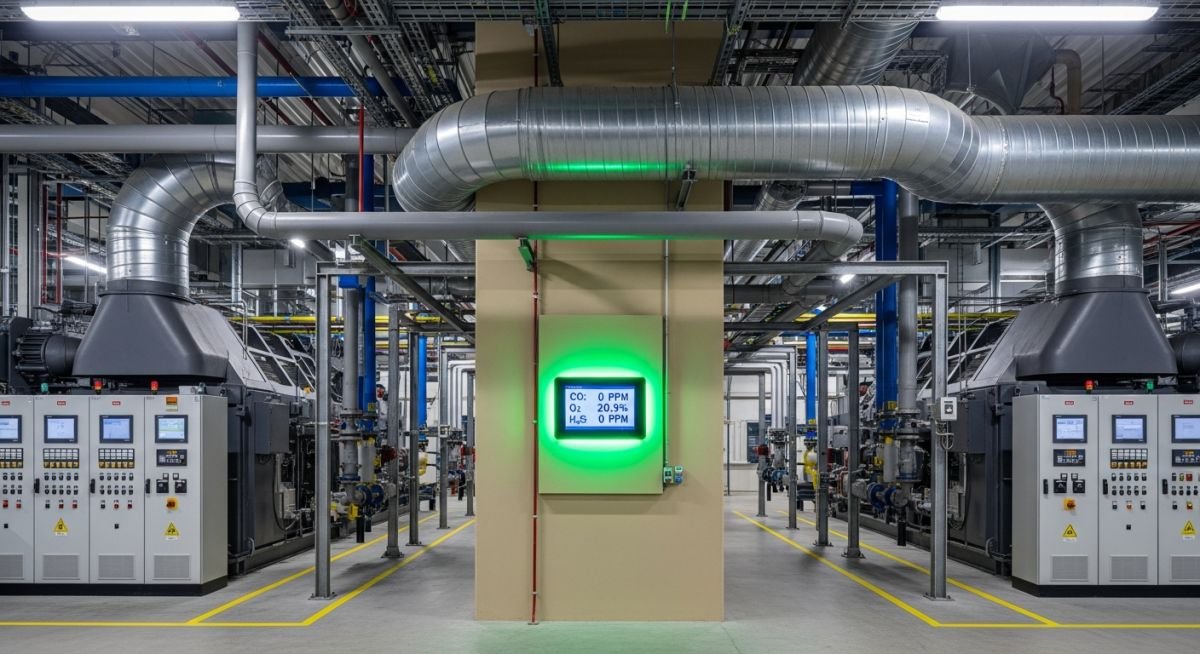
Carbon Monoxide Poisoning: Industrial Prevention and Engineering Safety Protocols
In my two decades of piping and process engineering, I have witnessed how easily Carbon Monoxide Poisoning can turn a routine maintenance shutdown into a site-wide emergency. Carbon monoxide (CO) is a silent, odorless, and colorless killer that stems from incomplete combustion in boilers, furnaces, and internal combustion engines. Unlike other process gases, CO binds to hemoglobin with an affinity 200 times greater than oxygen, effectively starving the body’s tissues of vital life support.
Engineering safety is not merely about installing a sensor; it is about understanding the fluid dynamics of gas dispersion and the specific ventilation requirements of your facility. This guide explores the technical rigor required to design robust detection systems and maintain safe atmospheric conditions in high-risk zones.
Key Engineering Takeaways:
- Implement multi-point gas detection arrays based on vapor density and airflow patterns.
- Ensure HVAC systems maintain a minimum of 6-12 air changes per hour in confined spaces.
- Standardize calibration intervals for electrochemical sensors to meet ANSI/ISA requirements.
- Integrate automated emergency shutdown (ESD) logic with ventilation overrides.
Engineering Strategies for Carbon Monoxide Poisoning Prevention
Carbon Monoxide Poisoning Prevention: The integration of redundant gas detection, strategic ventilation design, and rigorous process monitoring to maintain CO concentrations below the ACGIH Threshold Limit Value of 25 ppm.
To effectively mitigate the risk of Carbon Monoxide Poisoning, engineers must first calculate the potential generation rate (G) within a specific volume (V). The concentration (C) over time (t) is governed by the mass balance equation: C(t) = (G/Q) * (1 – exp(-Qt/V)), where Q represents the effective ventilation rate. In my experience, the most common failure point is assuming perfect mixing; in reality, stagnant zones often allow CO to accumulate far beyond the calculated average.
When designing detection arrays, I prioritize the placement of electrochemical sensors at the breathing zone (approximately 1.5 meters above the floor). While CO is slightly lighter than air (specific gravity 0.967), it often travels with heated exhaust plumes, meaning sensors must be placed near potential leak sources and in the path of natural convection currents. Per ISA-92.00.01, sensors must be calibrated using a certified span gas at least every six months to ensure accuracy within 5% of the full-scale range.
Field Warning: The Stagnation Trap
Never rely on a single central sensor. In large industrial bays, thermal stratification can create “pockets” of high CO concentration while the central sensor reads within safe limits. Always perform a computational fluid dynamics (CFD) analysis for complex geometries to identify these dead zones.
Ventilation design must account for the worst-case scenario: a total failure of the primary combustion exhaust system. I specify interlocked ventilation systems that trigger at 35 ppm (the NIOSH REL) and initiate a full process shutdown at 100 ppm. This logic must be hard-wired into the Distributed Control System (DCS) to bypass software-level latency, ensuring that the safety instrumented system (SIS) acts within milliseconds of a threshold breach.
Finally, consider the impact of ambient temperature on sensor performance. Electrochemical cells are highly sensitive to humidity and temperature fluctuations. In outdoor or semi-enclosed environments, I mandate the use of heated sensor housings to prevent condensation, which can block the gas-permeable membrane and lead to false negatives—a critical failure mode that has caused numerous preventable incidents in the field.
Safety System Implementation: The comparative analysis of automated detection versus passive ventilation strategies in industrial CO management.
Advantages
- Real-time monitoring provides immediate data for rapid evacuation.
- Automated ESD integration minimizes human error during emergencies.
- Data logging allows for trend analysis and predictive maintenance.
- Advanced sensors can detect CO at sub-ppm levels for early warning.
Disadvantages
- High initial capital expenditure for redundant sensor arrays.
- Regular calibration requirements increase long-term operational costs.
- Sensor poisoning from silicone or sulfur compounds reduces lifespan.
- Complex logic integration increases the risk of nuisance trips.
Industrial Safety Deployment: The strategic application of CO detection and ventilation protocols across diverse high-risk industrial sectors.
Petrochemical Refining Facilities
Refineries utilize extensive CO detection networks around catalytic cracking units where incomplete combustion is a constant risk. These systems are integrated into the plant-wide safety instrumented system to ensure that any deviation in flue gas composition triggers immediate pressure relief and ventilation adjustments.
Large-Scale Power Generation Plants
In power plants, CO monitoring is critical near boiler houses and turbine enclosures where high-temperature combustion occurs. Engineers implement redundant, high-temperature-rated sensors to monitor exhaust integrity, preventing the migration of toxic gases into control rooms or administrative areas.
Underground Mining Operations
Mining environments require specialized, ruggedized CO detection systems capable of operating in high-dust and high-humidity conditions. These systems are often linked to secondary ventilation fans that automatically increase airflow when CO levels exceed 10 ppm, ensuring the safety of personnel in confined subterranean tunnels.
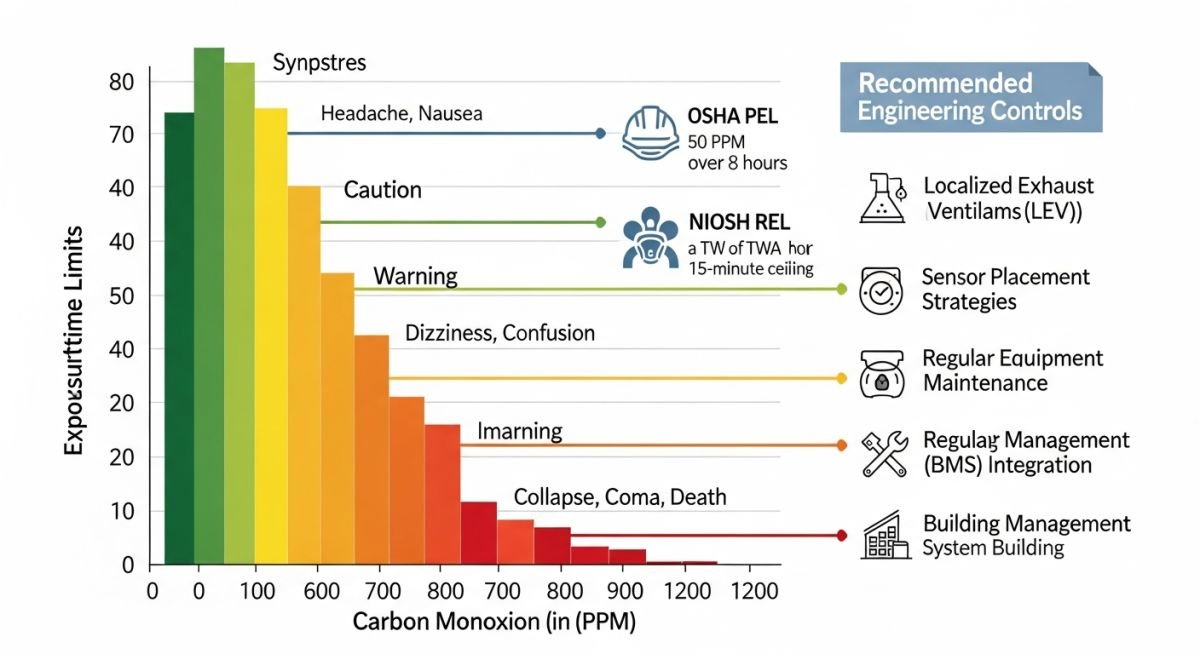
In my two decades of field experience, I have observed that relying solely on personal monitors is insufficient without a deep understanding of the regulatory exposure limits. The following table delineates the critical concentration thresholds that dictate engineering response, evacuation protocols, and the necessity for respiratory protection in industrial environments. These values are derived from OSHA and ACGIH standards, which serve as the baseline for all facility safety audits.
Engineers must ensure that fixed gas detection systems are calibrated to trigger alarms well before these thresholds are reached. The “Time-Weighted Average” (TWA) is particularly critical for long-shift operations where cumulative exposure can lead to chronic health degradation even if instantaneous peaks remain below the ceiling limit. Always cross-reference these values with your specific site-wide safety manual and local jurisdictional requirements, as some regions enforce stricter limits than the federal baseline.
| Exposure Metric | Concentration (ppm) | Regulatory Basis |
|---|---|---|
| OSHA PEL (8-hour TWA) | 50 ppm | 29 CFR 1910.1000 |
| ACGIH TLV (8-hour TWA) | 25 ppm | ACGIH Guidelines |
| IDLH (Immediately Dangerous) | 1200 ppm | NIOSH Pocket Guide |
To effectively manage Carbon Monoxide Poisoning risks, engineers must categorize the various technical entities involved in gas detection and mitigation. This matrix maps the hardware, the chemical properties of the gas, and the governing standards that dictate how we design our safety systems. Understanding these relationships is fundamental to building a robust defense-in-depth strategy for any industrial facility.
Each entity listed below represents a specific layer of the safety architecture. From the electrochemical sensors that detect molecular presence to the ventilation systems that provide the necessary air exchange rates, every component must be integrated into a centralized NFPA-compliant monitoring network. Use this matrix to audit your current facility setup and identify potential gaps in your safety coverage.
| Entity | Function | Standard Reference |
|---|---|---|
| Electrochemical Sensor | CO detection via oxidation | ISA-92.00.01 |
| HVAC Air Exchange | Dilution of toxic gases | ASHRAE 62.1 |
| SCBA Equipment | Emergency respiratory protection | NIOSH 42 CFR 84 |
Carbon Monoxide Poisoning Prevention: A systematic approach to site verification is the only way to ensure that your engineering controls remain effective over the lifecycle of the plant. I have developed this checklist based on recurring failures I have witnessed during site audits, where sensors were present but improperly located or poorly maintained.
-
Sensor Placement: Verify that detectors are installed at breathing zone height (3 to 5 feet) and not obstructed by equipment or stagnant air pockets. -
Calibration Frequency: Ensure all fixed and portable sensors undergo bump testing before every shift and full calibration every 30 days per ISA standards. -
Ventilation Interlocks: Confirm that the building management system (BMS) is hard-wired to trigger high-speed exhaust fans upon detection of CO levels exceeding 25 ppm. -
Alarm Audibility: Conduct a sound-level test to ensure that alarms are audible over ambient industrial noise (minimum 15 dB above background). -
Emergency Egress: Validate that all evacuation routes are clearly marked and that personnel are trained on the specific symptoms of CO poisoning, such as headache, dizziness, and nausea.
Regular site verification is not a one-time task but a continuous process. If your facility utilizes combustion-based equipment, you must also perform annual flue gas analysis to ensure that burners are operating at peak efficiency, thereby minimizing the generation of CO at the source. Document every inspection in a centralized logbook to maintain compliance with local safety regulations and insurance requirements.
Field Case Study: Real-World Application
The Problem: Inadequate Ventilation in a Boiler Room
A mid-sized manufacturing facility experienced a near-miss incident when a faulty burner caused CO levels to spike in an enclosed boiler room.
- Sensors were installed near the ceiling, failing to detect the gas accumulation at the breathing zone.
- The ventilation system was set to a manual override, which had been left in the “off” position by maintenance staff.
- Lack of a secondary alarm system meant that the control room was unaware of the rising concentration until a worker collapsed.
The Outcome: Engineering Control Remediation
Following the incident, we implemented a comprehensive safety overhaul that successfully mitigated future risks.
- Relocated all CO sensors to the 4-foot breathing zone and added redundant sensors near potential leak sources.
- Installed an automated logic controller that forces the HVAC system to 100% exhaust mode if CO exceeds 25 ppm.
- Implemented a mandatory “Pre-Entry” gas check protocol for all personnel entering the boiler room, regardless of duration.
My recommendation for similar facilities is to move away from manual ventilation controls entirely. By integrating gas detection directly into the facility’s PLC (Programmable Logic Controller), you remove the human element from the safety chain, ensuring that the environment is purged of toxic gases before a dangerous concentration is ever reached.
Frequently Asked Engineering Questions
Why do CO sensors need to be at breathing height?
- Placement at the breathing zone (3 to 5 feet) ensures the sensor detects the concentration that the worker is actually inhaling.
- Ceiling-mounted sensors often fail to detect CO until the gas has already reached dangerous levels throughout the entire room volume.
- Following NFPA 72 guidelines for gas detection placement is critical for ensuring rapid response times in industrial environments.
How often should I calibrate my CO detectors?
- Perform a “bump test” before every shift to verify that the sensor responds to a known concentration of gas.
- Conduct a full calibration at least every 30 days, or immediately if the sensor has been exposed to high concentrations of CO.
- Always document the calibration results in a logbook to satisfy OSHA inspection requirements during safety audits.
What is the difference between TWA and Ceiling limits?
- The Time-Weighted Average (TWA) represents the average exposure over an 8-hour shift, accounting for fluctuations in concentration.
- The Ceiling limit is an absolute maximum concentration that must never be exceeded, even for a single second.
- Engineering controls must be designed to keep the TWA well below the 25 ppm threshold to prevent chronic health issues.
Can I rely on smell to detect Carbon Monoxide?
- Relying on smell is a common cause of fatal accidents in industrial settings.
- Electronic gas detection is the only reliable method for identifying the presence of CO.
- If you suspect a leak, evacuate the area immediately and contact the emergency response team, regardless of whether you “smell” anything.
What are the first signs of CO poisoning?
- Common early symptoms include dull headaches, dizziness, weakness, and nausea.
- As exposure continues, victims may experience confusion, blurred vision, and loss of consciousness.
- If multiple workers in the same area report similar symptoms, treat it as a potential CO leak and initiate an immediate evacuation.
How does HVAC design impact CO safety?
- Ensure that your ventilation system provides adequate air exchange rates as defined by ASHRAE standards.
- Design the system to maintain a slight negative pressure in areas where combustion equipment is located to prevent gas migration.
- Integrate CO sensors with the HVAC control system to automatically increase exhaust rates when gas levels rise.
📚 Recommended Resources: Carbon Monoxide Poisoning
Complete Course on
Piping Engineering
Check Now
Key Features
- 125+ Hours Content
- 500+ Recorded Lectures
- 20+ Years Exp.
- Lifetime Access
Coverage
- Codes & Standards
- Layouts & Design
- Material Eng.
- Stress Analysis
