
CAPEX Estimation for Industrial Projects: A Technical Framework
In my two decades of managing large-scale piping and process plant projects, I have learned that the difference between a profitable venture and a financial disaster often lies in the precision of the initial CAPEX estimation. Many engineers treat cost estimation as a purely administrative task, but in reality, it is a rigorous engineering discipline that requires deep integration with P&IDs, plot plans, and material take-offs.
Accurate budgeting is not about guessing; it is about mapping every valve, pipe spool, and structural steel member to a specific cost driver. When we fail to account for the nuances of indirect costs or the volatility of escalation, we invite scope creep and project failure. This guide breaks down the technical components of CAPEX, providing you with the framework to build robust, defensible budgets that stand up to executive scrutiny.
Key Takeaways for Project Success:
- Mastering the AACE Class 5 through Class 1 estimate progression.
- Quantifying direct costs through precise material take-offs and labor productivity factors.
- Strategic allocation of contingency based on quantitative risk analysis (QRA).
- Integrating owner’s costs and escalation into the total project lifecycle budget.
Technical Breakdown of CAPEX Estimation for Industrial Projects
CAPEX Estimation for Industrial Projects: The rigorous technical methodology used to forecast the total investment required for asset acquisition, encompassing direct field costs, indirect engineering overheads, and risk-adjusted contingency reserves.
To build a reliable CAPEX estimate, we must first categorize costs into distinct buckets. Direct costs are those physically embedded in the plant, such as piping, instrumentation, and structural steel. I calculate these by applying unit rates to the quantities derived from the ASME-compliant design documents. For instance, the cost of a piping system is not just the pipe material; it is the sum of material costs, fabrication labor, field installation, and non-destructive testing (NDT) requirements.
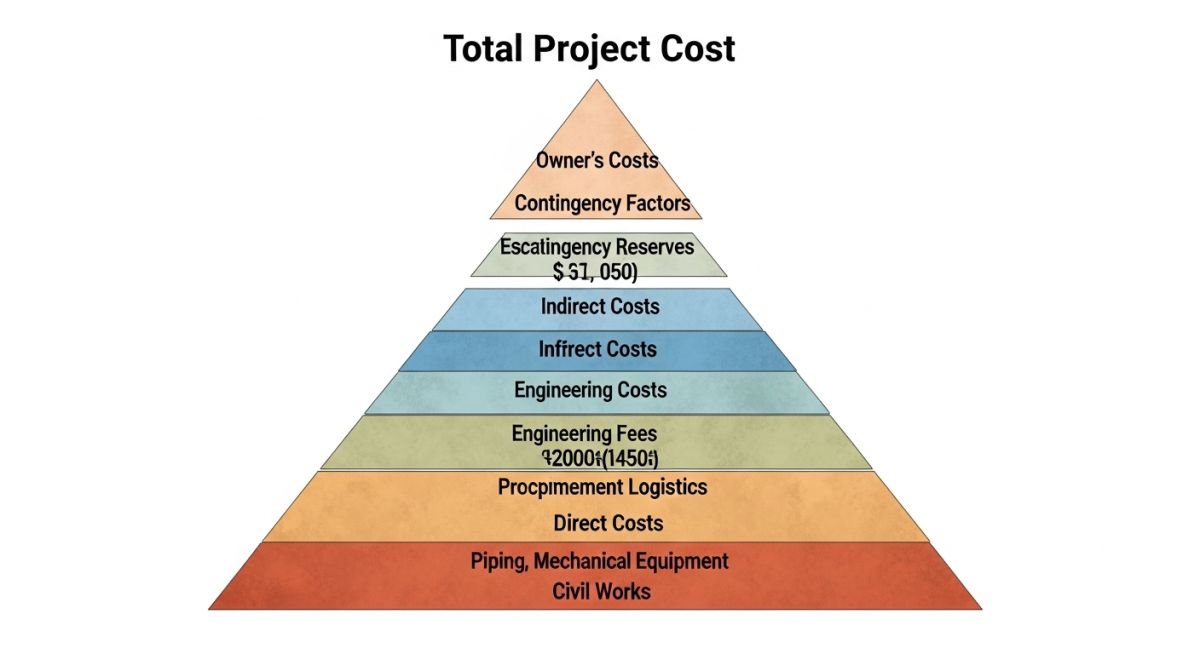
Indirect costs, often overlooked by junior engineers, represent the “soft” costs necessary to execute the project. These include engineering man-hours, project management, construction management, and temporary facilities. In my experience, these typically range from 15% to 30% of the total direct cost, depending on the project complexity and location. We must also account for Owner’s Costs, which include land acquisition, permitting, legal fees, and initial spare parts inventory.
Field Warning: The Contingency Trap
Never apply a flat percentage for contingency across an entire project. A high-pressure hydrogen unit requires a significantly higher contingency buffer than a standard utility water system. Use a risk-based approach, identifying specific technical uncertainties—such as soil conditions, long-lead equipment delivery, or regulatory changes—and assigning a probability-weighted cost to each.
Escalation is the final, often volatile, component. We must account for the time value of money and market fluctuations in steel, labor, and energy prices. I utilize the AACE International Recommended Practices to adjust for inflation over the project duration. If your project spans three years, failing to escalate your labor rates will result in a massive budget shortfall by the time you reach the construction phase.
Finally, the integration of these components requires a robust Work Breakdown Structure (WBS). By mapping every cost item to a WBS code, we ensure that no component is double-counted or omitted. This level of granularity allows for real-time tracking during the execution phase, enabling us to identify cost variances before they impact the bottom line.
CAPEX Estimation Strategic Trade-offs: The evaluation of benefits and limitations inherent in high-fidelity cost modeling versus rapid, high-level estimation techniques for industrial capital projects.
Advantages
- Improved financial predictability for stakeholders.
- Early identification of high-risk cost drivers.
- Enhanced ability to negotiate vendor contracts.
- Clearer alignment between design and budget.
- Reduced probability of mid-project funding gaps.
Disadvantages
- High initial investment in engineering hours.
- Risk of “analysis paralysis” in early phases.
- Sensitivity to inaccurate input data assumptions.
- Complexity in managing multi-currency fluctuations.
- Potential for false confidence in static models.
Industrial CAPEX Implementation Scenarios: The practical application of structured cost estimation frameworks across diverse sectors to ensure fiscal discipline and project viability.
Green Hydrogen Plant Infrastructure
Developing hydrogen production facilities requires precise estimation of electrolyzer costs and high-pressure piping materials. We must account for the rapid technological evolution of PEM stacks, which significantly impacts the long-term CAPEX profile compared to traditional steam methane reforming units.
Brownfield Refinery Revamp Projects
Revamping existing assets involves high uncertainty regarding tie-in points and legacy piping conditions. Our estimation must include extensive site surveys and contingency for unforeseen structural reinforcements, ensuring the budget reflects the reality of working within an operational plant environment.
Offshore Oil and Gas Platforms
Offshore projects demand extreme precision due to the high cost of logistics and specialized labor. We focus on modular construction costs, where the CAPEX is heavily weighted toward fabrication in controlled environments and the subsequent heavy-lift installation, requiring rigorous escalation modeling for maritime services.
In my two decades of managing large-scale piping and process plant projects, I have observed that the reliability of a CAPEX estimate is inextricably linked to the project definition maturity. We utilize the AACE International recommended practices to categorize estimates into five distinct classes. These classes serve as the primary communication tool between engineering teams and stakeholders, defining the expected range of accuracy based on the percentage of engineering completion.
The table below outlines the relationship between project definition, engineering progress, and the resulting cost variance. Understanding these thresholds is vital for preventing budget overruns during the Front-End Engineering Design (FEED) phase. When we move from Class 5 (Concept) to Class 1 (Full Project Definition), the contingency requirements typically decrease as the technical risks are identified and mitigated through detailed piping layouts, P&IDs, and vendor-certified equipment data.
| Estimate Class | Engineering Maturity | Expected Accuracy Range | Primary Purpose |
|---|---|---|---|
| Class 5 | 0% to 2% | -50% to +100% | Screening and Feasibility |
| Class 4 | 1% to 15% | -30% to +50% | Concept Study |
| Class 3 | 10% to 40% | -20% to +30% | Budget Authorization |
| Class 2 | 30% to 75% | -15% to +20% | Control/Bid Estimate |
| Class 1 | 65% to 100% | -10% to +15% | Check Estimate/Final |
Always remember that these ranges represent the statistical probability of the final cost falling within the specified bounds. If your project involves high-complexity piping materials or exotic alloys, the upper bound of these ranges should be adjusted upward to account for market volatility in raw material pricing.
Effective CAPEX estimation requires a structured approach to mapping technical entities against their financial counterparts. In my experience, the most common failure point in project budgeting is the misclassification of costs between direct and indirect categories. This matrix provides a clear technical mapping to ensure that every engineering deliverable is accounted for in the final financial model.
By aligning these entities with industry-standard codes, we create a transparent audit trail that satisfies both internal finance departments and external project auditors. This mapping is essential for tracking the “Cost of Quality” and ensuring that engineering hours are correctly allocated to the appropriate Work Breakdown Structure (WBS) elements during the execution phase.
| Entity Category | Technical Component | Standard Reference |
|---|---|---|
| Direct Cost | Piping, Valves, Fittings | ASME B31.3 |
| Direct Cost | Pressure Vessels | ASME BPVC |
| Indirect Cost | Construction Management | PMBOK Guide |
| Owner’s Cost | Permitting and Licensing | Local Regulatory Codes |
| Contingency | Risk-Adjusted Reserve | AACE 41R-08 |
This matrix should be used as a foundational document during the kick-off of any industrial project. By standardizing these definitions, you eliminate ambiguity in the cost reporting process and ensure that the project team speaks a common language regarding budget health and expenditure tracking.
Verification is the final line of defense against catastrophic budget failure. Before submitting any CAPEX estimate for executive approval, I mandate a rigorous review process that covers technical, commercial, and risk-based parameters. This checklist is designed to ensure that no hidden costs are overlooked during the estimation cycle.
-
Scope Definition: Confirm that the P&ID count matches the MTO (Material Take-Off) and that all battery limit interfaces are clearly defined per ASME B31.3. -
Vendor Quotes: Ensure that all long-lead equipment items have current, written budgetary quotes valid for the project duration. -
Escalation Factors: Verify that the escalation index accounts for regional labor rate fluctuations and raw material price volatility over the construction schedule. -
Contingency Logic: Validate that the contingency percentage is based on a quantitative risk assessment rather than a flat, arbitrary multiplier. -
Owner’s Costs: Include all non-EPC costs such as land acquisition, legal fees, insurance, and internal project management overhead. -
Constructability Review: Confirm that the estimate includes temporary facilities, heavy lift equipment, and site access requirements.
Each item on this list must be signed off by the respective discipline lead. In my experience, skipping the constructability review is the most common cause of “hidden” direct costs surfacing during the field execution phase. Always document the basis of your assumptions for every line item to facilitate future audits and project post-mortems.
Field Case Study: Real-World Application
The Challenge: Underestimated Piping Material Costs
A mid-sized refinery expansion project faced a 25% budget overrun during the procurement phase due to inaccurate initial material take-offs.
- Failure to account for high-alloy piping material surcharges.
- Incomplete P&ID review leading to missing valve and fitting counts.
- Lack of vendor-certified pricing for specialized instrumentation.
- Ignoring the impact of global supply chain disruptions on lead times.
The Outcome: Corrective Action and Recovery
By implementing a rigorous re-estimation protocol, the project team successfully stabilized the budget and completed the project within the revised contingency limits.
- Established a real-time MTO tracking system linked to the 3D model.
- Negotiated long-term supply agreements to lock in material pricing.
- Increased the contingency reserve for high-risk material categories.
- Improved communication between engineering and procurement teams.
My recommendation for similar projects is to perform a “bottom-up” estimate for all high-value piping components. Relying on historical cost factors for exotic materials is a dangerous practice that often leads to significant financial exposure. Always prioritize data-driven accuracy over speed during the early stages of the project lifecycle.
Frequently Asked Engineering Questions
How do I determine the appropriate contingency percentage?
- Identify specific technical and commercial risks for the project.
- Assign a probability of occurrence and a financial impact value to each risk.
- Calculate the expected value for each risk and aggregate them.
- Reference AACE 41R-08 for best practices in risk-based contingency modeling.
What is the difference between escalation and contingency?
- Escalation accounts for anticipated price increases due to inflation or market trends over the project timeline.
- Contingency covers the “unknown unknowns” or specific risks that may or may not occur during execution.
- Escalation is typically calculated using indices like the Producer Price Index.
- Contingency is a reserve for scope uncertainty and technical risk mitigation.
How are Owner’s Costs typically calculated?
- Internal project management and engineering oversight salaries.
- Land acquisition, legal fees, and environmental permitting costs.
- Insurance premiums, taxes, and financing interest during construction.
- Start-up and commissioning support staff and training programs.
Why is engineering maturity critical for CAPEX accuracy?
- Assumptions are replaced by verified data from P&IDs and 3D models.
- Vendor quotes replace budgetary estimates, reducing price variance.
- Construction sequences are finalized, allowing for more accurate labor productivity estimates.
- The range of uncertainty narrows, allowing for a reduction in the contingency reserve.
What are the risks of using historical cost data?
- Differences in site conditions, soil profiles, and local labor regulations.
- Changes in safety standards or environmental compliance requirements.
- Technological advancements that make old designs obsolete or inefficient.
- Market volatility that renders past pricing irrelevant for current procurement.
How do I handle indirect costs in my estimate?
- Construction management and field supervision personnel.
- Temporary site facilities, utilities, and security services.
- Heavy equipment rental and mobilization/demobilization costs.
- Engineering and design office overheads and software licensing.
📚 Recommended Resources: CAPEX Estimation for Industrial Projects
Read these Guides
- 📄 Capital Cost Estimation Explained: A Guide for Piping Engineers
- 📄 Mastering Cost Engineering: Essential Lifecycle Management for Industrial Projects
- 📄 Levelized Cost of Hydrogen: Engineering Economics for Industrial Decarbonization
- 📄 Green Ammonia Economics: A Technical Guide to Industrial Scale Profitability
Complete Course on
Piping Engineering
Check Now
Key Features
- 125+ Hours Content
- 500+ Recorded Lectures
- 20+ Years Exp.
- Lifetime Access
Coverage
- Codes & Standards
- Layouts & Design
- Material Eng.
- Stress Analysis
