
Mastering AACE International Standards for EPC Project Success
In my two decades of navigating the complexities of large-scale EPC projects, I have found that the difference between a profitable venture and a budget overrun often lies in the rigor of cost engineering. AACE International serves as the backbone for this discipline, providing the technical language and standardized methodologies that allow engineers to communicate risk, estimate capital expenditure, and control project schedules with precision.
Whether you are managing a multi-billion dollar refinery expansion or a modular skid fabrication project, aligning your internal workflows with AACE Recommended Practices is not just a best practice—it is a requirement for predictable project delivery. This guide explores the history, core competencies, and practical applications of AACE standards in modern engineering.
Key Takeaways
- Understand the evolution of AACE from a cost-focused society to a global authority on Total Cost Management.
- Learn how to map AACE Class 5 through Class 1 estimates to specific EPC project phases.
- Discover the value of professional certifications like the CCP and EVP in career advancement.
- Implement standardized Recommended Practices to reduce variance in project cost and schedule reporting.
Deep Dive: AACE International Cost Engineering Standards
AACE International Cost Engineering: The systematic application of scientific principles and techniques to problems of cost estimation, cost control, business planning, and management science, profitability analysis, and project management.
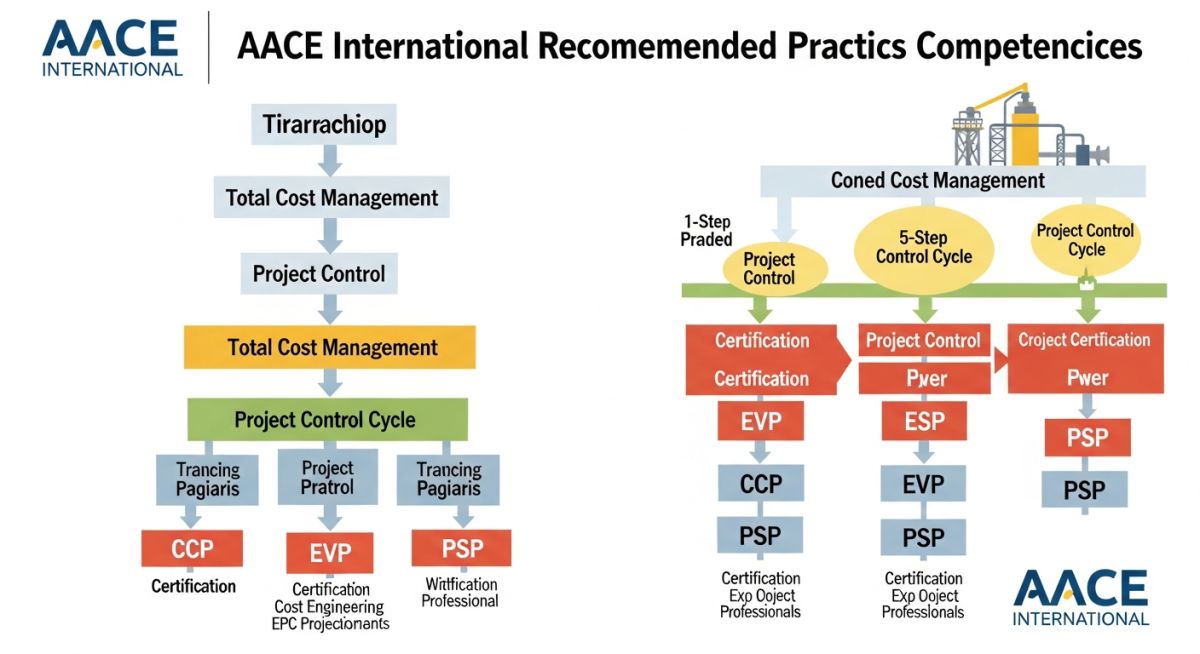
At the heart of AACE International lies the concept of Total Cost Management (TCM). Unlike traditional accounting, TCM integrates the entire project lifecycle, from the initial conceptual design to the final decommissioning of an asset. In my experience, the most critical aspect of this framework is the classification of estimates, which provides a common language between the owner, the EPC contractor, and the supply chain.
Estimating Classifications and Accuracy
AACE Recommended Practice 17R-97 defines the hierarchy of cost estimates. As an engineer, you must understand that the accuracy range is not merely a guess but a function of the project definition maturity. For instance, a Class 5 estimate, typically prepared during the conceptual phase, carries an accuracy range of -20% to -50% on the low end and +30% to +100% on the high end.
Field Warning: The Maturity Trap
Never attempt to force a Class 1 estimate (detailed design) accuracy onto a Class 4 estimate (feasibility study). Doing so ignores the inherent uncertainty in piping material take-offs, labor productivity factors, and site-specific geotechnical conditions. Always document the basis of estimate (BOE) to justify the contingency levels applied to your project budget.
Integrating AACE into EPC Workflows
To effectively utilize AACE standards, we must map them to the standard EPC project phases. During the Front-End Engineering Design (FEED) phase, the focus is on developing a Class 3 estimate. This requires a significant level of engineering definition, typically 10% to 40% of the total project scope. We utilize Recommended Practice 18R-97 to establish the cost estimate classification system, ensuring that stakeholders understand the risk profile associated with the current design maturity.
Calculation of contingency is another area where AACE provides rigorous guidance. Rather than applying a flat percentage, I recommend using the risk-based approach outlined in Recommended Practice 40R-08. This involves identifying specific project risks, quantifying their impact on the critical path, and using Monte Carlo simulations to determine the appropriate contingency reserve. This scientific approach removes the subjectivity that often plagues project budget negotiations.
AACE International Framework Implementation: The strategic adoption of standardized cost engineering practices to enhance project predictability versus the operational overhead required for full compliance.
Advantages
- Standardized communication across global project teams, reducing ambiguity in cost reporting.
- Scientific basis for contingency calculation, moving away from arbitrary percentage-based buffers.
- Clear alignment between project maturity and estimate accuracy, improving stakeholder expectation management.
- Access to a vast library of peer-reviewed Recommended Practices that solve common industry bottlenecks.
- Enhanced professional credibility through globally recognized certifications like the CCP and EVP.
Disadvantages
- Significant initial investment in training and process re-engineering for legacy organizations.
- Potential for “analysis paralysis” if teams over-complicate simple estimates with excessive rigor.
- High administrative burden to maintain compliance documentation for every project phase.
- Resistance from project managers accustomed to traditional, less transparent estimation methods.
- Requires continuous professional development to keep pace with evolving AACE standards and updates.
AACE Standardized Application: The practical deployment of cost engineering methodologies across diverse industrial sectors to ensure fiscal discipline and project success.
Oil and Gas Refinery Turnarounds
In refinery turnarounds, where time is the most expensive commodity, AACE scheduling and cost control practices are vital. By applying Recommended Practice 49R-06, engineers can effectively manage the high-intensity, short-duration work packages typical of maintenance outages. This ensures that labor productivity and material costs are tracked in real-time, preventing the common budget blowouts associated with scope creep during shutdown windows.
Large-Scale Infrastructure Capital Projects
For massive infrastructure projects like cross-country pipelines or power plants, AACE standards provide the framework for managing multi-year capital expenditure. The use of standardized Work Breakdown Structures (WBS) allows for consistent reporting across different engineering disciplines and geographic regions. This consistency is essential for executive-level decision-making when comparing the performance of multiple concurrent project sites.
Modular Fabrication and Off-site Construction
Modular construction requires precise cost tracking of off-site fabrication versus on-site installation. AACE methodologies help in isolating the costs of logistics, specialized transport, and site integration. By utilizing these standards, project teams can accurately compare the total cost of ownership between traditional stick-built methods and modular approaches, ensuring the most economical path is chosen for the project.
In my two decades of managing EPC project controls, I have found that the AACE International Recommended Practices (RPs) serve as the bedrock for standardized project delivery. These documents are not merely suggestions; they represent the industry consensus on how to quantify risk, estimate capital costs, and manage project schedules effectively across diverse global environments.
The following table categorizes the primary RPs that every project controls professional must master. By aligning your internal workflows with these specific standards, you ensure that your project data remains auditable, defensible, and consistent with international benchmarks. Note that these practices are frequently updated to reflect modern digital transformation trends in construction and engineering.
| RP Number | Title/Focus Area | Primary Application |
|---|---|---|
| 17R-97 | Cost Estimate Classification | Defining estimate accuracy ranges for EPC phases. |
| 41R-08 | Risk Analysis and Contingency | Quantitative risk assessment for capital projects. |
| 29R-03 | Forensic Schedule Analysis | Determining delay liability in complex litigation. |
Adopting these standards requires a disciplined approach to data collection. I always recommend that teams map their existing software outputs directly to these RP definitions to eliminate ambiguity during project audits or stakeholder reporting cycles.
The complexity of modern EPC projects demands a clear understanding of how various technical entities interact within the AACE framework. This matrix provides a structural overview of the key components that define professional cost engineering, linking specific organizational roles to the technical standards they must uphold during the project lifecycle.
By utilizing this mapping, project managers can identify potential gaps in their team’s competency or procedural documentation. Each entity listed below represents a critical node in the project controls ecosystem, where failure to adhere to AACE guidelines often leads to significant cost overruns or schedule slippage.
| Entity/Role | Standard Reference | Key Responsibility |
|---|---|---|
| Cost Estimator | 18R-97 | Developing deterministic and probabilistic estimates. |
| Scheduler | 37R-06 | Critical path management and resource leveling. |
| Risk Manager | 57R-09 | Monte Carlo simulation and risk register maintenance. |
This matrix serves as a foundational tool for project onboarding. When I bring new engineers onto a project, I use this mapping to ensure they understand that their specific role is governed by rigorous, internationally recognized standards rather than arbitrary internal preferences.
AACE International Compliance Implementation: Ensuring your project controls environment meets AACE standards requires a systematic verification of your data, processes, and reporting structures. This checklist is designed to help you audit your current project setup against the most critical requirements for EPC success.
- Estimate Classification: Have you verified that your current estimate aligns with the AACE 17R-97 accuracy ranges for the current project phase?
- Risk Register Integration: Is your quantitative risk analysis (QRA) updated monthly and linked to the project contingency budget as per AACE 41R-08?
- Schedule Health: Does your baseline schedule pass the standard 14-point schedule health check, including logic, lag, and float constraints?
- Change Management: Is there a formal, auditable change control process that tracks every scope deviation against the original baseline?
- Performance Measurement: Are your Earned Value Management (EVM) metrics calculated using consistent, time-phased budget data?
Verification should occur at every major project milestone. If you find that your team is deviating from these checkpoints, it is imperative to conduct a root-cause analysis immediately. In my experience, the most successful projects are those that treat these compliance items as non-negotiable project requirements rather than optional administrative tasks.
The Challenge: Misaligned Estimate Classification
A major petrochemical project faced a 30% cost overrun during the execution phase because the initial budget was based on a Class 5 estimate, yet treated as a Class 3 baseline.
- Lack of clear definition between estimate classes.
- Failure to account for market volatility in the early stage.
- Inadequate contingency allocation for undefined scope.
- Miscommunication between the engineering team and the project controls group.
The Outcome: Standardized Recovery and Control
By implementing AACE 17R-97 guidelines, the project team successfully re-baselined the project and regained control over the remaining capital expenditure.
- Achieved 95% accuracy in subsequent cost forecasting.
- Reduced contingency burn rate by 15% through better risk management.
- Improved stakeholder confidence via transparent, standard-based reporting.
- Established a repeatable process for future project phases.
My recommendation for any project facing similar issues is to immediately halt the current reporting cycle and perform a “gap analysis” against the AACE recommended practices. Do not attempt to fix the numbers until the underlying process for generating those numbers is aligned with industry standards.
Frequently Asked Engineering Questions
What is the primary purpose of AACE International?
- Developing and maintaining industry-standard Recommended Practices (RPs).
- Providing professional certification programs for estimators, schedulers, and project managers.
- Facilitating a global network for knowledge sharing and technical advancement.
- Promoting ethical standards in project management and cost control.
How do AACE estimate classes differ in practice?
- Class 5 estimates have a high range of uncertainty, often used for initial feasibility studies.
- Class 3 estimates are typically used for budget authorization and project sanctioning.
- Class 1 estimates are highly detailed, often used for final procurement and construction bidding.
- Each class requires a specific level of engineering definition to ensure the accuracy range is statistically valid.
Why is Earned Value Management (EVM) critical?
- It provides early warning signs of cost overruns and schedule delays.
- It allows for the calculation of performance indices like the Cost Performance Index (CPI) and Schedule Performance Index (SPI).
- It enables accurate forecasting of the Estimate at Completion (EAC).
- It forces the team to define clear, measurable work packages before execution begins.
What is the role of a certified cost professional?
- They ensure that cost data is collected, analyzed, and reported according to AACE standards.
- They lead the development of risk-adjusted budgets and contingency management plans.
- They provide objective, data-driven insights to support executive decision-making.
- They maintain the integrity of the project baseline throughout the project lifecycle.
How does AACE handle forensic schedule analysis?
- It defines various methods of analysis, such as “As-Planned vs. As-Built.”
- It emphasizes the importance of contemporaneous records and baseline integrity.
- It provides a framework for identifying concurrent delays and their impact on the critical path.
- It ensures that the analysis is defensible in a court of law or arbitration setting.
Can AACE standards be applied to non-EPC projects?
- The principles of risk management and contingency planning apply to any industry with high capital investment.
- The scheduling methodologies are effective in software development, manufacturing, and aerospace.
- The focus on data-driven decision-making is a universal requirement for organizational success.
- Many AACE members work in sectors outside of traditional construction, including IT, healthcare, and government infrastructure.
Complete Course on
Piping Engineering
Check Now
Key Features
- 125+ Hours Content
- 500+ Recorded Lectures
- 20+ Years Exp.
- Lifetime Access
Coverage
- Codes & Standards
- Layouts & Design
- Material Eng.
- Stress Analysis
