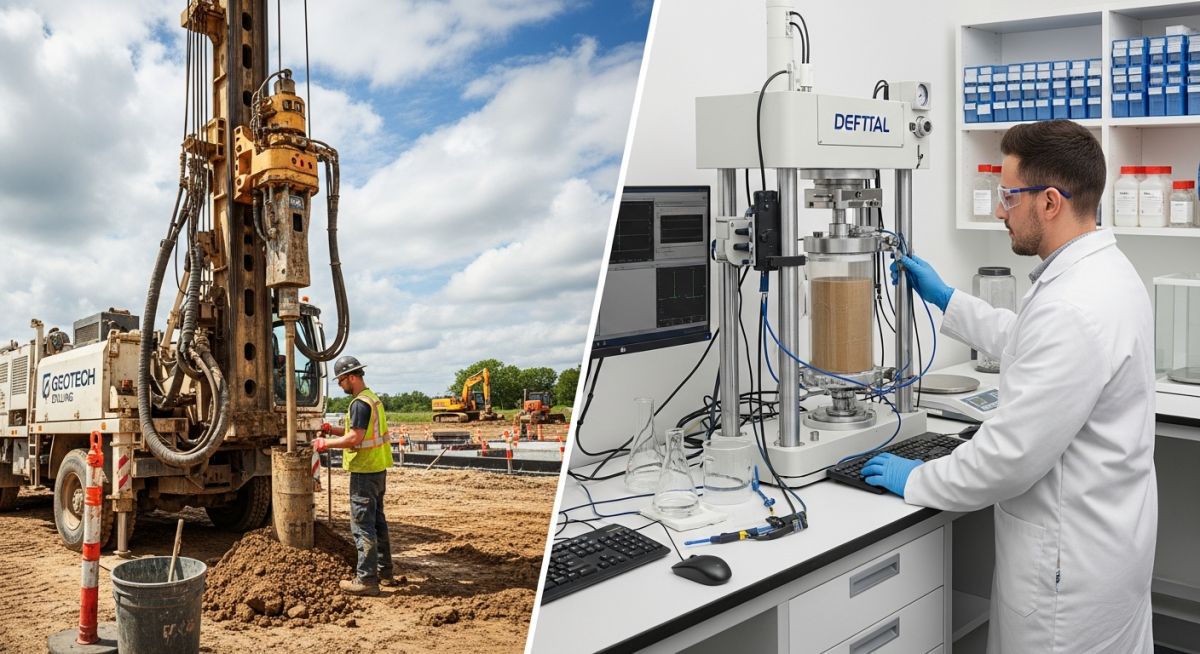
Geotechnical Investigations: Mastering Field and Laboratory Soil Analysis
In my two decades of experience managing large-scale industrial projects, I have learned that the foundation of any successful structure is not just concrete and steel, but the soil beneath it. Geotechnical investigations are the primary defense against structural failure, settlement, and long-term operational downtime. Whether you are designing a heavy-duty pipe rack or a massive storage tank, understanding the soil profile is non-negotiable.
This guide bridges the gap between raw field data and actionable engineering design. We will explore the nuances of the Standard Penetration Test (SPT), the precision of the Cone Penetration Test (CPT), and the critical laboratory tests that define soil behavior. By mastering these methodologies, you ensure that your foundation design meets the rigorous requirements of ASTM and ASCE standards.
Key Takeaways for Engineers:
- Correlate field N-values with soil density and shear strength.
- Identify soil plasticity through Atterberg limits for expansion risk.
- Utilize triaxial testing to model complex stress-strain behavior.
- Ensure site-specific data aligns with local building code requirements.
Technical Deep-Dive: Geotechnical Investigations and Field Testing
Geotechnical Investigations: Comprehensive subsurface characterization involving in-situ testing and laboratory analysis to establish soil bearing capacity, settlement potential, and slope stability parameters.
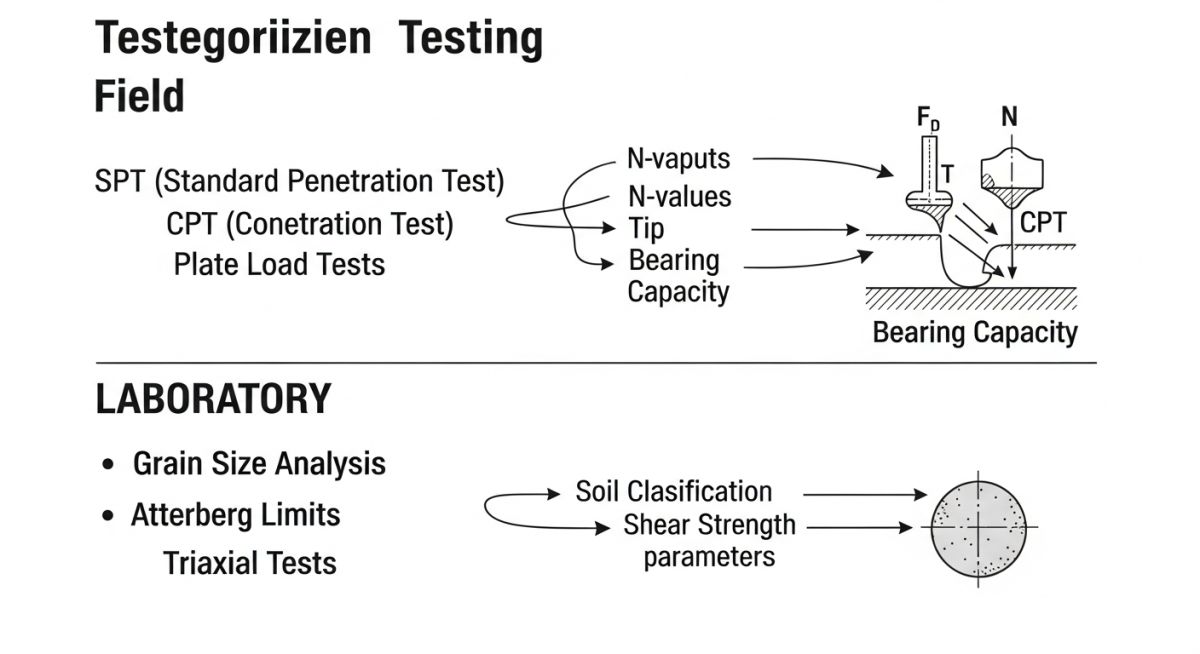
The reliability of a foundation design hinges on the accuracy of the soil parameters derived from field and laboratory testing. In my practice, I prioritize the Standard Penetration Test (SPT) as the workhorse of site investigation. Governed by ASTM D1586, the SPT provides the N-value, which is the number of blows required to drive a split-spoon sampler 300mm into the soil. This value is a direct indicator of relative density in granular soils and consistency in cohesive soils.
Advanced In-Situ Testing: CPT and Plate Load
While SPT is standard, the Cone Penetration Test (CPT) per ASTM D5778 offers continuous data collection. By pushing a cone-tipped probe into the ground, we measure tip resistance and sleeve friction simultaneously. This allows for a precise stratigraphic profile that SPT often misses due to its discrete sampling nature.
Field Warning: Data Normalization
Always normalize your SPT N-values for overburden pressure (N1,60). Failure to correct for effective stress in deep foundations leads to an overestimation of soil strength, which can result in catastrophic differential settlement during heavy loading cycles.
For shallow foundations, the Plate Load Test is the gold standard for determining the modulus of subgrade reaction. By applying a static load to a steel plate and measuring the settlement, we simulate the actual foundation behavior. This test is essential when dealing with non-homogeneous soil layers where empirical correlations might fail to capture the local stiffness variations.
Laboratory Analysis Protocols
Field data must be validated through laboratory testing. Grain size analysis, conducted via sieve and hydrometer methods, classifies the soil according to the Unified Soil Classification System (USCS). This classification dictates the drainage characteristics and potential for liquefaction.
Furthermore, Atterberg limits (Liquid Limit, Plastic Limit, and Plasticity Index) are critical for cohesive soils. These limits define the moisture content ranges where the soil transitions from solid to plastic to liquid states. High plasticity indices often signal expansive soils, which require specialized foundation treatments like soil stabilization or deep piers to mitigate heave.
Finally, the Triaxial Test provides the shear strength parameters (cohesion and angle of internal friction) under controlled drainage conditions. This is the most complex test but provides the most accurate data for modeling the stress-strain response of the soil under structural loads.
Geotechnical Testing Trade-offs: Balancing the cost of comprehensive site investigation against the long-term risk of structural failure and foundation remediation expenses.
Advantages
- Reduces uncertainty in bearing capacity calculations.
- Prevents over-designing foundations, saving material costs.
- Identifies hidden hazards like liquefaction or soft pockets.
- Provides empirical data for complex finite element modeling.
- Ensures compliance with local building codes and insurance.
Disadvantages
- High initial mobilization costs for heavy drilling rigs.
- Laboratory testing turnaround times can delay project schedules.
- In-situ tests are sensitive to operator skill and technique.
- Data interpretation requires specialized geotechnical expertise.
- Limited spatial coverage in large, heterogeneous sites.
Geotechnical Investigation Utility: Applying subsurface data to solve specific structural challenges across diverse industrial and civil engineering sectors.
Heavy Industrial Storage Tank Foundations
Large-diameter storage tanks exert massive vertical pressures on the subgrade. Geotechnical investigations are used to determine the consolidation settlement and the potential for differential settlement, which could compromise the tank shell integrity and lead to catastrophic leaks.
High-Rise Building Foundation Design
For skyscrapers, the investigation focuses on deep foundation systems like bored piles or caissons. We use CPT data to determine the skin friction and end-bearing capacity of deep soil strata, ensuring the structure remains stable against wind-induced overturning moments.
Pipeline Route Geotechnical Stability
Pipelines crossing varying terrains require soil analysis to assess slope stability and potential for soil liquefaction during seismic events. This data informs the selection of trenching methods and the design of thrust blocks at bends to prevent pipe movement.
Infrastructure Embankment Stabilization
Road and rail embankments rely on soil shear strength to prevent slope failure. By performing triaxial tests on compacted fill samples, engineers can predict the long-term stability of the embankment under dynamic traffic loads and environmental moisture fluctuations.
In my two decades of field experience, I have found that the reliability of foundation design hinges entirely on the accurate correlation of field test results to soil mechanical properties. Engineers must recognize that raw data from ASTM D1586 (Standard Penetration Test) or ASTM D5778 (Cone Penetration Test) are merely indices. These values require rigorous correction factors—such as overburden pressure, hammer efficiency, and borehole diameter—before they can be utilized in settlement or bearing capacity calculations.
The following table summarizes the typical correlation ranges I utilize when transitioning from field blow counts or tip resistance to design-ready parameters like undrained shear strength or relative density. Always remember that these are empirical relationships; they should never replace site-specific laboratory calibration or local experience in complex soil profiles. When dealing with sensitive clays or highly overconsolidated deposits, the scatter in these correlations increases significantly, necessitating a more conservative approach to the factor of safety.
| Test Method | Primary Parameter | Derived Property | Typical Correlation |
|---|---|---|---|
| SPT (N-value) | Blow Count | Relative Density (Dr) | Terzaghi & Peck (1967) |
| CPT (qc) | Tip Resistance | Undrained Shear Strength (Su) | Nk Factor Method |
| Plate Load | Load-Settlement | Modulus of Subgrade Reaction (k) | Terzaghi (1955) |
To maintain high-quality geotechnical investigations, I categorize every project component by its governing standard and physical objective. This matrix serves as my primary reference for ensuring that field teams and laboratory technicians are aligned on the specific testing requirements for a given soil classification. By mapping these entities, we reduce the risk of data gaps that often lead to foundation failure or excessive settlement during the construction phase.
The matrix below highlights the intersection between testing methodologies and the physical soil parameters they aim to quantify. Note that for complex projects, I often mandate a combination of both field and laboratory testing to validate the empirical correlations used in the design phase. This dual-verification approach is the hallmark of a robust geotechnical investigation program, ensuring that the final design parameters are grounded in both site-specific reality and standardized engineering practice.
| Entity | Standard | Application |
|---|---|---|
| Atterberg Limits | ASTM D4318 | Plasticity/Classification |
| Triaxial Test | ASTM D4767 | Shear Strength |
| Grain Size | ASTM D422 | Soil Gradation |
In my experience, the most common cause of project delays is incomplete site investigation data. Before finalizing any foundation design, I require my team to complete this verification checklist to ensure all critical soil parameters have been captured and validated against the project requirements.
-
Borehole Spacing: Verify that borehole density meets ASCE guidelines for the specific structure footprint. -
Groundwater Monitoring: Confirm that piezometers were installed and monitored for at least 24 hours to establish the static water table. -
Sample Preservation: Ensure all undisturbed samples were sealed and transported according to ASTM standards to prevent moisture loss. -
Calibration Logs: Check that all field equipment (SPT hammers, CPT cones) has valid calibration certificates within the last 12 months. -
Lab Correlation: Cross-reference field N-values with laboratory grain size analysis to confirm soil classification consistency.
This checklist is not merely a bureaucratic requirement; it is a safety mechanism. By systematically verifying these points, we mitigate the risk of encountering unforeseen soil conditions during excavation, which can lead to catastrophic foundation failure or massive cost overruns. Always document the verification process in the final geotechnical report to provide a clear audit trail for the design team and regulatory authorities.
The Problem: Unexpected Settlement in Soft Clay
During a high-rise foundation project, initial SPT data suggested competent soil, but the structure experienced differential settlement exceeding 50mm within the first month of construction.
- SPT N-values were artificially inflated by gravel lenses.
- Lack of CPT testing failed to identify thin, soft clay layers.
- Laboratory consolidation tests were not performed on the clay seams.
- Groundwater pressure was underestimated during the design phase.
The Outcome: Remediation and Design Correction
By implementing a secondary investigation program, we successfully stabilized the foundation and prevented further structural damage.
- Performed deep CPT soundings to map the continuous soft clay layer.
- Installed vertical drains to accelerate consolidation and increase shear strength.
- Redesigned the foundation using a raft system to distribute loads more evenly.
- Achieved a 40% reduction in differential settlement post-remediation.
My recommendation for similar sites is to never rely on a single testing method. If the soil profile shows any signs of heterogeneity, always supplement standard penetration tests with cone penetration testing and laboratory consolidation analysis to ensure the design accounts for the weakest soil layers, not just the average conditions.
Why is SPT N-value correction necessary?
- Energy correction (N60) accounts for the variation in hammer drop efficiency.
- Overburden correction (Cn) is vital for normalizing values in granular soils.
- Failure to correct these values often leads to an overestimation of soil bearing capacity.
When should I choose CPT over SPT?
- CPT provides near-continuous data, whereas SPT is discrete and intermittent.
- CPT is superior for identifying liquefaction potential in seismic zones.
- SPT remains necessary when physical soil samples are required for laboratory classification.
What is the role of Atterberg Limits?
- Liquid Limit and Plastic Limit define the plasticity index of the soil.
- High plasticity indicates a high potential for swelling and shrinkage.
- These limits are essential for determining the suitability of soil for subgrade construction.
How does the Triaxial Test differ from Direct Shear?
- Direct shear forces failure along a predetermined plane, which may not be the weakest path.
- Triaxial tests allow for the measurement of pore water pressure during shearing.
- Triaxial testing is the gold standard for complex foundation stability analysis.
Why perform a Plate Load Test?
- It is particularly useful for verifying the modulus of subgrade reaction.
- The test is limited by the size of the plate and the depth of influence.
- It serves as an excellent field verification tool for compacted fill quality.
What is the importance of Grain Size Analysis?
- It is essential for classifying soils according to the Unified Soil Classification System.
- The analysis helps predict the potential for frost heave and piping in hydraulic structures.
- It provides the basis for selecting appropriate filter materials in earth dam design.
Complete Course on
Piping Engineering
Check Now
Key Features
- 125+ Hours Content
- 500+ Recorded Lectures
- 20+ Years Exp.
- Lifetime Access
Coverage
- Codes & Standards
- Layouts & Design
- Material Eng.
- Stress Analysis

📚 Recommended Resources: Geotechnical Investigations
Read these Guides
- 📄 Essential Survey Instruments Used in Geotechnical Investigations for Site Analysis
- 📄 Preparing a Comprehensive RFP for Geotechnical Investigations: Expert Guide
- 📄 Optimizing Borehole Quantity and Location for Geotechnical Site Investigations
- 📄 How to Interpret SPT N-Values for Reliable Geotechnical Foundation Design