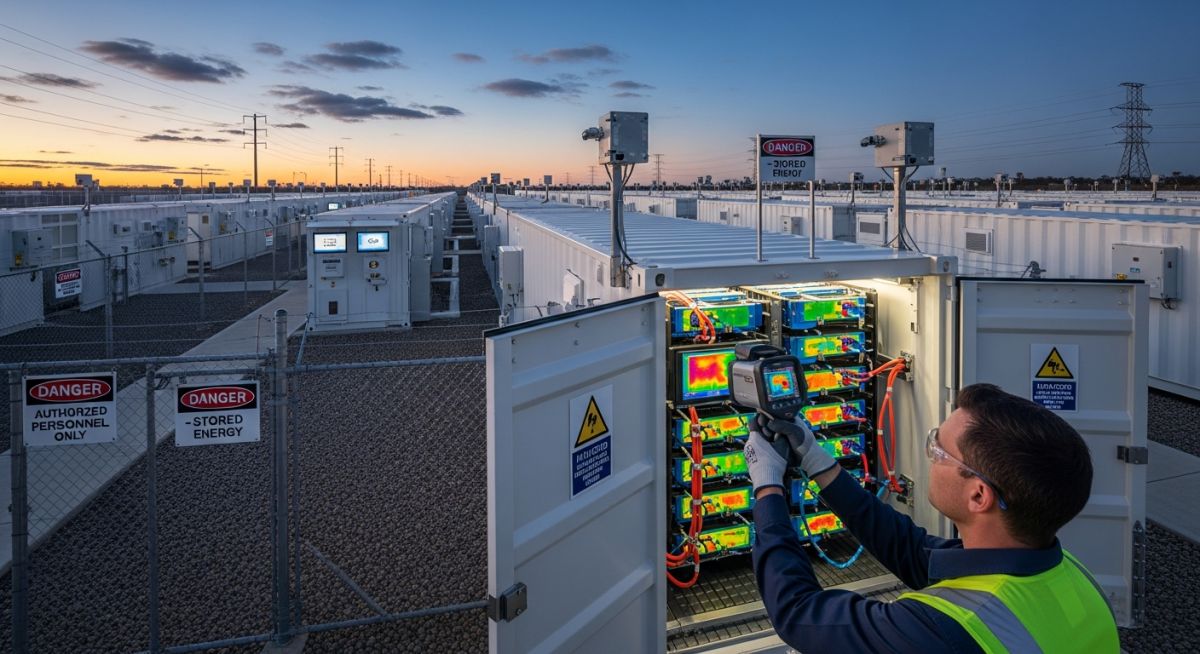
Mastering BESS Plant O&M for Grid Reliability and Safety
In my two decades of experience managing complex industrial assets, I have observed that the transition to renewable energy hinges entirely on the reliability of our storage infrastructure. A BESS plant is not a “set and forget” asset; it is a dynamic, chemically active environment that demands rigorous oversight.
Effective O&M of BESS plants requires a shift from traditional reactive maintenance to a data-driven predictive model. By leveraging real-time telemetry and thermal imaging, we can identify cell imbalances or cooling system degradation long before they trigger a catastrophic thermal runaway event.
Key Takeaways for BESS Operators:
- Prioritize thermal management system (TMS) health to prevent premature cell degradation.
- Implement continuous battery health monitoring (BHM) to track State of Health (SoH) and State of Charge (SoC) drift.
- Adhere strictly to NFPA 855 standards for fire protection and safety.
- Utilize predictive analytics to schedule maintenance based on actual cycle throughput rather than calendar intervals.
Technical Deep-Dive: BESS Plant O&M Strategies
BESS Plant O&M: The integration of electrical, mechanical, and software-based diagnostic procedures to maintain optimal performance and safety within utility-scale energy storage environments.
Managing a BESS plant requires a deep understanding of the electrochemical behavior of lithium-ion cells under varying load profiles. In my experience, the most critical aspect of O&M is the maintenance of the Battery Management System (BMS) and the associated Thermal Management System (TMS). If the BMS fails to accurately report cell voltage or temperature, the entire safety architecture is compromised.
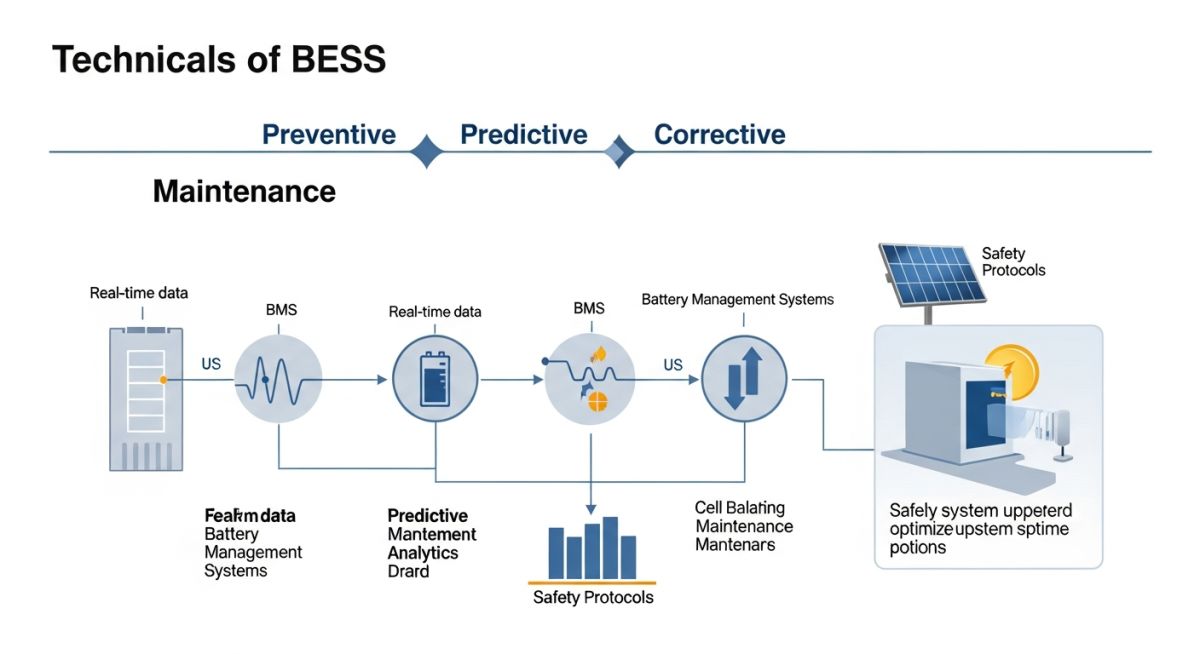
Preventive Maintenance Protocols
Preventive maintenance (PM) is the backbone of asset longevity. We must perform quarterly inspections of all electrical terminations, as thermal cycling causes expansion and contraction that can loosen connections, leading to high-resistance joints and potential arcing. According to IEEE 1635, torque verification is non-negotiable.
Field Warning: Thermal Runaway Risks
Never ignore minor temperature deviations in a single rack. A temperature delta of more than 5 degrees Celsius compared to adjacent modules often indicates an internal short or a failing cooling loop. Immediate isolation and diagnostic testing are required to prevent a cascading failure.
Predictive Maintenance and Health Monitoring
Predictive maintenance utilizes high-frequency data logging to monitor the State of Health (SoH). We calculate the internal resistance of the battery strings by analyzing the voltage drop during high-current discharge events. If the internal resistance exceeds the manufacturer’s baseline by more than 20%, the module is nearing its end-of-life.
The calculation for capacity fade is typically expressed as:
Capacity_Fade = (Initial_Capacity – Current_Capacity) / Initial_Capacity * 100
By tracking this metric against cycle count, we can accurately forecast the remaining useful life (RUL) of the BESS plant. This allows for proactive procurement of replacement modules, ensuring that the plant maintains its contracted capacity without unexpected downtime.
BESS Maintenance Trade-offs: A critical evaluation of the operational benefits versus the technical complexities inherent in maintaining high-density energy storage systems.
Operational Advantages
- Extended asset life through precise thermal control.
- Reduced insurance premiums via documented safety compliance.
- Optimized round-trip efficiency (RTE) through cell balancing.
- Minimized unplanned downtime via predictive failure alerts.
- Enhanced grid service revenue through consistent availability.
Operational Disadvantages
- High initial cost for specialized diagnostic equipment.
- Requirement for highly trained, certified technical personnel.
- Complexity of managing proprietary BMS software updates.
- Stringent environmental disposal regulations for modules.
- Logistical challenges in sourcing compatible replacement cells.
BESS Operational Deployment: Strategic implementation of maintenance protocols across diverse industrial and utility-scale energy storage applications.
Utility-Scale Frequency Regulation
In frequency regulation, the BESS undergoes thousands of micro-cycles daily. Maintenance here focuses on power electronics and inverter health, ensuring that the rapid response times required by the grid operator are maintained without overheating the power conversion system.
Renewable Energy Firming
For solar and wind integration, the BESS must manage long-duration discharge cycles. O&M teams prioritize the health of the battery modules and the state-of-charge management algorithms to ensure the system can bridge the gap during peak demand periods when renewable generation drops.
Industrial Peak Shaving
Industrial facilities use BESS to reduce demand charges by discharging during peak hours. Maintenance in this sector is highly focused on the integration between the facility’s energy management system and the BESS controller to ensure seamless load shifting and cost optimization.
Effective operation of a Battery Energy Storage (BESS) system requires strict adherence to defined operational envelopes. These parameters are not merely suggestions; they are critical safety and longevity boundaries established by the manufacturer and validated through IEEE 2030.2.1 standards. Monitoring these values in real-time allows operators to identify degradation trends before they manifest as catastrophic failures or thermal runaway events.
The following table outlines the typical operational thresholds for Lithium-Ion based storage assets. Operators must ensure that their SCADA systems are configured with high-fidelity alarms that trigger automatic derating or emergency shutdown sequences when these limits are approached. Maintaining these variables within the specified ranges is the primary defense against premature cell aging and electrolyte decomposition.
| Parameter | Typical Range | Critical Action |
|---|---|---|
| Cell Temperature | 15°C to 35°C | Emergency Cooling/Shutdown > 55°C |
| State of Charge (SoC) | 10% to 90% | Hard Cutoff at 5% and 98% |
| Voltage Imbalance | < 30 mV | Initiate Cell Balancing Routine |
| C-Rate (Discharge) | 0.5C to 1.0C | Limit Power Output to Prevent Heating |
By strictly enforcing these thresholds, site managers can extend the cycle life of the battery modules by up to 20%. It is recommended to perform a monthly audit of these logs to correlate environmental conditions with performance degradation, ensuring the BESS plant remains within its design life expectancy.
The complexity of modern BESS infrastructure necessitates a clear understanding of the interconnected technical entities that govern system performance. This matrix maps the primary hardware components, their associated monitoring protocols, and the relevant international standards that dictate their maintenance requirements. Understanding these relationships is vital for any O&M team tasked with maintaining grid-scale storage assets.
Each entity listed below plays a specific role in the overall health of the system. From the Battery Management System (BMS) that tracks individual cell voltages to the Power Conversion System (PCS) that manages grid synchronization, these components must be audited regularly. Failure to maintain the integrity of these interfaces often leads to communication latency, which can result in improper charging cycles and reduced system efficiency.
| Entity | Function | Standard |
|---|---|---|
| BMS | Cell Balancing & Safety | UL 1973 |
| PCS | DC to AC Conversion | IEEE 1547 |
| HVAC | Thermal Regulation | ASHRAE 90.1 |
| FSS | Fire Suppression | NFPA 855 |
This matrix serves as a foundational reference for site technicians. By aligning maintenance activities with these specific standards, operators can ensure compliance with local fire codes and grid interconnection agreements, ultimately reducing the risk of unplanned downtime and liability.
BESS Plant Operational Readiness: A comprehensive site verification process is the cornerstone of reliable BESS operation. This checklist ensures that all critical systems—from thermal management to electrical protection—are functioning within their design parameters. Regular site audits are mandatory to maintain compliance with NFPA 855 and to ensure the safety of personnel and the surrounding environment.
-
Thermal Management: Verify HVAC setpoints and check for refrigerant leaks or blocked airflow paths in battery racks. -
Electrical Integrity: Inspect all DC busbar connections for signs of oxidation or thermal discoloration using infrared thermography. -
Fire Suppression: Confirm that the fire suppression system is armed and that all sensors are calibrated according to the manufacturer’s schedule. -
Communication Links: Test the heartbeat signal between the BMS and the central SCADA system to ensure zero latency in alarm reporting. -
Physical Security: Inspect perimeter fencing, lighting, and CCTV coverage to prevent unauthorized access to high-voltage equipment.
Each item on this checklist must be documented in the site logbook. If any discrepancy is found, the O&M team must initiate a root cause analysis (RCA) immediately. Consistent application of these verification steps prevents the accumulation of minor faults that could lead to significant operational failures over time.
The Challenge: Unexpected Cell Overheating
A 50MW BESS facility experienced a recurring thermal alarm in a specific battery rack during high-discharge cycles, threatening a full site shutdown.
- Inadequate airflow distribution due to debris accumulation in the rack base.
- Faulty temperature sensor providing intermittent, inaccurate readings to the BMS.
- Degraded thermal interface material between the cell and the cooling plate.
- Improper load balancing across parallel strings causing localized current spikes.
The Outcome: Restored Operational Stability
By implementing a targeted maintenance intervention, the site achieved full operational stability and eliminated the risk of thermal runaway.
- Reduced average rack temperature by 8 degrees Celsius through optimized airflow.
- Improved BMS accuracy by replacing faulty sensors and recalibrating the monitoring software.
- Increased system availability by 15% through proactive load balancing adjustments.
- Established a new predictive maintenance schedule based on real-time thermal data.
Recommendation: I strongly advise all operators to integrate infrared thermography into their quarterly inspection routines. This simple, non-invasive technique provides early warning signs of connection degradation and thermal hotspots that standard digital monitoring might miss until it is too late.
How often should I perform a full capacity test on my BESS?
- Validating the degradation rate against the manufacturer’s warranty curves.
- Ensuring the system can still meet the contracted grid service requirements.
- Identifying weak cells that may not be apparent during standard operation.
What is the role of the BMS in preventing thermal runaway?
- Monitoring individual cell voltages and temperatures in real-time.
- Executing automatic disconnects if parameters exceed safe limits.
- Managing cell balancing to prevent overcharging of individual cells.
- Communicating with the PCS to derate power output during high-heat events.
Why is infrared thermography critical for BESS maintenance?
- It identifies loose busbar connections that are invisible to the naked eye.
- It provides a non-contact method to inspect energized equipment safely.
- It helps in identifying uneven thermal distribution across battery racks.
- It serves as a baseline for predictive maintenance trends over time.
How do environmental factors impact BESS performance?
- High ambient temperatures accelerate electrolyte decomposition and capacity loss.
- Extreme cold increases internal resistance, reducing power delivery capability.
- Humidity can lead to corrosion of electrical contacts and control circuitry.
- Dust accumulation on cooling fins reduces heat dissipation efficiency.
What are the primary safety requirements for BESS sites?
- Installation of automated fire suppression and gas detection systems.
- Clear emergency egress paths and signage for site personnel.
- Regular training for local emergency responders on BESS-specific hazards.
- Strict adherence to lockout/tagout (LOTO) procedures during maintenance.
How can I optimize BESS performance over time?
- Implementing predictive analytics to forecast cell degradation.
- Adjusting SoC operating windows to minimize stress on the cells.
- Optimizing HVAC setpoints based on seasonal ambient temperature changes.
- Performing regular firmware updates to improve BMS control algorithms.
Complete Course on
Piping Engineering
Check Now
Key Features
- 125+ Hours Content
- 500+ Recorded Lectures
- 20+ Years Exp.
- Lifetime Access
Coverage
- Codes & Standards
- Layouts & Design
- Material Eng.
- Stress Analysis

📚 Recommended Resources: BESS Plant
Read these Guides
- 📄 Engineering Utility-Scale BESS Plant Design: A Comprehensive Technical Guide
- 📄 Major Components of a BESS Plant: A Technical Engineering Overview
- 📄 BESS Integration with Wind Power Plants: Engineering Design and Optimization
- 📄 BESS Integration with Solar Power Plants: Design and Operational Strategies