
Additionality Explained Under RFNBO Rules: A Technical Engineering Perspective
In my two decades of experience navigating complex energy infrastructure projects, I have rarely encountered a regulatory hurdle as transformative as the Additionality requirements under the EU Renewable Energy Directive (RED II) and the subsequent Delegated Acts for RFNBOs (Renewable Fuels of Non-Biological Origin). As engineers, we are accustomed to designing for efficiency and reliability, but now we must design for temporal and geographical correlation.
The core challenge lies in proving that your electrolyzer plant is not merely drawing from an already saturated grid, but is instead driving the deployment of new wind or solar assets. This article dissects the technical rigor required to meet these standards, moving beyond policy rhetoric into the actual site-level constraints and electrical balancing requirements that define modern hydrogen facility design.
Key Takeaways for Project Success
- Understand the strict temporal correlation requirements (hourly matching) for renewable energy input.
- Master the geographical correlation criteria to ensure energy source proximity to the electrolysis site.
- Learn the specific documentation pathways for proving new capacity installation.
- Identify the impact of grid congestion on your hydrogen production duty cycle.
Complete Course on
Piping Engineering
Check Now
Key Features
- 125+ Hours Content
- 500+ Recorded Lectures
- 20+ Years Exp.
- Lifetime Access
Coverage
- Codes & Standards
- Layouts & Design
- Material Eng.
- Stress Analysis
Additionality Explained Under RFNBO Rules: Technical Design Parameters
RFNBO Additionality Compliance: The technical methodology for validating that renewable electricity inputs for hydrogen production originate from new, unsubsidized generation assets that would not have been commissioned without the project’s financial incentive.
From an engineering standpoint, the Additionality mandate forces a fundamental shift in how we size and integrate renewable power purchase agreements (PPAs). We are no longer designing for simple annual energy yield; we are designing for hourly synchronization between the electrolyzer load and the renewable generation profile. This requires a sophisticated energy management system (EMS) capable of real-time grid monitoring and load shedding.
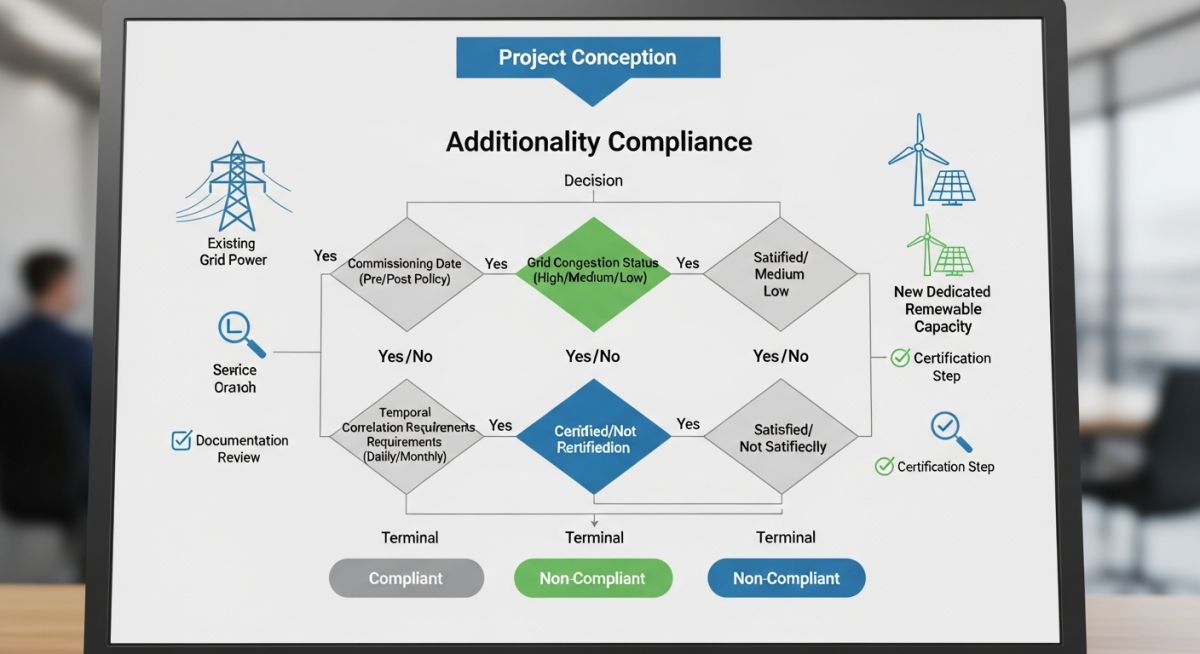
Temporal Correlation and Grid Balancing
The Delegated Act mandates that renewable electricity must be produced within the same hour as the hydrogen production. This creates a significant “duck curve” challenge for the plant operator. If the wind isn’t blowing or the sun isn’t shining, the electrolyzer must either ramp down or source power from a certified renewable source that meets the additionality criteria.
To calculate the required capacity, we use the following logic: P_electrolyzer_max <= P_renewable_new_installed * Capacity_Factor_effective. However, the effective capacity factor is heavily penalized by the hourly matching requirement. In my experience, this often necessitates the inclusion of behind-the-meter battery energy storage systems (BESS) to buffer the intermittency and maintain the required hourly correlation without triggering a shutdown of the electrolysis stack.
Field Warning: Grid Congestion Risks
Even if you have a PPA with a new wind farm, the grid operator may issue a curtailment order due to local congestion. Under RFNBO rules, electricity sourced during periods of grid congestion or when the renewable asset is curtailed does not count toward your additionality quota. Your design must account for these “lost” hours in your annual hydrogen production forecast, or you risk failing the carbon intensity threshold of 3.38 kg CO2e per kg H2.
Furthermore, the geographical correlation requirement stipulates that the renewable asset must be located in the same bidding zone as the electrolyzer. If the bidding zone is interconnected, you may source from adjacent zones, but only if the price differential indicates a lack of congestion. This adds a layer of complexity to site selection, as we must now perform a nodal price analysis before finalizing the project location.
Additionality Regulatory Impact: The dual-sided effect of strict renewable integration rules on project bankability and operational complexity within the green hydrogen sector.
Advantages
- Market Integrity: Ensures that green hydrogen production genuinely contributes to the decarbonization of the energy grid.
- Long-term Asset Value: Drives the development of high-capacity factor renewable assets, improving the overall grid resilience.
- Regulatory Certainty: Provides a clear, standardized framework for project developers to qualify for subsidies and green premiums.
- Carbon Intensity Compliance: Guarantees that the final product meets the stringent EU thresholds for “renewable” status.
Disadvantages
- Increased CAPEX: Requires significant investment in BESS and advanced control systems to manage hourly correlation.
- Operational Complexity: Demands sophisticated software for real-time tracking of renewable energy certificates and grid status.
- Curtailment Risk: High sensitivity to grid congestion, which can lead to unexpected downtime and revenue loss.
- Site Selection Constraints: Limits the viable locations for electrolysis plants to areas with specific grid capacity and renewable potential.
Additionality Implementation Scenarios: The practical deployment of RFNBO-compliant hydrogen systems across diverse industrial and energy-intensive sectors.
Green Steel Manufacturing
Steel plants are integrating large-scale electrolysis units to replace coking coal with green hydrogen for direct reduced iron (DRI) processes. By adhering to additionality rules, these facilities ensure that their hydrogen input is truly carbon-neutral, allowing them to market their output as “green steel” under strict EU taxonomy regulations.
Sustainable Aviation Fuel (SAF) Production
Refineries producing synthetic kerosene require massive quantities of green hydrogen to combine with captured carbon. The additionality framework forces these refineries to co-locate with new offshore wind farms, ensuring the hydrogen feedstock meets the stringent lifecycle emission requirements for aviation fuels.
Chemical Feedstock Decarbonization
Ammonia production facilities are transitioning to green hydrogen to reduce their reliance on natural gas-based steam methane reforming. Implementing additionality-compliant renewable energy sources allows these chemical giants to significantly lower their Scope 1 and Scope 2 emissions while maintaining continuous production cycles through smart grid integration.
To ensure compliance with the Delegated Act on Renewable Fuels of Non-Biological Origin (RFNBO), project developers must meticulously map their electricity procurement strategy against specific temporal and geographical correlation requirements. The following table outlines the critical thresholds for renewable energy sources, distinguishing between direct line connections and grid-based power purchase agreements (PPAs).
Understanding these parameters is vital for calculating the carbon intensity of your hydrogen output. Failure to align with these specific criteria results in the disqualification of the hydrogen as “green,” effectively nullifying the economic incentives associated with RFNBO compliance under the EU Renewable Energy Directive.
| Source Type | Temporal Correlation | Geographical Constraint | Additionality Status |
|---|---|---|---|
| Direct Line | Real-time (Hourly) | Same Site | Deemed Additional |
| Grid PPA (New) | Hourly (2030+) | Bidding Zone | Verified Additionality |
| Grid PPA (Existing) | Monthly/Hourly | Bidding Zone | Non-Additional |
The data above highlights that while direct line connections offer the most straightforward path to compliance, grid-based procurement requires rigorous hourly matching to satisfy the evolving regulatory landscape. Developers should prioritize projects that can demonstrate clear, verifiable additionality through new capacity installations.
This matrix serves as a technical reference for engineers and project managers navigating the complex regulatory framework of RFNBO production. It maps the primary entities involved in the certification process, their associated acronyms, and the governing standards that dictate the operational requirements for green hydrogen facilities.
By standardizing these definitions, we ensure that all stakeholders—from procurement teams to environmental auditors—are aligned on the technical requirements for proving additionality. This alignment is essential for maintaining the integrity of the hydrogen supply chain and ensuring that all production data is audit-ready for ISO 14064 or similar carbon accounting standards.
| Entity/Parameter | Acronym | Regulatory Reference |
|---|---|---|
| Renewable Fuel of Non-Biological Origin | RFNBO | EU RED II/III |
| Power Purchase Agreement | PPA | Delegated Act 2023 |
| Guarantees of Origin | GO | Directive 2018/2001 |
Each entity listed plays a specific role in the lifecycle of a green hydrogen project. The interaction between these entities, particularly the link between GOs and PPA contracts, forms the backbone of the additionality proof required by regulators to prevent the cannibalization of existing renewable energy resources.
Verifying additionality is a multi-stage process that requires rigorous documentation of both the energy source and the temporal alignment of production. As an engineer, I have found that maintaining a centralized compliance ledger from the project inception phase is the most effective way to avoid audit failures during the operational life of the plant.
Site Verification Checkpoints
-
☐
Confirm the renewable installation was commissioned no more than 36 months prior to the electrolyzer. -
☐
Validate that the renewable installation is not receiving operational support (e.g., feed-in tariffs). -
☐
Ensure the PPA contract explicitly identifies the specific renewable asset providing the power. -
☐
Verify that the bidding zone of the renewable asset matches the electrolyzer location. -
☐
Implement hourly metering systems to satisfy the temporal correlation requirements for grid-connected assets.
Beyond these technical checkpoints, it is vital to maintain a clear audit trail of all energy transactions. This includes the retirement of Guarantees of Origin (GOs) specifically for the hydrogen production process. If your project relies on grid power, you must demonstrate that the renewable energy was not already claimed by another consumer, which is a common pitfall in complex PPA structures. Always consult with legal and regulatory experts to ensure your specific jurisdiction’s interpretation of the EU Delegated Act is fully reflected in your project design documents.
The Challenge: Retroactive PPA Qualification
A mid-sized hydrogen facility attempted to qualify existing wind farm output as “additional” by signing a new PPA, which failed the regulatory audit.
- The wind farm was commissioned five years prior to the electrolyzer.
- The facility lacked hourly metering data for the initial production phase.
- The PPA did not include a “new capacity” clause required by the local regulator.
- The energy source was already tied to a separate corporate sustainability claim.
The Outcome: Successful Compliance Pivot
The project team successfully restructured the energy procurement strategy to meet RFNBO standards.
- Repowered the existing wind farm to qualify as “new capacity.”
- Installed high-precision smart meters for real-time hourly correlation.
- Secured a dedicated PPA that ring-fenced the renewable output.
- Achieved full certification within 18 months of the corrective action.
My recommendation for similar projects is to avoid the “existing asset” trap entirely. If you are planning a new hydrogen facility, integrate the renewable energy procurement strategy into the initial FEED (Front-End Engineering Design) phase. Relying on existing assets often leads to significant regulatory friction and potential loss of green hydrogen subsidies.
Frequently Asked Engineering Questions
What defines “new” capacity under RFNBO rules?
- Repowering existing assets can qualify if the investment significantly increases capacity.
- The 36-month window is a strict regulatory threshold.
- Projects must provide commissioning certificates as proof of age.
How does temporal correlation work for grid-connected projects?
- Hourly matching ensures that hydrogen is produced only when renewable energy is actually available.
- This prevents the use of “dirty” grid power during peak demand periods.
- Advanced energy management systems are required to track these intervals.
Can I use existing grid power for green hydrogen?
- Grid power is only acceptable if it is fully covered by PPAs with new renewable assets.
- The energy must be sourced from the same bidding zone.
- Standard grid mix certificates are insufficient for RFNBO compliance.
What is the role of the Bidding Zone?
- This prevents “paper-based” green energy claims across long distances.
- It ensures that the renewable energy actually impacts the local grid.
- Cross-border PPAs are only allowed under very specific, limited conditions.
How do I prove additionality to auditors?
- Maintain a digital ledger of all energy transactions.
- Ensure all Guarantees of Origin are retired for the specific hydrogen batch.
- Engage third-party certification bodies early in the project lifecycle.
Are there exemptions for existing renewable plants?
- Check local national implementation of the EU RED II/III directives.
- Repowering is the most common path for using older sites.
- Always assume strict compliance is required unless a formal exemption is granted.
