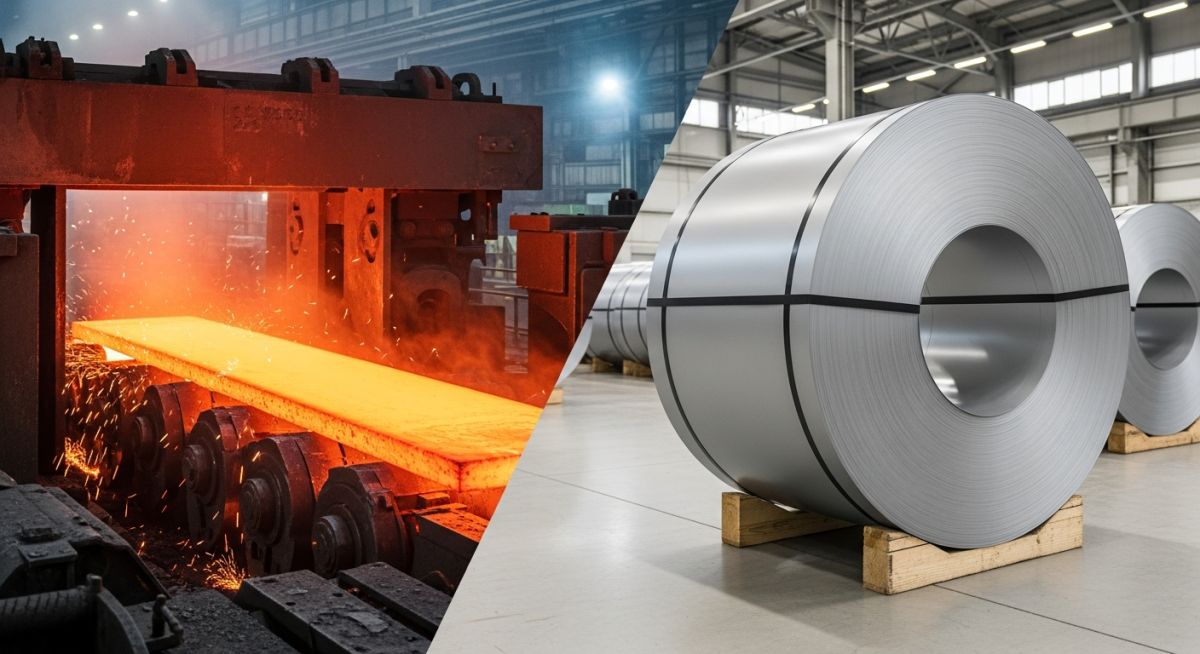
Hot Rolled vs Cold Rolled Steel: What Are the Differences?
In my 20 years of managing piping and structural steel projects, I have seen many engineers make costly mistakes by selecting the wrong steel processing type. The choice between hot rolled and cold rolled steel is not merely aesthetic; it dictates the yield strength, residual stress profile, weldability, and dimensional stability of your entire structure. When you are designing heavy-duty pipe racks, pressure vessel supports, or high-precision machinery frames, understanding how these metals behave under load is the difference between a successful installation and a catastrophic structural failure.
Many young designers assume that steel is just steel, but the thermal history of the material changes its molecular structure. Hot rolling and cold rolling are the two primary methods used to shape carbon steel, and each process imparts distinct physical characteristics. Let us break down the metallurgical differences, mechanical properties, and practical field applications so you can make an informed engineering decision on your next project.
Key Engineering Takeaways
- Processing Temperature: Hot rolling is performed above 1700 degrees Fahrenheit (927 degrees Celsius), while cold rolling is processed at room temperature.
- Dimensional Tolerances: Cold rolled steel offers tight tolerances (typically +/- 0.002 inches) compared to the looser tolerances of hot rolled steel.
- Yield Strength: Cold rolling increases yield strength by up to 20% through strain hardening, but introduces significant residual stresses.
- Surface Finish: Hot rolled steel features a rough, scaled surface, whereas cold rolled steel has a smooth, oily finish ideal for painting or plating.
Analyzing Hot Rolled vs Cold Rolled Steel Mechanical Properties
To understand the physical differences, we must look at the grain structure of the metal during manufacturing. Hot rolling takes place above the recrystallization temperature of steel, which is approximately 1700 degrees Fahrenheit (927 degrees Celsius). At this extreme temperature, the steel grains grow and reform dynamically as the metal passes through the reduction rollers. This prevents the steel from work hardening, keeping it highly ductile and easy to form into large structural shapes like I-beams, wide flanges, and heavy plates.
Conversely, cold rolled steel starts as hot rolled coil that has been allowed to cool to room temperature. The steel is then processed through cold reduction mills, where the thickness is reduced by up to 30% without any added heat. This cold working deforms the existing grain structure, elongating the grains in the direction of rolling and dramatically increasing the dislocation density within the crystal lattice.
In my experience, welding cold rolled steel requires extreme caution. The heat input from welding recrystallizes the strain-hardened grains, causing localized softening in the heat-affected zone (HAZ). This can lead to unexpected structural warping and a localized reduction in yield strength back to hot-rolled levels. Always perform a stress-relief heat treatment if dimensional stability is critical post-welding.
The Mathematics of Strain Hardening
The increase in strength during cold rolling is mathematically modeled using Hollomon’s Equation for flow stress. This relationship demonstrates how plastic deformation increases the load-bearing capacity of the material:
Where:
– K = Strength Coefficient of the material (MPa)
– n = Strain Hardening Exponent (dimensionless, typically 0.15 to 0.25 for low-carbon steel)
Because cold rolling forces the material to undergo plastic deformation at room temperature, the true strain value increases, which directly raises the true stress required for further deformation. This is why cold rolled steel exhibits a significantly higher yield strength than its hot rolled counterpart.
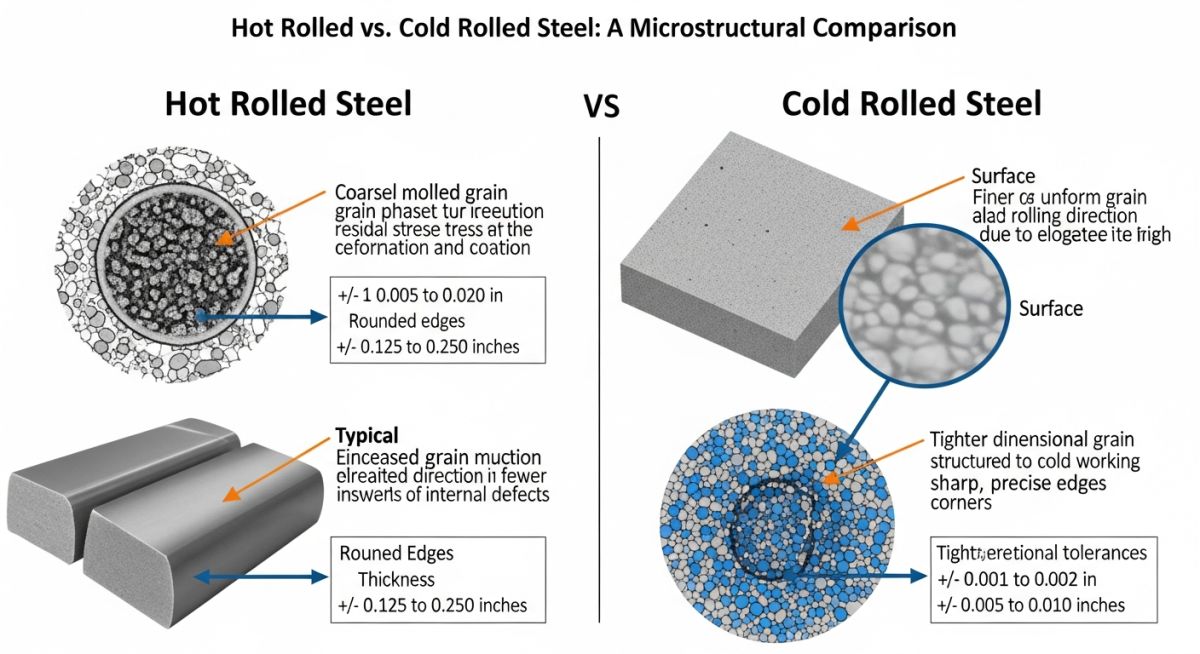
When specifying materials under ASME Boiler and Pressure Vessel Code (BPVC) or AISC Steel Construction Manual guidelines, you must account for these mechanical variations. Hot rolled steel is highly favored for structural members where ductility and fracture toughness are paramount, while cold rolled steel is specified for precision shafts, linkages, and thin-walled tubing where high yield strength and tight tolerances are non-negotiable.
The table below outlines the typical mechanical and physical properties of standard hot rolled carbon steel (such as ASTM A36) versus cold rolled carbon steel (such as ASTM A1008).
| Mechanical Property | Hot Rolled Steel (ASTM A36) | Cold Rolled Steel (ASTM A1008) | Engineering Significance |
|---|---|---|---|
| Yield Strength | 250 MPa (36,000 psi) | 310 – 410 MPa (45,000 – 60,000 psi) | Cold rolling increases yield limit by work hardening. |
| Tensile Strength | 400 – 550 MPa (58,000 – 80,000 psi) | 450 – 580 MPa (65,000 – 84,000 psi) | Ultimate load capacity is higher in cold worked steel. |
| Elongation at Break | 20% to 23% | 12% to 15% | Hot rolled steel is significantly more ductile. |
| Dimensional Tolerance | +/- 0.010 to 0.050 inches | +/- 0.001 to 0.003 inches | Cold rolled is required for precision machining. |
| Surface Finish | Rough, scaled, blue-gray oxide layer | Smooth, oily, reflective, scale-free | Cold rolled requires less surface prep for coating. |
This matrix maps the core technical entities, structural acronyms, and physical parameters to their respective standard references and typical industrial applications.
| Entity / Acronym | Physical Parameter | Standard Reference | Application Scope |
|---|---|---|---|
| HR (Hot Rolled) | High Ductility, Low Residual Stress | ASTM A36 / A1011 | Structural beams, railway tracks, heavy plates |
| CR (Cold Rolled) | High Yield Strength, Low Tolerance | ASTM A1008 / A108 | Automotive body panels, precision tubes, shafts |
| HAZ (Heat Affected Zone) | Microstructural Grain Growth | AWS D1.1 | Welded joints, structural steel connections |
| UTS (Ultimate Tensile) | Maximum Engineering Stress Limit | ASTM E8 / E8M | Tensile testing, structural safety factors |
Specifying Hot Rolled vs Cold Rolled Steel in Projects
Before releasing a bill of materials (BOM) to procurement, you must verify that the selected steel type matches the fabrication and environmental demands of the project site. Use this checklist during your design review phase to prevent field failures.
Engineering Design & Procurement Checklist
-
Dimensional Tolerance Verification: Does the component require a tolerance tighter than +/- 0.010 inches? If yes, specify cold rolled steel to avoid costly post-machining operations.
-
Welding and Thermal Exposure: Will the component undergo extensive structural welding? If using cold rolled steel, ensure the weld procedure specification (WPS) accounts for localized annealing and potential warping.
-
Surface Finish and Coating: Is the steel visible to the public or does it require high-gloss powder coating? Cold rolled steel is preferred; hot rolled steel will require sandblasting or pickling to remove mill scale.
-
Structural Load and Ductility: Is the structure subject to seismic loading or high-cycle fatigue? Hot rolled steel (such as ASTM A36) provides superior ductility and predictable plastic deformation.
-
Budget and Scale: For large-scale structural frames, is the budget optimized? Hot rolled steel is significantly cheaper per ton and should be used for all primary structural members where precision is secondary.
Field Case Study: Real-World Application
The Problem: Structural Warping in Precision Cleanroom Frames
During the construction of a semiconductor cleanroom facility, the mechanical contractor fabricated the support frames for high-precision robotic arms using cold rolled steel tubing (ASTM A513). The design required a flatness tolerance of +/- 0.02 inches across a 10-foot span.
However, during the welding of the cross-braces, the intense heat input released the internal residual stresses locked inside the cold rolled tubes. This caused the frames to warp by up to 0.18 inches, rendering the robotic arms inoperable due to misalignment.
The Outcome: Material Substitution and Stress Relief
As the lead consultant, I advised the team to halt fabrication. We implemented a two-part solution:
- We substituted the primary structural members with hot rolled steel (ASTM A36) which had been thermally stress-relieved prior to fabrication.
- For the mounting plates where precision was mandatory, we used cold rolled steel but modified the welding procedure to use low-heat-input TIG welding with a staggered stitch pattern to minimize thermal gradient.
This adjustment reduced the post-welding distortion to within the allowable +/- 0.015 inches, saving the project over 120,000 in scrap material and preventing a three-week schedule delay.
This case highlights why you cannot look at material properties in isolation. You must always design with the fabrication process in mind. If you are welding extensively, hot rolled steel is your friend. If you need raw dimensional accuracy without welding, cold rolled steel is the superior choice.
===CASE_STUDY_BLOCK===
Frequently Asked Engineering Questions
Is hot rolled steel stronger than cold rolled steel?
Why does cold rolled steel warp when welded?
Can you paint hot rolled steel directly?
What are the typical dimensional tolerances for cold rolled steel?
Which steel is more cost-effective for large structural frames?
How does the recrystallization temperature affect the steel manufacturing process?
===FAQ_BLOCK===
Complete Course on
Piping Engineering
Check Now
Key Features
- 125+ Hours Content
- 500+ Recorded Lectures
- 20+ Years Exp.
- Lifetime Access
Coverage
- Codes & Standards
- Layouts & Design
- Material Eng.
- Stress Analysis