What is Material Safety Data Sheet (MSDS)? | MSDS VS SDS
In my 20-plus years of managing piping systems and chemical process plants, I have seen firsthand how a single misunderstood chemical parameter can lead to catastrophic field failures. I remember a project in 2012 where a contractor attempted to flush a stainless steel line with an acid mixture without checking the chemical compatibility. Had they referenced the document in question, they would have avoided a costly line rupture. Understanding these safety documents is not just about regulatory compliance; it is a matter of life and death on the shop floor.
Key Takeaways
- The transition from MSDS to SDS standardized chemical safety into a strict 16-section format.
- OSHA compliance mandates immediate access to these sheets for all employees handling hazardous materials.
- Engineers must use physical properties from these sheets to design safe ventilation and piping systems.
Chemical Hazard Communication: The systematic process of identifying, documenting, and mitigating chemical risks in industrial facilities to ensure regulatory compliance with OSHA and international safety standards.
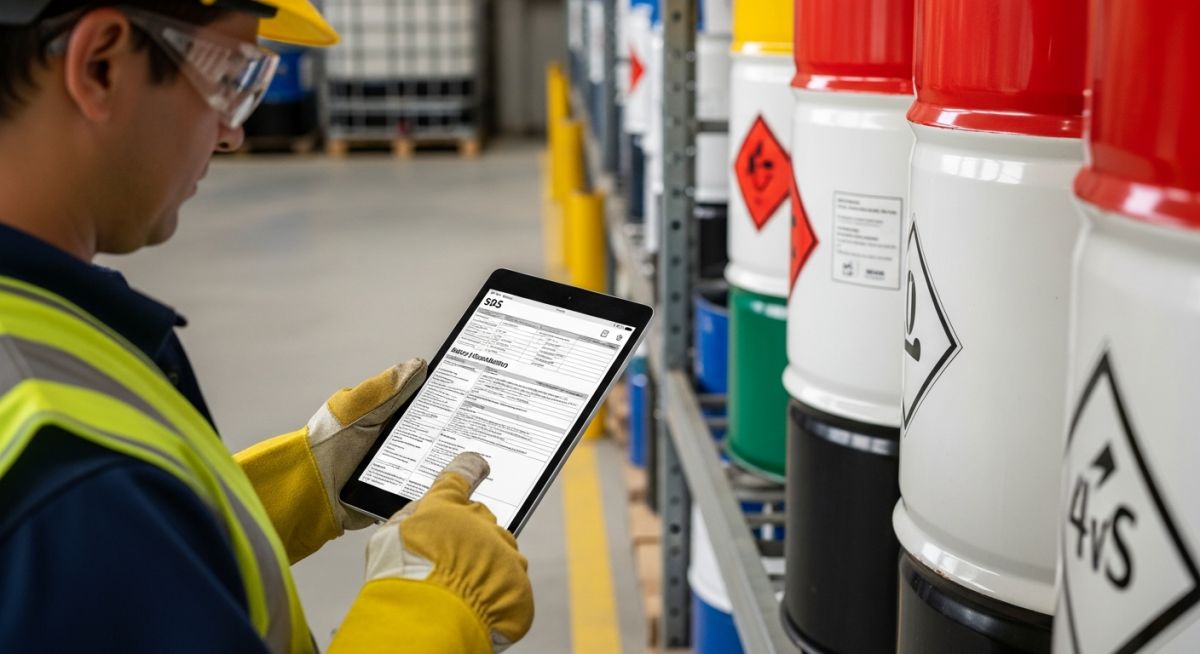
Every industrial facility that stores, processes, or transports chemicals must maintain a comprehensive inventory of safety documents. Under the OSHA 29 CFR 1910.1200 Hazard Communication Standard, employers are legally required to make these documents readily available to workers. In my experience, relying on memory or outdated labels is a recipe for disaster. These sheets provide the exact physical constants, exposure limits, and reactivity profiles needed to design safe containment systems.
Engineering Calculations for Safe Ventilation
To illustrate the practical engineering application of these safety sheets, let us calculate the required dilution ventilation rate for a workspace handling Toluene. The safety sheet provides the critical physical properties: Specific Gravity (SG) of 0.87, Molecular Weight (MW) of 92.14 grams per mole, and a Threshold Limit Value (TLV) of 20 parts per million (ppm).
Suppose our process evaporates Toluene at a rate of 0.1 gallons per hour. We apply a safety design factor (K) of 4 to account for imperfect air mixing in the piping bay.
Where:
– SG = Specific Gravity (0.87)
– ER = Evaporation Rate (0.1 gallons/hour)
– K = Safety Factor (4)
– MW = Molecular Weight (92.14)
– TLV = Threshold Limit Value (20 ppm)
Step 1: Numerator = 403 * 1,000,000 * 0.87 * 0.1 * 4 = 140,244,000
Step 2: Denominator = 92.14 * 20 * 60 = 110,568
Step 3: Q = 140,244,000 / 110,568 = 1,268.39 CFM
The resulting required ventilation rate is approximately 1,268 cubic feet per minute. Without extracting these exact physical constants from the safety sheet, an engineer cannot safely size the HVAC or exhaust systems.
Transitioning from Material Safety Data Sheet to SDS
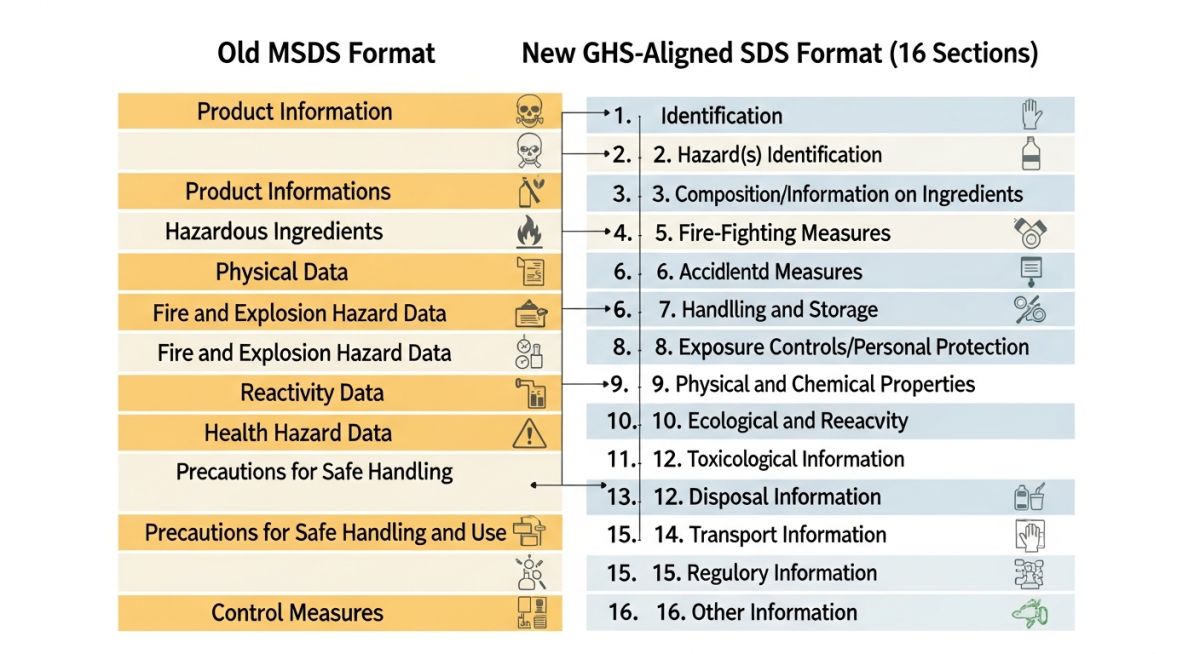
GHS Alignment: The regulatory transition from non-standardized MSDS formats to the highly structured 16-section Safety Data Sheet (SDS) format mandated by the Globally Harmonized System of Classification and Labelling of Chemicals.
The old MSDS format was notoriously difficult to navigate during an emergency. Because there was no standardized layout, one manufacturer might list first-aid measures on page one, while another buried them on page five. In 2012, OSHA aligned its standards with the Globally Harmonized System (GHS), transitioning the industry to the 16-section Safety Data Sheet (SDS). This change brought global consistency, making it much easier for my field crews to locate critical safety data instantly.
| Feature | Old MSDS Format | New GHS SDS Format |
|---|---|---|
| Structure | Non-standardized (8 to 10 sections) | Strictly standardized (16 sections) |
| Pictograms | Varying or none | Standardized GHS red-bordered diamonds |
| Signal Words | Not mandatory or inconsistent | Mandatory (“Danger” or “Warning”) |
| Global Compliance | Regional standards only | Internationally recognized under GHS |
| Entity / Acronym | Technical Definition | Standard Reference |
|---|---|---|
| GHS | Globally Harmonized System of Classification and Labelling of Chemicals | UNECE GHS Purple Book |
| OSHA HCS | Hazard Communication Standard regulating chemical safety in the workplace | 29 CFR 1910.1200 |
| CAS Number | Unique numerical identifier assigned by the Chemical Abstracts Service | CAS Registry Standard |
| TLV-TWA | Threshold Limit Value – Time Weighted Average for 8-hour daily exposure | ACGIH Guidelines |
Chemical Inventory Audit: A structured field verification protocol designed to reconcile physical chemical storage with active safety documentation to guarantee immediate emergency accessibility.
In my role as a lead engineer, I perform regular audits of our chemical safety documentation. A common mistake is assuming that having a digital database is sufficient. If the power goes out during a plant emergency, your operators must be able to access physical binders immediately. Use this checklist to verify your facility’s compliance status.
Field Verification Checklist
-
Verify that every hazardous chemical on-site has a corresponding 16-section SDS. -
Confirm that physical binders are located within 10 seconds of walking distance from chemical storage areas. -
Ensure all chemical container labels display the correct GHS pictograms matching Section 2 of the SDS. -
Check that the revision dates on all safety sheets are within the last three to five years. -
Validate that training records exist for all employees handling chemicals under OSHA 29 CFR 1910.1200(h).
Field Case Study: Real-World Application
The Problem: Outdated MSDS Formats Cause Chemical Reaction
During a piping maintenance turnaround at a chemical processing plant in Texas, operators mixed two cleaning agents (nitric acid and an organic solvent) inside a stainless steel flush line. The facility was still using outdated, non-standardized MSDS binders from the early 2000s. Because the reactivity hazards were buried deep within a poorly organized section of the old document, the operators failed to recognize the severe incompatibility. The resulting exothermic reaction caused a rapid pressure spike, rupturing the piping manifold and releasing toxic fumes.
The Outcome: Standardizing to GHS SDS
I was brought in to audit the facility’s safety systems and redesign the chemical handling protocols. We immediately transitioned their entire chemical inventory to the standardized 16-section SDS format. We implemented digital terminal kiosks at every piping manifold and trained the operators on Section 10 (Stability and Reactivity). This systematic update reduced chemical handling incidents to zero over the next three years, proving that standardized safety documentation directly impacts field safety.
My direct recommendation for any plant manager is to mandate that engineering contractors submit the latest GHS-compliant SDS for every chemical brought on-site before work permits are approved.
Frequently Asked Engineering Questions
What is the primary difference between an MSDS and an SDS?
Are old MSDS documents still legally acceptable under OSHA?
Where can I find chemical compatibility information on an SDS?
Who is responsible for creating and updating these safety sheets?
How does the GHS classification system affect piping design?
What are the penalties for non-compliance with SDS regulations?
===
Complete Course on
Piping Engineering
Check Now
Key Features
- 125+ Hours Content
- 500+ Recorded Lectures
- 20+ Years Exp.
- Lifetime Access
Coverage
- Codes & Standards
- Layouts & Design
- Material Eng.
- Stress Analysis