What is Vapor Density and Why Is It Important?
In my 20-plus years of designing piping systems and managing process safety in petrochemical plants, I have seen how minor oversights in physical properties lead to catastrophic field failures. One property that engineers frequently oversimplify—often with dangerous results—is vapor density. Understanding how a gas behaves when released into the atmosphere is not just a theoretical exercise; it is a fundamental safety requirement for piping layouts, relief valve sizing, and gas detection placement.
When we compare the vapor densities of air and water, we uncover physical behaviors that directly contradict common intuition. For instance, many junior engineers assume that adding water vapor to air makes the mixture heavier. In reality, the opposite is true. By mastering these thermodynamic principles, we can design safer facilities, prevent hazardous gas pooling, and ensure compliance with international safety codes.
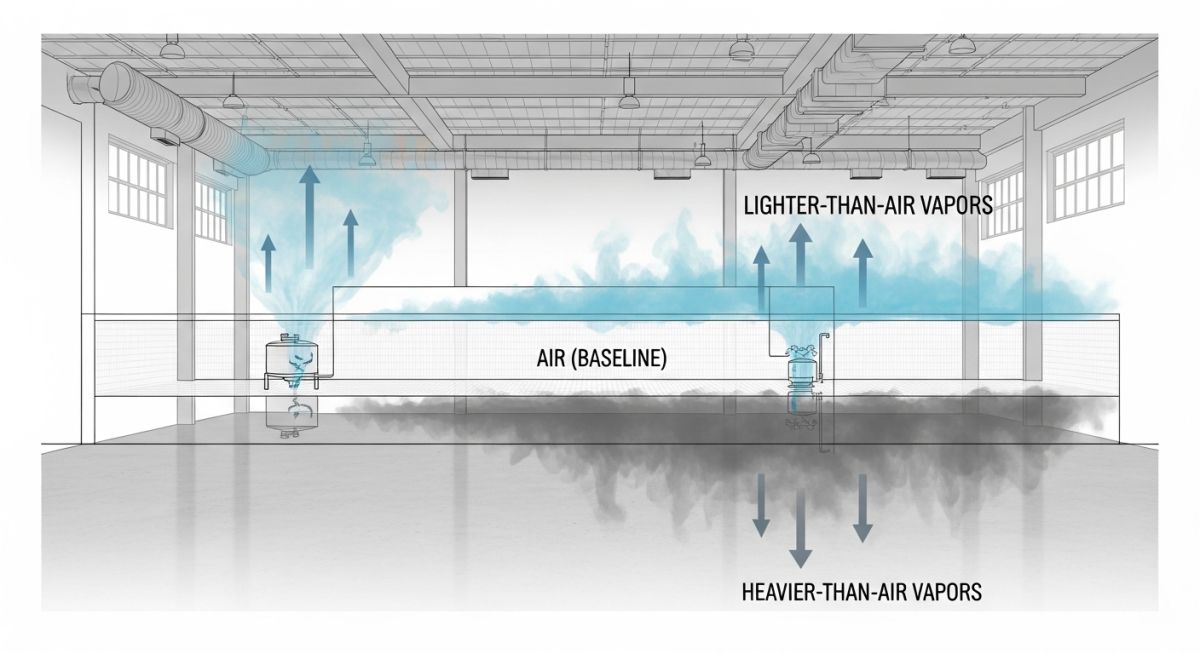
- Gases with a vapor density less than 1.0 (such as methane and water vapor) rise and disperse rapidly in open air.
- Heavy vapors with a density greater than 1.0 (such as propane, butane, and chlorine) sink, pooling in low-lying areas like trenches and sumps.
- Humid air is less dense than dry air because water molecules displace heavier nitrogen and oxygen molecules.
- Gas detector placement must be strictly aligned with the target gas’s relative density to ensure early warning capability.
Complete Course on
Piping Engineering
Check Now
Key Features
- 125+ Hours Content
- 500+ Recorded Lectures
- 20+ Years Exp.
- Lifetime Access
Coverage
- Codes & Standards
- Layouts & Design
- Material Eng.
- Stress Analysis
Understanding Vapor Density in Process Safety Design
To understand how vapor density functions, we must look at the molecular level. The reference standard is dry air, which has an average molecular weight of approximately 28.97 grams per mole. By setting the vapor density of dry air to 1.0, any gas with a molecular weight less than 28.97 will have a vapor density less than 1.0, making it lighter than air. Conversely, any gas with a molecular weight greater than 28.97 will have a vapor density greater than 1.0, making it heavier than air.
The Ideal Gas Law Derivation
We derive relative vapor density directly from the Ideal Gas Law. The absolute density of any gas is defined by the following equation:
Where:
P = Absolute pressure of the system (Pa)
MW = Molecular weight of the gas (kg/mol)
R = Universal gas constant (8.314 J/mol·K)
T = Absolute temperature (K)
Because relative vapor density compares the gas density to air density at the exact same temperature and pressure, the variables P, R, and T cancel out completely. This leaves us with a highly simplified, practical engineering formula:
Comparing Water Vapor and Air
Let us apply this formula to water vapor. A water molecule (H2O) consists of two hydrogen atoms and one oxygen atom, yielding a molecular weight of 18.015 grams per mole.
With a vapor density of 0.622, water vapor is significantly lighter than dry air. This explains why humid air is less dense than dry air at the same temperature and pressure. When water vapor enters the atmosphere, it does not add to the weight of the air; instead, it displaces diatomic nitrogen (MW = 28.01) and diatomic oxygen (MW = 32.00), reducing the overall density of the gas mixture.
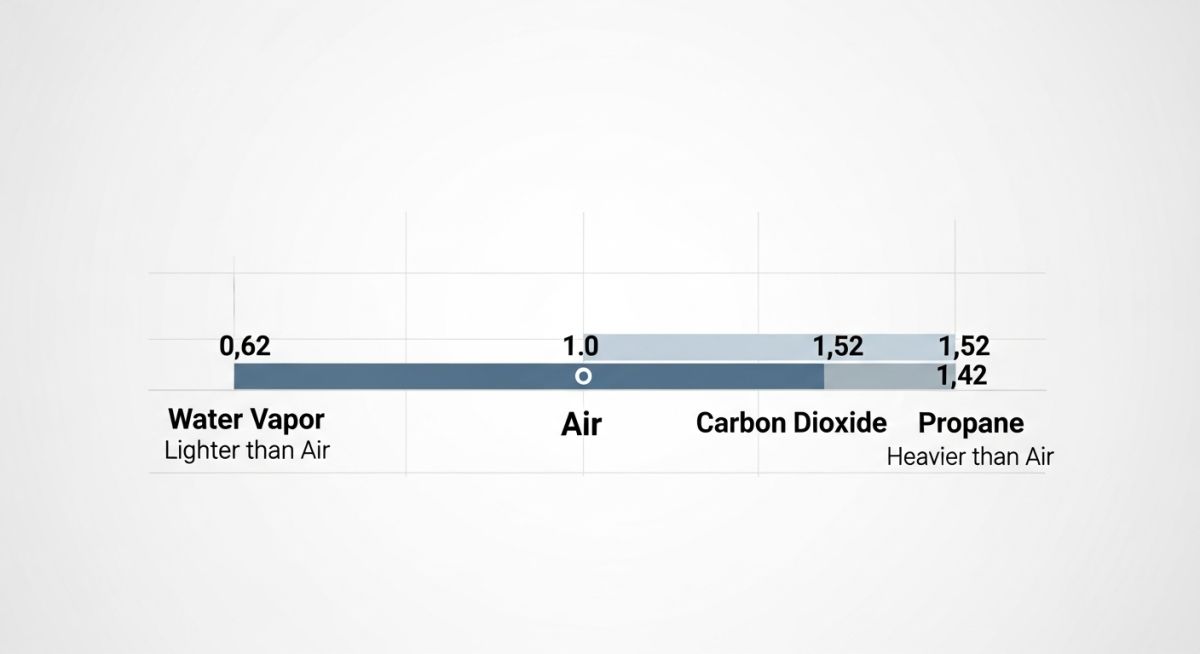
The table below provides reference values for common industrial gases. These values are calculated at standard temperature and pressure (0°C and 101.325 kPa) relative to dry air.
| Gas Name | Chemical Formula | Molecular Weight (g/mol) | Vapor Density (Air = 1.0) | Atmospheric Behavior |
|---|---|---|---|---|
| Hydrogen | H2 | 2.016 | 0.070 | Rises rapidly |
| Helium | He | 4.003 | 0.138 | Rises rapidly |
| Methane (Natural Gas) | CH4 | 16.040 | 0.554 | Rises and disperses |
| Water Vapor | H2O | 18.015 | 0.622 | Rises and disperses |
| Dry Air | N2/O2 mix | 28.970 | 1.000 | Neutral buoyancy |
| Hydrogen Sulfide | H2S | 34.080 | 1.176 | Sinks and pools |
| Carbon Dioxide | CO2 | 44.010 | 1.519 | Sinks and pools |
| Propane | C3H8 | 44.100 | 1.522 | Sinks and pools |
| Chlorine | Cl2 | 70.900 | 2.447 | Sinks heavily |
This matrix maps physical parameters to piping design decisions, safety standards, and mitigation strategies.
| Parameter | Physical Meaning | Piping & Layout Impact | Governing Code / Standard |
|---|---|---|---|
| VD < 0.8 | Light gas, highly buoyant | High-point vents, roof-level detectors, upward-pointing relief stacks | API RP 521 / NFPA 68 |
| 0.8 < VD < 1.2 | Neutrally buoyant gas | Mid-level breathing zone detectors, active mechanical cross-ventilation | OSHA 1910.146 (Confined Spaces) |
| VD > 1.2 | Heavy gas, gravity-driven flow | Low-point drains, grade-level detectors, trench barriers, closed flare headers | NFPA 497 / API RP 500 |
Verifying Vapor Density in Piping Layouts
When executing a piping layout or a 3D model review, you must systematically verify that physical gas properties are integrated into the physical design. Use this field checklist during your next design review to ensure no critical safety parameters are missed.
-
Identify Fluid Composition: Extract the exact molecular weight of the process stream from the process simulation heat and material balance (HMB) sheet. Do not rely on generic gas names. -
Calculate Temperature Effects: Verify if high operating temperatures could temporarily reduce the density of a heavy gas, causing it to rise initially before cooling and sinking. -
Position Gas Detectors Correctly: Ensure detectors for light gases (e.g., hydrogen, methane) are located at high points or ceiling levels, while detectors for heavy gases (e.g., propane, H2S) are placed within 300 mm of the floor or grade. -
Review Relief Valve Discharges: Confirm that atmospheric relief vents for gases with a vapor density greater than 1.5 are routed to a closed flare system rather than vented directly to the atmosphere. -
Assess Trench and Pit Ventilation: Verify that any piping trench or valve pit handling heavy hydrocarbons includes passive sloped drainage or active mechanical exhaust systems pulling from the lowest point.
Field Case Study: Real-World Application
My direct recommendation for any facility handling mixed hydrocarbons is to perform a comprehensive dispersion study. Never assume a gas mixture will behave like its lightest component. Always design your safety systems for the worst-case scenario, which is typically represented by the heaviest components in the stream.
Frequently Asked Engineering Questions
How does temperature affect relative vapor density?
Why is humid air less dense than dry air?
What is the difference between vapor density and specific gravity?
Where should gas detectors be placed for heavy vs. light gases?
How does vapor density influence relief valve discharge piping design?
Which standards govern hazardous area classification based on vapor density?
