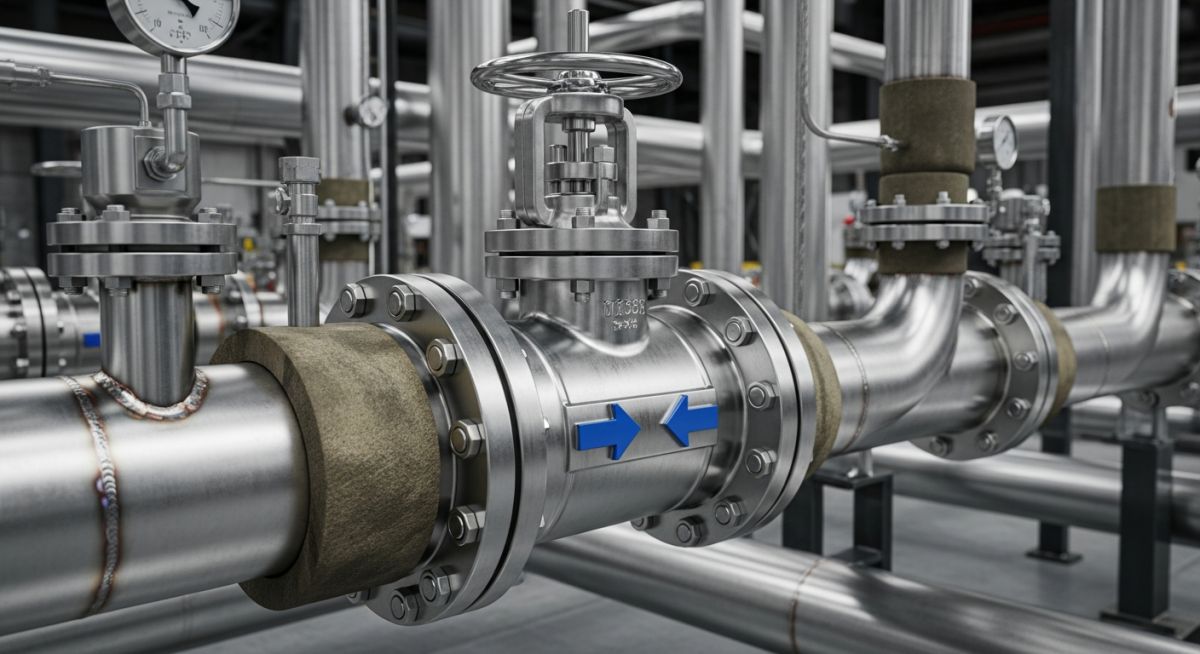
What is a Non-Return Valve? Types, Working, and Symbols
In my 20 years of troubleshooting piping systems across petrochemical plants and water treatment facilities, I have seen many systems suffer catastrophic failures due to a simple oversight: selecting the wrong type of check valve. A Non-Return Valve (NRV) is often treated as an afterthought during the design phase. However, this silent guardian is the only line of defense protecting your multi-million dollar pumps, compressors, and flow meters from devastating reverse flow and water hammer.
Unlike control valves or isolation valves, an NRV does not require an external actuator, electrical power, or manual intervention. It is a purely passive, flow-actuated device. Understanding how these valves operate, their specific mechanical limitations, and how to interpret their symbols on a Piping and Instrumentation Diagram (P&ID) is fundamental for any piping designer or plant engineer.
Key Takeaways from a Piping Expert
- Self-Actuating Design: Operates solely on fluid pressure differentials, eliminating the need for external power or manual control.
- Critical Protection: Prevents reverse flow that can spin pumps backward, damage impellers, and contaminate clean process lines.
- Diverse Configurations: Available in swing, lift, ball, and dual-plate wafer designs, each tailored to specific fluid phases and velocities.
- Code Compliance: Must be specified and tested in accordance with API Spec 6D, API 594, and ASME B16.34.
How Does a Non-Return Valve Work?
To understand the physics of an NRV, we must look at two key parameters: cracking pressure and reseating pressure. Cracking pressure is the minimum upstream pressure required to lift the disc, ball, or plate off its seat and initiate flow. Reseating pressure is the pressure at which the valve element makes contact with the seat again, completely shutting off the flow path.
Let us look at the mathematical relationship governing the cracking pressure of a spring-loaded lift check valve. The cracking pressure is calculated by dividing the spring force by the effective area of the valve disc:
Where:
– P_cracking is the cracking pressure in Pascals (Pa).
– F_spring is the force exerted by the spring in Newtons (N).
– A_disc is the effective area of the valve disc in square meters (m²).
For example, if a spring exerts a force of 15 Newtons on a disc with a diameter of 50 millimeters, the effective area is approximately 0.00196 square meters. This results in a cracking pressure of approximately 7,653 Pascals, or 0.0765 bar. If the upstream fluid pressure does not exceed this value, the valve remains closed.
In my field inspections, I frequently encounter severe piping vibrations caused by “valve slam.” This occurs when a swing check valve is installed in a system with high-velocity backflow. When the pump stops, the fluid reverses direction rapidly before the valve disc can close. The reverse flow slams the disc onto the seat, creating a high-pressure shockwave (water hammer) that can rupture pipe joints and destroy instrumentation. In such systems, a non-slam nozzle check valve or a spring-assisted dual-plate check valve must be specified instead.
What Are the Main Non-Return Valve Types?
Selecting the correct NRV type requires a deep understanding of the fluid medium (liquid, gas, or slurry), flow velocity, and piping layout. Let us break down the most common industrial configurations:
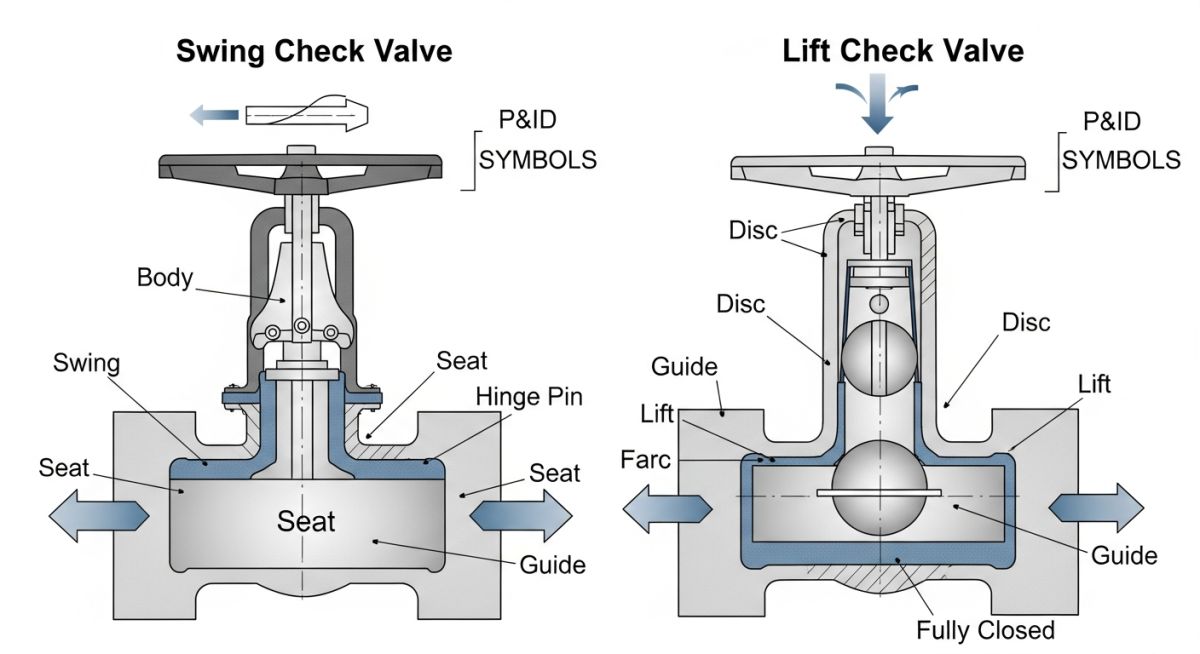
1. Swing Check Valves
The swing check valve is the most widely used design in general piping systems. It features a disc that swings on a hinge or shaft. When flow occurs, the disc swings completely out of the flow path, offering very low resistance to flow and a minimal pressure drop. These valves are ideal for low-velocity liquid systems but are highly susceptible to valve slam in rapid-reversal systems. They must be installed horizontally or in vertical lines with upward flow.
2. Lift Check Valves
A lift check valve operates similarly to a globe valve. The disc is guided as it lifts vertically off the seat by upstream pressure. These valves are highly reliable for high-pressure, high-temperature steam, air, and gas systems. Because the fluid must make a 90-degree turn through the valve body, the pressure drop is significantly higher than that of a swing check valve. They are typically used in smaller pipe sizes (under 2 inches) and must be installed in horizontal lines.
3. Ball Check Valves
Ball check valves utilize a spherical ball as the closure element. The ball is pushed off the seat by fluid pressure and rolls into a recess out of the flow path. When flow stops, gravity or a spring returns the ball to the seat. These valves are highly effective for viscous fluids, slurries, and wastewater systems because the rolling action of the ball makes them self-cleaning and highly resistant to clogging.
4. Dual-Plate Wafer Check Valves
The dual-plate wafer check valve features two spring-loaded semi-circular plates hinged on a central pin. When flow starts, the plates fold open. When flow stops, the springs rapidly close the plates before reverse flow can develop. This design is incredibly compact, lightweight, and virtually eliminates water hammer, making it the preferred choice for large-diameter water and hydrocarbon pipelines.
Key Engineering Standards for Non-Return Valve Selection
When designing a piping system, you cannot simply select an NRV from a catalog without verifying its compliance with industry standards. The table below provides a comprehensive comparison of the primary NRV types, their operating limits, and their typical applications.
| Valve Type | Cracking Pressure | Pressure Drop | Water Hammer Risk | Best Fluid Medium | Standard Orientation |
|---|---|---|---|---|---|
| Swing Check | Very Low (< 0.05 bar) | Low | High | Clean Liquids, Water | Horizontal / Vertical Up |
| Lift Check | Medium (0.1 – 0.3 bar) | High | Medium | Steam, Air, Gases | Horizontal Only |
| Ball Check | Low (0.05 – 0.1 bar) | Medium | Low | Slurries, Wastewater | Horizontal / Vertical Up |
| Dual-Plate Wafer | Low (0.03 – 0.08 bar) | Medium | Very Low | Hydrocarbons, Water | Any Orientation |
Technical Mapping & Specifications Matrix
To streamline the procurement and engineering design process, the following matrix maps the core technical entities, design standards, and material specifications required for high-performance NRV integration.
| Parameter / Entity | Applicable Code / Standard | Standard Materials | Engineering Significance |
|---|---|---|---|
| Design & Construction | API Spec 6D / API 594 | ASTM A216 WCB, A351 CF8M | Defines wall thickness, pressure ratings, and structural design limits. |
| Pressure Testing | API 598 / ISO 5208 | N/A (Testing Protocol) | Specifies allowable leakage rates for high and low-pressure closure tests. |
| Face-to-Face Dimensions | ASME B16.10 | N/A (Dimensional Standard) | Ensures physical interchangeability between different valve manufacturers. |
| Flange Dimensions | ASME B16.5 | Carbon Steel, Stainless Steel | Governs bolt circle diameters, flange thickness, and gasket surface finishes. |
How to Verify Non-Return Valve Installation
During my time managing field construction, I have witnessed several instances where an NRV was installed backward. This simple error completely blocks the process flow, leading to immediate pump trip or line overpressurization. To prevent this, I developed a strict site verification checklist that must be completed before any piping system is hydrotested or commissioned.
Pre-Commissioning Field Checklist
-
Flow Direction Arrow: Verify that the cast or stamped arrow on the valve body matches the process flow direction shown on the approved P&ID.
-
Mounting Orientation: Ensure swing check valves are installed horizontally or vertically with upward flow. Lift check valves must only be installed in horizontal runs.
-
Internal Clearance: For wafer-style check valves, verify that the adjacent piping ID is large enough to allow the valve plates to swing fully open without hitting the pipe wall.
-
Spring Tension & Movement: Manually depress the disc or plates to ensure smooth, unhindered travel and positive spring return to the seat.
-
Upstream/Downstream Straight Runs: Ensure there is a minimum of 5 to 10 pipe diameters of straight run upstream of the valve to prevent turbulent flow from causing disc chatter and premature wear.
Field Case Study: Real-World Application
The Problem: Pump Impeller Failures at a Desalination Plant
At a major seawater desalination facility, operators reported repeated mechanical seal and impeller failures on two large high-pressure feed pumps operating in parallel. The pumps were rated at 450 cubic meters per hour at 65 bar.
Upon investigation, I discovered that when Pump A was shut down for routine maintenance while Pump B remained online, Pump A would spin backward at high speed. The installed swing check valve on the discharge of Pump A was failing to close completely due to mineral scaling on the hinge pin, allowing high-pressure seawater to flow backward through the idle pump.
The Solution: Retrofitting with Dual-Plate Wafer Check Valves
I recommended replacing the scaled swing check valves with spring-assisted dual-plate wafer check valves conforming to API 594, featuring Super Duplex (ASTM A890) plates and Hastelloy C springs to resist seawater corrosion.
The spring-assisted design ensured that the valve plates closed the instant the forward flow velocity dropped to zero, well before reverse flow could establish.
Following the retrofit, the plant recorded zero reverse-rotation events. The mechanical seal life of the pumps extended from an average of 3 months to over 24 months, saving the operator thousands of dollars in maintenance costs and preventing unplanned plant shutdowns.
Frequently Asked Engineering Questions
What is the difference between a check valve and a non-return valve?
Can a non-return valve be installed vertically?
What causes a non-return valve to leak?
How do you size a non-return valve?
What is a non-slam check valve?
What are the standard P&ID symbols for non-return valves?
===FAQ_BLOCK===
Complete Course on
Piping Engineering
Check Now
Key Features
- 125+ Hours Content
- 500+ Recorded Lectures
- 20+ Years Exp.
- Lifetime Access
Coverage
- Codes & Standards
- Layouts & Design
- Material Eng.
- Stress Analysis