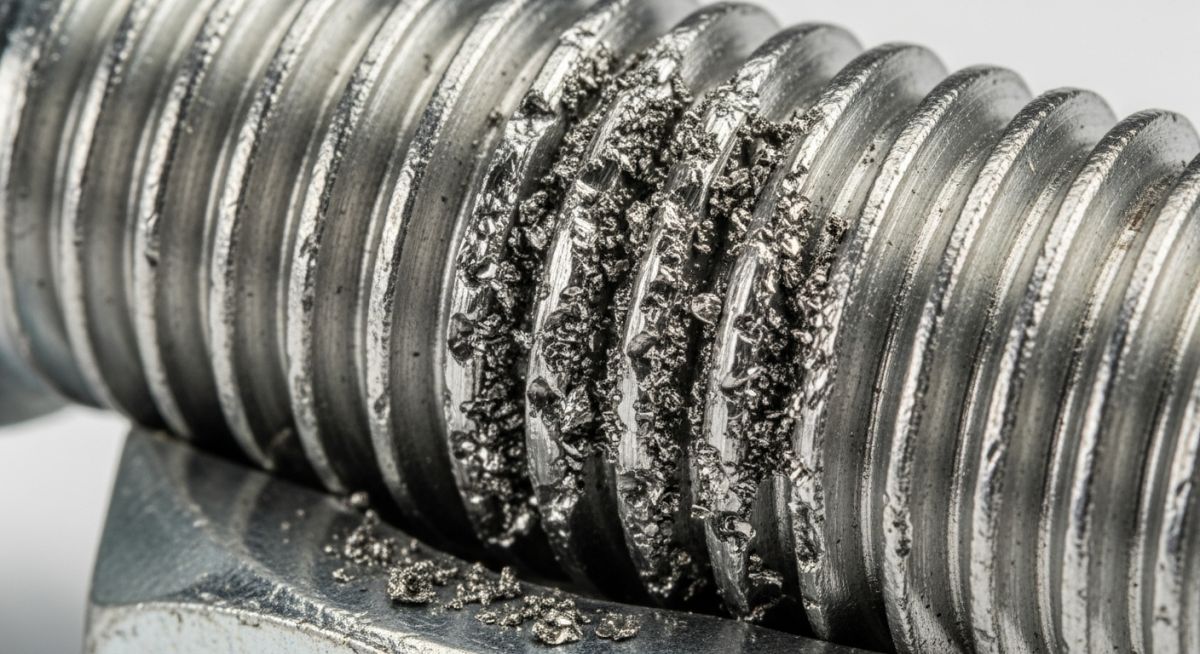
What is Metal Galling and How to Prevent It
In my 20 years of piping engineering, I have seen countless stainless steel flanges and high-pressure bolts completely seized due to a silent killer: metal galling. It happens in a split second during torque-up, turning a routine maintenance window into a multi-day shutdown nightmare where bolts must be torched off. When two clean metal surfaces slide against each other under load, they do not just slide; they interact at a microscopic level. Without proper mitigation, this interaction leads to catastrophic surface damage.
- Galling is a severe form of adhesive wear, not simple abrasion.
- Austenitic stainless steels (like 304 and 316) are highly susceptible due to their self-passivating chromium oxide layer.
- Lubrication, material selection, and controlled torque are the primary defense mechanisms.
- Hardness differentials of at least 50 Brinell between mating parts significantly reduce risk.
- Thread design modifications, such as using coarser threads, help mitigate localized stress concentrations.
Understanding Metal Galling Mechanisms and Causes
Metal Galling Mechanisms: The microscopic transfer of material between sliding metallic interfaces occurs when high contact pressures disrupt protective oxide films, leading to localized cold welding under standards like ASTM G98.
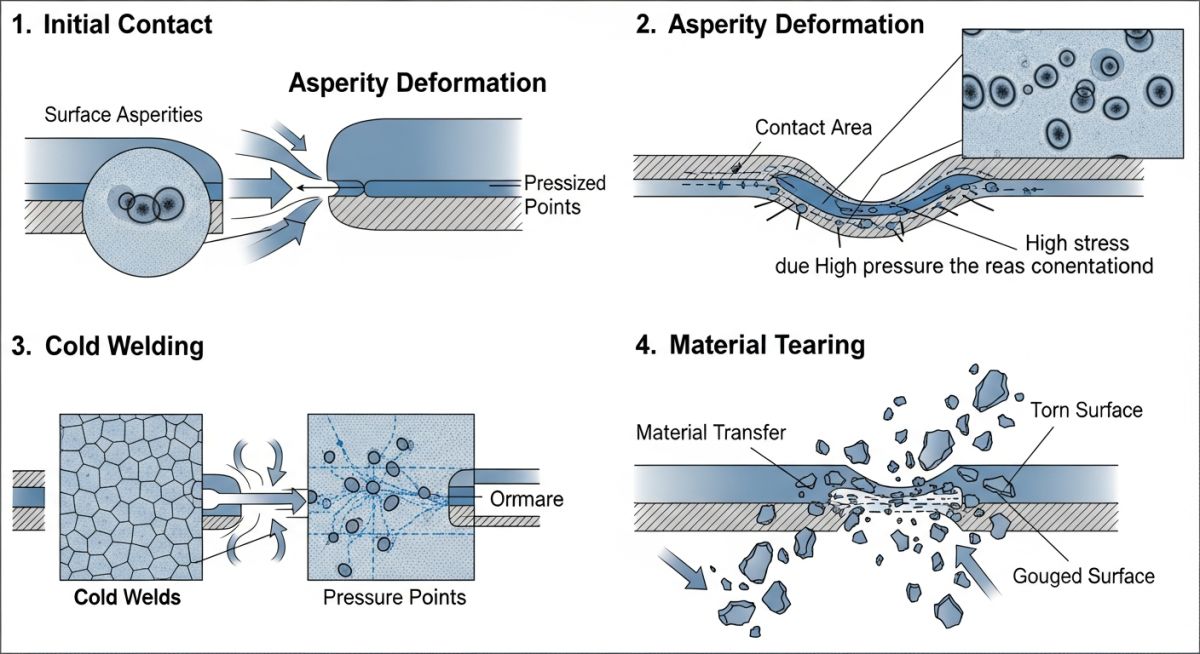
To understand why this happens, we must look at the surface topography. No matter how polished a metal surface looks, microscopically it is a landscape of peaks and valleys called asperities. When two surfaces slide under load, the actual contact area is incredibly small—limited only to these microscopic peaks.
The real contact pressure (P_real) at these microscopic asperities is defined by the formula: P_real = F / A_real, where F is the applied normal force and A_real is the actual contact area. Because A_real is approximately equal to F divided by the yield hardness (H) of the softer material, the local stress at these microscopic peaks easily exceeds the yield strength of the alloy, initiating plastic deformation.
In materials like stainless steel, aluminum, and titanium, a thin, protective passive oxide layer prevents corrosion. However, under high sliding pressure, this oxide layer is sheared off. The exposed, highly reactive bare metal atoms on opposing surfaces instantly form atomic bonds—essentially cold welding together. As sliding continues, these micro-welds tear apart, pulling chunks of metal out of one surface and depositing them on the other. This self-reinforcing cycle of destruction quickly leads to complete mechanical seizure.
Never use high-speed impact wrenches on dry stainless steel fasteners. The rapid heat generation and high localized shear stress will trigger instantaneous galling, permanently seizing the bolt before the target torque is reached.
Alloys with high ductility and low work-hardening rates are the most vulnerable. Austenitic stainless steels (304 and 316) are notorious because their passive chromium oxide layer is easily ruptured, and the underlying metal is relatively soft and ductile. Conversely, materials that work-harden rapidly or have high cobalt content (such as Stellite alloys) resist galling by preventing localized plastic deformation.
The table below outlines the threshold galling stress for various material pairings tested under ASTM G98 protocols. Selecting the right pairing is a fundamental step in engineering design.
| Material Pair (Button vs. Block) | Hardness (BHN) | Galling Threshold Stress (ksi / MPa) | Risk Level | Recommended Application |
|---|---|---|---|---|
| 304 SS vs 304 SS | 150 / 150 | < 2 ksi (14 MPa) | Extreme | Avoid sliding contact without heavy lubrication. |
| 316 SS vs Nitronic 60 | 150 / 200 | > 50 ksi (345 MPa) | Very Low | High-load sliding wear, valve stems. |
| Carbon Steel vs Carbon Steel | 180 / 180 | 10 ksi (69 MPa) | Moderate | Standard structural bolting with anti-seize. |
| Bronze vs Stainless Steel | 120 / 150 | > 30 ksi (207 MPa) | Low | Threaded bushings, rotating shafts. |
This matrix maps key tribological entities, standards, and physical parameters that design engineers must reference when specifying anti-galling protocols.
| Entity / Acronym | Technical Definition | Governing Standard | Mitigation Strategy |
|---|---|---|---|
| ASTM G98 | Standard test method for galling resistance of materials. | ASTM G98 | Use to pre-qualify alloy pairings during the design phase. |
| Nitronic 60 | Silicon and manganese alloyed austenitic stainless steel. | UNS S21800 | Substitute for standard 316 SS in high-wear components. |
| Asperity | Microscopic surface peak or roughness deviation. | ASME B46.1 | Control surface finish (Ra) between 0.5 and 1.5 microns. |
| Adhesive Wear | Material transfer caused by localized welding. | ISO 15243 | Apply solid film lubricants or hard coatings. |
Field Procedures for Preventing Metal Galling
Metal Galling Prevention Checklist: A systematic field verification protocol designed to eliminate adhesive wear during mechanical assembly by controlling surface preparation, lubrication, and torque application under ASME PCC-1 guidelines.
Before any high-pressure flange assembly or structural bolting operation begins, field technicians must execute this checklist to ensure mating surfaces do not undergo destructive adhesive wear.
-
Verify Material Compatibility: Ensure mating fasteners do not consist of identical soft alloys (e.g., avoid 316 bolt with 316 nut unless treated).
-
Inspect Thread Integrity: Check for pre-existing burrs, nicks, or rolled threads using a thread go/no-go gauge.
-
Measure Surface Roughness: Confirm mating surfaces are within the optimal Ra range of 0.8 to 1.6 micrometers.
-
Apply Approved Lubricant: Coat threads uniformly with nickel-based anti-seize or molybdenum disulfide conforming to ASME PCC-1 Appendix H.
-
Calibrate Torque Tools: Ensure manual torque wrenches are calibrated within +/- 4% to prevent localized over-stressing.
-
Control Assembly Speed: Limit rundown speed to under 30 RPM to minimize frictional heat generation.
-
Confirm Hardness Differential: Verify that the nut hardness is at least 50 Brinell points different from the bolt if no lubricant is permitted.
Field Case Study: Real-World Application
During a fast-track turnaround at a petrochemical refinery, a crew assembled 24-inch Class 900 stainless steel (316L) piping flanges using standard 316L stud bolts. To save time, the crew used high-speed pneumatic impact wrenches without applying thread lubricant. Within seconds of tightening, 14 out of 20 studs seized completely before reaching 30% of the target torque. The seized bolts had to be cut off with oxy-acetylene torches, damaging the flange faces and delaying the startup by 36 hours, costing the operator over 180,000 in lost production.
I was called to resolve the failure. We implemented a three-part remediation plan: first, we replaced the 316L nuts with Nitronic 60 (UNS S21800) nuts to establish a high-hardness differential; second, we mandated the use of a high-purity nickel anti-seize compound conforming to ASME PCC-1; third, we enforced manual torque-up in a star pattern using calibrated hydraulic tensioners. The remaining flanges were assembled with zero failures, and subsequent inspections during the next turnaround showed clean, reusable threads.
My direct recommendation for all high-pressure stainless steel piping systems is to mandate Nitronic 60 nuts on standard stainless studs as a default specification in your piping class sheets. This simple material change eliminates the risk of galling even if field crews fail to apply lubricant properly.
Frequently Asked Engineering Questions
What is the difference between galling and normal adhesive wear?
Why is stainless steel more prone to galling than carbon steel?
How does surface roughness affect the risk of metal galling?
Can coatings or surface treatments permanently prevent galling?
What role does temperature play in the galling mechanism?
How does ASME PCC-1 address galling in bolted flange joints?
Complete Course on
Piping Engineering
Check Now
Key Features
- 125+ Hours Content
- 500+ Recorded Lectures
- 20+ Years Exp.
- Lifetime Access
Coverage
- Codes & Standards
- Layouts & Design
- Material Eng.
- Stress Analysis
