What is Fracking and How Does Hydraulic Fracturing Work?
In my 20-plus years of field experience across major oil and gas plays, I have watched the energy landscape transform completely. At the heart of this transformation is a highly sophisticated, often misunderstood engineering process. When clients and junior engineers ask me to explain the mechanics of unconventional reservoirs, the conversation always starts with a fundamental question: what is fracking?
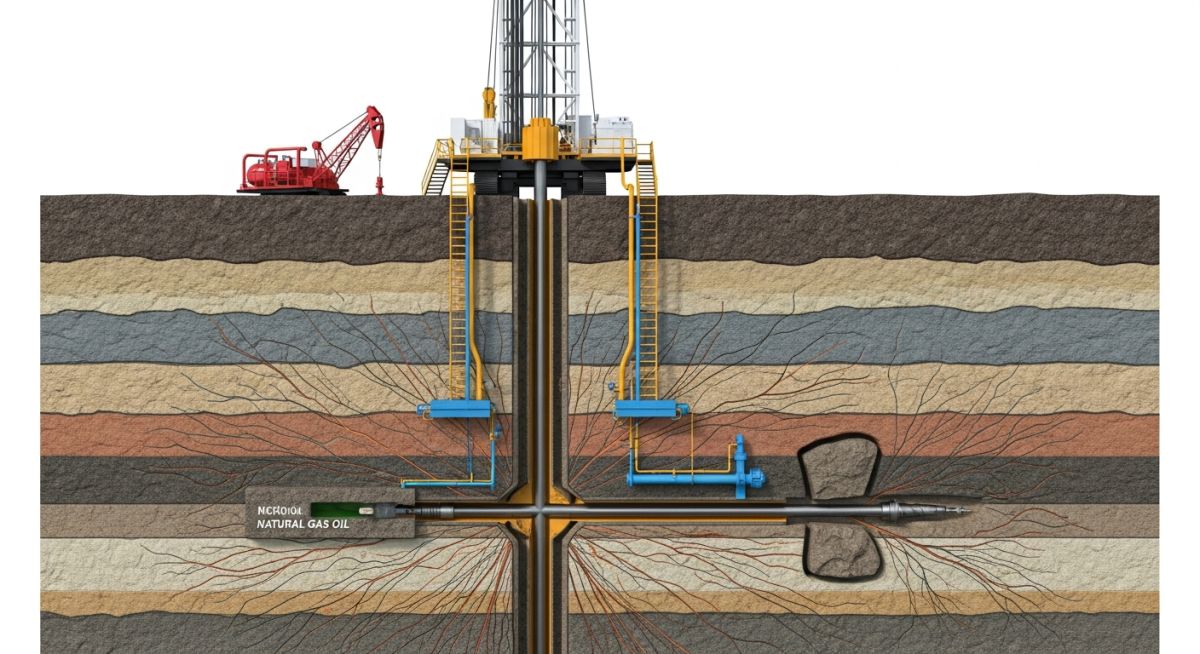
To understand this process, we must look beyond the surface-level debates and dive deep into the geomechanics, fluid dynamics, and structural piping systems that make horizontal drilling and stimulation possible. It is not merely about pumping water underground; it is a highly controlled, mathematically modeled operation designed to crack rock formations miles beneath our feet with surgical precision.
Key Engineering Takeaways
- Geomechanical Precision: Fracturing requires exceeding the rock’s breakdown pressure, which is calculated based on minimum and maximum horizontal stresses.
- Multi-Barrier Integrity: Multiple concentric strings of steel casing and specialized cement protect shallow freshwater aquifers from high-pressure stimulation fluids.
- Proppant Transport: Engineered sand or ceramic beads are suspended in viscous fluids to keep newly created micro-fractures open after pressure is released.
Understanding What is Fracking and Shale Mechanics
To truly grasp the engineering behind unconventional extraction, we must analyze the physical properties of shale. Shale is an ultra-low permeability sedimentary rock. Unlike conventional sandstone reservoirs where hydrocarbons flow freely through interconnected pore spaces, shale traps oil and gas in isolated pockets. Without artificial stimulation, commercial production is physically impossible.
The process begins with directional drilling. We drill vertically down to a kickoff point, typically several thousand feet deep, and then gradually curve the wellbore to run horizontally through the target shale play. This horizontal section can extend for over two miles, maximizing exposure to the hydrocarbon-bearing rock.
The Geomechanics of Rock Failure
Once the well is cased and cemented, we initiate the fracturing process. This requires calculating the exact breakdown pressure of the rock. If our injection pressure is too low, the rock will not fracture; if it is too high, we risk uncontrolled fracture propagation into adjacent non-target zones.
The breakdown pressure (Pb) is mathematically defined by the Hubbert and Willis equation:
Where:
- sigma_min: Minimum horizontal in-situ stress (PSI)
- sigma_max: Maximum horizontal in-situ stress (PSI)
- T_0: Tensile strength of the shale matrix (PSI)
- P_0: Pore pressure of the reservoir fluid (PSI)
In my experience, managing these stress fields is the most critical aspect of well design. We use microseismic monitoring and diagnostic fracture injection tests (DFIT) to map these stresses in real time. This ensures that the fractures propagate perpendicular to the minimum horizontal stress, which is the path of least resistance, creating a highly complex network of conductive pathways.
Field Warning: Stress Shadowing Effects
In multi-stage horizontal wells, fracturing one stage increases the local stress field around the wellbore. This phenomenon, known as stress shadowing, can severely restrict fracture propagation in subsequent adjacent stages. Engineers must carefully optimize stage spacing and fluid injection rates to prevent premature screen-outs and uneven reservoir drainage.
Fluid Chemistry and Proppant Selection
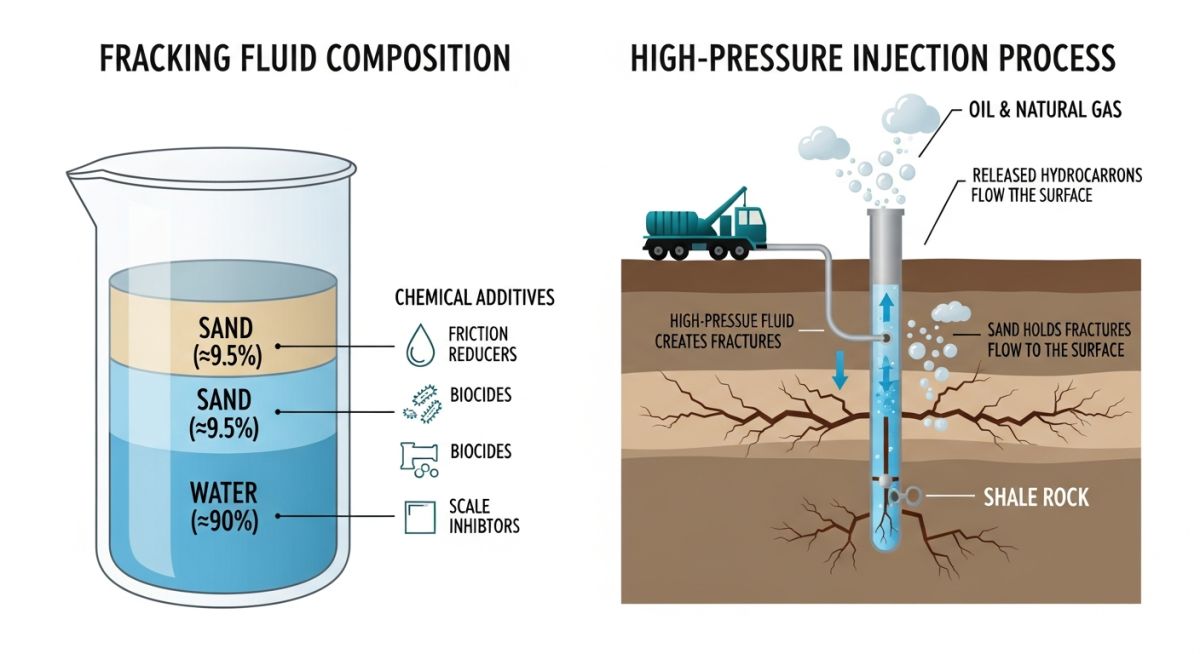
The fracturing fluid is not just water. It is a highly engineered mixture designed to perform specific physical tasks. Typically, 99% of the fluid consists of water and proppant (usually high-purity silica sand), while the remaining 1% contains chemical additives.
These additives include friction reducers (to lower turbulent pressure losses in the piping), biocides (to prevent bacteria from degrading the fluid or producing corrosive hydrogen sulfide), and scale inhibitors. The proppant is critical; once the hydraulic pressure is released, the rock naturally wants to close back up. The proppant acts as tiny pillars, keeping the micro-fractures open and allowing the trapped hydrocarbons to flow back to the wellbore.
===

What is Fracking and How Does Hydraulic Fracturing Work?
In my 20-plus years of field experience across major oil and gas plays, I have watched the energy landscape transform completely. At the heart of this transformation is a highly sophisticated, often misunderstood engineering process. When clients and junior engineers ask me to explain the mechanics of unconventional reservoirs, the conversation always starts with a fundamental question: what is fracking?
To understand this process, we must look beyond the surface-level debates and dive deep into the geomechanics, fluid dynamics, and structural piping systems that make horizontal drilling and stimulation possible. It is not merely about pumping water underground; it is a highly controlled, mathematically modeled operation designed to crack rock formations miles beneath our feet with surgical precision.
Key Engineering Takeaways
- Geomechanical Precision: Fracturing requires exceeding the rock’s breakdown pressure, which is calculated based on minimum and maximum horizontal stresses.
- Multi-Barrier Integrity: Multiple concentric strings of steel casing and specialized cement protect shallow freshwater aquifers from high-pressure stimulation fluids.
- Proppant Transport: Engineered sand or ceramic beads are suspended in viscous fluids to keep newly created micro-fractures open after pressure is released.
===DEEP_DIVE_BLOCK===
Understanding What is Fracking and Shale Mechanics
To truly grasp the engineering behind unconventional extraction, we must analyze the physical properties of shale. Shale is an ultra-low permeability sedimentary rock. Unlike conventional sandstone reservoirs where hydrocarbons flow freely through interconnected pore spaces, shale traps oil and gas in isolated pockets. Without artificial stimulation, commercial production is physically impossible.
The process begins with directional drilling. We drill vertically down to a kickoff point, typically several thousand feet deep, and then gradually curve the wellbore to run horizontally through the target shale play. This horizontal section can extend for over two miles, maximizing exposure to the hydrocarbon-bearing rock.
The Geomechanics of Rock Failure
Once the well is cased and cemented, we initiate the fracturing process. This requires calculating the exact breakdown pressure of the rock. If our injection pressure is too low, the rock will not fracture; if it is too high, we risk uncontrolled fracture propagation into adjacent non-target zones.
The breakdown pressure (Pb) is mathematically defined by the Hubbert and Willis equation:
Where:
- sigma_min: Minimum horizontal in-situ stress (PSI)
- sigma_max: Maximum horizontal in-situ stress (PSI)
- T_0: Tensile strength of the shale matrix (PSI)
- P_0: Pore pressure of the reservoir fluid (PSI)
In my experience, managing these stress fields is the most critical aspect of well design. We use microseismic monitoring and diagnostic fracture injection tests (DFIT) to map these stresses in real time. This ensures that the fractures propagate perpendicular to the minimum horizontal stress, which is the path of least resistance, creating a highly complex network of conductive pathways.
Field Warning: Stress Shadowing Effects
In multi-stage horizontal wells, fracturing one stage increases the local stress field around the wellbore. This phenomenon, known as stress shadowing, can severely restrict fracture propagation in subsequent adjacent stages. Engineers must carefully optimize stage spacing and fluid injection rates to prevent premature screen-outs and uneven reservoir drainage.

Fluid Chemistry and Proppant Selection
The fracturing fluid is not just water. It is a highly engineered mixture designed to perform specific physical tasks. Typically, 99% of the fluid consists of water and proppant (usually high-purity silica sand), while the remaining 1% contains chemical additives.
These additives include friction reducers (to lower turbulent pressure losses in the piping), biocides (to prevent bacteria from degrading the fluid or producing corrosive hydrogen sulfide), and scale inhibitors. The proppant is critical; once the hydraulic pressure is released, the rock naturally wants to close back up. The proppant acts as tiny pillars, keeping the micro-fractures open and allowing the trapped hydrocarbons to flow back to the wellbore.
===DATA_TABLES_BLOCK===
Selecting the correct fluid system and proppant type is a balancing act between reservoir depth, temperature, and closure stress. The table below outlines the primary fluid systems utilized in modern hydraulic fracturing operations.
| Fluid System | Viscosity Range (cP) | Proppant Carrying Capacity | Primary Application |
|---|---|---|---|
| Slickwater | 2 – 5 cP | Low to Moderate | Brittle shale formations with high natural fracture density. |
| Linear Gel | 10 – 30 cP | Moderate |
Complete Course on
Piping Engineering
Check Now
Key Features
- 125+ Hours Content
- 500+ Recorded Lectures
- 20+ Years Exp.
- Lifetime Access
Coverage
- Codes & Standards
- Layouts & Design
- Material Eng.
- Stress Analysis
