What is a Vibration Analyzer? Working Principles and Industrial Applications
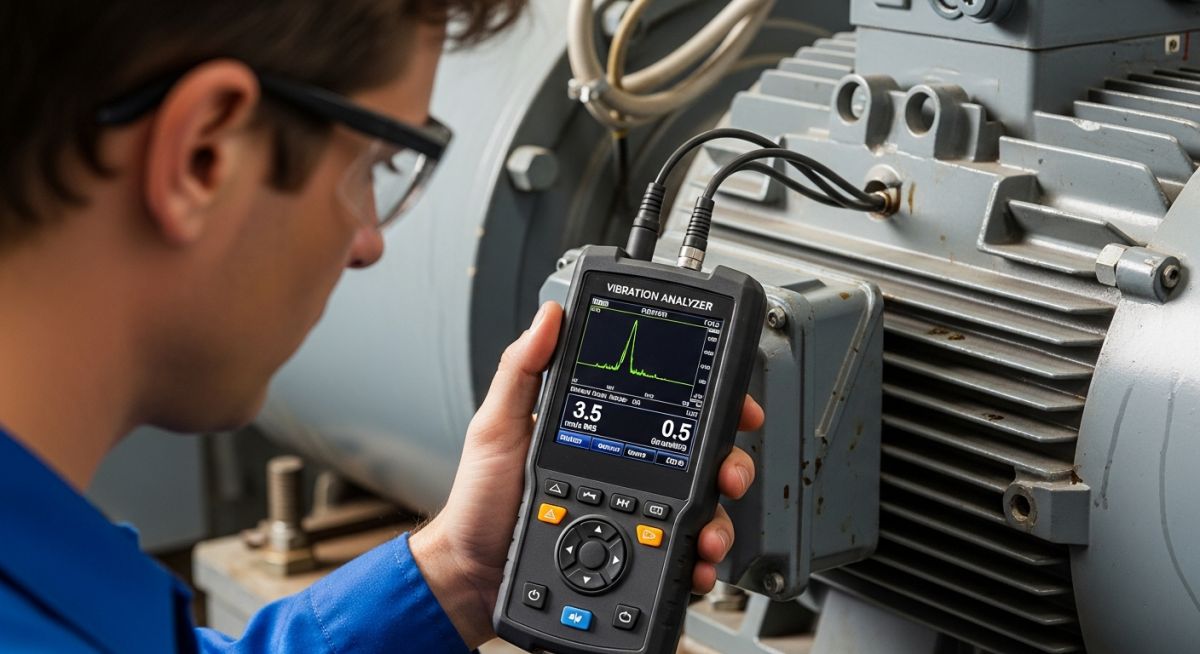
Imagine you are standing next to a 500HP critical feedwater pump when a subtle, high-pitched whine begins to cut through the floor’s ambient noise. You know something is wrong, but is it a failing inner race on the outboard bearing, or is the coupling simply losing its alignment? Without a Vibration Analyzer, you are forced into a “run-to-fail” gamble that could cost your facility hundreds of thousands in unplanned downtime. This guide moves beyond basic meters to show you how to decode the “language of machines” using precision spectral analysis.
Key Takeaways
- Precision Diagnostics: Transition from simple overall vibration levels to pinpointing specific component faults using FFT.
- Standard Compliance: Align your maintenance thresholds with ISO 10816 and ISO 20816 frameworks.
- Hardware Evolution: Understand why high-resolution 24-bit data acquisition is the new baseline for 2026 diagnostics.
What is a Vibration Analyzer?
A Vibration Analyzer is a sophisticated diagnostic instrument that captures mechanical oscillations via sensors, converting time-domain signals into frequency-domain spectra using Fast Fourier Transform (FFT). It allows engineers to identify specific machine faults like imbalance, misalignment, and bearing defects by analyzing amplitude at discrete frequency peaks.
“In my 20 years of field inspections, I have seen that a Vibration Analyzer is only as good as the technician’s understanding of signal processing. A high-resolution screen means nothing if you haven’t correctly set your Fmax or your lines of resolution to distinguish between belt pass frequencies and motor slip.”
– Atul Singla, Founder of EPCLand
Table of Contents
Complete Course on
Piping Engineering
Check Now
Key Features
- 125+ Hours Content
- 500+ Recorded Lectures
- 20+ Years Exp.
- Lifetime Access
Coverage
- Codes & Standards
- Layouts & Design
- Material Eng.
- Stress Analysis
Vibration Analyzer Mastery Quiz
Test your diagnostic engineering depth
Question 1 of 5
What is the primary mathematical process a Vibration Analyzer uses to convert time-waveforms into a frequency spectrum?
How a Vibration Analyzer Works: From Sensor to Signal
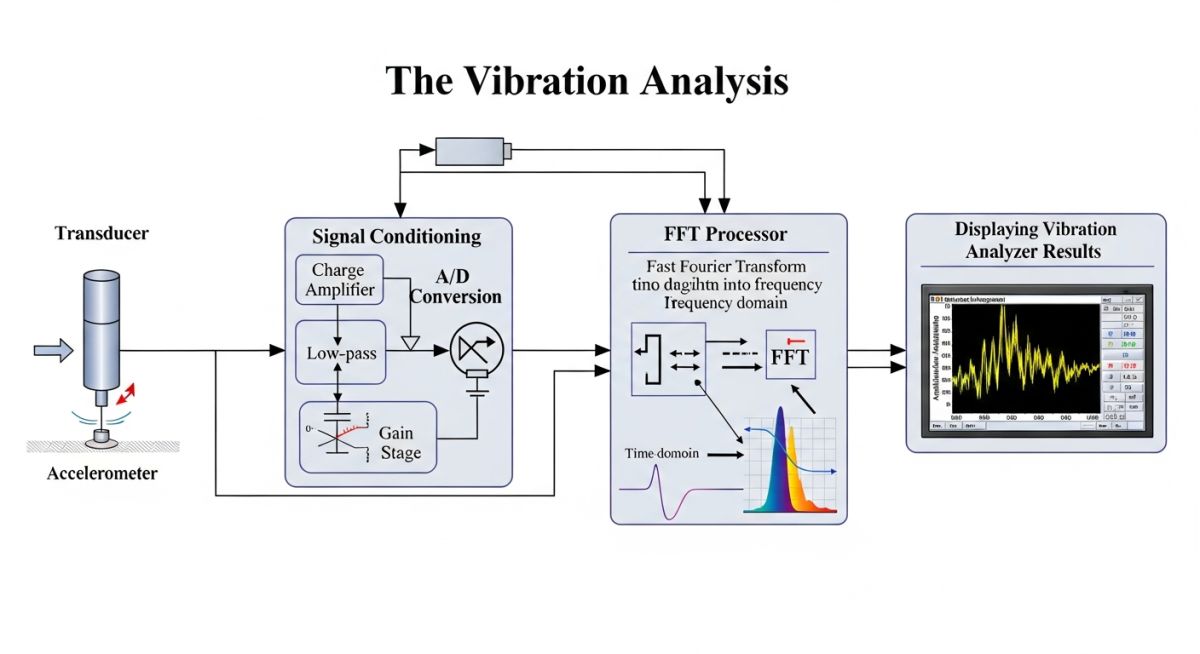
The internal architecture of a modern Vibration Analyzer is a marvel of signal processing engineering. It begins with the transducer—typically a piezoelectric accelerometer—mounted securely to the bearing housing of a machine. As the machine rotates, mechanical forces create stress on the piezoelectric crystal inside the sensor, generating a proportional electrical charge. This raw analog signal is sent to the Vibration Analyzer, where it undergoes high-speed sampling and digitization.
Once digitized, the Vibration Analyzer applies the Fast Fourier Transform (FFT) algorithm. This mathematical operation decomposes the complex, messy time-waveform (vibration over time) into a series of discrete frequency peaks. By examining these peaks, an engineer can distinguish between a 1x rotational speed vibration (indicative of unbalance) and high-frequency energy spikes that signal early-stage bearing race degradation. For deeper study on the mathematical foundations of these oscillations, engineers often consult resources like the Mobius Institute Vibration Training standards.
Critical Industrial Uses of a Vibration Analyzer
In the heavy industry sector, the Vibration Analyzer is the primary weapon against unplanned downtime. It is not merely a “check-up” tool; it is used for precision root cause analysis. For instance, in power generation, a Vibration Analyzer is used to perform “coast-down” tests to identify critical speeds and resonance frequencies in massive steam turbines. Without this data, a turbine could accidentally be operated at a frequency that matches its natural resonance, leading to catastrophic structural failure.
Furthermore, the Vibration Analyzer is indispensable for field balancing. When a new impeller is installed in a centrifugal blower, even slight manufacturing variances can cause excessive force. By using a 2-channel Vibration Analyzer with a tachometer input, technicians can calculate the exact weight and angular position required to bring the machine back into compliance with ISO 10816-3. This proactive approach extends the life of seals and bearings by up to 300% compared to machines running at “tolerable” but non-optimized levels.
The density of data provided by a Vibration Analyzer allows for “envelope detection” or “demodulation.” This technique strips away the low-frequency noise of the rotating shaft to focus purely on the high-frequency metal-on-metal impacts within a bearing. This early warning system can detect a flaw months before a technician could ever hear it or feel it by hand, providing ample time for a scheduled outage during the next planned maintenance window.
Essential Features to Look for in a Vibration Analyzer
Selecting a Vibration Analyzer in 2026 requires more than just checking for a digital screen. High-fidelity data acquisition is governed by ASME B133.8, which outlines the requirements for gas turbine installation and vibration monitoring. Modern units must provide a high dynamic range (typically 24-bit ADCs) to ensure that low-amplitude bearing signals aren’t lost in the noise floor of high-amplitude rotational energy.
Input Channel Accuracy for Vibration Analyzer Selection
While single-channel units are common for basic route collection, a professional Vibration Analyzer should offer at least two synchronous channels. This allows for phase analysis—a critical step in distinguishing between unbalance and misalignment. Without synchronous sampling, your data loses the temporal relationship between different points on the machine train, making precise diagnostics nearly impossible.
Frequency Range and Dynamic Resolution
The frequency range (Fmax) must exceed the highest anticipated fault frequency. For high-speed gearboxes, this can be up to 20 kHz. Furthermore, the “Lines of Resolution” (LOR) in a Vibration Analyzer determine the “bin width” of your spectrum. As machines become more complex with variable frequency drives (VFDs), having 12,800 or even 25,600 lines of resolution is vital to separate the electrical line frequency from the mechanical running speed.
| Feature | Standard Specification | Advanced (2026) Requirement |
|---|---|---|
| ADC Resolution | 16-bit | 24-bit (Ultra-low noise floor) |
| Max Lines of Resolution | 3,200 LOR | 25,600+ LOR (For VFD Analysis) |
| Synchronous Channels | 1 Channel | 4+ Channels (Triaxial + Phase) |
| Connectivity | USB/Serial | Wi-Fi 6E / Cloud Synchronization |
Handheld vs. Portable Vibration Analyzer Units
The distinction between handheld and portable systems has blurred, yet the application remains distinct. A handheld Vibration Analyzer is designed for ergonomics during long walk-through routes in a refinery. Conversely, a portable multi-channel workstation is often required for transient analysis—capturing data during a machine start-up or shutdown. For expert specifications on portable instrumentation, engineers often refer to API Standard 670, which governs machinery protection systems.
Frequency Resolution Calculator
Determine the required LOR for your Vibration Analyzer setup.
Spectral Bin Width (Δf)
Lower values provide better detail for your Vibration Analyzer spectrum.
Engineering Note: To distinguish between 1x RPM and electrical line frequency (50/60 Hz), your Δf should be less than 25% of the difference between the two frequencies.
EPCLand YouTube Channel
2,500+ Videos • Daily Updates
Unmasking Structural Resonance with a Vibration Analyzer
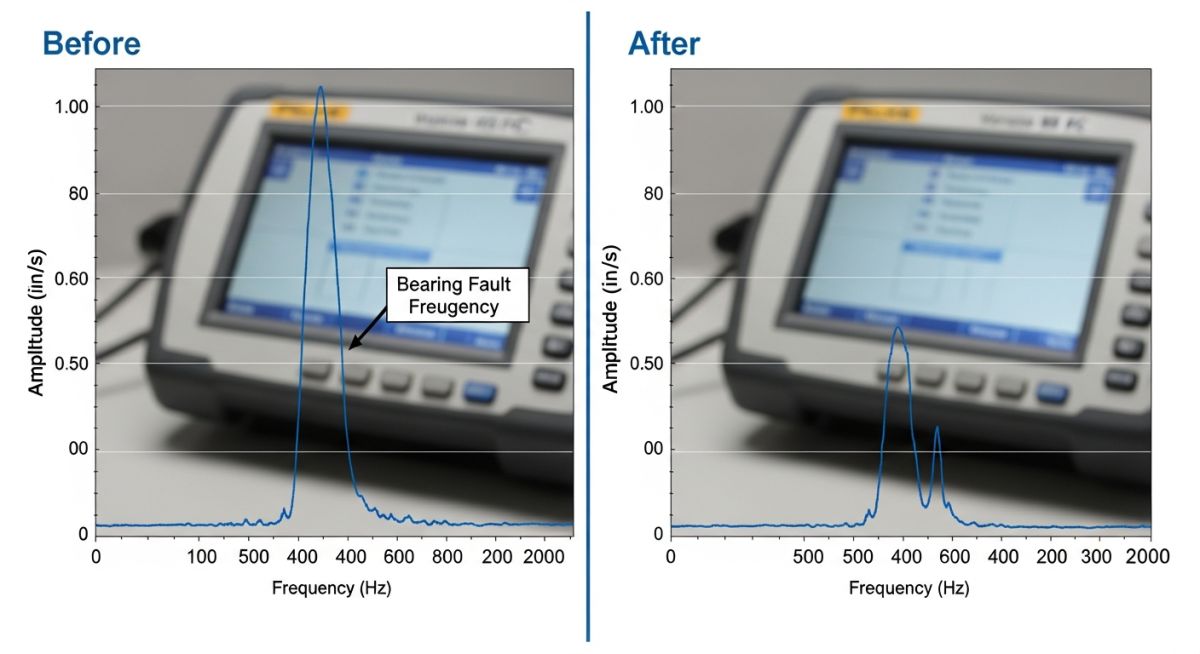
A large cooling tower fan exhibited excessive vibration levels exceeding 12 mm/s RMS, triggering multiple safety trips. Traditional balancing efforts failed to reduce the amplitude. By deploying a multi-channel Vibration Analyzer, our engineering team performed a “bump test” (Impact Test) while the machine was idle to identify the system’s natural frequencies.
The Finding
The Vibration Analyzer revealed a natural frequency at 29.5 Hz, dangerously close to the fan’s operating speed of 30 Hz (1800 RPM). This created a resonance condition where even minor residual unbalance was amplified by 10x.
The Solution
Structural stiffeners were added to the motor mount to shift the natural frequency to 35 Hz. A follow-up scan with the Vibration Analyzer confirmed the resonance peak had moved, reducing operating vibration to 1.8 mm/s RMS.
This case highlights why a simple vibration meter is insufficient; without the spectral data from a Vibration Analyzer, the plant would have continued wasting time on unnecessary balancing.
Don’t miss this video related to Vibration Analyzer
Summary: Master Piping Engineering with our complete 125+ hour Certification Course: ……
Expert Insights: Lessons from 20 years in the field
Beware of Mount Type: A Vibration Analyzer is often limited by its sensor mounting. For high-frequency bearing diagnostics (above 2 kHz), always use a stud mount or a high-strength rare-earth magnet. Hand-held “stinger” probes filter out the very high frequencies you need to see.
The VFD Ghost: In modern plants, Variable Frequency Drives (VFDs) introduce electrical switching frequencies. Use your Vibration Analyzer to check for “fluting” damage in bearings caused by stray shaft currents, which often appears as a haystack of peaks in the 2 kHz to 10 kHz range.
Data Averaging: Never rely on a single instantaneous “snapshot.” Configure your Vibration Analyzer for at least 8-12 RMS averages with 50% overlap to ensure the spectrum represents the steady-state machine condition and not a transient event.
Frequently Asked Questions about Vibration Analyzers
What is the difference between a vibration meter and a Vibration Analyzer? ▾
How often should I use a Vibration Analyzer for predictive maintenance? ▾
Which vibration unit should I use: Displacement, Velocity, or Acceleration? ▾
Why does my Vibration Analyzer show a “Ski-Slope” at low frequencies? ▾
Can a Vibration Analyzer detect lack of lubrication? ▾
Is a wireless Vibration Analyzer as good as a wired one? ▾
📚 Recommended Resources: Vibration
Read these Guides
🎓 Advanced Training




Related posts:
![High-grade industrial Wing Nut Types and Applications for mechanical assemblies.]()
Wing Nut Types and Applications: The 2026 Engineering Guide
![Industrial Monorail Crane Systems installed in a modern manufacturing plant 2026.]()
Monorail Crane Systems: Design, Types & 2026 Standards Guide
![Lead engineer performing a Factory Acceptance Test FAT on an industrial skid system 2026]()
Factory Acceptance Test FAT: The 2026 Engineering Guide to Zero-Defect Delivery
![Professional engineering workspace showing a Basis of Design document layout for a 2026 project.]()
Basis of Design: How to Write a BOD for Engineering Projects in 2026
![Industrial Flare Knockout Drum Sizing and installation in a refinery relief system.]()
Flare Knockout Drum Sizing: Design & API 521 Standards (2026 Guide)
![Advanced Reboiler Control Systems in a modern petrochemical refinery 2026.]()
Reboiler Control Systems: Engineering Guide to Precision Control 2026